
How To Start Freelancing: A Step-by-Step Guide From a 7-Year Freelancer
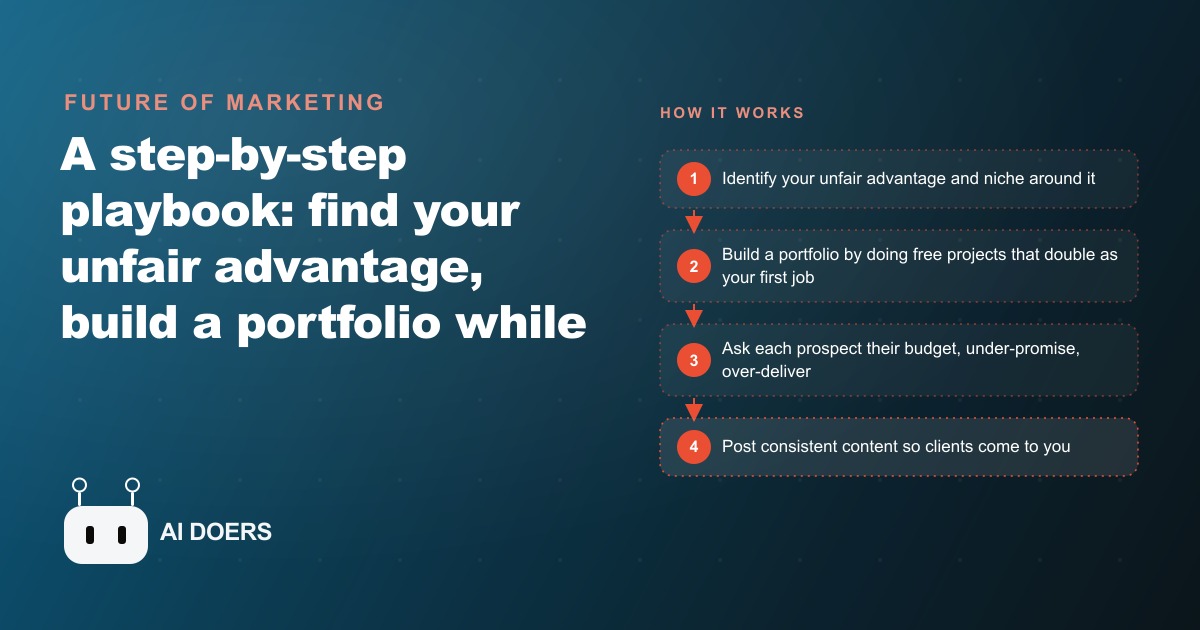
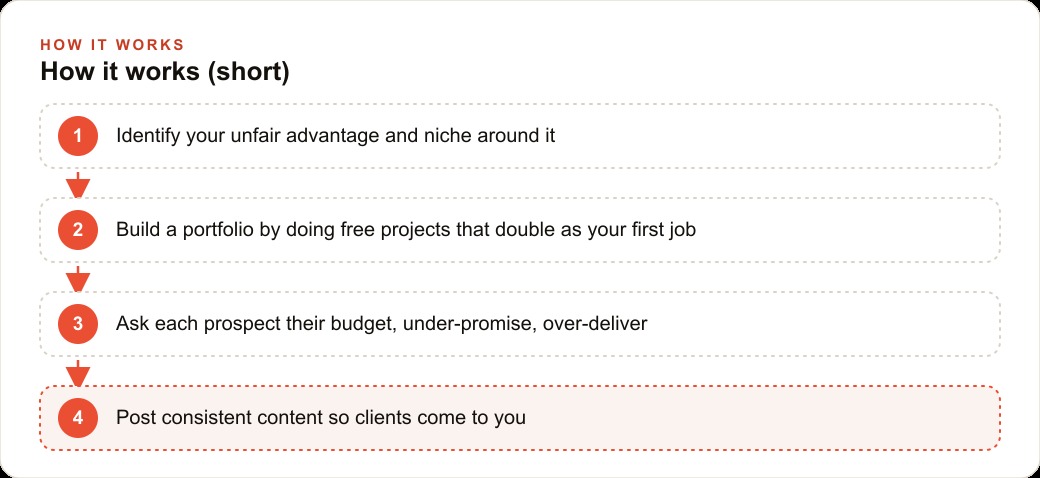
Start by identifying your unfair advantage, niche your offering around it, build a portfolio by doing free projects that double as your first job, then build systems like consistent content that source clients for you instead of relying on luck or referrals.

Ten moves that turn freelancing from luck into a system
I am Madhuranjan Kumar, and I am writing this from the experience of someone who has freelanced for years and hired plenty of freelancers from the other side of the table. Most people start freelancing by competing on the same generic skills as everyone else, which is why most people struggle. The way through is not to work harder at being interchangeable. It is to build a system, move by move, that makes clients choose you on purpose and eventually come to you on their own. Here are the ten moves, in the order I would actually run them.
1. Build the whole thing on your unfair advantage
The first move decides everything after it. Find the one thing that genuinely sets you apart and build your offering around it. That can be real domain expertise like coding or woodworking, a personality trait like patience or relentless attention to detail, or simply being fast at figuring things out. The mistake beginners make is competing their weaknesses against other people's strengths, which is a game you cannot win. Start from the corner where you are already strong, and everything downstream gets easier because you are no longer swimming against yourself.
2. Treat having no experience as an edge
If you have no track record, you might think you have nothing to offer. You are wrong, and it is worth understanding why. Being new means people hold low expectations of you and are often more willing to take a chance on someone eager than on a polished but generic pitch. Enthusiasm and a visible willingness to try your best beat a slick presentation early on, because clients taking a risk on a newcomer are buying attitude and hunger, not a résumé. Lean into being new instead of apologizing for it.
3. Escape the hot dog stand
Picture a row of identical hot dog stands at a venue: same product, same skill, same price. The only thing deciding which one a customer picks is chance. That is the default state of most freelancers, and luck is a terrible business model. This move is a mindset shift more than a tactic. Once you see that being interchangeable means surrendering your income to randomness, you stop tolerating it. The rest of the moves are all ways to climb out of that row of identical stands.
4. Niche down until the right client has a reason to pick you
Specificity is the differentiator. A software engineer who learns AI product work separates instantly from a sea of generic consultants. A video editor who loves games specializes in editing for gamers and becomes the obvious choice for that crowd. Niching down feels risky because it seems to shrink your market, but it does the opposite: it makes you the clear answer for a specific person instead of a vague maybe for everyone. You are not narrowing your opportunity. You are giving the right client a reason to choose you over the row of identical stands.
5. Build a portfolio aimed at the client, not at yourself
Put yourself in the client's shoes and ask what proof they would want to see before hiring you. Then build a portfolio that shows exactly that one clear strength, not a scattered showreel of everything you can do. A focused portfolio that proves a single capability beats a sprawling one that proves nothing in particular. This is where niching pays off again, because a narrow focus is far easier to demonstrate convincingly than a claim to do it all. Show the work that matters to the client you actually want.
6. Fill the portfolio with free projects that double as your first job
Here is the practical engine for building proof from nothing. Email professors or local businesses and offer a real project, run a small workshop, manage a community, redo someone's thumbnail. Treat every free project like a paid one and over-deliver on it. This is not charity, it is how you manufacture experience and samples at the same time, and one of those free projects often converts into a paid contract, which can turn into ongoing work. The free project is not the destination. It is the on-ramp, and the quality you put into it decides whether the ramp leads anywhere.
7. Break the golden handcuffs before they trap you
There is a trap waiting for anyone coming from a salary. Convert an early contract to an hourly rate and it can feel like half your old pay, or close to working for free, so you talk yourself out of it. This is the golden handcuffs, and it kills more freelance careers than any lack of skill. If you refuse every gig that pays less than your old full-time rate, you will never actually start. Early on, the fact that you are getting paid at all is already a win. Take the work, build the reputation, and let the rate climb from there once you have proof and momentum.
8. Become the farmer, not the hunter
This is the strategic heart of the whole thing. The hunter chases each meal and goes hungry on the bad days. The farmer plants a system that feeds the family all winter. In freelancing, the hunter waits for referrals and hopes work arrives. The farmer builds something that sources clients whether or not any single lead comes through. Every move up to now has been about winning individual jobs. This one is about building the machine that makes winning jobs a repeatable outcome instead of a lucky event.
9. Post consistent content so clients come to you
The highest-return farming system is consistent content about your work, written or video, published on a regular schedule. It is the single highest-ROI source of clients I know, and it works precisely because it compounds. Expect it to take around six months of steady posting before contract work starts flowing, and understand that the slowness is the point, because most people quit before the compounding kicks in, which is exactly why it works for the few who do not. Once inbound work is flowing, you finally get to pick and choose instead of taking whatever comes. This is also the move where the skills overlap with real marketing, the same content foundation that sources freelance clients feeds SEO and organic search and gives you material to promote through Facebook and Instagram ad campaigns if you ever want to accelerate it.
10. Price by asking, then under-promise and over-deliver
The final move is about protecting the reputation the other nine built. When you do not know what to charge, ask the client their budget to get an anchor point instead of guessing and either scaring them off or underselling yourself. Then manage delivery ruthlessly: if a job will take two weeks, quote four, and define your post-project support window up front so clients do not lean on you forever. Under-promise and over-deliver, every time. Your reputation is the entire business, and one delighted client who felt you beat expectations is worth more than three who felt you barely met them.
Why the order of these moves matters as much as the moves
Before the worked example, I want to make one point that most freelancing advice skips: the sequence is not decorative. These ten moves build on each other, and running them out of order is why so many people stall. You cannot build a focused portfolio, move five, until you have chosen a niche, move four, and you cannot choose a niche well until you know your unfair advantage, move one. Skip the foundation and you build a portfolio that shows everything and proves nothing, which is the single most common mistake I see.
The same dependency runs through the back half. The content engine, move nine, is the highest-return system you have, but it only compounds if it is aimed at the niche you defined earlier. Generic content about being available for hire attracts nobody, while specific content about the exact problem you solve for a specific kind of client attracts precisely the people you want. And the pricing discipline of move ten only protects a reputation that the earlier moves built. There is no reputation to protect if you never shipped the free flagship projects of move six. So when I say run them in order, I do not mean it as a tidy formatting choice. I mean that each move is the soil the next one grows in, and planting out of sequence is how people end up busy for a year with nothing compounding.
There is also a psychological reason the order matters. The early moves are cheap and fast, writing down your advantage, picking a niche, sending a few emails. The later moves, especially the content engine, are slow and require patience through months of apparent silence. If you try to start with the slow, patience-heavy move before you have the quick wins of an early paid project under your belt, you are far more likely to quit. The sequence front-loads the encouragement and back-loads the endurance test, which is exactly the order a human being can actually sustain.
A worked example: the freelance designer
Let me run all ten through one concrete case, a freelance designer trying to build a real service business rather than a string of one-off gigs. First, the unfair advantage: maybe it is branding for wellness studios, or packaging design, or fast turnaround on social ad creative. Pick the lane where taste and speed are strongest and aim there instead of offering design in general. Second, the focused portfolio that proves that one strength, seeded with a few free projects for businesses in the chosen niche and treated like flagship work.
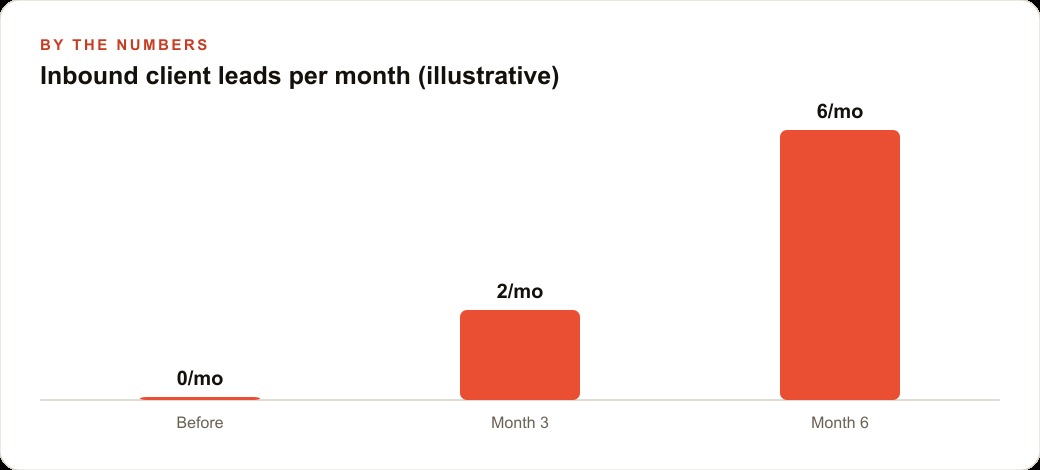
Then the content engine. Post weekly: before-and-after redesigns, short breakdowns of process, the thinking behind a logo. Put illustrative numbers on the arc. Inbound leads might sit at zero for the first stretch, climb to a couple a month around month three as the body of work accumulates, and reach six or more a month by month six once the compounding takes hold. On pricing, ask each prospect their budget to anchor correctly, and early on remember that getting paid at all is a win. Under-promise and over-deliver on every job, quoting four weeks for two weeks of work and defining the support window up front. The clients who come in from all this land in a simple CRM and website stack where follow-up is organized instead of forgotten, so no warm lead slips through the cracks while the designer is heads-down on a project.
How to start this week
You do not need all ten in place at once, you need the first few started now. Write down your unfair advantages today, being honest about what genuinely sets you apart rather than what you wish did, then pick the single niche that uses the most of them. Take one free project this week and treat it like a flagship client to seed your portfolio, because proof is the thing that unlocks everything after it. Ask every prospect their budget before naming a price, so you anchor to what they can actually spend instead of guessing. And begin posting weekly content immediately, because the farmer's system takes months to mature and the sooner you plant it, the sooner clients come to you instead of you chasing them.
You can absolutely do all of this yourself, and I would encourage you to send that first free-project email this week rather than waiting until your portfolio feels ready, because it never will feel ready and the first project is how you make it ready. If you would rather have someone help you define your edge, shape a portfolio that converts, and build the content system that sources clients on autopilot, that is exactly the kind of work I do for clients, and you can bring me in to handle it.
That is exactly what we do at AI DOERS. Book a private 30-minute call with Madhuranjan Kumar and we will map the fastest path to it for your specific business.
Book your call →
Madhuranjan Kumar
Madhuranjan Kumar brings 20 years of performance-marketing experience and has managed over $200 million in Facebook ad spend for brands across the United States and beyond. His expertise spans the full modern marketing stack: Meta, Google Ads, TikTok, email automation, CRM, and the websites that hold it together. At AI DOERS he turns that track record into lead-generation systems for businesses across every industry.