
How to Start an AI Business in 2026, According to the Data
Start an AI services business that helps small and medium companies use AI, lead with an AI tools audit, and use warm outreach to land your first client. Community data across 270,000 members shows the median time from zero to first client is just 9 days, with 91% coming from people you already know.

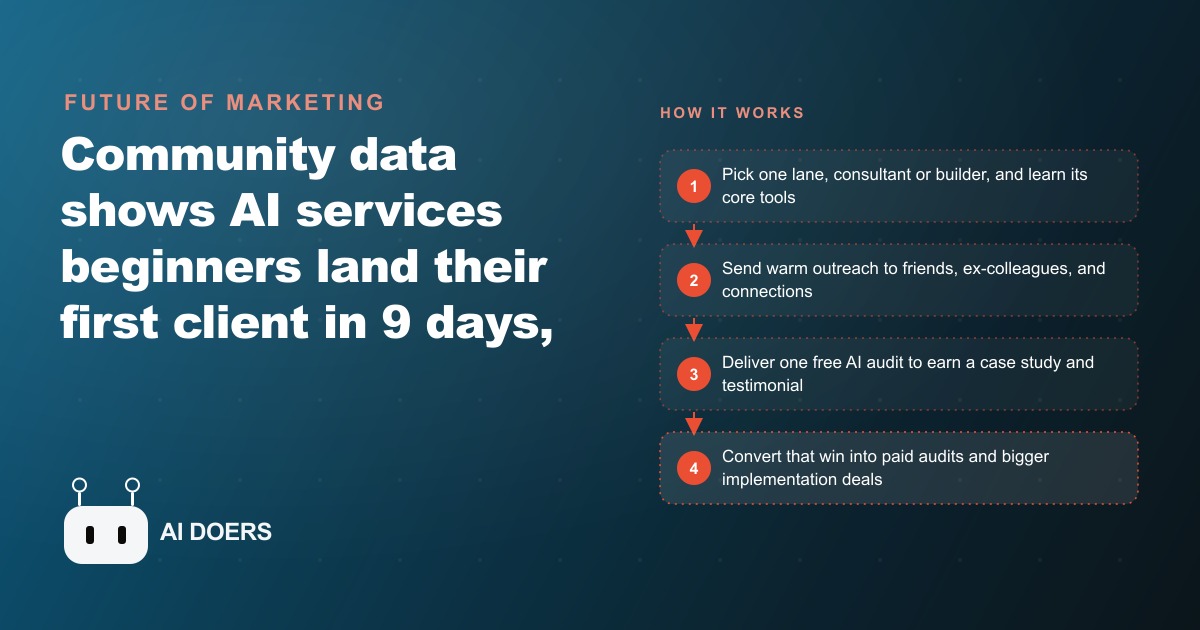
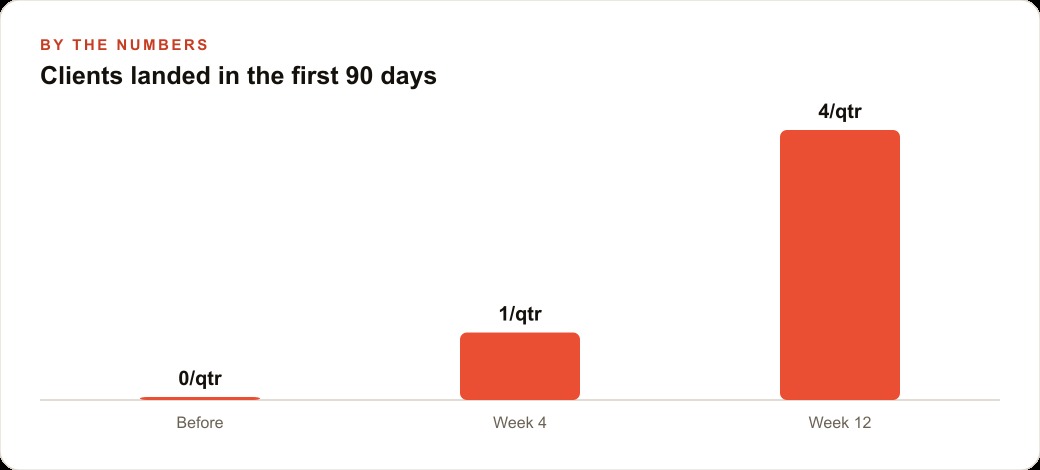
The standard advice for anyone starting a service business is to spend the first three to six months on preparation: build the skills, build the portfolio, build the brand, then go find clients. Community data from 270,000 members of an AI services accelerator contradicts that sequence almost completely. The median time from starting to landing a first paid client is nine days. The first client almost never comes from brand, content, or advertising. And the offer that is growing fastest is not the one that requires the most technical skill to deliver.
Why 9 days to first client contradicts the "take months to prepare" advice
The nine-day median is the most disorienting number in the dataset, not because it is surprising that some people move fast, but because it is the median. Half the tracked members who landed a first client did so in nine days or fewer from starting. This is not the right tail of an optimistic distribution. It is the midpoint of a tracked, logged dataset covering thousands of people.
What makes this possible is the structure of the offer. An AI tools audit does not require delivering a custom-built system. It requires observing how a business currently operates, identifying where AI tools could save time or add capability, and delivering a written report recommending specific next steps. A person who has spent one week learning the core tools has enough knowledge to run a credible audit for a small business that has done nothing with AI yet. The gap between what the auditor knows and what the client knows is large enough for the engagement to be genuinely valuable, even at the very beginning of the provider's experience.
The implication is that waiting to feel ready is not a risk management strategy. It is a delay strategy that costs the opportunity of clients who could have been served and paid during the waiting period. The preparation most people think they need happens faster on real projects than in any course or practice environment. A first client teaches you more about your offer in two weeks than a month of study would, because real client situations surface gaps you would never have predicted.
The 91 percent warm outreach finding and what it reveals about how trust actually transfers
Ninety-one percent of first clients came from warm outreach. Not cold email, not LinkedIn ads, not a lead generation service, and not a website that ranked for the right keyword. Direct messages, phone calls, and in-person conversations with people the provider already knew.
This finding is consistent with how high-trust services have always been sold, but it is worth stating explicitly because most new service business advice leads with content creation, social media presence, and inbound marketing. Those things matter for later stages. They are nearly irrelevant for the first client.
The reason warm outreach works is that trust is the primary constraint in buying a professional service. A small business owner who does not know you has no basis to evaluate whether you can do what you say you can do. There is no track record, no portfolio of recognizable client names, and no social proof that is meaningful to someone who has never encountered you before. A friend, former colleague, or professional contact who already trusts your judgment as a person can extend that trust to a new service you are offering, particularly if you frame the first engagement as a low-risk audit rather than an open-ended commitment.
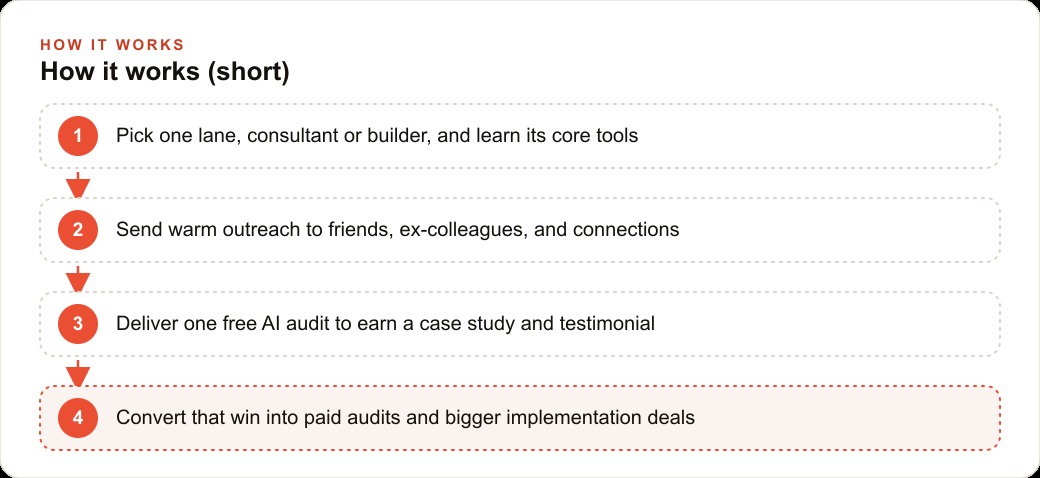
The practical implication is that the first week of any AI services business should not be spent on content or outreach systems. It should be spent writing a list of every person in the existing network and reaching out with a specific, no-pressure offer: a free AI tools audit with no obligation. People who already trust you will say yes to a free audit at a far higher rate than strangers, and the first yes converts directly into the first case study and testimonial that makes future conversations with strangers possible.
There is also a sequencing point that the data makes clear. Content and inbound marketing are amplifiers. They amplify the credibility that already exists. If no credibility exists yet, there is nothing to amplify. A LinkedIn post from someone who has no case studies, no testimonials, and no track record produces almost no response regardless of how good the content is. The same LinkedIn post from someone who has two case studies and three testimonials performs completely differently, because the audience can verify the claims. Warm outreach builds the credibility. Content then amplifies it. Getting the sequence right saves months.
Why AI audits grew 400 percent while basic chatbots declined: the buyer's psychology has matured
The combination of rising audit demand and falling chatbot demand tells a story about where buyers are in the AI adoption curve. Twelve months ago, a small business hearing about AI for the first time was often most interested in the most visible and familiar application: a chatbot on the website. That made sense as an entry point because it was legible, it had analogies the buyer understood from their experience with customer service bots, and the expectation was modest enough that a mediocre result would not cause significant harm.
Buyers have matured past that. They have seen enough chatbots that perform inconsistently, frustrate customers with wrong answers, and fail to integrate with anything the business already uses to be skeptical of another one. What they want now is someone who can help them understand their specific situation: which parts of their operation are genuinely ready for AI, which tools are worth the switching cost, and what the realistic return looks like before they commit to anything. That is an audit.
The audit is also the correct first move for a provider who has limited experience with a client's specific industry. It creates a structured reason to spend time inside the business, ask questions, and understand the workflow before recommending anything. That understanding is exactly what makes implementation recommendations work in practice rather than on paper. A chatbot recommendation that ignores how the front desk actually handles customer questions will fail in ways that a proper audit would have prevented.
What the deal-size tripling tells you about where the market is in the adoption curve
Average deal size grew from approximately 4,120 dollars in 2024 to approximately 13,870 dollars in late 2025, a 340 percent increase in twelve months. The share of deals above 10,000 dollars moved from 8 percent to 49 percent in the same period.
These numbers describe a market crossing from early-adopter to mainstream. Early-adopter buyers in any market are willing to experiment with limited budget and low expectations because they are curious and willing to absorb some risk in exchange for being early. As a technology matures and more buyers enter, the ones arriving later are more conservative, more skeptical, and want proof before committing. They also have more internal alignment behind the purchase, which means larger authorized budgets and clearer success criteria. That is what a 340 percent increase in average deal size indicates: the buyers who are now entering the market are bringing real purchasing authority and expecting a measurable business outcome.
Voice AI systems like AI receptionists are up 278 percent year over year. Document-search systems that let a company search its own internal knowledge base are up over 300 percent. Basic chatbot sales fell by 50 percent. The fastest-growing offer of all is the AI audit, up 400 percent year over year. This is the market telling you what buyers actually want and what they will pay for.
This matters for how a new provider should think about pricing. The instinct to start cheap to win the first client is reasonable as a deliberate phase, but it should not become a permanent posture. The market is paying significantly more for well-scoped, outcome-oriented AI services work than it was twelve months ago, and underpricing relative to that market is a choice worth making consciously rather than by default because it feels safer.
The two lanes and why they produce a referral network rather than a competitive rivalry
The consultant lane and the builder lane are not competing for the same clients in the same moment. A consultant who runs an audit and identifies a voice AI system the client needs cannot implement it without builder skills. A builder who gets a scoped project referral does not have to prospect for it. Each lane creates opportunities that feed the other, and the natural structure of the work keeps them complementary rather than competitive.
One member of the accelerator earned 65,000 dollars on referred voice AI deals without doing any prospecting at all. The referrals came from consultants in the network who had identified the need in their audit clients but did not have the technical skills to build the systems themselves. That is not an unusual arrangement. It is the way professional service networks have always worked: the person who identifies the opportunity and the person who executes it split the value rather than compete for it, and both come out ahead compared to working alone.
The practical implication for someone choosing a lane is that the choice does not close off the other. A consultant who builds enough audit relationships will accumulate more builder referral opportunities than they can personally pursue, which generates income through referrals while they stay in the diagnostic and advisory work they are best at. A builder who establishes a reputation for quality implementations will attract consultant referrals with pre-qualified clients who already understand the value and have budget approved, skipping the sales cycle entirely.
What a free first project buys that no sales pitch or portfolio can replicate
Seventy-three percent of six-figure earners in the community started with a free project. The logic behind this is straightforward once you understand what the free project is actually purchasing.
A sales pitch from someone with no portfolio asks the buyer to extend trust based on claims alone. A portfolio from past projects at a previous employer does not transfer cleanly because the buyer did not pay for that work and is not the client who benefited from it. A free project for this specific buyer at this specific business, delivered well, produces three things that no pitch or portfolio replicates: a testimonial from a real client in a real business context, a case study documenting a real outcome, and a relationship with someone who experienced your work firsthand and is now positioned to refer you to everyone they know who is asking about AI.
For a dental clinic, this plays out in a way worth walking through in detail. The provider approaches the practice with an offer of a free AI tools audit. The audit takes a few hours and identifies three immediate opportunities: an AI voice receptionist handling after-hours booking inquiries, a simple tool on the website answering routine questions about insurance and availability, and an automation handling appointment recall and confirmation messages. Each of these addresses a friction point the practice already recognizes and has been meaning to solve. The audit report recommends specific tools and estimates the implementation cost and the expected return for each.
The report earns a testimonial and a case study. More importantly, it opens a conversation about paid implementation. A voice receptionist that recovers just four missed booking calls per week, at an average dental procedure value of 180 dollars, returns 720 dollars per week in revenue that was previously being lost to voicemail. That recovery easily justifies an implementation fee in the range of 5,000 to 10,000 dollars on straightforward financial logic, without requiring the practice to take any speculative risk. The free audit made that conversation possible because it demonstrated specific knowledge of this practice's situation and specific evidence of the return, rather than a generic pitch about what AI can do in theory.
Madhuranjan Kumar works with business owners and new service providers on exactly this kind of strategy: mapping the right starting offer, structuring the first audit, and converting that first engagement into a repeatable pipeline.
That is exactly what we do at AI DOERS. Book a private 30-minute call with Madhuranjan Kumar and we will map the fastest path to it for your specific business.
Book your call →
Madhuranjan Kumar
Madhuranjan Kumar brings 20 years of performance-marketing experience and has managed over $200 million in Facebook ad spend for brands across the United States and beyond. His expertise spans the full modern marketing stack: Meta, Google Ads, TikTok, email automation, CRM, and the websites that hold it together. At AI DOERS he turns that track record into lead-generation systems for businesses across every industry.