
How to Sign AI Automation Clients With Zero Followers
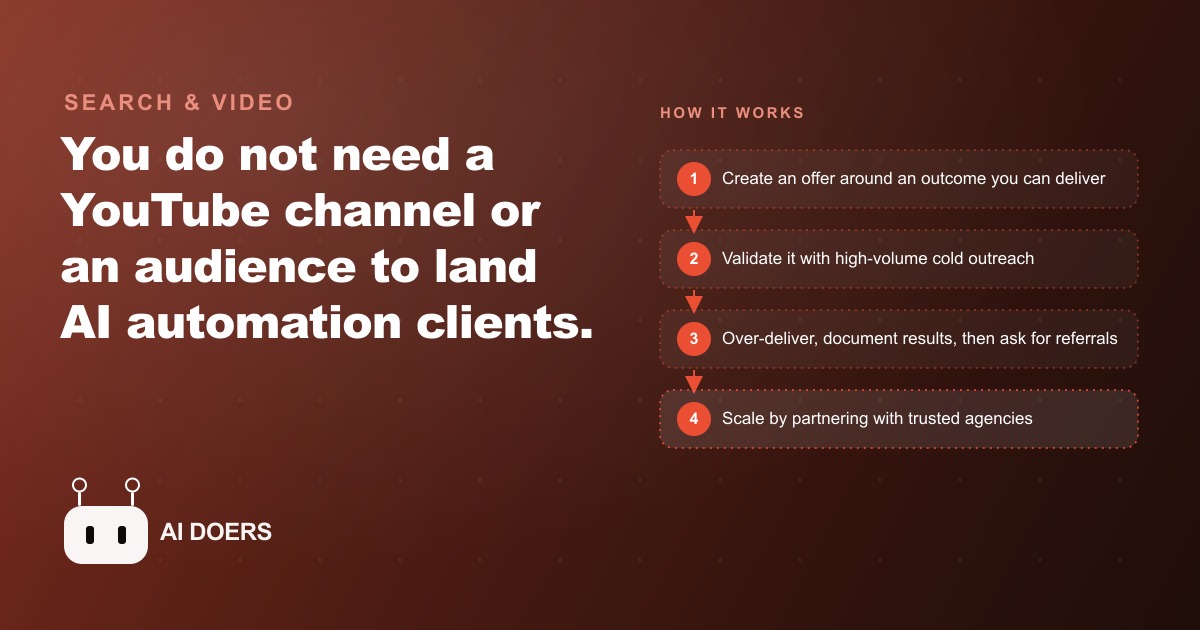
You do not need an audience to land AI automation work. Three methods, cold outreach, referrals, and borrowed authority, can sign your first clients this month.

The window for getting AI automation clients by explaining what AI is has closed. Buyers have heard the pitch. What changes whether you get on a call today is proof, not enthusiasm, and the businesses that have figured this out are signing clients without a YouTube channel, without a LinkedIn following, and without any content output at all.
I am Madhuranjan Kumar, and the three methods that actually produce clients for someone starting from zero are cold outreach with a real proof point, referrals from completed work, and borrowed authority through agency and consultant partnerships. Content helps, and over time it compounds in ways the other methods do not. But the best-paying clients rarely arrive through content first. They arrive because someone they already trust mentioned you, or because you reached out with something demonstrable in hand. The missing piece for most people starting out is not a posting schedule. It is a proof of work that makes the outreach worth taking seriously.
Cold outreach without a proof point is a coin flip
Cold outreach is the fastest path from zero to your first conversation. It is also the method most people abandon because they approach it in the wrong order. The first thing any serious prospect asks when they receive a pitch for AI automation is who you have done this for. If the honest answer is nobody yet, your response rate reflects that reality and no amount of message optimization changes it meaningfully.
The correct order is to acquire one proof point before any outreach goes out, even a free project with someone you know. A lead-capture automation for a friend who runs a dental practice. A client follow-up sequence for a landscaping company found through a mutual contact. An appointment reminder system for a yoga studio that was losing track of cancellations. The specifics matter less than the result you can document. Before the automation, the practice missed approximately 30 percent of after-hours inquiry calls with no follow-up. After, every inquiry receives a response within two minutes regardless of when it arrives. That before-and-after structure is a proof point. It is the difference between a cold message that says you build AI automations and a cold message that says you built a lead response system for a dental practice that reduced missed leads by roughly 30 percent.
The conversion difference between those two messages is significant at real outreach volumes. Sending 200 messages to dental office managers without a proof point produces a response rate around 2 percent, which is four replies and perhaps one conversation that goes anywhere. Sending the same 200 messages with a specific documented result from a comparable business typically produces response rates three to four times higher. At that same volume, the difference is between one conversation and eight to twelve. Message framing and outreach timing matter and are worth optimizing, but neither variable moves the needle as much as having something real and specific to reference.
Choose one or two outreach channels and learn what works there before adding more. The discipline of working one channel long enough to develop depth in it, understanding what subject lines produce opens, what message length produces replies, what framing produces positive responses rather than polite declines, compounds faster than spreading attention across five platforms and never developing fluency in any of them.
The message itself should sell the outcome, not the technology. The dental office manager is not evaluating your technical implementation choices. They are asking whether they are losing leads that their Meta ads or Google Ads campaigns already paid to generate, and whether there is a practical and low-risk way to stop losing them. Frame the offer in those terms and the technology behind it becomes an irrelevant detail.
Removing risk from the first engagement dramatically improves conversion from conversation to signed work. Structuring the initial project around delivery before payment, removing the contract requirement for the first engagement, and asking only for permission to document and share the results if the results are good, makes saying yes substantially easier than a formal proposal with a retainer agreement attached.
Track every outreach effort and every response. The reply rate, the positive response rate, the conversion from conversation to project, and the specific message versions and channels that produced each step all feed back into the next round of outreach. Outreach volume without tracking produces activity without learning. Volume plus tracking produces a system that improves every week.
Referrals are the most reliable channel and nobody asks for them
Referrals outperform every other acquisition channel for high-quality clients because trust transfers directly. When a client who knows the quality of your work introduces you to someone in their network, you arrive in that conversation as a recommended specialist rather than a cold contact. The new prospect has already received a signal before you say a word.
Most people who produce good work never ask for a referral. This is not because they are unaware that referrals work. It is a timing and framing failure that plays out consistently. Asking for a referral before results are clearly established puts the client in an uncomfortable position, because they cannot honestly recommend you yet. Asking in a way that feels transactional makes the request feel like an obligation attached to a service relationship rather than a natural extension of a collaboration that went well.
The right moment is specific and recognizable. It is the moment when you can point to before-and-after numbers for a result the client actually cares about. The dental practice that was missing 30 percent of after-hours leads is now capturing all of them with immediate follow-up, and you have the data showing the change. At that moment, after the client has seen and acknowledged the result clearly, a simple question lands naturally: do you know anyone else dealing with a similar issue? I am happy to take a look at their situation. That is the complete ask. It is low-pressure, specific about what you do, and delivered at the moment when the client is most positively oriented toward you.
Clients who arrive through referrals close faster and at higher rates than cold outreach clients because the trust barrier is already lower. They are not evaluating whether you are legitimate. They are evaluating whether the timing is right for them. That distinction reduces the typical sales cycle considerably and produces clients who negotiate less aggressively on price, because they are buying on a recommendation rather than from a cold message in their inbox.
The referral request also trains your clients to think of you as someone they can recommend. Most people do not naturally think to recommend a service provider even when they are happy with the work. The act of asking once, at the right moment, makes it much more likely that the same client refers unprompted in the future when they hear someone else describe a problem you could solve.
Borrowed authority scales faster than any audience you can build
The borrowed authority approach is the fastest path to a high-quality client pipeline for someone starting from zero, and it is underused because it requires a fundamentally different outreach target than most people default to.
Instead of building your own audience over months and waiting for it to generate inbound interest, you partner with people who already have one. Agencies, consultants, coaches, accountants, and professional service firms that work with small businesses have trusting client relationships that took years to develop. You approach them not as a competitor but as a specialist they can bring in to create value for the clients they already serve.
You offer to run free AI discovery sessions or workflow audits for their clients at no cost to the partner and no cost to the client. The partner looks like a hero for bringing in expertise that helps their people. Any project that closes from those introductions generates a revenue share, typically between 15 and 25 percent, which goes to the partner for making the introduction. The economics are straightforward: if you close a project worth two thousand dollars through a partner introduction, at a 20 percent share the partner receives four hundred dollars and you keep sixteen hundred. Without the introduction, you might have sent one hundred cold messages to get the same conversation, and the close rate on cold conversations is substantially lower than on warm introductions.
The outreach to a potential partner is structured differently from outreach to a prospect. You are not asking the partner to pay you or to accept any risk. You are offering something their clients benefit from at zero cost to the partner, with a share of any revenue generated for providing the introduction. Most agencies and consultants who genuinely care about their clients' results find this straightforward to say yes to, because the downside is zero and the upside is a new service they can offer that makes them more valuable.
The businesses best suited to this approach as partners are the ones already managing the CRM and website stack for their clients, digital marketing agencies in particular, because AI automations that connect to lead management systems and customer communication workflows are immediately relevant to what those clients are already spending money on. Partnering with an agency that runs paid advertising for small businesses means their clients are already investing in lead generation and are naturally receptive to anything that helps them capture and act on those leads faster.
Sell the conversation first, build the automation second
The most common mistake for someone entering AI automation services is building before selling. The reasoning feels intuitive: you build something impressive, show it, and clients see the value immediately. In practice, you end up with a portfolio of automations built for problems that may not match the ones your target market has, with no signal about what to build next and no clients while you built.
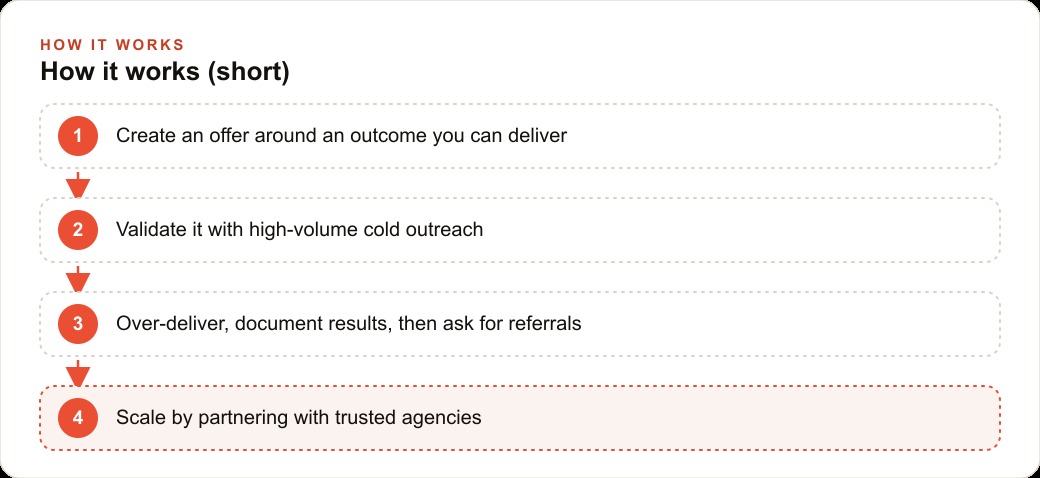
The correct sequence is the inverse. Create the offer first, defined by a specific outcome you are confident you can deliver. Send outreach for that offer as though the implementation is ready and available. The conversations that come back tell you whether the problem description resonates, whether the price point lands, whether the outcome framing is specific enough to generate real interest, and which objections come up consistently. That information is market research, and it costs only the time required to send the messages.
If two hundred messages for an offer produce twelve replies, those twelve conversations tell you which part of the offer resonated most, which concerns repeat across prospects, and whether the price you named was above or below the range that created interest rather than resistance. You build after you have that information. The first automation you actually build is the one with the clearest market signal behind it, which is a much better starting point than the one that seemed most technically interesting in the abstract.
The offer should be framed around a specific outcome in the client's language, not around the technology used to deliver it. A system that responds to every lead your advertising generates within ninety seconds is an offer. An AI-powered multi-step automation with webhook triggers and conditional routing logic is a description of an implementation. Clients buy outcomes. They evaluate implementations only after they have decided the outcome is worth pursuing.
Maintaining a clear record of every outreach effort, every conversation, and every outcome creates a feedback loop that improves every dimension of the system over time. The message version that produced a 6 percent response rate beats the one that produced 2 percent for a reason, and understanding that reason is what lets you carry the improvement into the next campaign rather than rediscovering it by accident. The referral request that produced two introductions from one client was worded and timed in a specific way, and capturing that framing means it can be replicated reliably rather than hoping it repeats. The partnership approach that generated three closed projects in a quarter had specific characteristics about the partner type and the offer structure that distinguished it from the partnerships that produced conversations but no closed work. Building that institutional knowledge deliberately, rather than letting it live only in memory, is what separates a client acquisition system that compounds from one that produces inconsistent results and never improves.
Building your own presence through SEO and organic search is a valuable long-term investment that runs in parallel with the three methods above. The businesses that grow fastest run both tracks simultaneously, so that by the time content begins generating inbound interest, a functioning client base and a set of documented case studies already exist to convert that interest at a much higher rate than content alone would produce without them.
That is exactly what we do at AI DOERS. Book a private 30-minute call with Madhuranjan Kumar and we will map the fastest path to it for your specific business.
Book your call →
Madhuranjan Kumar
Madhuranjan Kumar brings 20 years of performance-marketing experience and has managed over $200 million in Facebook ad spend for brands across the United States and beyond. His expertise spans the full modern marketing stack: Meta, Google Ads, TikTok, email automation, CRM, and the websites that hold it together. At AI DOERS he turns that track record into lead-generation systems for businesses across every industry.