
How To Sell A $5,000 Claude Code AI Operating System To Small Businesses
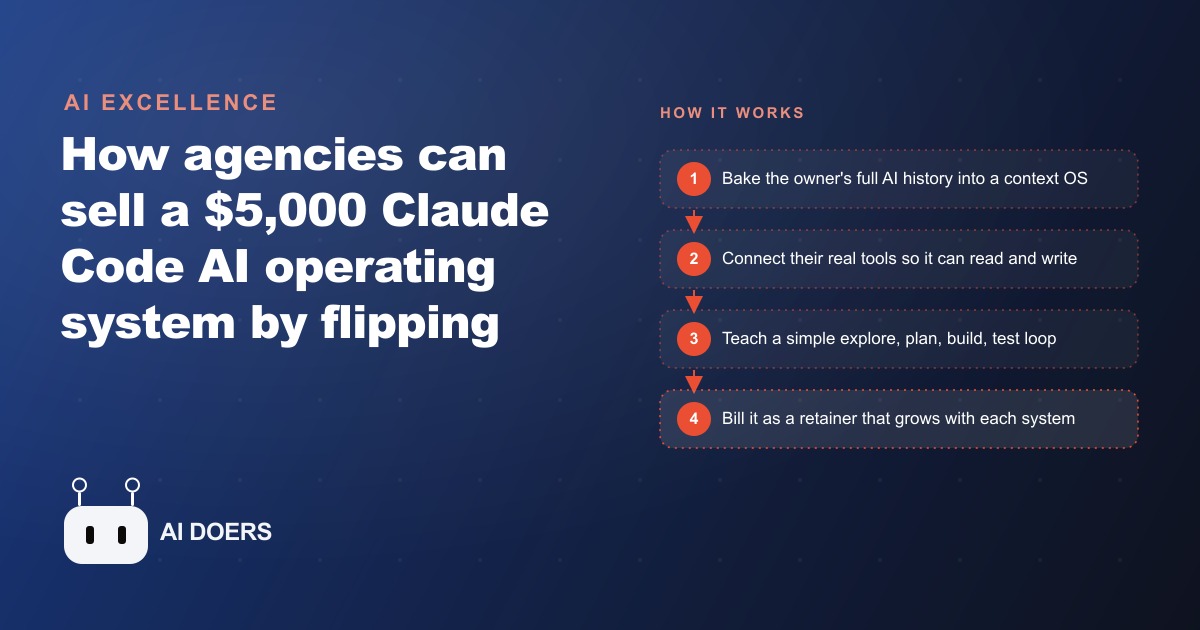
You sell it by flipping automation from one-off point solutions to a context-first base: export the owner's AI history into a context OS, plug in their real tools like Stripe and their CRM, then deliver it as a productized retainer instead of a single big upfront.

The automation business just flipped upside down
For two years the entire AI services industry sold the same thing: point solutions. One bot for lead capture, one automation for invoicing, one workflow that scraped a spreadsheet and pinged a channel. Each piece hooked into a single process and hunted around for whatever context it could find. That model made money, but it only ever scratched the surface of what a business actually needed. The shift that matters now is that the smartest agencies have stopped leading with the automation and started leading with the context. They install a contextualized base first, then layer automation on top of it. I am Madhuranjan Kumar, and this reordering is the reason a five thousand dollar setup fee suddenly makes sense to a small business owner who would never have paid it for a single chatbot.
Call the thing you install an AI operating system. It is one workspace, built on Claude Code, that wraps a small business so the owner can read live data and trigger real actions through a single chat. You are no longer selling a bot that does one job. You are selling the layer the whole company runs on. That is a different product, a different price point, and a different relationship with the client, and it is why this is worth understanding whether you sell these systems or buy one.
Context first is the whole unlock
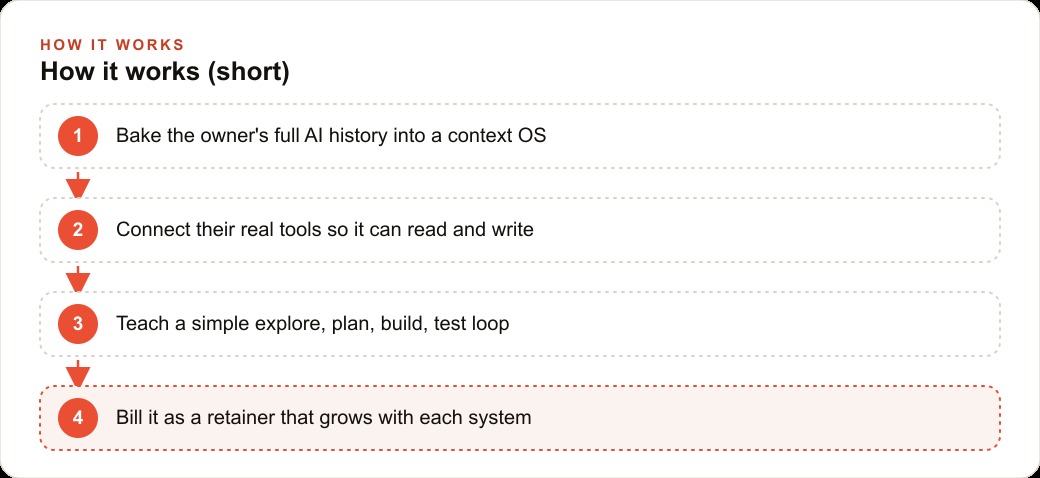
The old sequence was backwards. Agencies built the automation and then tried to feed it enough context to be useful, which meant the owner spent forever copying and pasting the same background into every new prompt and every new tool. The new sequence starts by baking the owner's accumulated knowledge into the system before a single automation gets written.
In practice that means exporting the owner's full ChatGPT or Claude history and folding it into a workspace with a clean folder structure, so the system already understands the business the way the owner does. It knows the pricing, the voice, the customers, the promises made on past calls. Once that base exists, the distance between an idea and a working system collapses, because the agent is no longer guessing about the fundamentals every time you ask it to do something. This is the part people underestimate. The automation was never the hard part. The context was.
Plugging in the tools that actually run the business
A context base that can only talk is half a system. The real leverage comes when you connect the platforms the business runs on, so the workspace can both pull data in and write actions back out. That means wiring in payments through Stripe, customer records through the CRM, the ad accounts, and the analytics. Now the owner can ask which jobs were most profitable last month and get a straight answer instead of a hunch, and can ask the system to draft and queue real work instead of just describing it.
This is where the operating system framing earns its name. When the context and the integrations are both in place, an owner can genuinely run large parts of the company from one chat and barely touch the underlying app interfaces anymore. The last job is teaching a few workflows. A simple explore step walks the owner through deciding what to automate versus what to merely augment, then you make a plan, chunk it, build one piece at a time, and test. Give a capable agent enough context and the right connections, and most of the remaining work becomes asking it what to do next.
Why almost any owner-bottlenecked business qualifies
The businesses that need this most are the ones where the owner is the bottleneck, which is nearly all of them. If the owner spends nights stitching numbers across apps, forgetting what was promised on a call, and holding the entire operation in their head, the operating system hands that load to a system. A law firm can wire matter notes and billing into one place. An e-commerce brand can fold orders, ad spend, and support tickets together. A real estate team can join listings, showings, and pipeline.
The build pattern never changes across industries. You write the context so the agent understands the business, connect the data so it stops guessing, add the workflows the owner repeats most, and let it report and act. The industry only decides which tools you plug in, not the shape of the system. That is exactly why an agency can resell the same playbook to wildly different clients, and why the offer scales instead of turning into bespoke custom work every single time.
A worked example: the HVAC operator drowning in every role
Consider an HVAC company where the owner is simultaneously the lead tech, the dispatcher, the quoter, and the bookkeeper. The goal of the build is to take that scattered load off one person. I would start by writing the context base: the service area, the equipment brands they install, the pricing tiers for repair versus replacement, the brand voice they use with homeowners, and who on the crew handles installs versus service calls.
Next I would connect the real tools. The scheduling and dispatch software, the invoicing, the reviews, and the ad accounts, so the owner can ask which jobs were most profitable last month and get a straight number back. Then I would teach two or three workflows the owner actually repeats every week. Building a quote from a tech's site notes. Drafting a maintenance plan follow up to every customer whose system is past warranty. Writing the morning dispatch summary that shows which calls are urgent and which can wait.
Because everything runs from one chat, the owner can sit in the truck between calls and queue real work, like drafting a tune up campaign for every furnace install older than ten years, and the finished piece is waiting after the next job. For an HVAC shop already running paid acquisition, that same context base makes the marketing sharper, because the system knows the real margins and can shape the offers behind the Facebook and Instagram ad campaigns instead of guessing at them. The company keeps doing exactly what it did before. The owner just stops being the only operating system holding it together.
Package it as a retainer, not a lottery ticket
The single biggest mistake agencies make with this is pricing it as one enormous upfront fee. That is a lottery ticket for you and a leap of faith for the client, and it caps your income at the number of new deals you can close each month. The model that actually works is a retainer that grows as you add systems.
Start by picking where your offer sits on the spectrum. On one end you can train owners to fish, teaching them to build it themselves, but that mostly just creates competitors, so I avoid it. In the middle sits the agency service, where you set up the operating system, solve the first big problem in person, and leave a custom chat workspace behind. On the far end is the productized version, where you wrap the operating system into a niche dashboard, like an orders system for e-commerce, and sell the finished result, because most owners want the fish, not the lesson.
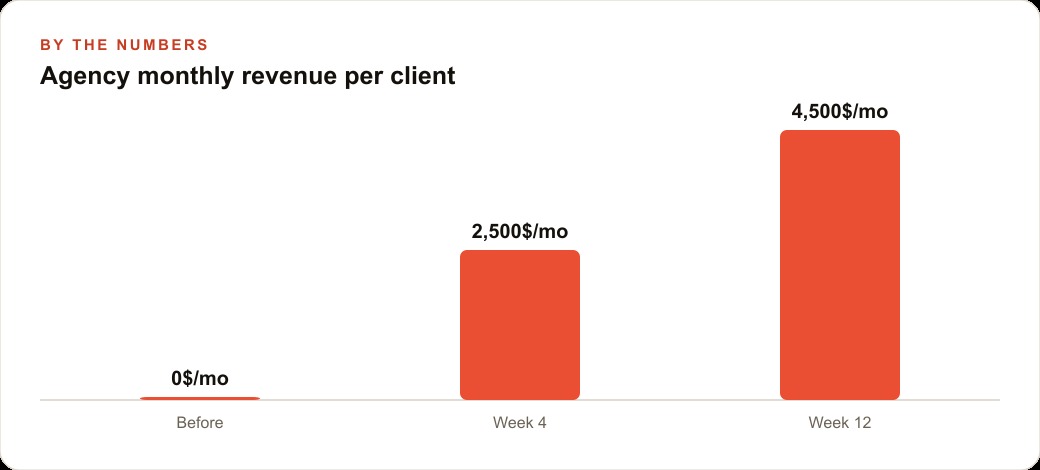
On numbers, a clean structure is roughly a five thousand dollar setup to install the context and integrations, then twenty five hundred a month that can climb to four or five thousand as you layer more systems on. Treat those figures as illustrative rather than a promise, because every business is different, but the shape is the point. The reason this finally pencils out is speed. Development is fast enough now that one person can serve a client properly without a team of developers behind them. Fixed monthly revenue that compounds per client beats a string of one off payments every time.
Solve the first painful problem before you ask for the retainer
The move that makes the retainer easy to sell is proof on day one. Do not install a sprawling system and hope the client sees the value over the following quarter. Pick the loudest, most expensive pain the owner has, solve that one thing first, and let the relief sell the rest. The setup fee buys the context and the integrations plus that first win. The retainer buys everything after it.
That sequencing changes the whole conversation. Instead of a hopeful pitch about what the operating system could eventually do, you are pointing at a problem that stopped hurting this week. From there, each new system you add is an obvious upsell rather than a hard sell, and the monthly number climbs naturally as the owner keeps saying yes to the next piece.
The next opening: proving the value you created
Once the systems are running, a second service appears almost for free. Someone has to quantify what all of this is actually saving. Which automations fire, how often, and how much time each one takes off the owner's plate. Most agencies never measure this, which means they leave the strongest retention argument on the table.
Building a simple return tracking layer into the operating system turns a fuzzy sense of it helps into a monthly report the owner can see. That report is what makes the retainer sticky, because now the client is looking at a concrete number every month instead of wondering whether the spend is worth it. The same instinct that makes a business track cost per lead on Google Ads applies here: what gets measured gets kept, and what gets measured gets expanded.
The objections owners raise, and how to answer them
Every owner hits the same three worries when you propose this, so it helps to have honest answers ready. The first is data. Handing a system access to Stripe, the CRM, and the ad accounts feels risky, and it should be treated seriously. The answer is scoped access and clear boundaries: the system reads what it needs, writes only where you have approved, and every sensitive action can be set to require a confirmation before it fires. You are not handing over the keys to the building, you are giving a very capable assistant a defined set of permissions.
The second worry is dependence. Owners fear building the whole operation around a system they do not understand and cannot maintain. This is a fair concern, and the honest response is that the context base is portable knowledge, not a locked box. Because it is built from the owner's own history and stored in a readable structure, the business keeps its context even if it changes tools later. The retainer buys ongoing improvement, not hostage taking.
The third worry is whether the staff will actually use it. A system nobody adopts is worthless, no matter how well built. The move that solves this is starting with the owner's single most painful task and making that one thing dramatically easier before introducing anything else. Adoption follows relief. Once the owner feels the load lift on the worst part of their week, the rest of the team follows, because the value is no longer theoretical.
Where the money leaks without a base like this
It is worth naming the cost of doing nothing, because that is the real comparison. A bottlenecked owner is expensive in ways that never show up on a spreadsheet. Deals slip because a follow up was forgotten. Margin erodes because nobody has time to check which jobs actually made money. Marketing spend gets set by gut rather than by what the numbers say, which quietly wastes budget month after month.
An operating system does not just save time, it plugs those leaks. When the context and the data live in one place, the forgotten follow ups stop being forgotten, the profitable jobs become obvious, and the spend on paid channels gets pointed at what actually works. That is why the retainer holds. The client is not paying for a novelty, they are paying to stop losing money in the seams of a business that used to run entirely inside one overloaded head.
You can absolutely build and sell this yourself, and I would tell any agency owner to start by installing a context base for one client this week and pricing it as a retainer. If you would rather have someone map a specific business, wire the real tools together, and stand up the first working system so the proof lands on day one, that is exactly the kind of build I do, and you can bring me in to handle it.
That is exactly what we do at AI DOERS. Book a private 30-minute call with Madhuranjan Kumar and we will map the fastest path to it for your specific business.
Book your call →
Madhuranjan Kumar
Madhuranjan Kumar brings 20 years of performance-marketing experience and has managed over $200 million in Facebook ad spend for brands across the United States and beyond. His expertise spans the full modern marketing stack: Meta, Google Ads, TikTok, email automation, CRM, and the websites that hold it together. At AI DOERS he turns that track record into lead-generation systems for businesses across every industry.