
How to Actually See Your AI Agents Working in Real Time
AI agents normally hide their work inside a terminal. A simple visual layer turns each one into a character you can watch, so you can manage them like a small team instead of guessing.

Three AI agents were running simultaneously on a Thursday afternoon in a busy hair salon. The owner glanced at a small screen between clients, saw two agents working and one waiting for her approval, tapped a confirmation, and turned back to her next appointment. The interaction took under fifteen seconds.
This is what AI management actually looks like in a working business. Not a conversation with a chat tool during a break. Not a question typed into a search bar at the end of the day. An ongoing operation, supervised in real time, from the floor of the salon, between haircuts. The inbox was being answered, reviews from the past two weeks were being analyzed for patterns, and the weekly promotional post was being updated for the upcoming holiday hours. All three were running while the owner worked.
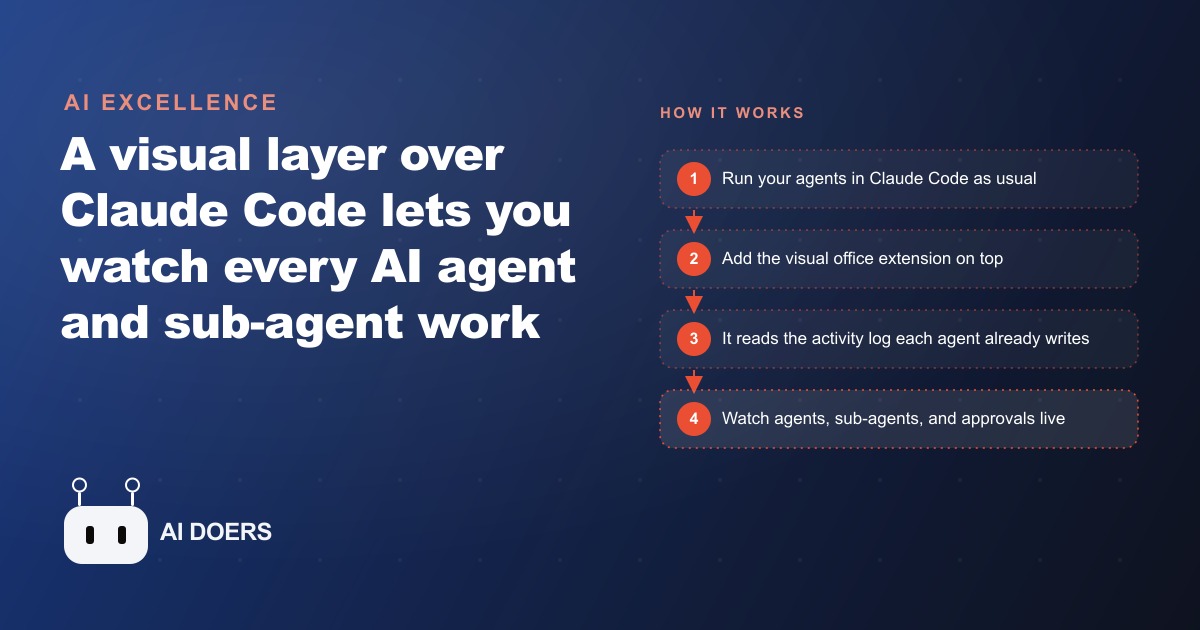
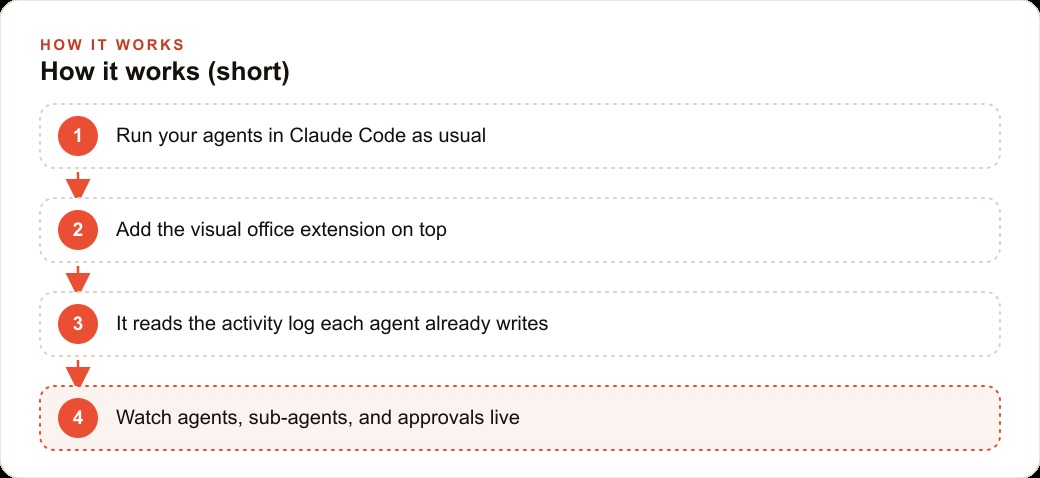
What made this possible is a visual layer over the AI agent tool, a free extension that turns each running agent into a small animated figure in a visible workspace. When an agent finishes, its figure goes still. When one pauses to ask for approval before continuing, a notification appears. When the main agent delegates a piece of work to a sub-agent, a second figure appears on screen. None of this changes how the agents work. It only changes what the owner can see, and that visibility changes everything about what she is willing to delegate permanently.
The Inbox That Got Answered While the Salon Owner Cut Hair
The salon's inbox had been a quiet source of stress for months. Not urgent stress, but the persistent kind that comes from knowing something is undone while you are doing something else. Potential clients asking about Saturday availability. Existing clients asking about price changes. Suppliers asking about next month's product order. Messages arrived throughout the day and were read in batches at 5 p.m., after the last client left.
By batch-reading time, some messages were ten or twelve hours old. A potential client who sent a booking inquiry at 9 a.m. and heard back at 5 p.m. had almost certainly booked elsewhere. The delay was not a failure of intention. It was the structural result of one person running a full schedule with no one dedicated to communication during working hours.
The first agent the owner set up handled the inbox. It read incoming messages, drafted replies in her voice using templates she had written and approved, and queued them for her to confirm before sending. She reviewed the queue during her morning break. The drafts for ninety percent of messages were ready to send as written. The review took two minutes. The inbox was cleared by 10 a.m. every day instead of by 5 p.m.
That improvement mattered. But the more significant shift came when she added the second and third agents and needed to manage all three at once. That is when the visibility problem appeared, and solving it is what made permanent delegation possible.
Visibility Is the Condition for Trust, Not a Nice-to-Have
When a single agent runs invisibly, the lack of visibility is tolerable. You know what you asked it to do, you wait a few minutes, and you check the result. But when three agents are running simultaneously, each handling a different task, each at a different point in its process, invisibility becomes genuinely unmanageable.
Without the visual layer, running three simultaneous agents means three terminal windows open in the background, each scrolling raw text that updates unpredictably, with no clear indication of which agent is waiting for input, which has finished, and which has gotten stuck. The typical response to this is to check each window every few minutes, which means either missing the moment something needs attention or spending so much time monitoring that the productivity benefit disappears.
The visual layer solves this with a status summary that can be read in a single glance. One agent is animated: it is working. One has gone still: it finished. One shows a pause indicator with a notification: it is waiting for approval before continuing. The owner reads that state in under two seconds and either turns back to her client or taps the confirmation. The cognitive overhead of managing three agents becomes comparable to glancing at a group message to see if anyone is waiting for a response.
This comparison to managing a team is more than a casual metaphor. The psychological requirement for trusting delegated work is the same whether the worker is human or artificial. You need to be able to check in periodically, see that work is actually happening, and intervene when something requires your judgment. Workers you cannot check on, human or AI, create anxiety because you cannot confirm progress, catch problems early, or time your attention to match when your input is actually needed.
The visual layer does not make the agents more reliable. The agents were already running correctly. What it does is make their work visible, and visible work is the precondition for real delegation. Once you can see the agents working, glance at their status between appointments, and trust that you will be notified when something needs you, delegation stops being an experiment and becomes a stable operating mode.
Consider what happens without the visual layer when a second agent gets added. The owner asked a second agent to pull reviews from the past two weeks and identify patterns. She opened a second terminal window. Both agents were now running. At some point one of them stopped producing output. She could not tell if it had finished, hit an error, or was still working through a large batch. She checked the first terminal, checked the second, went back to the first, and spent eight minutes in that loop before realizing the second agent had finished ten minutes earlier and its output was sitting in a file she had not checked. Eight minutes of checking and rechecking a terminal is not a management workflow. It is anxiety without information. The visual layer replaced that loop with a two-second glance.
A note on security belongs here because it is often skipped. Any extension that reads and displays agent activity logs should be verified before installation. The check is simple: confirm the publisher has a real, verifiable identity and a public track record; confirm the extension makes no outbound network connections; confirm no data leaves the local machine. A visual layer that shows local agent activity should stay entirely local. An extension that sends activity data to an external service is a security concern regardless of how useful the visualization appears to be.
The owner also recovered approximately four hours per week from running these three agents, measured by the time that previously went into batch email management, reviewing printed review summaries, and manually updating the promotional calendar each week. None of those four hours required anything about AI visibility to recover. What the visual layer did was make the delegation stable enough that she stopped second-guessing it. The hours stayed recovered because she trusted the system, and she trusted the system because she could see it working.
Managing Agents Is the New Management Skill
The owner of the salon is not a developer. She did not write the agents, configure the visual layer, or choose the tools. She worked with someone who set it up on her behalf, confirmed it was running on real tasks she cared about, and began managing it from that point forward.
What she learned over the first six weeks is that managing agents is a skill that develops quickly because it closely resembles managing a small team. The questions are the same: who is busy, who is idle, who needs a decision from me, and what should the idle one be working on. The cadence is different, checking in for fifteen seconds between clients rather than holding a morning standup, but the managerial instinct transfers directly.
The practical skill is knowing when to approve and when to intervene. Most of the time, the inbox draft is ready to send and the approval is a tap. Occasionally a message arrives from a client in a complicated situation and the draft is technically accurate but not quite right for the relationship: too formal, or missing the context of a recent in-person conversation. That is the moment that requires the owner's judgment. The visual layer makes that moment visible rather than hidden. The agent pauses, the notification appears, and the owner can step in precisely rather than discovering the issue after the message was sent.
The instinct that builds over weeks of managing agents is a calibrated sense of output quality. The owner learns which categories of input produce reliable drafts and which require closer review. She learns that messages from long-term clients about scheduling disputes need a personal touch that the template does not provide. She learns that messages from potential first-time clients asking about services are handled cleanly nearly every time. That discrimination between what to check carefully and what to approve at a glance is real skill, and it compounds with experience.
The session that shifted how the owner thought about the system happened in week three. The review analysis agent, processing two weeks of online reviews, surfaced a pattern she had not noticed: three reviews spread across six weeks each mentioned a wait time issue that occurred after the color processing step. The agent had pulled the relevant reviews, identified the pattern, and drafted a note. The owner read it in ninety seconds and had business intelligence that would have taken an hour of active reading to find on her own.
This is what agent management eventually produces beyond faster task execution. When agents are running consistently and you can see what they are finding, they produce information synthesis as a byproduct of the work. The review analysis agent was not only saving time on drafting replies. It was surfacing a pattern in client feedback that pointed to a fixable operational issue. That kind of observation, available to any business that runs agents with visibility into what they found, is one of the less obvious but genuinely valuable returns on the practice.
The management skill this represents is not technical. It is the same skill required to manage any competent team: clarity about what each person is responsible for, a reliable way to see how the work is going, and the judgment to step in when something needs a decision only you can make. The visual layer provides the middle element. The other two were already there. The only thing that changed is that the work became something she could see, and visible work is what earns trust, one glance at a time.
The broader shift this points to is that as more businesses run multiple AI agents simultaneously, the ability to manage those agents effectively becomes a genuine competitive advantage. The teams that can run four agents in parallel and keep each one on task will outperform the teams that run one agent at a time and lose hours checking on it. Visibility is what makes parallel operation manageable. The visual layer is not a convenience feature. It is the infrastructure that allows real AI management to happen at the pace a working business requires. The owner's situation six months after setup is worth describing plainly. Three agents run most days, supervised in check-ins that take under five minutes total across the workday. She has not changed any agent's core configuration since month two, because the output quality stabilized quickly and stayed there. The system handles the same volume of inbox, review, and promotion work it handled on day one, and it does so without any ongoing time investment from her beyond the glances and approvals. That stability, the fact that it keeps running without requiring attention, is the outcome that visible management makes possible. Invisible systems require constant checking to verify they are still working. Visible systems can be trusted at a glance, and trust is what turns a trial into a permanent part of how the business operates.
That is exactly what we do at AI DOERS. Book a private 30-minute call with Madhuranjan Kumar and we will map the fastest path to it for your specific business.
Book your call →
Madhuranjan Kumar
Madhuranjan Kumar brings 20 years of performance-marketing experience and has managed over $200 million in Facebook ad spend for brands across the United States and beyond. His expertise spans the full modern marketing stack: Meta, Google Ads, TikTok, email automation, CRM, and the websites that hold it together. At AI DOERS he turns that track record into lead-generation systems for businesses across every industry.