
How to Scrape Almost Any Website With an LLM in 2024
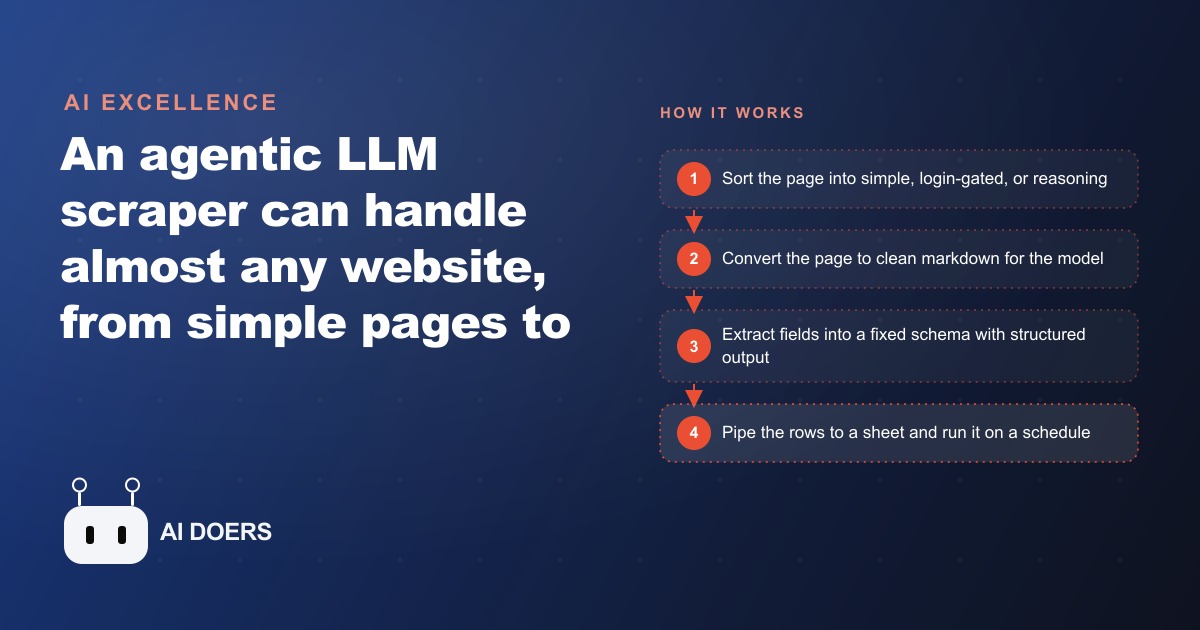
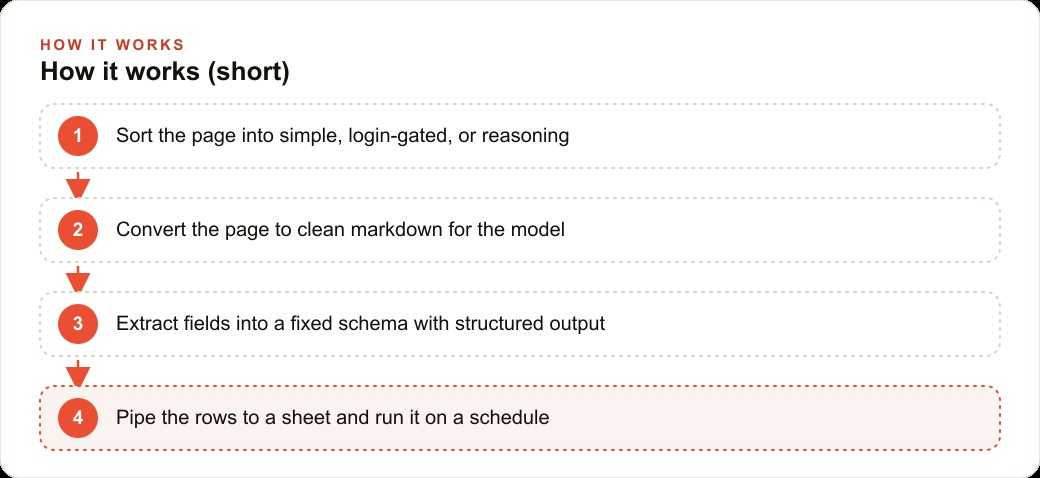
Sort the job into three buckets, then match the tool. Feed raw HTML to an LLM with structured output for simple pages, convert pages to clean markdown with Firecrawl or the free Jina Reader, and use AgentQL plus Playwright to log in, clear popups, and paginate the sites behind a wall.

Custom-coded web scrapers are engineering debt with a branding problem. The industry spent fifteen years calling them infrastructure, wrapping them in Docker containers, and writing deployment guides about their production readiness. Then the website redesigned its navigation, changed a class name, or moved a button one level up in the DOM, and the selector broke, the data pipeline stopped, and someone spent half a day rewriting a file everyone assumed was finished. That maintenance cost is the real cost of custom scrapers, and it never appears in the initial build estimate.
The LLM-plus-agent approach beats custom parsers on every dimension that matters for a business: it tolerates layout changes, produces reliable structured output, handles the gated sites that stopped traditional scrapers, and costs a fraction of the ongoing engineering time required to keep bespoke parsers alive. This is not a marginal improvement. It is a category change, and the businesses still investing in custom HTML parsers are paying for a liability they call an asset.
Custom Scrapers Are Maintenance Debt Disguised as Infrastructure
A custom scraper is written for one website's HTML structure at one point in time. The code finds data by navigating a chain of selectors: find the container with this class, find the child with that tag, extract the text inside it. When the website updates its template, changes a class name, or restructures its DOM for any reason, the selector chain breaks. The scraper silently returns empty data or errors out, and the owner of the pipeline usually discovers the problem not when it breaks but when they notice the spreadsheet has not updated in three days.
This failure mode is not a bug that can be fixed once. It is a recurring cost built into the architecture of the approach. Websites change. They run A/B tests that alter DOM structure across user segments. They redesign seasonal pages. They migrate to new frameworks. They update their CMS. Every one of those events is a potential scraper break, and there is no way to know it happened without monitoring every field that matters and alerting on unexpected nulls or stale timestamps.
The honest accounting of a custom scraper's total cost includes the initial build time, the monitoring infrastructure, the engineering hours spent on each break-and-repair cycle, and the opportunity cost of data gaps during outage periods. For a scraper hitting a site that changes its layout twice a year, the repair cycles alone can exceed the original build time within 18 months. After that the scraper is more expensive to maintain than it cost to build, and the cost continues indefinitely. That is not infrastructure. That is a liability that happens to return useful data when it is working. Calling it infrastructure is how organizations avoid revisiting the decision.
Layout Changes Are a Solved Problem When the Extractor Reads Content, Not Selectors
An LLM extractor does not care about class names. It reads the semantic content of a page the same way a person does and extracts the fields it was asked to find regardless of which HTML element wraps them. When the website moves a product price from an H2 inside a div with a specific class to a span with a data attribute, the selector breaks and the custom parser stops working. The LLM extractor reads the concept of a product price and finds it in the new location because it understands what a price is, not where it happens to sit in the DOM today.
This tolerance for layout change is not a soft benefit. It is the primary economic argument for replacing custom scrapers with LLM-based extraction. The engineering time spent on scraper maintenance scales with the number of sites being scraped and the rate at which those sites change their structure. The LLM extraction cost scales with the volume of content being processed, and that cost has been falling steadily. The crossover point, where LLM extraction becomes cheaper than maintenance on an equivalent custom parser, arrived some time ago for most business use cases.
The practical implication is that a scraping pipeline built on LLM extraction does not require a human to intervene when a layout changes. The extraction runs, finds the content by meaning rather than structure, and returns the same schema it returned last week. The monitoring burden drops dramatically because the most common source of silent failures, changed selectors, no longer applies. What remains to monitor is the availability of the page and the quality of the extracted output, both of which are simpler problems than tracking selector drift across dozens of sites. The shift is from reactive firefighting to proactive quality monitoring.
Why Free Tools Now Cover the Three Hardest Scraping Scenarios
Most scraping jobs fall into one of three buckets. Simple public pages where the content is available to anyone without a login. Login-gated pages behind authentication, cookie dialogs, and possibly verification steps. And reasoning tasks where the relevant data is spread across multiple pages and requires judgment about which page to check and how to synthesize across them.
Custom scrapers struggle with all three in different ways. Simple public pages are where custom scrapers work best, but layout changes still break them. Gated pages have always been the hardest problem: a custom parser can handle the login once it is programmed, but the login flow changes, the cookie management drifts, and the parser breaks when the site adds a new verification step. Reasoning tasks are outside the scope of what custom scrapers can do at all, because they require the kind of judgment about content that only a language model can provide.
Free and low-cost tools now cover each scenario without custom engineering per site. For simple public pages, Jina Reader converts any URL to clean markdown with no API key at small volume by prepending a prefix to the target URL. The markdown strips navigation, ads, footers, and cookie notices and delivers the content the model actually needs. Firecrawl handles JavaScript-rendered pages and captures the most complete version of the page for cases where Jina falls short. Spider Cloud sits between the two in detail and rate limits.
For login-gated pages, Playwright drives a real browser and AgentQL identifies UI elements in plain language so the agent can click the correct button without knowing its class name or ID. The agent can save authenticated session state to a file after the first login, so every subsequent run skips the authentication step and goes straight to the data. For reasoning tasks across multiple pages, an agent browses, reads, and synthesizes without requiring the developer to specify in advance which page holds the answer. Each of these tools is either free at practical volumes or costs a fraction of what a developer hour costs, and combining them covers the scenarios that used to require a custom build for every site.
The Schema Contract That Makes a Pipeline Reliable Instead of Fragile
The weakness in any extraction system is consistency. A custom scraper either finds the element and returns its text or fails entirely. An LLM without structured output can drift: it might call the same field "price" one day and "cost" the next, or return a currency symbol in some rows and omit it in others. That inconsistency makes the downstream pipeline fragile because the spreadsheet or database receiving the data has to accommodate variation that the extraction process should have resolved.
Structured output solves this at the model level. When you define a schema with specific field names, their expected types, and whether each is required, the model response conforms to that shape on every run. If the field cannot be found, the structured output raises a clear signal, a null or a validation error, rather than returning a plausible-looking wrong value. That signal is what allows the pipeline to detect extraction failures before they propagate into a business decision based on bad data.
The schema is the contract between the extraction and everything downstream. A scraping pipeline that commits to a schema can be tested automatically: every run either passes the schema validation or it does not, and a failed validation triggers a review rather than silently passing bad data through. This is a higher reliability standard than most custom scrapers ever achieve, because custom scrapers typically either return a value or fail with an error, with no middle ground for partial or ambiguous extraction. Structured output adds that middle ground and makes the pipeline auditable in a way that selector-based extraction cannot match. The schema becomes documentation of what the pipeline is supposed to produce, checked automatically on every run.
The ROI Calculation That Ends the Debate for Most Businesses
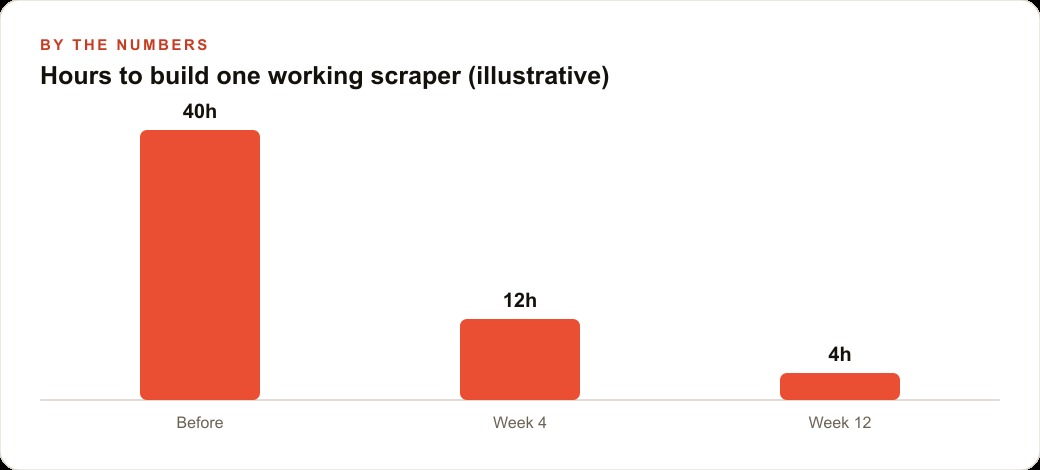
The economic case for switching to LLM-based scraping comes into focus when the full cost of the alternatives is visible. Consider an e-commerce store monitoring 10 competitor product pages and a supplier catalog with several hundred items. The custom scraper approach requires building a parser for each site, monitoring for breaks, and repairing each one when the site updates. At two sites changing their layout per year and two hours of engineering time per repair, that is 20 hours of developer time annually just on maintenance, not counting the initial build cost or the data gaps during outage windows.
The LLM approach requires defining a schema, writing the extraction prompt once, and configuring the pipeline to run on a schedule. When a site's layout changes, the extraction adapts because it reads content by meaning. The schema validation flags any extraction where the output deviates from the expected format, so the team knows about quality issues without needing to watch each site manually.
On staff time alone: if the team currently spends three hours per week manually copying competitor prices and supplier availability into a tracking spreadsheet, the scraper recovers those hours entirely. Three hours per week across 52 weeks is 156 hours of staff time annually. At $25 per hour in labor cost, that is $3,900 in recovered labor per year. The LLM scraping pipeline takes one afternoon to stand up, costs roughly ten to thirty dollars per month in inference depending on volume, and requires less than an hour per month of maintenance because layout changes do not break it.
The ROI pays back within the first six weeks and then saves indefinitely. The businesses still building bespoke parsers are paying a premium to own a liability. The ones using LLM-based extraction are buying a pipeline that gets better and cheaper to run as the tools improve. The debate is not really about technology. It is about whether the status quo has a lower total cost than the alternative, and once the full cost of custom scraper maintenance is counted, the comparison is not close.
The Reuse Dividend That Changes the Math Further
One advantage of LLM-based extraction the ROI calculation above does not fully capture is the reuse factor. A custom scraper built for one website is useful for exactly one website. Adapting it to a second website with a similar structure requires reviewing the existing code, updating the selectors, testing the new extraction, and handling whatever the second site does differently. The work of the first build does not transfer cleanly to the second.
An LLM extraction schema built for one website transfers almost entirely to similar websites. The schema for extracting product name, current price, stock availability, and active discount code from one e-commerce product page applies directly to another e-commerce product page without selector changes. The extraction prompt may need minor adjustments based on how the second site describes its products, but the fundamental pattern: convert the page to clean markdown, define the schema, extract the fields, validate the output, is identical. The first site's build becomes a template for the second, the second for the third.
For a business monitoring 10 competitor pages, this reuse means sites two through ten cost a fraction of what the first one cost to configure. For an agency building scraping pipelines for multiple clients in the same industry, the reuse extends across engagements: the schema and prompt architecture built for one client's competitor monitoring is immediately applicable to the next client in the same vertical. The fixed cost of figuring out the pattern is paid once. The variable cost of applying it is small and shrinking. The businesses still rebuilding a new custom scraper for each new data source are paying a per-site cost that LLM-based extraction converted into a one-time setup cost months ago.
That is exactly what we do at AI DOERS. Book a private 30-minute call with Madhuranjan Kumar and we will map the fastest path to it for your specific business.
Book your call →
Madhuranjan Kumar
Madhuranjan Kumar brings 20 years of performance-marketing experience and has managed over $200 million in Facebook ad spend for brands across the United States and beyond. His expertise spans the full modern marketing stack: Meta, Google Ads, TikTok, email automation, CRM, and the websites that hold it together. At AI DOERS he turns that track record into lead-generation systems for businesses across every industry.