
How to Run a Solo AI Creative Agency With Two Subscriptions
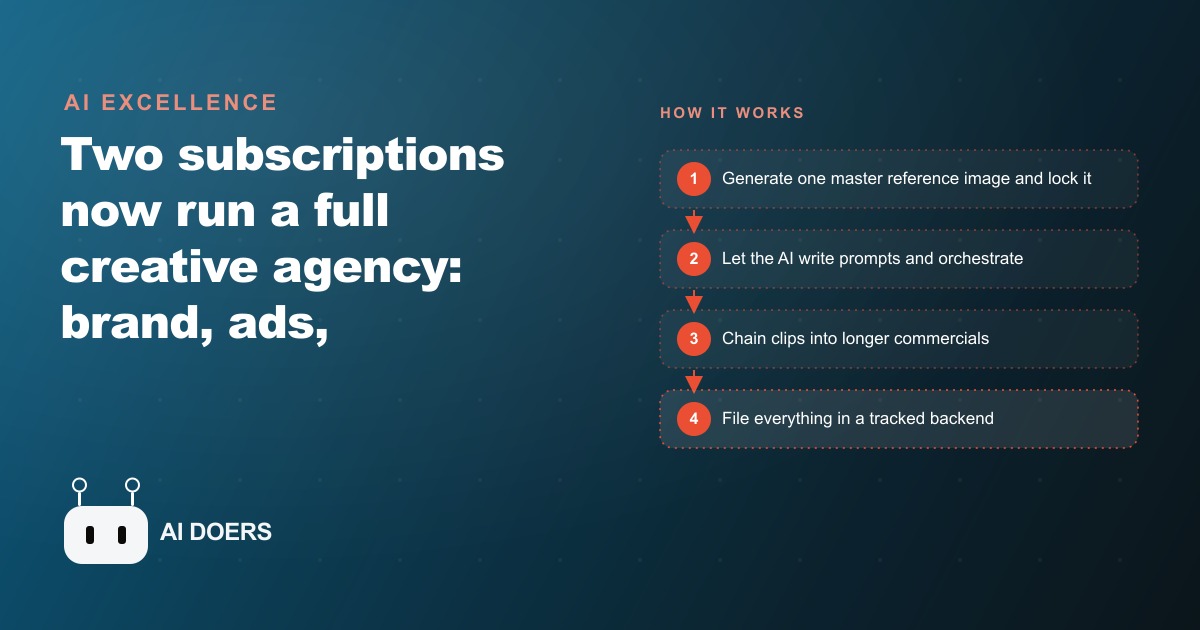
One person can now run a full creative agency on two tools: one generates every image and video, the other writes the prompts and orchestrates the pipeline, with a backend that tracks clients and competitor signal.

The most interesting number in creative production right now is not what AI tools cost to run, it is the gap between that cost and what clients are still willingly paying for the same output.
I, Madhuranjan Kumar, want to take that gap apart systematically, because it is large enough to build a business on and specific enough to design a real operation around. A solo AI creative agency is not a theoretical possibility. It is a business model with definable costs, predictable outputs, and a margin structure that traditional agencies cannot approach. Understanding how it works requires going deeper than "AI makes things faster." It requires understanding the specific techniques that separate consistent professional output from occasional impressive output, and the business infrastructure that turns a production skill into a repeatable client engagement.
The gap between production cost and client price expectation is structural and temporary
When a client hires a creative agency for brand photography, product videos, and digital advertising creative, they are drawing on a price expectation that was calibrated by the cost structure of traditional production. Art directors, photographers, video producers, retouchers, motion designers: the cost of assembling that capability has historically been substantial, and clients price their expectations accordingly.
AI tools have not yet fully disrupted that price expectation, even as they have dramatically changed the production cost. This gap, the difference between what clients still expect to pay and what it now costs to deliver comparable output, is the economic foundation of the solo AI creative agency model.
A solo operator with two subscriptions totaling $100 to $150 per month can produce output that a client reasonably values at $2,000 to $5,000 per month per engagement. The tools to do this are available now. The gap is real. And the clients who need this kind of output exist in every market segment and every city.
The gap is also temporary. As more operators build on this model, as client awareness of AI creative capabilities increases, and as pricing normalizes, the margin will compress. The operators who build now, who develop genuine production skill and client relationships while the gap is wide, will be the ones with sustainable businesses when it narrows. This is not a warning to wait. It is an argument to move, because the asset you are building is not just the tool skill. It is the client relationship, the reference library, and the production process, all of which have value independent of the current pricing gap.
The master reference image is doing more architectural work than it appears to
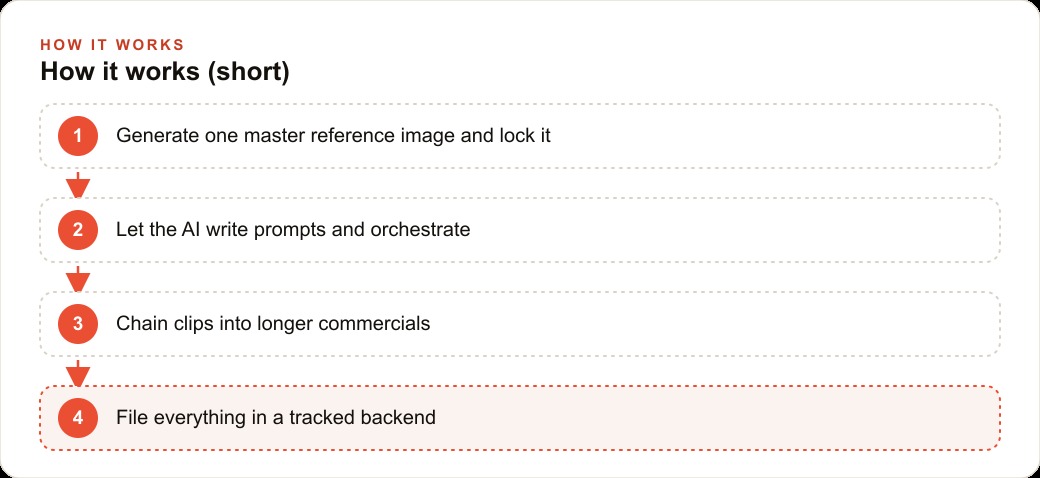
The first technical skill that separates consistent professional output from occasional impressive output is the use of a master reference image. Most people who experiment with AI image and video generation do not develop a reference image system. They prompt freshly for each generation, tweak when the result is wrong, and end up with output that looks coherent in isolation but inconsistent across a deliverable set.
A master reference image solves this. It is an image, generated or sourced, that establishes the exact visual language of the client's brand: the color palette, the lighting quality, the composition style, the texture and mood. Every subsequent generation references this image, either explicitly through the tool's reference or style-lock features, or by including a description of it in the prompt as an anchor.
The architectural work the reference image is doing is maintaining consistency across everything produced for a client without requiring the operator to re-establish that consistency in every prompt. A product shot, a hero banner, a social card, and a video thumbnail can all feel like they came from the same visual world if they are all anchored to the same reference. Without the anchor, each piece is a fresh stylistic negotiation that produces visual fragmentation across the deliverable set.
Building the master reference image is a half-day investment at the start of an engagement. The return is consistency across weeks of output without the iterative friction of matching style from scratch each time. It is also the foundation of the client's confidence that the output is theirs: it looks like their brand rather than like generic AI output.
Prompt authoring versus prompt guessing: one produces consistent output, the other does not
There is a distinction between prompt authoring and prompt guessing that most people who use AI generation tools never make explicitly, but that determines almost everything about the reliability of their output.
Prompt guessing is what happens when you describe what you want in natural language, see what the tool returns, adjust your description based on what came back, and repeat until you get something usable. This process works for exploration. It does not scale to professional production because it is non-reproducible. You cannot deliver consistent output to a client if every piece required a different negotiation to produce.
Prompt authoring is a different discipline. You build a prompt structure that reliably produces a defined category of output: product shots with a specific lighting setup, brand portraits with specific color grading, motion graphics with specific animation style. The structure includes the elements that have been tested and found to be stable: subject description, environment, lighting specification, style reference, negative constraints. You test the structure across multiple generations and refine it until it reliably returns the output category you defined.
The authored prompt is the production asset. Once you have authored the prompt structure for a client's product shots, you can produce twenty variants without starting from scratch. The consistency is in the structure, not in the skill of describing it freshly each time. The operator who has a library of authored prompts across five client engagements has a production capability that scales linearly with the library. The one who guesses fresh each time does not.
The clip-chaining technique that turns 15-second generation limits into 30-second commercials
One of the practical constraints of current AI video generation is the maximum clip length on most platforms: between five and twenty seconds depending on the tool and model. For product demonstrations, brand videos, or social advertising, twenty seconds covers a single beat but rarely a complete commercial.
Clip chaining extends beyond this limit by generating a series of clips where each clip begins visually consistent with where the previous clip ended, then assembling them in sequence to produce a continuous-feeling video that exceeds the per-clip limit.
Executing this well requires two things. First, a clear storyboard before any generation: you need to know what each clip is showing, what the beginning and ending frames look like, and how the visual continuity passes from one clip to the next. Generating clips opportunistically and hoping they assemble coherently does not produce a professional result.
Second, a reference image for each transition point. If clip one ends on a product sitting on a white surface with light coming from the left, clip two needs to begin on the same product in a composition that continues that visual logic. Generating clip two without that reference will return something visually inconsistent at the cut, and the cut will be visible in the assembled video.
A well-executed three-clip chain produces fifteen to twenty seconds of continuous-feeling video from segments that each meet the platform's per-clip limit. These lengths cover most social ad placements and all short-form product showcase segments. The generation limit is a design constraint to work with, not a barrier to professional output.
Viral presets are not shortcuts, they are applied competitive intelligence about what already worked
Every major AI generation platform ships with preset style options: cinematic, editorial, lifestyle, high-fashion, and dozens of others. Most operators treat these as aesthetic shortcuts, a way to reach a finished-looking result faster.
The more useful way to think about them is as applied competitive intelligence. The presets that are most prominent on these platforms exist because the visual style they produce has performed well in the market. Platform teams identify visual styles that generate strong engagement in real distribution contexts and build presets that make those styles accessible.
Selecting a preset thoughtfully is therefore a strategic decision, not an aesthetic one. You are asking: what visual style has already been proven to generate engagement in this content category, and can I apply that style to my client's product. The answer to that question depends on understanding what each preset is optimizing for and matching it to the client's distribution context and target audience.
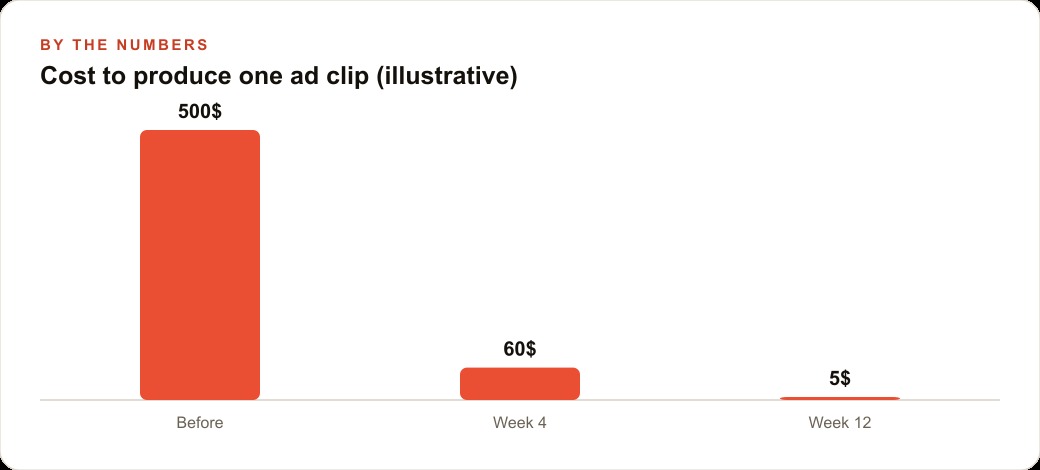
Madhuranjan Kumar, producing a full deliverable set for a single product in one day: brand identity, product photographs in multiple contexts, three static ad variants, and two commercial clip chains. Tool cost: $100 to $150 per month total. The comparable cost to produce ongoing output at this volume via a traditional creative agency: $15,000 to $30,000 per month. A solo agency charging $2,000 per month per client on a $150 per month tool base operates at margins that most traditional agencies cannot approach, and can serve more clients simultaneously than a traditional agency can staff for.
Viral presets are not the ceiling, the authored system is
Building on the preset foundation with authored prompt structures and master reference images is what takes the output from impressive to consistent. The preset establishes the visual vocabulary. The authored system applies that vocabulary reliably across every piece produced for a client.
The operators building sustainable solo agency businesses are not the ones running the most impressive single pieces. They are the ones who have built systems that produce professional output consistently, at volume, without the variation that makes clients nervous about reliability. Consistency is the product. The impressive pieces are the demonstration of what the consistent system can produce at its peak.
The backend is what separates a project from a business
Everything described above is production capability. An operator who builds these skills can produce consistent professional creative output for clients. But production capability alone is a freelance project, not a business.
The backend infrastructure is what makes it a business: the client communication system that sets expectations and delivers work in a predictable format, the asset management that means a client's reference images and authored prompt structures are retrievable months after the initial engagement, the revision process that is scoped and bounded rather than open-ended, and the pricing structure that reflects the value of the output rather than the cost of the tools.
The largest source of margin compression in a solo agency is not tool cost. It is unscoped revision cycles, inconsistent delivery formats that create client confusion, and asset management failures that require recreating work that should have been preserved. A client who asks for "a few tweaks" on a video where the reference images are not saved and the prompt structure was not documented is asking for significant production work at no additional cost.
A backend that saves the reference, documents the prompt structure, and defines revisions as changes to the original rather than complete regenerations prevents that scenario from occurring. The backend infrastructure does not need to be elaborate. It needs to be consistent: a standard delivery format, a standard asset storage structure, a standard scope document that defines what a revision is, and a prompt library that lets you reproduce prior work reliably. Build these systems once and they maintain themselves. The gap between what this output costs and what clients pay for it is real. Keeping that gap from eroding requires delivering work professionally, predictably, and reproducibly, which is a backend problem as much as a production one.
The practical reality is that the business infrastructure takes two days to build and then largely runs itself. The asset storage system is a folder convention applied consistently. The scope document is a one-page template customized once per client at engagement start. The prompt library is built during production and grows without deliberate effort. The operators who skip this step because it feels administrative are the ones whose production skill never converts to a profitable business. The ones who build it find that the business runs at the margin the gap creates, reliably, and compounds as the client portfolio grows.
That is exactly what we do at AI DOERS. Book a private 30-minute call with Madhuranjan Kumar and we will map the fastest path to it for your specific business.
Book your call →
Madhuranjan Kumar
Madhuranjan Kumar brings 20 years of performance-marketing experience and has managed over $200 million in Facebook ad spend for brands across the United States and beyond. His expertise spans the full modern marketing stack: Meta, Google Ads, TikTok, email automation, CRM, and the websites that hold it together. At AI DOERS he turns that track record into lead-generation systems for businesses across every industry.