
How to Put Your AI Agents on a VPS So They Run On Their Own
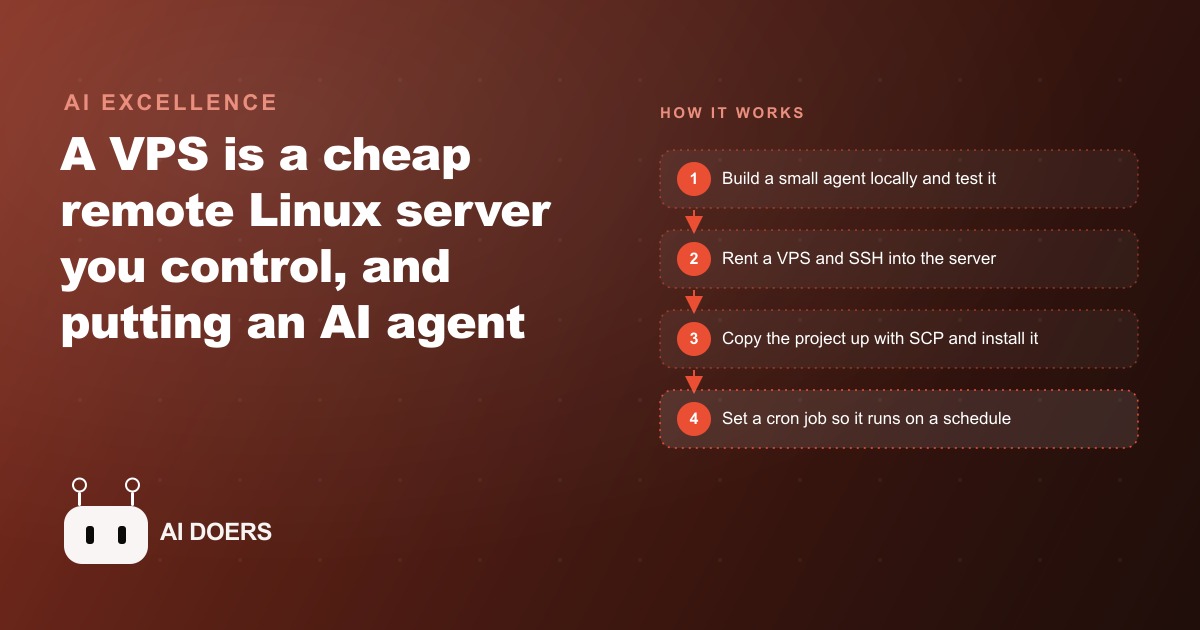
A VPS is a cheap remote Linux server you control. Put an AI agent on it with a scheduled job and the work runs every day on its own. Here is how it works and how I would set it up for a client.

There is a particular kind of magic in a piece of software that does useful work while you sleep, and almost nobody outside of engineering circles realizes how cheap that magic has become. I am Madhuranjan Kumar, and I want to make the case for the most underrated tool in the whole AI-for-business conversation, which is not a model or an app but a small remote computer that costs about the price of a coffee each month. Rent one of these, put an AI agent on it, tell it to run at nine every morning, and you now own a tireless worker that never logs off, never forgets, and never asks for anything. The gap between the people who understand this and the people who do not is going to widen fast, and I would rather you be on the right side of it.
The machine I am talking about is a virtual private server, usually shortened to VPS. Strip away the jargon and it is just a remote computer running Linux, with its own processor, memory, and storage, sitting in a data center somewhere, rented to you for a few dollars a month and yours to control completely. That last word, completely, is the whole argument. Most people's instinct when they want to run something automatically is to reach for a cloud service or a subscription tool where somebody else owns the server and sets the rules. A VPS flips that. You own the environment.
Why owning the box beats renting a service
The case for self-hosting on a VPS comes down to three advantages that compound over time. The first is control of your data and privacy. When your agent runs on a machine you control, the information it touches stays yours, rather than flowing through a third party's platform under their terms. For a business handling customer details or internal records, that difference is not academic, it is the whole ballgame.
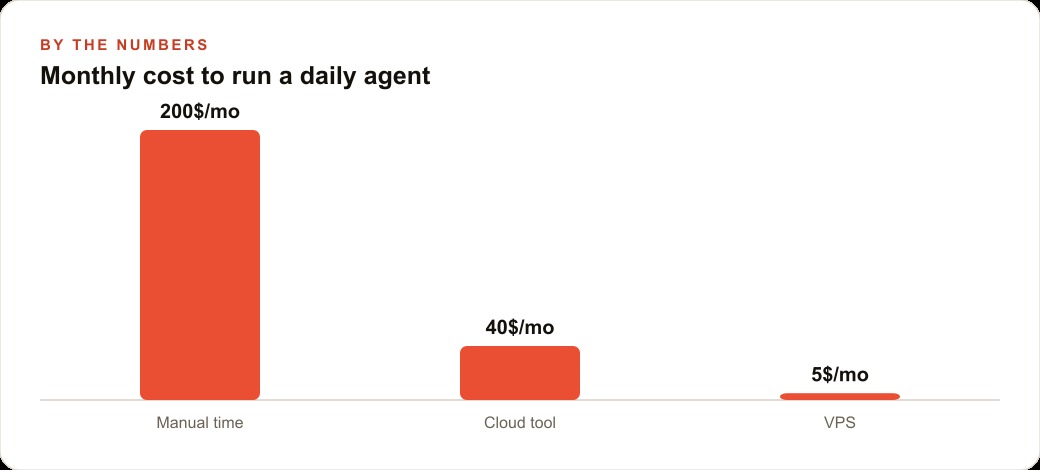
The second is cost, and the gap here is genuinely startling. A cloud automation tool priced per task or per seat can quietly climb into real money as your usage grows. A modest VPS is a flat few dollars a month no matter how hard you work it, and because a simple agent barely taxes the machine, that single box can run near idle while hosting the job. The third advantage is freedom from lock-in. Because you built the agent yourself and it lives in a plain folder on a standard Linux server, moving it somewhere else later is trivial. You are never trapped inside one vendor's ecosystem, watching them raise prices because they know switching is painful. Own the box and you keep the leverage.
There is a second-order effect of that flat pricing that most people miss, and it is where the economics get genuinely fun. Because a simple agent uses almost none of the machine's capacity, one modest server can host not just one agent but dozens of them at once. Your morning news scraper, a nightly lead summarizer, a weekly report builder, a price watcher checking a competitor twice a day, they can all live on the same box and still leave it sitting near idle. Compare that to a per-task cloud tool, where each new automation adds to the bill, and the contrast is stark. On a VPS your tenth agent costs essentially nothing extra. That is the moment the model stops being a way to save a little money and becomes a platform you can keep building on, which is why engineers reach for it instinctively and why more business owners should.
Picture it as a small computer that lives in a data center, never sleeps, and quietly does a job for you on a schedule whether or not you ever log in to check on it. That mental image is the entire promise. Everything else is just the plumbing that gets you there, and the plumbing is far simpler than most people fear.
From a paragraph of intention to a working agent
Here is the part that would have been impossible for a non-programmer a few years ago and is now genuinely approachable. You do not need to be a developer to build the agent that goes on the server. A coding assistant can scaffold a small program from a single paragraph of plain-English intention. You describe what you want, something like build me an agent that scrapes a news page every morning, runs the results through a model to pull out the useful trends, and saves a short report, and the assistant produces the working project and walks you through running it.
What you bring is not coding skill. It is a clear intention and the willingness to follow the steps the assistant gives you, testing the thing on your own machine until it does what you want. That local testing loop matters, because you want the agent proven and reliable before it ever goes near the server. Build it, run it, watch it fail, fix it, run it again, until it works cleanly. Only then does it graduate to the box.
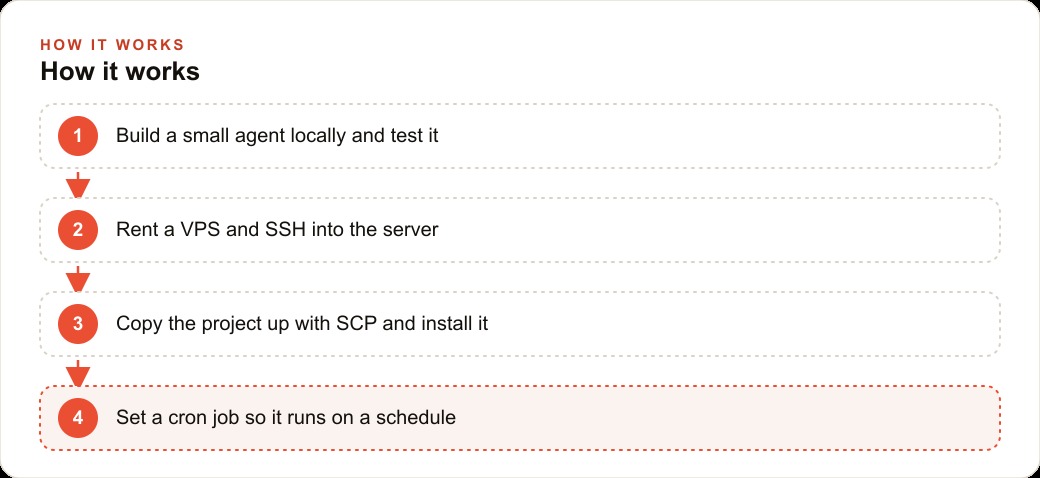
Getting it onto the server sounds intimidating and is not. Two tools carry almost all the weight. SSH is a protocol that lets you securely reach into the remote machine from any terminal, anywhere, giving you remote control over an encrypted connection. SCP rides on top of SSH and copies your local project folder up to the server in a single command. So the flow is: build and test locally, SSH into the VPS, SCP the working folder up, and install the same dependencies on the server that you installed on your own machine. It is the same project, just now living somewhere that never turns off.
The one command that turns a script into an employee
The final piece is what actually converts a program you have to run by hand into something that runs itself, and it is a decades-old, rock-solid piece of Linux called cron. Cron is a scheduler. You tell it to run a specific command at specific times, say nine in the morning every single day, and from that point forward the agent runs on its own, forever, without you touching it. That is the whole trick. There is no complicated orchestration platform, no ongoing babysitting. One scheduling entry and your morning report writes itself before you have poured your first cup of coffee.
Two small habits keep this safe and sane, and I would not skip either. Keep your project in a git repository and commit at each working step, so if a change breaks something you can roll straight back to the last version that worked. And keep your secrets, things like API keys, in an environment file that git is told to ignore, so those keys never get tracked or accidentally shared. Neither habit takes more than a minute to set up, and together they turn a fragile experiment into something you can trust running unattended.
What this looks like inside a real business
Let me ground all of this in a concrete, illustrative example, because the abstract version undersells it. Take a moving company, the kind that runs on quotes and lives or dies by how fast it responds to leads. Every night, quote requests trickle in through the website and the inbox, and every morning the office starts cold, with a coordinator wading through unread messages before any real work can begin.
I would put that morning scramble on a VPS. Picture an agent scheduled by cron to run at seven each morning. It pulls every overnight quote request from the website and inbox and runs each one through a model to extract the key facts: pickup and drop-off locations, home size, the requested date, and any tricky detail like a piano or a third-floor walk-up. It writes a clean summary for each lead and drafts a first reply, so when the coordinator sits down the triage is already done and the urgent jobs are flagged at the top. If the company handles, say, 15 overnight leads a night and each one took the coordinator about 12 minutes to read, sort, and draft a reply for, that is roughly three hours of every morning reclaimed before the day even starts.
From there I would add a second scheduled agent for the back office, one that assembles a simple daily snapshot of jobs booked, crews assigned, and follow-ups due, plus a weekly one that flags quotes that never got a response so none slip through the cracks. The deterministic parts, the reminders and the scheduling logic, run as plain reliable code, while the model handles the genuinely hard part, which is reading messy human descriptions and pulling structure out of them. All of it lives on one small server costing a few dollars a month, running whether the owner is on a job site or fast asleep. None of this replaces the crews or the coordinator. It removes the reactive scramble that keeps the office one step behind all day.
The value does not stop at the office door, either. Those clean, fast first replies are exactly what improves the return on the leads flowing in from Facebook and Instagram ad campaigns and Google Ads, because speed to first response is one of the biggest levers on whether a quote turns into a booked job. Feed the structured leads the agent produces into the CRM and website stack, and the follow-up sequence that used to depend on a busy coordinator remembering to send it now runs on its own. The cheap little server quietly makes the expensive marketing work harder, which is the kind of leverage that is easy to miss until you have it.
The businesses that benefit are not exotic, either. Any operation with a repeating task that touches data is a candidate, and almost every business has several of those buried in someone's manual routine. If something useful should happen every morning or every hour, collecting leads, watching prices, summarizing inquiries, generating a daily report, a small agent on a VPS will do it quietly and cheaply. Service companies, shops, agencies, and trades all have these recurring chores, and the people currently doing them by hand almost never enjoy the work. Handing those chores to a scheduled agent does not just save time, it frees a human from the exact tasks that make a job feel like drudgery, which is a quieter benefit that owners tend to appreciate more than the cost savings once they feel it.
The honest part about doing this yourself
I want to be straight about what is easy here and what is not, because the difference is where people either succeed or stall. Standing up a first agent is genuinely doable in an afternoon if you follow the coding assistant step by step, rent a modest server, SSH in, copy the project up, install the dependencies, run it once by hand to confirm it works on the box, and then set a cron entry and verify the schedule is listed. Start with one agent and one schedule before you add a second. That is the beginner-friendly path, and it is real.
The harder part is not the typing, it is the judgment. Choosing the right task to automate first, setting up the server cleanly, and making the agent reliable enough to trust when nobody is watching, those are the things that separate a demo from a system you actually depend on. This is exactly where a lot of people get their first agent running, hit an error message a week later, and quietly abandon the whole idea. If you enjoy the tinkering, follow the do-it-yourself path above and you will learn an enormous amount. If you would rather have the agent built, deployed to a server, and handed over already running on a schedule, that is precisely the kind of setup worth bringing in someone who has wired it up many times before. Either way, the underrated truth stands: a computer that works while you sleep is no longer expensive or exotic, and the businesses that figure that out first are going to feel like they hired a whole shift of quiet, tireless staff for the price of lunch.
That is exactly what we do at AI DOERS. Book a private 30-minute call with Madhuranjan Kumar and we will map the fastest path to it for your specific business.
Book your call →
Madhuranjan Kumar
Madhuranjan Kumar brings 20 years of performance-marketing experience and has managed over $200 million in Facebook ad spend for brands across the United States and beyond. His expertise spans the full modern marketing stack: Meta, Google Ads, TikTok, email automation, CRM, and the websites that hold it together. At AI DOERS he turns that track record into lead-generation systems for businesses across every industry.