
How to Price AI Workflows With Value-Based Pricing and the PRICE Framework
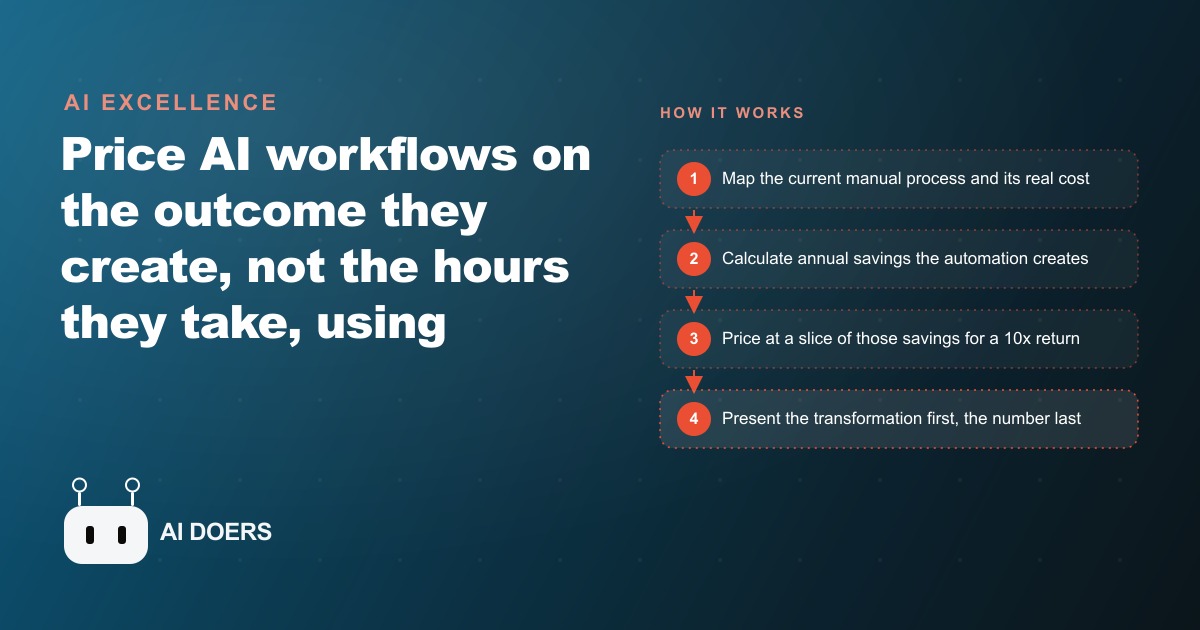
Price AI workflows on the outcome they create, not the time they take. Anchor on time saved, money saved, and fewer errors, aim for a ten times first-year return, then grow the account with retainers using a simple five-step framework.

Charging by the hour for AI automation work is the fastest way to guarantee you get paid the least for the work that is worth the most. That is my position, and I will defend it for the rest of this article. The moment you put your build on an hourly meter, you have told the client that your value equals your typing speed, and you have capped your income at the number of hours in a week. Worse, you have punished yourself for getting good, because the better you are, the faster you finish, and the less you earn for the same result. The whole model is backwards, and beginners default to it precisely because it feels safe and fair. It is neither.
The alternative is to price on the outcome the automation delivers, not the hours you spend building it, and I want to walk through why the hourly instinct is wrong, why the outcome instinct is right, and how to actually run it without hand waving. Businesses do not pay for your time. They pay for results. When you build an AI workflow you are usually doing at least one of three things: saving the business money, saving time, or reducing human error. That is where the value sits, and that is what the price should be tied to. Ask how much time or money the workflow saves every week, and price against that return, not against your effort.
The objection I hear first, and why it is wrong
The pushback is always the same. It feels dishonest to charge five thousand dollars for something that took a day to build. I understand the instinct, and it is exactly the instinct that keeps skilled people broke. Consider a bottle of water. In an air conditioned office it is worth almost nothing. To someone who just crossed a desert it is worth a great deal. The water did not change. The value did, because value is not universal, it lives in the situation of the person receiving it. The same AI system can be worth far more to one business than to another, and pricing to the worth of the solution is not a trick, it is an honest reading of what you actually delivered.
The reason the hourly model feels more honest is that it is easier to defend, not that it is more truthful. Anyone can justify eight hours times a rate. It takes more confidence to say, this workflow saves you twelve thousand dollars a year, so here is what it costs. But that second sentence is the truthful one, because it prices the thing the client actually receives. The dishonesty, if there is any, runs the other way. Charging by the hour quietly overcharges the client for your slow days and undercharges them for your brilliant ones. Outcome pricing is the version that stays fair as your skill grows.
Always show the math, out loud
Here is the part that separates outcome pricing from simply naming a big number and hoping. Whatever price you say, assume the client will ask how you got there, and be ready to walk them through it calmly. When you can show the return on investment, the price stops feeling like an expense and starts feeling like an investment that pays for itself, and you come across as a long term partner rather than a vendor. The number is not the pitch. The math behind the number is the pitch.
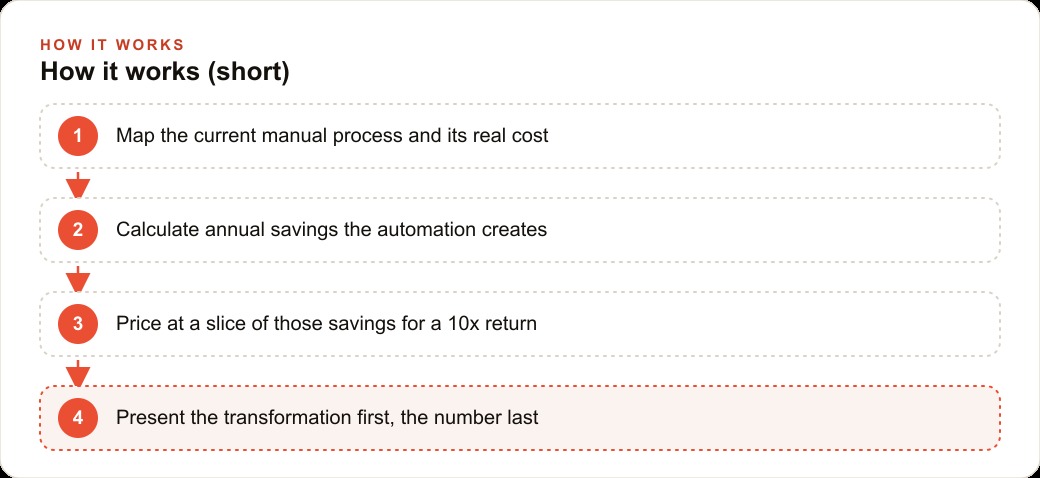
The math is not complicated. Start from discovery, because you cannot price honestly without understanding the current process end to end. Map how often the task happens, what triggers it, who handles it, how long it takes, and what that time costs in dollars based on salary and headcount. Then compare the manual version to the automated version, being realistic, and only count the part you actually automate. Say a support task takes one hour a day and that hour is worth fifty dollars. Over a year that is roughly twelve thousand dollars of time, and the workflow that removes it saves the business that twelve thousand. A good rule of thumb is that the client should see about a ten times return in the first year, so ten percent of the savings, around twelve hundred dollars, is a fair starting price. That is precisely the sentence you say when they ask how you reached the number, and it builds instant trust. The real impact is often larger, because freeing that hour also lets the employee do higher value work, so the return compounds.
Land the client on value, then keep them on retainer
The single build is where the relationship starts, not where it should end, and this is the second place beginners leave money on the table. Once you deliver a project or two and earn trust, you move into monthly retainers, and the math shifts because now you are pricing your time, your team, and ongoing support rather than a one time outcome. You protect your margin. Work out what it costs to service the client each month, then aim for at least fifty percent margin. If delivery costs five thousand a month, you might price the retainer at ten thousand. The client gets predictable cost and priority access, and you get stable income and a real relationship instead of forever chasing the next one off build.
This is where the contrarian point compounds. The hourly freelancer finishes a job and goes cold, hunting for the next client every month. The person who prices on value lands the account with a strong first result, then converts it into recurring revenue through maintenance, optimization, and version two expansions. The deeper you integrate into how the business runs, the harder you are to replace, and the more your income stabilizes. One sale becomes a partnership. That is not a pricing tactic, it is a different business model, and it is only available to people who stopped thinking in hours.
Running the numbers for one moving company
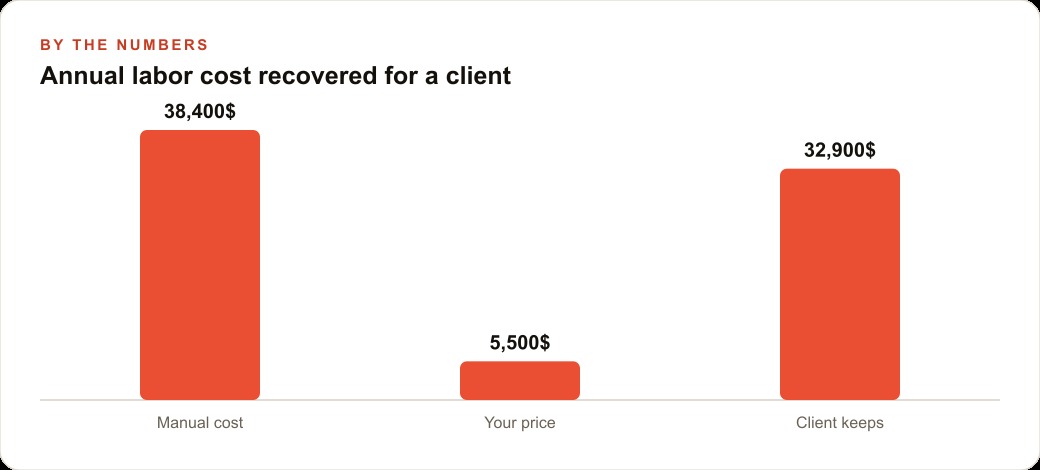
Let me make it concrete with an illustrative example. Picture a moving company that gets about twenty quote requests a week from its website form, and each one takes an office staffer roughly an hour to read, follow up, estimate, and book. That staffer's time is worth forty dollars an hour, so the process costs eight hundred dollars a week, about thirty two hundred a month, which annualizes to roughly thirty eight thousand dollars a year in labor. I would start in discovery, mapping exactly how leads arrive, who handles them, and where the bottlenecks are, which is how we land on that thirty eight thousand figure rather than guessing at it.
Then I would identify the return. An AI workflow that instantly responds to each request, gathers the move details, and books the estimate saves most of that labor. I would price the project at around fifteen percent of the annualized savings, roughly fifty five hundred dollars, and walk the owner through that math so it is obvious the system pays for itself several times over in the first year. Before naming the price, I would describe the after picture: instant replies, faster quotes, fewer leads going cold, because the transformation has to be sold before the number appears. After launch I would add a simple maintenance and optimization plan at about ten percent of the project fee per month and track speed to lead and leads per week so the growing impact stays visible and version two becomes an easy yes.
Notice how the automation touches the rest of the business. Those instant replies only matter if the leads are landing somewhere organized, which is why the workflow lives inside the CRM and website stack where follow up automation carries the next touches. If the company is buying quote requests through Facebook and Instagram ad campaigns or Google Ads, cutting the response time from an hour to seconds directly raises how many of those paid leads convert, which means the same ad budget produces more booked jobs. The pricing conversation is really a conversation about the whole revenue engine, and that is why it commands a real number.
Sell the transformation, and never lead with the number
There is one more place beginners sabotage themselves, and it happens in the room, not in the spreadsheet. They lead with the price. They have done the discovery, run the math, and built a defensible number, and then they open the conversation by saying it out loud before the client has any picture of what they are buying. A number with no context is just a cost, and a cost is something a client instinctively tries to shrink. The fix is to sell the transformation first. Paint the after picture in vivid, concrete terms, list exactly what is included, and only then, once the client can see the outcome clearly, do you name the number. By that point the price reads as the cost of the outcome they already want, not as an abstract fee to negotiate down.
This ordering is not a manipulation, it is honesty in the right sequence. The value genuinely is the transformation, so it makes sense to establish the transformation before the price. For the same reason, the same identical workflow can and should carry a different price for different clients, because the outcome is worth a different amount to each of them. A system that saves a small practice twelve thousand dollars a year and an established firm forty thousand a year is not the same product priced two ways, it is the same tool delivering two different amounts of value, and pricing to the value each receives is the truthful move. The person who charges one flat rate regardless of the client's situation is the one being arbitrary, not the one who prices to worth.
The final piece of the contrarian stance is knowing when to walk. When a client pushes back on price, the instinct is to discount, and discounting is almost always the wrong lever. Adjust the scope instead. Remove a piece of the deliverable so the smaller price matches a smaller outcome, which keeps your value ratio intact and teaches the client that the price tracks the result. And when someone simply refuses to see the work as anything but hours to be minimized, be willing to walk away entirely. A client who fights the value framing on day one will fight it on every invoice for the life of the relationship, and that relationship will cost you more in aggravation than the revenue is worth. Protecting your pricing model is protecting your business.
The framework that keeps it repeatable
To stop pricing from being guesswork, run it through a repeatable sequence. Prepare by grounding yourself in value and remembering you charge for outcomes, not hours. Research the manual process in full during discovery. Identify the return by turning that research into real numbers and applying the ten times rule. Communicate by painting the transformation, listing what is included, and explaining how testing and quality assurance work before you ever say the number. Expand after delivery with maintenance, optimization, and new workflows so one sale becomes a long term partnership. When a client pushes back, adjust the scope rather than the price, and be willing to walk away from anyone who undervalues the work, because a client who only respects hourly rates will fight you on every invoice forever.
The strongest argument for all of this is what it does to the quality of your work. When you are paid for outcomes, you are motivated to make the outcome great, not to stretch the hours. When you are paid by the hour, efficiency is a punishment. Price on value and your incentives finally point the same direction as your client's, which is the whole reason the model wins. You can absolutely price your own workflows this way once the framework is in your hands. If you would rather have the discovery, the return math, and the proposal built for you, you can hand it to an expert and present a number you can stand behind without flinching.
That is exactly what we do at AI DOERS. Book a private 30-minute call with Madhuranjan Kumar and we will map the fastest path to it for your specific business.
Book your call →
Madhuranjan Kumar
Madhuranjan Kumar brings 20 years of performance-marketing experience and has managed over $200 million in Facebook ad spend for brands across the United States and beyond. His expertise spans the full modern marketing stack: Meta, Google Ads, TikTok, email automation, CRM, and the websites that hold it together. At AI DOERS he turns that track record into lead-generation systems for businesses across every industry.