
How to Make Money With AI Workflows and Agents
Reusable workflows plus a single agent that knows how to use them turn one chat window into a real content and product engine. Here is how the pieces fit and how a business would put them to work.

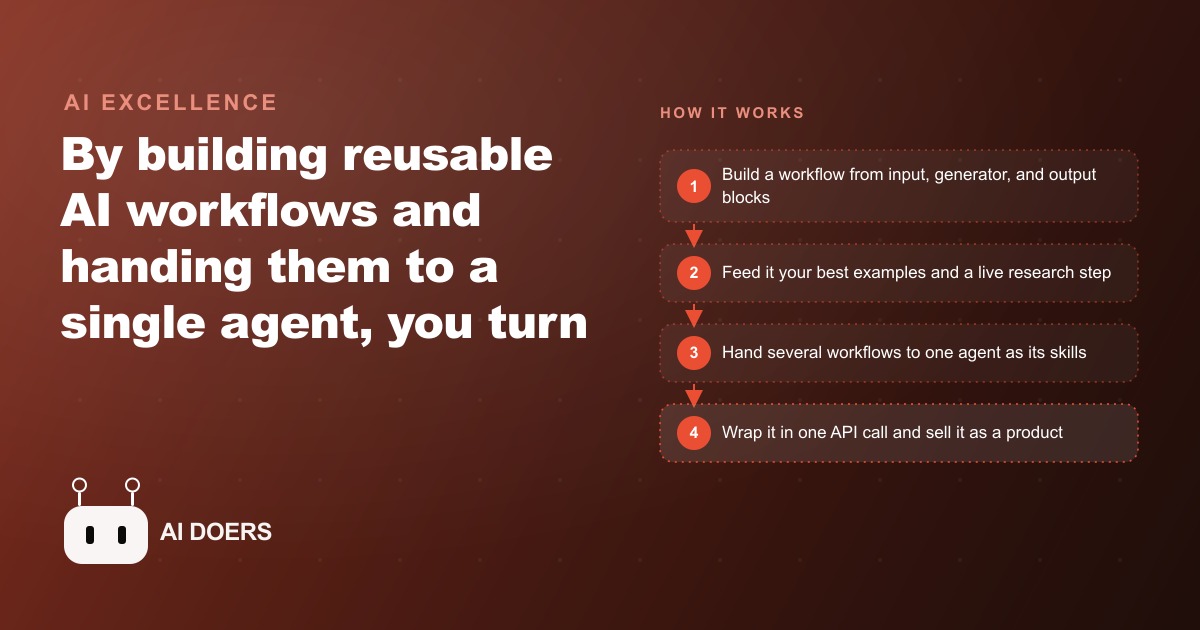
Most people trying to sell AI services are doing it backwards. They are selling the technology, not the outcome. They show a demo, explain the workflow, describe the tools, and then wonder why the prospect does not convert. The reason is that nobody pays for a workflow. They pay for a repeatable, sellable result that the workflow produces. Once you flip that frame, the business model becomes obvious, and the path from learning the tools to charging for them gets much shorter.
I am Madhuranjan Kumar, and my argument here is not that AI workflows are new or complicated. It is that the people making real money from them have figured out one thing most others have not: the technology is not the product. The repeatable output is.
The tech is not the product, the repeatable output is
A workflow is a sequence of AI steps that reliably produces a specific kind of output. An input block, several generator blocks, and an output. The mechanics are not interesting on their own. What is interesting is that once a workflow reliably produces something valuable, you have an asset. You can use it to produce at scale. You can license it. You can wrap it in a simple app and charge for the output.
The businesses that make money from this understand the distinction from the start. They do not build a workflow and then wonder who might want it. They identify a specific output that someone already pays for or would pay for, and then they build a workflow that produces it reliably. The tool follows the demand, not the other way around.
For any business that currently produces social posts, marketing images, scripts, or reports manually, a well-built workflow does not replace the output. It replaces the manual production time. The client still pays for the deliverable. The business keeps more of the margin because the time cost dropped.
One workflow built well beats a dozen half-working automations
The temptation when learning these tools is to build many workflows quickly to cover as many use cases as possible. The result is usually a collection of automations that each require hand-holding, produce inconsistent output, and need frequent maintenance. That is not a product. That is a collection of fragile experiments.
One workflow built to production quality, tuned until it produces reliable output every time, and packaged cleanly is worth more than twelve prototype automations. It is also what makes selling actually possible. You cannot sell something that fails twenty percent of the time. You can sell something that produces the agreed output reliably.
Building one workflow well means: choosing an input the user can fill in clearly, running the model to return structured JSON rather than a wall of text, placing each variable exactly where it belongs in the output, feeding it examples of the best past work rather than instructions, and adding a live research step for context that the model would otherwise miss. Each of those choices is a quality decision. The model learns the pattern from real examples far better than from a long prompt. The research step is what keeps the output current instead of generic.
Structured JSON output is what separates a prototype from a sellable tool
The technical detail that most separates a prototype from something you can reliably sell is how the output is structured. A workflow that returns a wall of unstructured text requires the user to parse it, extract the useful parts, and place them where they belong. A workflow that returns JSON splits the response into named variables that each go exactly where they are supposed to.
Title one through five, caption one through five, image prompt one through five: these are distinct pieces the workflow places automatically, not text the user manually reformats every time. That automation of the formatting is what makes the tool feel polished rather than like a raw model response the user still has to process.
Parallel steps compound this advantage. Steps that do not depend on each other can run at the same time rather than sequentially. Generating five caption options and five image variations in parallel produces a full set of choices in the time it would take to produce one sequentially. For a client whose previous process was a single option produced slowly and manually, that is a visible and immediate improvement.
For a business running Facebook and Instagram ads where creative variation is the single most important lever for improving performance, a workflow that produces five complete, on-brand creative variations in the time the old process produced one is a direct competitive advantage. More variations to test means more data on what works, which means the campaigns that run on Google Ads alongside social benefit from the same creative quality insights.
An agent that decides which workflow to run is worth ten separate tools
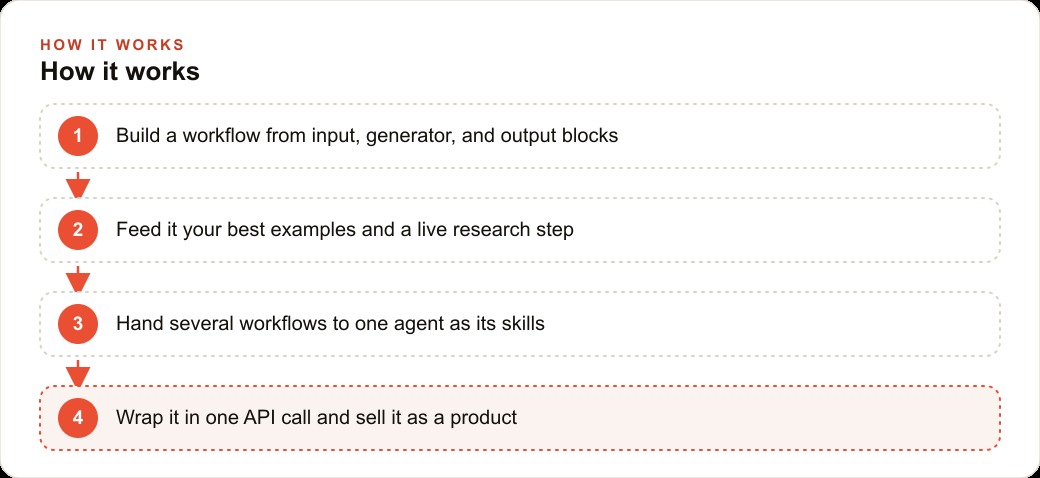
The upgrade from a workflow to a product happens when you hand several workflows to a single agent as its skills. Instead of the user opening a different workflow for every task, they give the agent one instruction and the agent decides which skill to invoke, runs it, and returns the result.
Ask the agent to research a topic and produce a short audio piece, and it chooses the research skill, passes the result to the audio skill, and delivers both. Ask it to make today's special post for the restaurant, and it selects the post-generation workflow, applies the research step for seasonal context, and returns the full set of captions and images. The user interacts with a single interface. The complexity of the tool selection and execution is invisible.
This is the agent design that makes a workflow into a usable product rather than a technical demonstration. A client does not want to manage which workflow to use. They want to say what they need and receive it. The agent layer provides that experience without requiring any change to the underlying workflows. The CRM and website stack that manages client relationships works on the same principle: the user interacts with one interface that routes their actions to the right underlying system. The agent layer is the same pattern applied to AI workflows.
The API wrapper is how a workflow becomes something you can charge for
The last step from workflow to product is exposing the whole backend as a single API call. When every step of a workflow, from the input through the generation and the formatting to the output, is wrapped behind one endpoint, the user never needs to know what runs inside. They send a request, they receive a result.
That single API call is what lets you drop the workflow backend into a simple app and sell access to the output. The user pays for what they receive, not for access to the underlying model or workflow mechanics. The SEO content that a well-built content workflow produces is the deliverable. The workflow is the production system that makes the deliverable reliable and fast. The client buys the content. The workflow is your competitive infrastructure.
The progression is straightforward: build one workflow that produces real output reliably, structure the output as JSON so every piece lands where it belongs, hand it to an agent so the user has one interface, wrap it behind an API call so it can be embedded in an app, and sell the output. None of those steps require a large team or a long timeline. The first workflow built well and sold honestly is the proof of concept for the whole model. Start there.
That is exactly what we do at AI DOERS. Book a private 30-minute call with Madhuranjan Kumar and we will map the fastest path to it for your specific business.
Book your call →
Madhuranjan Kumar
Madhuranjan Kumar brings 20 years of performance-marketing experience and has managed over $200 million in Facebook ad spend for brands across the United States and beyond. His expertise spans the full modern marketing stack: Meta, Google Ads, TikTok, email automation, CRM, and the websites that hold it together. At AI DOERS he turns that track record into lead-generation systems for businesses across every industry.