
How to Grow an Audience When You Have Zero Followers
The path from nobody to a real audience is not a growth hack. It is daily posting, honest improvement, and a story worth following, and it applies just as much to a business as to a creator.

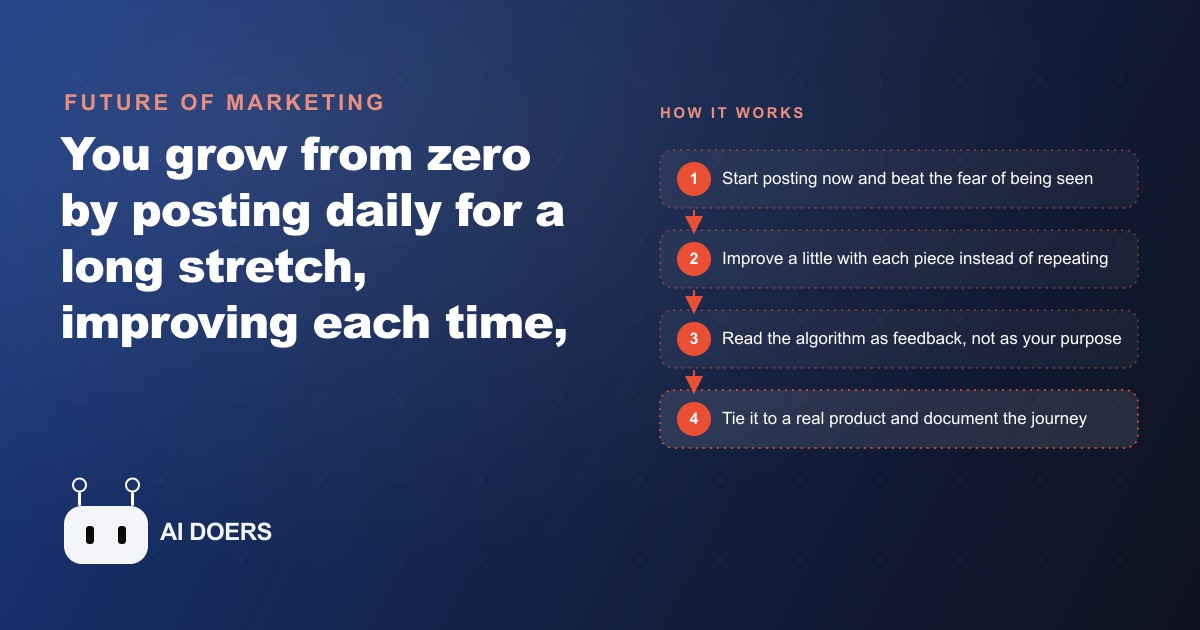
One founder posted daily for a year, most of it rough phone video with no edits, before a single product launch turned that quiet audience into an explosion. The audience was the asset that made the launch work, and the audience came from showing up over and over when almost nobody was watching. That is the uncomfortable shape of growing from zero, and it is worth spelling out plainly because most advice about it is either a magic trick or a lie. I, Madhuranjan Kumar, have watched enough of these climbs to distill the honest version into eight rules that actually hold, for a solo creator and for a business alike.
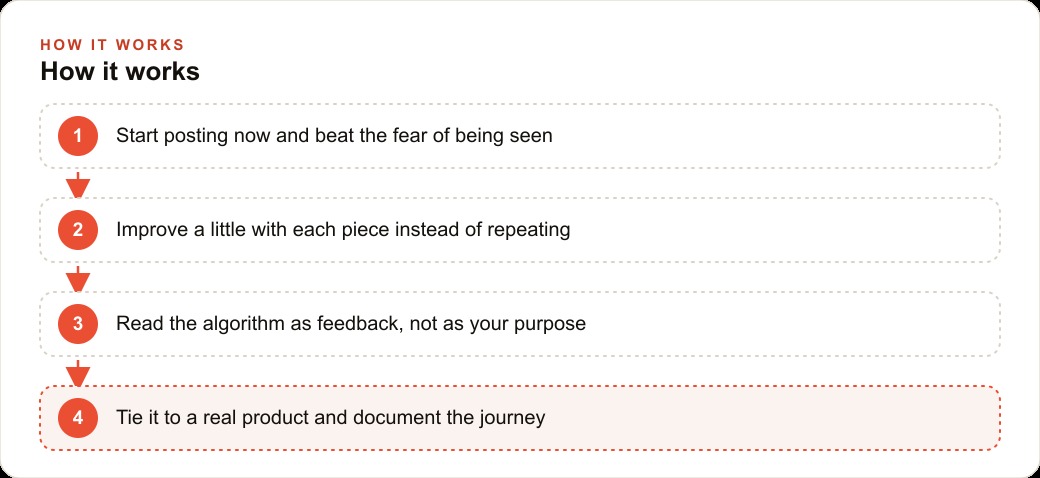
1. Start before you feel ready
The first obstacle is not strategy, it is fear. Pointing a camera at yourself and hitting publish is genuinely uncomfortable, and that discomfort stops more people than any algorithm ever will. The fix is blunt: start anyway, even if your first pieces are rough and a little embarrassing. The act of shipping is what teaches you, and no amount of planning substitutes for it. A business version of this fear shows up as "our content is not polished enough yet." It never will be. Ship the rough version and let reality sharpen it.
2. Assume it takes a hundred posts
Set your expectations at the right altitude. Early on you might pull a hundred or two hundred views for your first ten, fifty, even a hundred posts, and that is completely normal, not a sign you are failing. The people who quit almost always quit inside that flat stretch, right before the curve would have started to bend. Budget for a long run-up. If you decide in advance that the first hundred pieces are tuition rather than a referendum on your worth, the flat stretch stops feeling like rejection and starts feeling like practice.
3. Improve, do not just repeat
Here is the rule that separates the people who break through from the people who grind forever: you do not get rewarded for showing up, you get rewarded for showing up and getting better. Posting the same video a hundred times and hoping is not consistency, it is stubbornness. Every piece should try to be a little better than the last one. Change the hook, tighten the first three seconds, try a different format, pick a sharper topic. Consistency plus iteration is the engine. Consistency alone just spins.
4. Read the algorithm as feedback, not as your boss
The algorithm will never explain its rules, but it is constantly telling you what works through how each piece performs. Treat those numbers as a coach giving you signal, not as the reason you create. This distinction matters more than it sounds. If the numbers become your whole purpose, you drift toward whatever the crowd rewards this week, the work goes hollow, and you stop making things you actually believe in. Use the feedback to get better at saying your thing. Do not let it quietly replace your thing.
5. Plant a flag on real value
Commit to content rooted in what you genuinely believe, the kind of thing that would be useful if you just said it out loud to someone on the street. This is a strategic choice, not a moral one. Low-quality growth hacks are easy to copy, which is exactly why they are easy to forget. Value built on your real convictions is hard to copy and hard to forget, because it carries your fingerprints. Pick the hill you will not abandon when a shinier trick shows up next month, and let it anchor everything.
6. Build a personal brand, because it compounds
When a single venture fails, you usually start from zero again. When you have built a brand rooted in who you are and what you stand for, that identity carries forward into every future project. It compounds while individual campaigns reset. This is why treating content as a long-term bet on yourself, rather than a series of disposable promotions, is the higher-leverage move. The audience that trusts the person or the brand will follow them into the next product, the next idea, the next pivot. A one-off campaign cannot do that.
7. Turn the product into the content
The strongest audiences form around the story of building something real. Document the work as you go: the material you sourced, the sample that arrived wrong, the packaging you redesigned, the first big order that made your hands shake. That is content people actually follow, because it is a human just ahead of them figuring it out in real time, not a faceless catalog with prices on it. Pairing a real product with the honest story of making it is what makes you hard to ignore. The build is not separate from the marketing. The build is the marketing.
8. Tell your real, unscripted story
People crave two things: relatability and someone just slightly ahead of them on the path they want to walk. An honest, unpolished account of your actual day beats a rehearsed pitch every time, because the pitch triggers people's defenses and the story lowers them. Say what actually happened, including the parts that did not work. The audience that grows around honesty is more loyal and more likely to buy, because they feel they know you rather than feeling sold to.
What this looks like for a real business
Let me ground all eight rules in one worked example: a small e-commerce store selling a tight line of home goods, starting from zero followers. The owner does not have a big ad budget, which is exactly the situation these rules were built for, because the mechanics of audience-building do not change between a solo creator and a company.
The owner commits to one rough post a day and plants a flag on a simple value: honesty about how good home goods are actually made. Instead of discount posts, the content documents the journey. Why a candle is poured at a specific temperature. A supplier order that came in the wrong color and what it cost to fix. The redesign of a box so it survives shipping. Each piece tries to be a little sharper than the last, and the owner reads the numbers as feedback, doubling down on whichever format the algorithm keeps rewarding.
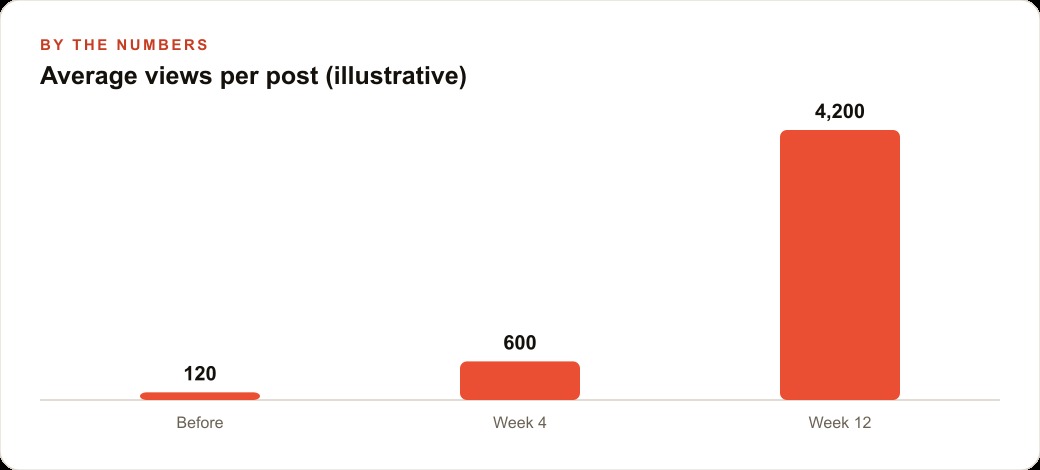
Put some illustrative numbers on the climb. The first month averages around 120 views a post, and it feels like shouting into an empty room. By week four, after roughly thirty pieces and steady iteration on hooks, that average has climbed toward 600. By week twelve, with one format clearly working and a genuine story people have started following, posts are averaging in the low thousands, call it 4,200. Nothing here is a viral fluke. It is the flat stretch, then the bend, exactly as rule two predicted.
One high-leverage move accelerates it: a post that invites people to comment a specific word to get a link, which lifts reach and quietly builds a contact list at the same time. Those contacts flow into the CRM and website stack where a simple follow-up sequence nurtures them toward a first purchase, so the audience is not just watching, it is convertible. And because the owner resisted turning every clip into a hard sell, the audience that trusts the story buys without being pushed. The organic content also does double duty: the same behind-the-scenes material feeds SEO and organic search with real, specific pages that rank, and it becomes the raw creative that makes any later spend on Facebook and Instagram ad campaigns far cheaper, because authentic footage outperforms polished stock almost every time.
The store grows as a natural side effect of a brand people genuinely want to follow. That is the whole trick, and it is not really a trick at all. It is eight unglamorous rules applied for longer than most people are willing to apply them.
The comparison trap that kills most people at post ten
There is a specific way this fails, and it has a name worth remembering: comparing your chapter one to someone else's chapter fifty. At post ten, averaging a hundred views, you open your feed and see a creator in your niche pulling tens of thousands, and the natural conclusion is that you are simply not cut out for this. That conclusion is almost always wrong. Madhuranjan Kumar you are envying posted their own flat, ignored first hundred pieces two years ago, in private, before you ever found them. You are watching their highlight reel and comparing it to your rough draft.
The defense is to compete only with your last piece. Was this hook sharper than the one before? Did this open land faster? Did you try something you were scared to try? Those are the only comparisons that produce improvement. Comparison against a stranger's peak produces nothing but the urge to quit, right in the stretch where quitting guarantees you never find out what would have happened at post one hundred and fifty.
The contact-list move that turns views into a business
The eight rules build an audience, but for a business the audience only matters if it converts, so it is worth going deeper on the one mechanic that bridges the two. The move is a post that asks people to comment a specific word to receive a link or a resource. It does two things at once. First, comments are a strong engagement signal, so the post gets pushed to more people, which grows reach. Second, and more importantly, everyone who comments can be sent a direct message with the link, and that message opens a private channel you own rather than one the platform controls.
For the home-goods store, that word-comment post might offer a short guide on choosing candles that actually last, or a discount on a first order. The people who comment are self-selecting as interested, which is exactly who you want. Those contacts then flow into the store's list, where a simple welcome sequence introduces the brand story, shares the behind-the-scenes journey they have not seen yet, and makes a soft first offer. Illustratively, if a post reaches ten thousand people at week twelve and two percent comment the word, that is two hundred warm contacts from a single piece of content, a list that costs nothing and compounds every time you run the play. The audience stops being a vanity number and becomes a pipeline.
Patience is the actual skill
Strip away the tactics and the real lesson is about time horizon. The founder who posted daily for a year before a launch was not more talented than the people who quit at post thirty. They simply decided in advance that the flat stretch was the price of admission, not a verdict. That single decision, treating the first hundred pieces as tuition, is what separates the people who eventually break through from the ones who tried hard for three weeks and gave up. Momentum in this game is not a switch you flip. It is a curve that stays flat far longer than feels fair and then bends fast, and the only people present when it bends are the ones who refused to leave.
Why this works the same for a company as for a person
It is worth stating plainly that none of these rules are creator-specific, because that is where most businesses talk themselves out of the whole approach. The mechanics of attention do not change when the account belongs to a company instead of a person. A brand still has to start before it feels ready, still has to survive a flat first hundred pieces, still gets rewarded for improving rather than repeating, and still grows fastest when it plants a flag on a real belief and documents a real journey. The only difference is that a business usually has more excuses to hide behind, more committees to slow the first post, and more temptation to make every piece a sales pitch.
The businesses that win at this are the ones that let a real human carry the brand, because relatability does not come from a logo. When the owner or a genuine team member shows up honestly, shares the actual behind-the-scenes work, and treats the audience as people slightly behind them on the same path, the content compounds exactly the way it does for a solo creator. A brand rooted in who the company actually is carries forward into every product launch and every pivot, while a disconnected ad campaign resets to zero the day the budget stops. That durability is the entire reason a business should treat audience-building as a long-term asset rather than a marketing line item.
The hard part was never the camera. It is the patience to sit through the flat stretch and the willingness to improve in public where everyone can see the rough versions. A focused owner can start this week and have real momentum within a few months. You can run this playbook yourself using the eight rules above, or bring in someone who has watched these climbs before to set the strategy and shorten the slow part, so more of your effort lands during the stretch where it compounds.
That is exactly what we do at AI DOERS. Book a private 30-minute call with Madhuranjan Kumar and we will map the fastest path to it for your specific business.
Book your call →
Madhuranjan Kumar
Madhuranjan Kumar brings 20 years of performance-marketing experience and has managed over $200 million in Facebook ad spend for brands across the United States and beyond. His expertise spans the full modern marketing stack: Meta, Google Ads, TikTok, email automation, CRM, and the websites that hold it together. At AI DOERS he turns that track record into lead-generation systems for businesses across every industry.