
How to Actually Deliver AI Projects: Hosting, Security, and Handover
Building an AI workflow is the easy part. Delivering it well means deciding who hosts it, securing the data, sorting out API keys, testing like an engineer, and handing it over with documentation that protects everyone.

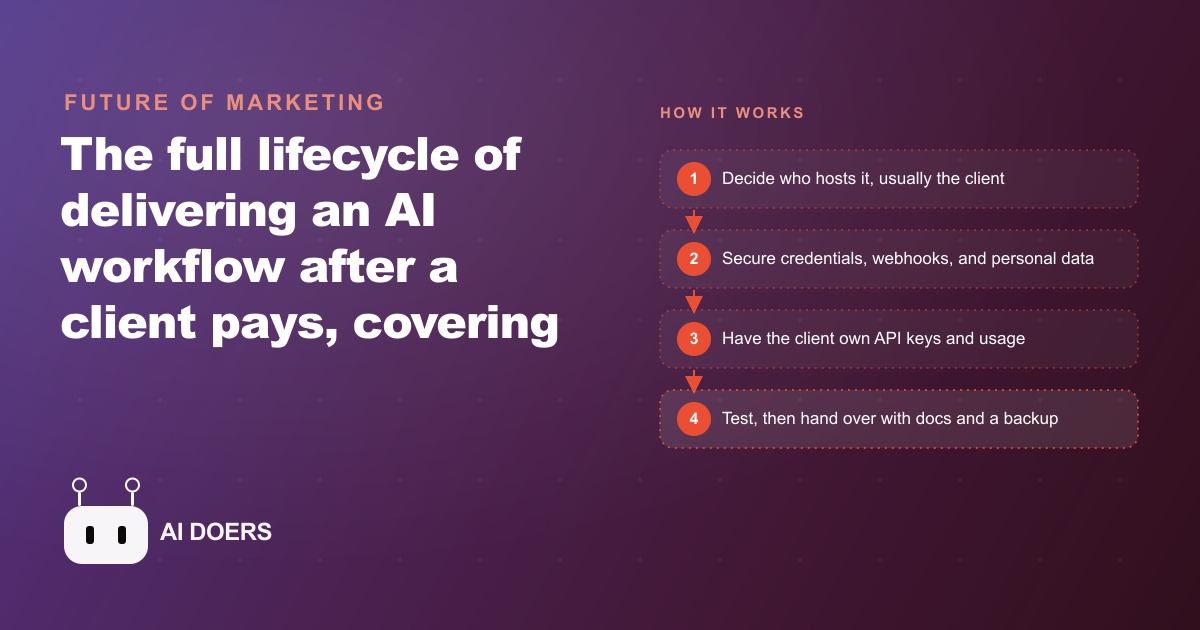
The build is the easy part. Anyone can wire up an AI workflow that works on their own screen. What separates a one off gig from a client who hires you again is everything that happens after they pay: where the workflow lives, how the data stays safe, who owns the API keys, whether it survives real world input, and how cleanly you hand it over. That delivery layer is where most people are weakest, so let me take it apart properly.
I am Madhuranjan Kumar, and people constantly ask me the same three questions: how do you host these workflows, what does a handover actually look like, and how do you deal with security. The answer is a lifecycle with five distinct facets, and each one has a right default that keeps both you and the client protected.
Facet one: hosting is a licensing decision before it is a technical one
Where the workflow runs is not really a hosting question, it is a licensing question, and getting the order wrong can put you on the wrong side of your platform's terms. The rule with most automation platforms is that you can sell services around the tool, but you cannot turn it into your own product without a commercial license. That single line determines your options.
There are three, and they are not equal. Option one, which I recommend almost every time, is that the client hosts their own instance and you build inside it. You can help them set it up, but they own it and they pay for it, which keeps you cleanly compliant and removes you as a single point of failure. Option two is hosting it yourself only for your own agency's internal automations, where the client never logs in at all. Option three is hosting it as a product for others, which crosses the line into a software as a service offering and requires a proper paid commercial or enterprise license. Most people who get into trouble do so by drifting into option three without realizing it, hosting one client, then another, until they have quietly built an unlicensed product. Decide the facet consciously and default to the client owning it.
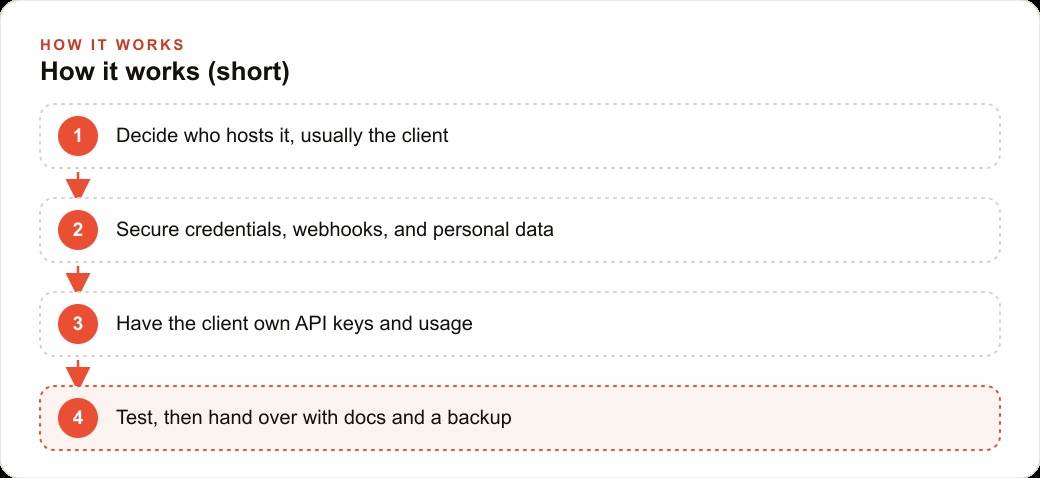
Facet two: security is credentials, webhooks, and personal data
Security in these builds breaks down into three concrete areas, and vague good intentions do not cover any of them. The first is credentials. Good platforms encrypt credentials at rest and reference them by name, so a correct handoff never exposes raw keys. The mistake to never make is storing a secret in plain text inside a node where anyone with access to the workflow can read it. Reference credentials properly and a handover cannot leak them.
The second area is webhooks, and this is the one people underestimate. A webhook is a public door into your workflow, an address anyone on the internet can send a request to. Harden every one of them. Use HTTPS so the traffic is encrypted, verify the signing secrets that providers give you so you know a request genuinely came from them, and never put sensitive data in the URL itself. Skip these and you have left a door open for random requests to hit your client's systems.
The third area is personal data. For anything touching a CRM, payments, or customer information, follow basic privacy practices: minimize the data you store, limit who can see the run logs, and know exactly where data flows so it can be deleted or corrected on request. Being self hostable is genuinely a selling point for privacy sensitive clients, because they can keep everything inside their own environment, and you can offer that as a real advantage.
Facet three: API keys belong to the client, always
This facet is short but it saves more headaches than any other. The client should own their API keys and pay for their own usage, full stop. The ideal flow is that they sign up for the AI or third party service, enter their own billing, generate the key, and paste it into the workflow themselves. The key never travels to you, costs stay transparent and predictable, and you never become the person who gets blamed when usage spikes and a bill jumps.
If a client genuinely insists that you handle the key for them, do it safely, never over plain text. Transfer it through a secure vault with a one time expiring link so the secret is not sitting in an email or a chat log forever. But the strong default is that they own it. Keeping yourself out of the billing babysitter role is not laziness, it is professionalism, because it aligns the cost of usage with the person actually generating that usage.
Facet four: test like an engineer who expects things to break
Testing is where the difference between a hobbyist and a professional shows most clearly. Plan the test data with the client early, ideally before the contract is even signed, using real sample inputs they can anonymize. Agree up front on two things: what good output looks like, and what must never happen. Those definitions are your target and your guardrail.
Then test like an engineer planning for failure, not like someone hoping it works. Feed in dozens of real style examples, log every input, every middle step, and every output, and go hunting for trouble on purpose: bad data, no data, duplicates, malformed entries. Build guardrails so that when something fails, it fails safely and quietly, with timeouts and error alerts rather than silent dropped jobs. With AI nodes specifically, you also have to check the softer qualities, relevance, tone, safety, and consistency, because a workflow can run without errors and still produce output that embarrasses the client. Run internal QA for several days before the client ever touches it. The goal is not to prove it works. The goal is to find where it breaks while it is still your problem and not theirs.
Facet five: handover is a clean copy plus a paper trail
The final facet is the one that protects the relationship long after the build. Duplicate the workflow so you keep a test backup and push a clean copy to production, exactly the way real software teams separate their test and production environments. Make future changes on the test version first, confirm they work, then promote them. Back up the exported workflow file somewhere safe so a single accident cannot erase months of work.
Keep the production workflow tidy, with clear names and sticky notes so the client's own staff can follow what each step does. Double check that no secret keys are left sitting in any node. Record a short walkthrough video so there is a human explanation to go with the build. Then close the legal and financial side properly: a written scope, a clear definition of done, agreed payment terms, a statement of who owns what, exit terms, and a decision on whether an ongoing maintenance retainer makes sense. Documentation and that walkthrough protect both sides, because they turn fuzzy expectations into a record everyone agreed to.
The maintenance conversation belongs at the start, not the end
One facet quietly determines whether a delivered project becomes an ongoing relationship or a slow source of resentment, and it is the maintenance question. Most people leave it for the end, mention a retainer awkwardly at handover, and either get a no or get roped into unpaid support because nothing was agreed. The fix is to raise it at the start, as part of scoping, so both sides know from day one what happens after go live.
The reason this matters is that AI workflows are not static. The tools they depend on release updates, APIs change, a provider tweaks a response format, and a workflow that ran perfectly in spring can quietly break in autumn. Someone has to watch for that, and the client needs to decide up front whether that someone is you on a retainer or their own staff on their own time. Neither answer is wrong, but leaving it undecided is. An unspoken expectation that you will fix things forever for free is the fastest way to turn a profitable project into a resentful one.
Framed early, the retainer becomes a clear, optional service rather than an awkward ask. You explain that tools drift, that ongoing reliability has a cost, and that a small monthly arrangement keeps the system healthy. The client chooses knowingly, and either way the boundary is clean.
An HVAC company, worked through all five facets
Let me ground the whole lifecycle in one example with illustrative numbers. Imagine you have built a workflow for an HVAC company that takes service requests, qualifies them, and books appointments on the calendar. Here is how I would deliver it across the five facets.
Hosting first: I would have the company own their own automation instance and invite me in as a builder, so the system runs on their account and they pay the roughly modest monthly hosting themselves. Security second: the workflow handles customer names, addresses, and phone numbers, so I would harden the intake webhook with HTTPS and a verification token, store only the data the booking actually needs, and limit who can see the run logs. API keys third: I would walk the owner through signing up for the AI and calendar tools, entering their own billing, and pasting the keys in themselves, with a short walkthrough showing exactly where to click, so a summer usage spike lands on their card and their expectations, not mine.
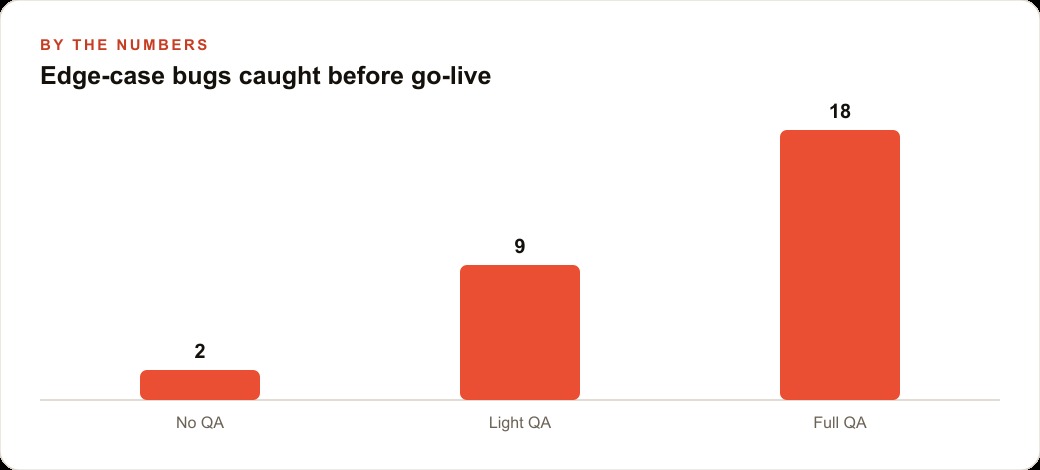
Testing fourth: before go live I would push dozens of real style requests through it, including bad phone numbers, duplicate bookings, and after hours emergencies, logging every result and adding guardrails so a failure alerts the office instead of silently dropping a job. Picture the payoff in rough terms: light testing might catch a handful of edge cases, but thorough testing across dozens of scenarios can surface many times more before a single real customer is affected, which is the difference between a smooth launch and a summer of angry calls. Handover fifth: I would duplicate the flow into a clean production version, label every step with sticky notes so their office manager can follow it, back up the file, and record a walkthrough. Then we close with a written definition of done and decide whether a monthly maintenance retainer makes sense for updates during peak season. The company ends up with a system they own, understand, and trust, and I stay out of the billing babysitter role when usage spikes in July.
This delivery discipline is what turns a one time build into a durable relationship, and it connects naturally to the rest of a business. A booking workflow like this feeds directly into the client's CRM and website stack, where the qualified appointments live and follow up happens. The same clean lead capture makes the money spent on Google Ads and on Facebook and Instagram ad campaigns actually traceable, because every enquiry lands in one place instead of scattering across inboxes. Delivery is not the boring part of the job. It is the part that makes everything upstream worth paying for.
You set it up by treating delivery as its own discipline, not an afterthought. Decide hosting first and default to the client owning it. Lock down credentials and webhooks, and respect privacy for any personal data. Make the client own their API keys and usage so costs stay predictable. Test with real data, log everything, and build guardrails so failures are safe and quiet. Then hand over with a clean production version, backups, tidy documentation, and a walkthrough, and put scope, definition of done, payment, ownership, and exit terms in a written agreement.
You can absolutely learn to deliver AI projects this professionally yourself, and doing so is what will earn you repeat clients instead of one off gigs. If you would rather have an expert host, secure, test, and hand over the whole system the right way, that is the kind of work I do for clients, and you can bring me in to protect both your time and your reputation.
That is exactly what we do at AI DOERS. Book a private 30-minute call with Madhuranjan Kumar and we will map the fastest path to it for your specific business.
Book your call →
Madhuranjan Kumar
Madhuranjan Kumar brings 20 years of performance-marketing experience and has managed over $200 million in Facebook ad spend for brands across the United States and beyond. His expertise spans the full modern marketing stack: Meta, Google Ads, TikTok, email automation, CRM, and the websites that hold it together. At AI DOERS he turns that track record into lead-generation systems for businesses across every industry.