
How to Build and Sell an AI Support Agent in About 12 Minutes With No Code
A no-code platform crawls a business website, loads its knowledge base, brands the chat widget, and runs on the AI model you pick, which means you can demo a working agent on a mock site and charge setup plus a monthly fee.

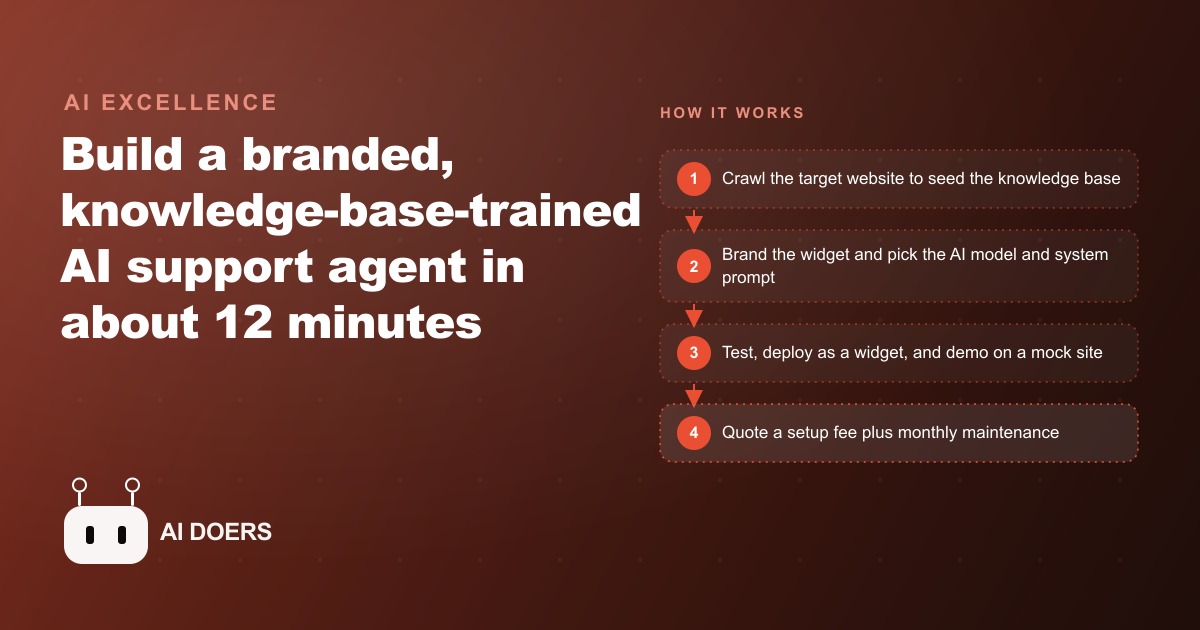
The sale happens the moment the owner types their own question and the agent answers it correctly
I am Madhuranjan Kumar, and I want to reframe how you think about closing a client for an AI support agent service. Most people in this space approach it as a sales conversation followed by a technical delivery. The conversation happens first, the proposal goes out, the client considers it, sometimes decides not to proceed, and then the build happens if they do. This sequence produces a particular close rate that most consultants accept as normal.
The close rate when you invert the sequence is different. Build the agent first. Demo it on a mock version of the client's actual website with their actual content. Send the live link before you mention price. The owner types their own question about their own service and gets a correct, helpful answer. That moment is not a convincing argument. It is direct experience. Direct experience closes sales that persuasive arguments do not.
This is the contrarian claim: the demo IS the product. Not a step before the product. Not a preview of the product. The experience of interacting with a working, branded agent trained on the business's own content is the thing you are selling, and it is the thing that needs to happen before the conversation about price begins.
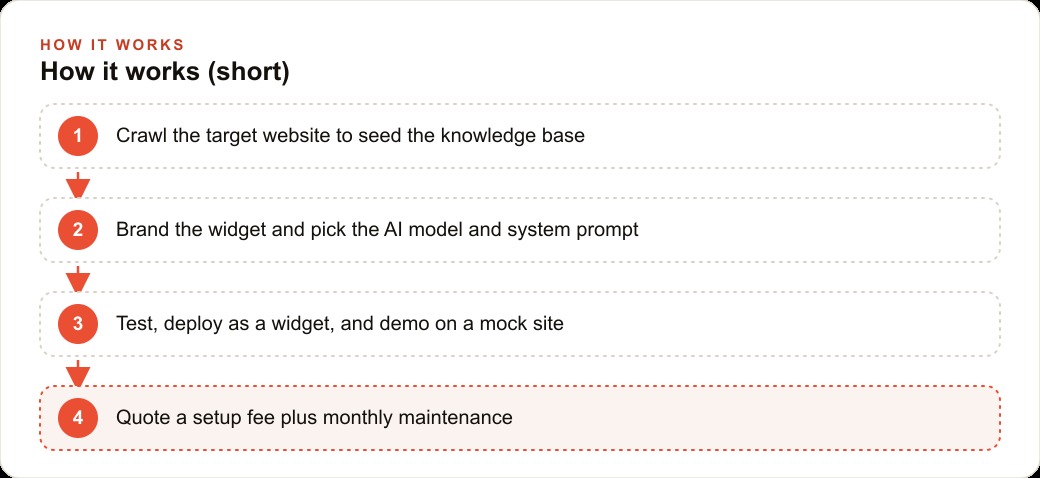
Why describing an AI agent to a local business owner rarely lands
The description of an AI agent's capability is abstract in a way that does not connect to a business owner's daily experience. Tell a restaurant owner that an AI agent can answer questions about your menu and hours around the clock, and they understand the words but cannot feel the value. They are already skeptical about AI because they have heard pitches that overpromised and underdelivered. They have a website that kind of works. They have Google Maps that shows their hours. They are not immediately aware of how many customers leave their site without getting the answer they needed.
Abstract capability claims require the listener to do the cognitive work of translating the claim into their own context. Most business owners are not going to do that work in a cold sales conversation. They will nod, say it sounds interesting, and go back to running their business.
When the owner types their own question and the agent answers it, the translation work is done. The value is immediate and specific. They asked when we are open on Sundays and the agent said Sunday hours are 11 am to 6 pm, and then offered to help with anything else. That is not a capability claim. That is a demonstration that this tool, right now, serves a real customer query about this specific business. The gap between abstract claim and concrete experience is where most AI service pitches fail.
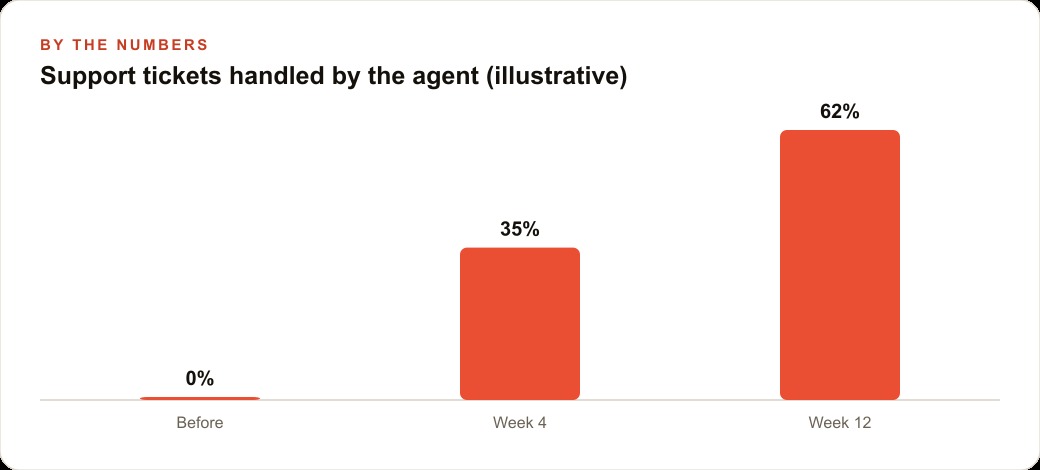
What changes when the owner tests it on their own website content first
The standard approach to demoing an AI chatbot is to show the prospect a generic demo on a generic website, usually one of the tool provider's showcase examples, and then explain how it would work for their business if they signed up. The mental leap from the generic demo to their specific business is significant, and not all prospects make it successfully.
Building the demo on a mock version of their actual site, using content crawled from their real website, eliminates the mental leap entirely. The owner is not being asked to imagine how it would work. They are experiencing how it already does work, for their business, with their content, with their branding on the widget. The knowledge base reflects their actual services and policies because the crawler built it from their real pages.
The specific effect this has on the conversation that follows the demo is measurable. Objections shift from I am not sure if this would work for my business, which is a skepticism about fit, to the widget color does not quite match our brand, and how often can we update the content, which are implementation questions. Implementation questions mean the prospect has already mentally moved past whether to proceed and is thinking about how. That mental shift is the work the demo does that no sales conversation can replicate.
The build that takes 12 minutes and the demo experience that takes three seconds
The 12-minute build is not the point of pride. Any competent practitioner can build a functional no-code agent in 12 minutes with the right platform. What differentiates the consultants who close consistently from the ones who struggle is the quality of the demo delivery, not the speed of the build.
The demo quality is determined by three things: the crawl coverage, the system prompt quality, and the brand match. Crawl coverage means the knowledge base includes all the pages and documents a real customer would need answers from, not just the homepage. System prompt quality means the agent behaves within appropriate scope, handles off-topic questions gracefully, and speaks in a voice that matches the business. Brand match means the widget color, the agent name, and the personality match the business's existing brand rather than the platform's defaults.
These three elements take 20 to 30 minutes of work beyond the core crawl and build. The work is not technically difficult. It is attentive work: reading the business's website carefully enough to understand the tone, testing the agent against the questions a real customer would ask, and adjusting the system prompt based on what breaks. The extra time produces a demo that the owner experiences as their own rather than as a template with their logo on it.
The three seconds that matter most are the first time the owner types their question and reads the response. Before those three seconds, you are a service provider with a pitch. After those three seconds, you are someone who built something for their business before asking for anything in return. That repositioning is worth far more than the $200 to $500 setup fee you will charge.
Building the right system prompt is the work most people skip
The system prompt is the configuration that determines whether the agent stays on topic, handles sensitive questions appropriately, and declines gracefully when asked things it should not answer. It is also the most frequently skipped step in builds that prioritize speed over quality.
An agent without a well-written system prompt will answer questions it should not answer, claim knowledge it does not have, and behave inconsistently when a caller pushes back. For a business with any kind of trust requirement, whether a medical office, a legal practice, or a financial service, an agent that makes authoritative claims outside its scope is not just unhelpful. It is a liability.
The system prompt needs to establish the agent's role, define what it can and cannot discuss, specify how it should handle questions that require professional judgment, and instruct it on what to do when a question falls outside its knowledge base. The instruction about out-of-scope questions is especially important: an agent told to say I do not have that information available, but I would be glad to connect you with someone who can help will handle ambiguous situations correctly. An agent with no instruction on this point will generate a confident answer using general knowledge, which may be wrong in ways specific to this business.
A recurring retainer that the knowledge-base refresh makes obvious
The knowledge base that makes the agent valuable today becomes a liability if it is not maintained. A business that updates its pricing, changes its services, adds a new location, or revises its policies does not automatically update the agent's knowledge. An agent trained on a website from six months ago will give callers wrong information about current hours, current pricing, or services that no longer exist.
The knowledge-base refresh is the mechanism that makes a monthly maintenance retainer obvious rather than awkward to propose. You are not selling ongoing access to your expertise. You are selling the continued accuracy of a tool the business is already using and already values. When a client asks why they need a monthly retainer after the initial build, the answer is concrete: your agent currently knows what your website said when we built it. When your prices change, when you add a service, when you update your policies, someone needs to update the agent or it will keep answering with the old information. That someone is me, and that is what the retainer covers.
A business that experiences this firsthand, when they update their hours and then call the agent to test it and get the old hours, understands the value of the maintenance retainer immediately. This is a common enough situation that proactively scheduling a first check-in at 30 days after launch, specifically to verify that the agent's content is still accurate, is a good practice for establishing the expectation of ongoing maintenance before it becomes a problem.
The full arc from build to retainer is: build in 12 minutes, deliver on a live mock site, close before the price conversation, configure the system prompt carefully, and schedule the 30-day content check. Each step exists because of the logic of the previous one. The demo that closes is only impressive because the content crawl was thorough and the system prompt was careful. The retainer that renews is only obvious because the 30-day check surfaced the first content drift. The 12-minute build is the starting point, not the accomplishment.
The referral architecture that the demo-first approach enables
The standard referral request, do you know anyone else who might be interested, produces low-quality referrals because it asks the client to guess which of their contacts shares the same unmet need that the client had. Most people are not good at this guess because the need was not obvious to them before they experienced the solution either.
The demo-first approach creates a specific referral mechanism that bypasses the guessing problem. A client who has had the experience of typing their own question and seeing a correct answer from a branded agent has a concrete, demonstrable thing to share with their contacts. They are not sharing a recommendation to use an AI consulting service. They are sharing a working demo: click this link, type your question about your business, see what happens.
This is the referral mechanism that performs best for AI service sales: not a testimonial or a recommendation but an invitation to experience what the client experienced. The prospect who follows the referral link and types their own question about their own business is receiving the same demo that closed the referring client. The close rate on this type of referral significantly exceeds the close rate on a traditional word-of-mouth referral because the referral itself is the demonstration.
Building the referral mechanism means maintaining the demo infrastructure: the ability to spin up a branded, content-loaded agent for a new prospect in the time between a referral occurring and the prospect following up. With the build time at 12 to 20 minutes for a well-practiced deployment, the infrastructure requirement is minimal. The investment in building the process pays off in every referral conversion that the traditional recommendation-only approach would have left at a lower close rate.
The price conversation that happens after the demo instead of before it
The sequence of price-before-demo produces a different negotiation than demo-before-price. In the price-before-demo sequence, the prospect evaluates the price against a general sense of what AI services cost, negotiates from a position of skepticism, and agrees to a price that reflects their uncertainty about the value.
In the demo-before-price sequence, the prospect evaluates the price against the specific experience they just had: they typed their question, they got a correct answer, they saw the tool working for their business. The price now gets evaluated against that experience, not against a general sense of market rates. A prospect who has just experienced the tool answering their question correctly is evaluating the price against the value of that experience, not against the cost of alternative options they have not seen demonstrated.
This is the mechanism that makes the demo-first sequence produce higher close rates at higher price points. The anchor for the price negotiation is the demonstrated value, not the stated rate. Demonstrated value anchors are more favorable than market-rate anchors for any service that can demonstrate its output clearly before the buyer commits.
That is exactly what we do at AI DOERS. Book a private 30-minute call with Madhuranjan Kumar and we will map the fastest path to it for your specific business.
Book your call →
Madhuranjan Kumar
Madhuranjan Kumar brings 20 years of performance-marketing experience and has managed over $200 million in Facebook ad spend for brands across the United States and beyond. His expertise spans the full modern marketing stack: Meta, Google Ads, TikTok, email automation, CRM, and the websites that hold it together. At AI DOERS he turns that track record into lead-generation systems for businesses across every industry.