
How To Build An AI Second Brain You Can Actually Chat With
Build a knowledge base in a free Obsidian vault, capture articles and video transcripts with the web clipper, and let a coding agent scaffold a wiki, then add a grounded journal, a CRM, and an hourly automation so the system ingests and backs itself up on autopilot.

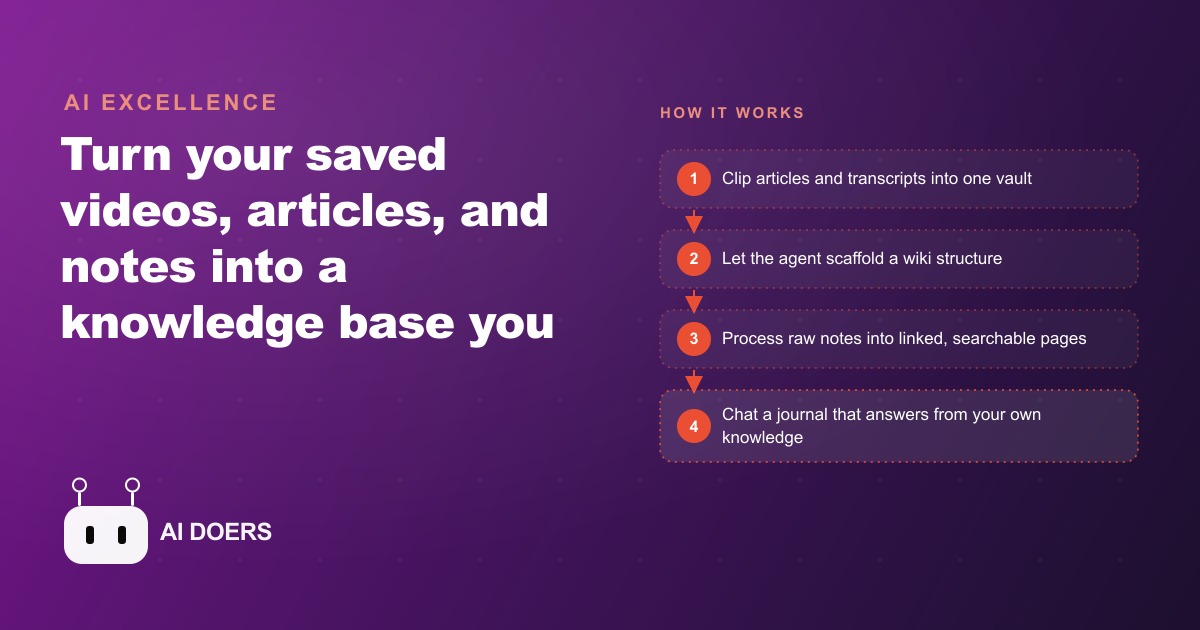
The note taking graveyard just got a way out
Almost every second brain ever built is a graveyard. You save this breakdown, clip the article, bookmark the podcast, and the information settles into a folder where it quietly dies, because nobody reviews a dumping ground by hand. That has been the unavoidable flaw in personal knowledge systems for years. What changed recently is that a coding agent pointed at a plain folder of notes can now scaffold a real, connected knowledge base and answer from it in your own voice, which turns passive storage into an assistant you actually talk to. I am Madhuranjan Kumar, and this shift from a dead archive to a living system is the part worth paying attention to, because it finally makes the effort of saving things pay off.
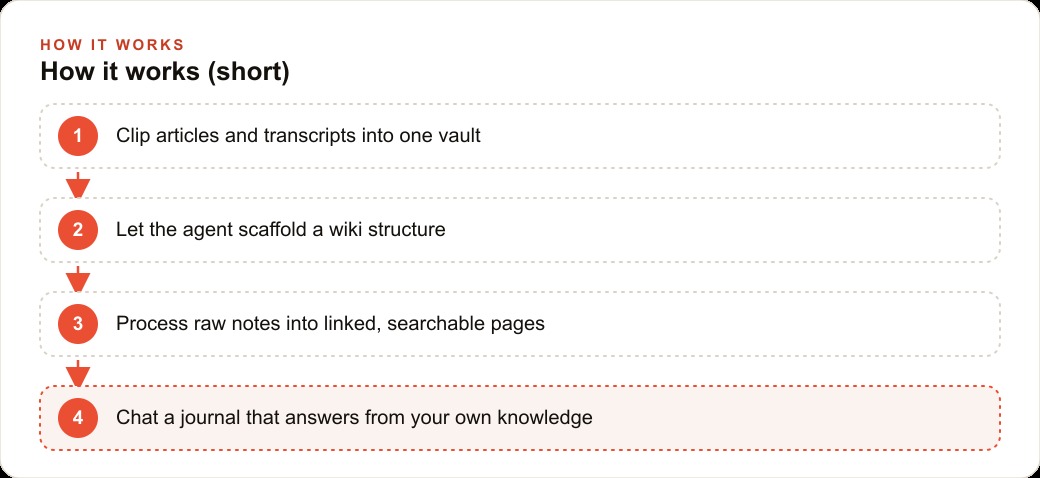
The change is not a new app. It is a new capability layered on free tools you may already have. A free markdown vault holds the notes. A free web clipper captures pages and, for video, pulls the full transcript automatically. A coding agent does the part that used to require a developer: it builds the structure, processes raw sources into linked pages, and answers questions grounded in what you saved. None of those pieces is new on its own. Combined, they close the gap that made second brains useless.
Why storage alone was always going to fail
It helps to be precise about why the old approach died. Saving is easy and reviewing is hard, so the ratio was always going to tip toward accumulation. You dump transcripts, articles, and podcasts into one place at the speed you consume them, and you revisit them at the speed you have free time, which is roughly never. The archive grows, your ability to search it by memory shrinks, and within a few months you cannot even remember what is in there.
The fix is not more discipline, because more discipline was never coming. The fix is to make the system pull your saved knowledge back into the moment you are stuck, rather than waiting for you to dig it up. That single reversal, from a passive dumping ground to an active assistant grounded in what you have already learned, is the entire reason this generation of second brain is worth building when the last several were not.
The three pillars that give the system a shape
Under the hood, the setup rests on three pillars sitting on one knowledge base. The wiki holds everything you save from the web. A lightweight contact record holds the people you meet at events and on calls. The journal is the layer where you actually interact with all of it. The knowledge base sits at the center, and the other two connect to it, which is what keeps the whole thing coherent instead of turning into another pile.
The markdown vault is the visibility layer. Every note is a plain text file you can open, read, and edit, which means you can see exactly how the system is built rather than trusting a black box. The web clipper is the intake: one click saves any page into the vault, and for video it automatically pulls the full transcript into a note, so the raw material lands without effort. The coding agent is the engine that builds and runs everything on top of that raw material. Three free tools, three clear jobs.
From raw clips to a connected graph
The mechanics are more approachable than they sound. You create an empty vault, point the agent at that folder, and prompt it to build a wiki based on a known public plan for structuring a knowledge base. It scaffolds a raw folder, a wiki folder, and a few control files, including one that acts as the operating manual for the whole system. If it over builds, you simply tell it to prune back to the minimal plan, and it does.
Nothing happens automatically until you tell the agent to process the raw folder. When it does, it summarizes each source, then extracts the people, companies, tools, ideas, and themes into separate wiki pages that cross reference each other the way a well kept note system connects ideas. Processed sources move to a done folder so nothing gets ingested twice, which means you always know exactly what has been handled. Over time the connections fill in, and the archive stops being a list and becomes a graph. Because that operating manual file is just prompts, you change the system's behavior by editing that one file rather than rebuilding anything.
Who this actually changes things for
Any business that runs on accumulated knowledge should care, which is most of them. A consultant can turn every client call, article, and saved talk into a searchable base they query before the next meeting. An agency can keep its playbooks, swipe files, and past campaigns connected so nothing gets reinvented from scratch. A real estate team can capture market notes and neighborhood research that any agent can pull up on demand.
The structure flexes to whatever your real inputs are, whether that is clients, recipes, research papers, or workouts, because the machinery does not care about the topic. The payoff is identical everywhere: instead of a junior person re searching something the team already learned six months ago, the grounded journal surfaces the exact saved source. That saved knowledge is also quietly reusable elsewhere. The same library that answers your internal questions is raw material for SEO and organic search, because the research and the answers you have already gathered are exactly what good content is made of. The industry only changes what you clip, not how the system is built.
A worked example: the roofing company with knowledge trapped in one head
A roofing business accumulates a surprising amount of hard won knowledge, and almost all of it lives in the owner's head or scattered across text threads. How to handle each insurance carrier's claim process. Which underlayment works for which roof pitch. Supplier price quirks. The scripts that turn an inspection into a signed job. The details of every commercial client. That knowledge is exactly what a second brain captures, and losing it whenever a key person leaves is exactly the risk it removes.
Here is how I would set this up. I would create one vault and start clipping the useful material: manufacturer install guides, the best training videos on storm damage claims, and the company's own notes, so the transcripts and articles land in one place automatically. Then I would let the agent scaffold the wiki and process those sources into linked pages, extracting the carriers, the materials, the suppliers, and the recurring objections into their own cross referenced notes.
The contact pillar earns its keep here. Every property manager, adjuster, and referral partner the team meets becomes a record with how and where you met them, so a year later a salesperson can ask where did I meet this contact and get a straight answer. The journal is where it pays off on a hard day: a rep stuck on a denied insurance claim can brain dump the situation and the system surfaces the exact saved advice and the past job where the team handled the same carrier. That same captured knowledge feeds the customer facing side too, since the field notes and job records naturally connect into the CRM and website stack where follow up on quotes and past customers lives. To keep it effortless, I would set an hourly automation that processes new clips and pushes a backup to a private repository, so the crew just clips what they find in the field and the knowledge base builds itself.
The move to make this week
You do not build the whole thing at once. Start with one vault and one source type. Create a free markdown vault and a raw folder before you save anything else, then install the web clipper so articles and video transcripts land in one click. Point a coding agent at the folder and have it scaffold the wiki from a known plan, then trim it back to the minimal set if it over builds. Process a handful of sources first so you can watch the linked pages form, and only then add the journal and contact behavior by editing the operating manual file.
Once that feels solid, schedule an hourly automation that processes new clips and pushes a backup, and from then on you just clip and forget while the system ingests, links, and protects everything on its own. All you really need is the vault and a coding agent, and unlike a static archive, this one gets smarter and more connected the longer it runs. That is the whole story: the tool that used to be a graveyard is now a system that compounds.
Why a grounded answer beats a generic one every time
It is worth dwelling on the single feature that makes this whole thing worth building, because it is easy to shrug past. The difference between chatting with a blank general assistant and chatting with your own grounded system is the difference between plausible and correct. Ask a generic model a question and it answers from the average of everything it has read, which is often fine and occasionally confidently wrong for your specific situation. Ask a grounded second brain the same question and it answers from the material you personally vetted and saved, and it can show you the exact source.
That grounding does two things a generic answer cannot. It keeps the facts aligned with what your business actually knows to be true, rather than a plausible guess, and it surfaces the original source so you can verify and go deeper. For a business, that distinction is not academic. A generic answer that sounds right but is subtly wrong can cost a deal or a client. An answer pulled from your own proven material carries the authority of experience, because it literally is your experience, indexed and made searchable.
The compounding advantage most people never reach
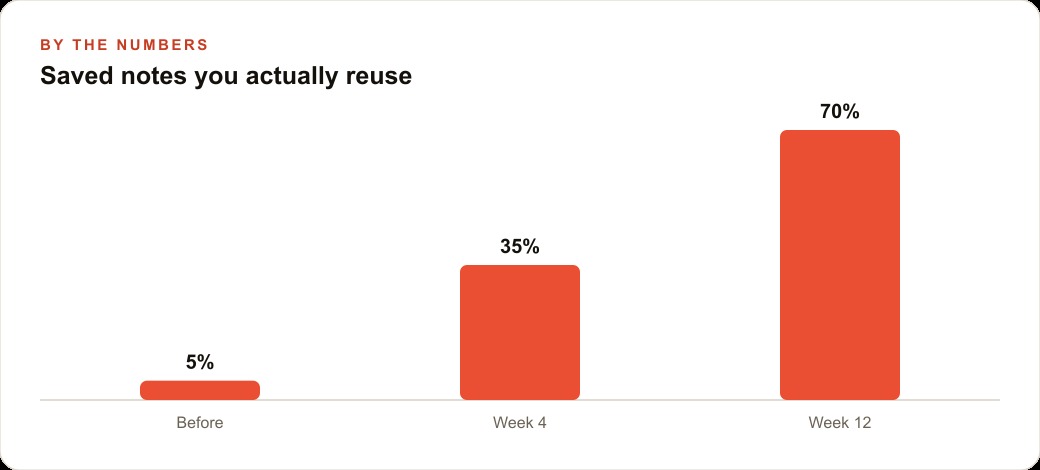
The reason so few people get value from a knowledge base is that the payoff is back loaded. On day one, a fresh vault with a handful of notes is barely more useful than a folder. The value shows up only after weeks of clipping, once the graph has enough connected pages that a single question pulls together sources you had forgotten you saved. Most people quit before they reach that point, which is exactly why the automation matters: it removes the discipline requirement that kills most systems.
When ingestion runs on a schedule and backups happen on their own, the only human action left is the one thing you would do anyway, saving something interesting when you find it. Everything after the clip is automatic. That is what lets the system cross the threshold from graveyard to genuine asset, because it keeps building even in the weeks you are too busy to tend it. A knowledge base that compounds while you ignore it is the only kind that survives contact with a real schedule, and it is the whole reason this generation of the tool finally works.
The team dimension makes the compounding sharper still. When several people clip into a shared base, the knowledge stops living in individual heads and starts belonging to the business itself. A new hire can query years of accumulated answers on their first week, and a departing employee no longer takes irreplaceable context out the door with them. For any business where the real value sits in what people have learned, turning that scattered learning into a shared, searchable asset is not a productivity tweak, it is protection against the single biggest risk a knowledge business carries, which is knowledge walking out the door.
You can absolutely build this yourself, and I would encourage any knowledge heavy business to start by clipping into one vault this week. If you would rather have someone design the structure around your specific business, wire in the journal and the contact records, and set the automation so it runs hands off from day one, that is exactly the kind of build I do, and you can bring me in to handle it.
That is exactly what we do at AI DOERS. Book a private 30-minute call with Madhuranjan Kumar and we will map the fastest path to it for your specific business.
Book your call →
Madhuranjan Kumar
Madhuranjan Kumar brings 20 years of performance-marketing experience and has managed over $200 million in Facebook ad spend for brands across the United States and beyond. His expertise spans the full modern marketing stack: Meta, Google Ads, TikTok, email automation, CRM, and the websites that hold it together. At AI DOERS he turns that track record into lead-generation systems for businesses across every industry.