
How to Build a No-Code Lead Agent in OpenAI's Agent Builder
OpenAI's Agent Builder is a visual no-code canvas where you chain narrow agents, connect tools without code, and ship a working lead machine that searches the web, fills a spreadsheet, and drafts personalized emails for review.

Most business automation built by developers fails not because the developer lacked skill but because the developer lacked something the owner had: complete knowledge of what the job actually requires in practice. The translation between those two people is where the value disappears, and the cost of that translation failure is not only the time wasted on the wrong system. It is the next project that never gets started because the last one did not deliver. I am Madhuranjan Kumar, and the argument I want to make in this piece is that no-code agent builders eliminate that translation layer entirely, and that the right person to write the automation instructions is the person who has been doing the work manually.
Most automation fails in the translation between the person who knows the job and the person who builds it
Think about what happens when a business owner hires a developer to automate a sales outreach workflow. The owner has spent two years doing this work manually. She knows which lead sources convert at a higher rate and which ones waste call time. She knows that a warm referral from an existing client requires a different opening than a cold inquiry from a contact form. She knows that following up three times over ten days converts better than following up once. She knows that the first email for a potential partner should mention something specific about their business rather than using a generic pitch. She knows that certain types of contacts respond to one proposed first step but not another.
None of that knowledge transfers automatically into a developer brief. The developer asks a standard set of questions: what triggers the automation, what data goes in, what output should come out, which tools are involved. The owner answers as honestly as she can, but the knowledge that does not make it into the brief, all the nuance and judgment accumulated from two years of doing the work, is absent from the system when it ships. The automation handles the main path cleanly and fails the moment it hits the first edge case that the owner would have handled instinctively.
This is not a people problem. It is a structural problem with the traditional model of automation development. The person with the deepest knowledge of the workflow is not the person building the system, and the knowledge that does not survive the handoff does not show up until the automation is running on real data.
OpenAI's Agent Builder is a visual, no-code canvas at the OpenAI platform where you drag building blocks called nodes onto a screen and draw arrows that show how data flows from one step to the next. The nodes are simple: a start node where input arrives, an agent node where the thinking happens, a connector node that reaches your external tools, and a guardrail node that acts as a safety check against unwanted inputs or outputs. Each agent node holds a name, a model selection, a memory setting, a list of tools, and a system instructions field where you write the agent's behavior in plain language.
That system instructions field is where the translation problem is solved. The owner who knows exactly what a good outreach message requires can write those requirements directly into the field, using the same language she would use to explain the job to a new team member on their first day. No handoff. No brief. No translation layer. The person who holds the knowledge is also the person writing the instructions.
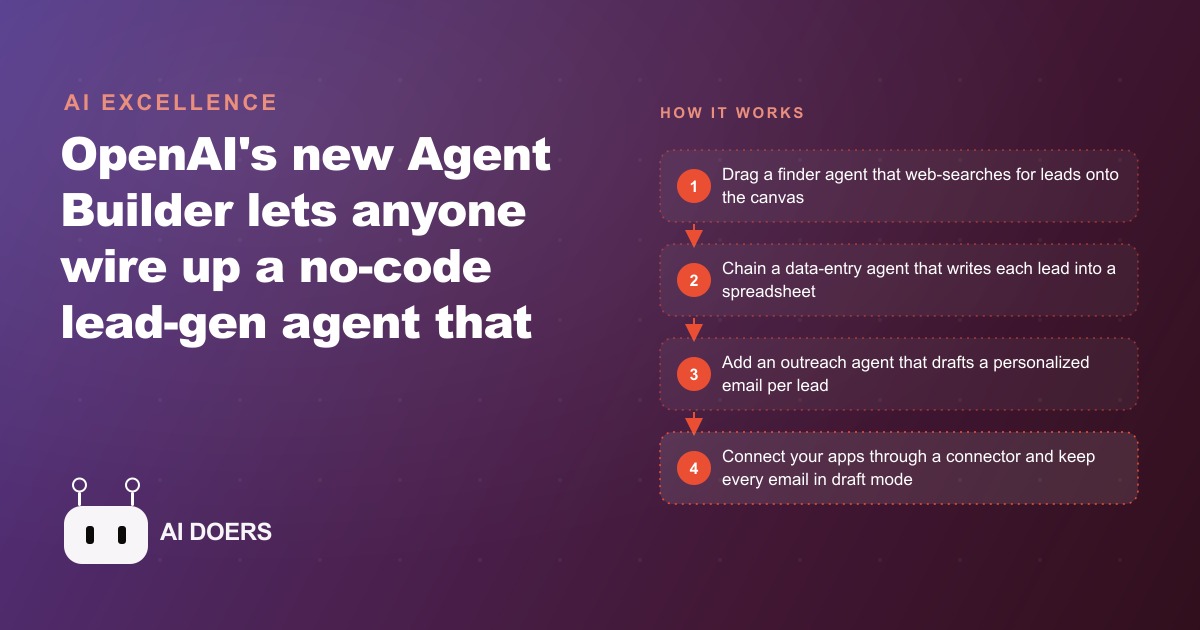
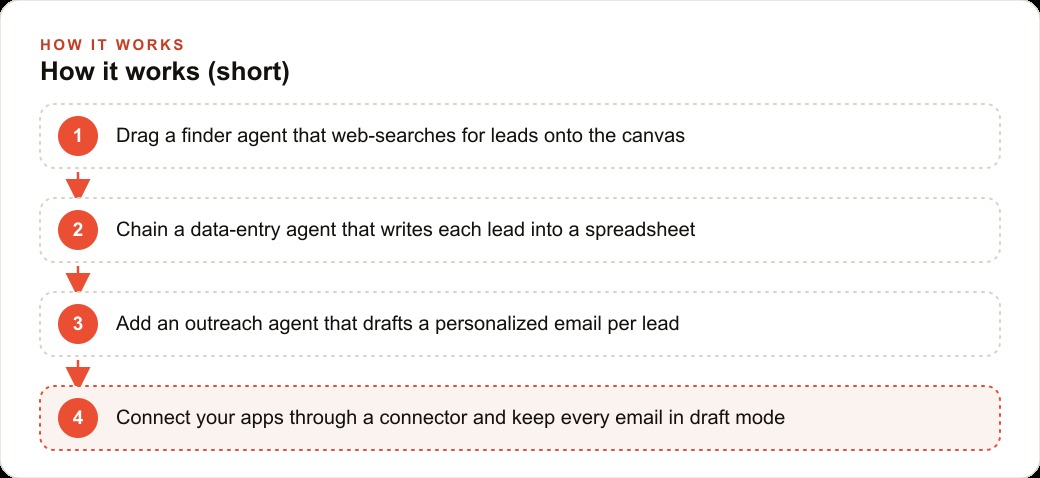
The three-agent pattern that Agent Builder is designed around maps cleanly onto the way any effective salesperson or outreach coordinator already thinks about the work. The first agent finds the right contacts. The second agent records them to a structured tracker. The third agent writes a personalized message for each one and saves it for review. This is not an abstract technical architecture. It is a description of the same three phases that any manual outreach process already goes through. Agent Builder makes that workflow buildable by the person who runs the process, not just describable to a developer.
The three-agent pattern maps directly onto how a good salesperson already thinks about outreach
A salesperson thinking clearly about outreach already divides the work into three phases. The first is discovery: who are the right people to contact, where can I find them, and what do I need to know about each one before I reach out. The second is organization: how do I record what I found so nothing falls through and so I can track where each contact is in the process. The third is outreach: what do I say to each specific contact that is relevant to their situation and increases the likelihood they want to talk.
A salesperson who conflates these phases loses contacts, sends generic messages, and cannot audit the process when results decline. Separating them into dedicated activities is what high-performing outreach coordinators do intuitively, whether or not they have ever framed it that way.
The Agent Builder chain externalizes that intuition into a system. For a med spa looking to build its referral partner network, the finder agent uses web search to identify the right categories of local businesses: wedding planners, bridal boutiques, high-end fitness studios, hair salons, and dermatology offices that refer out services they do not offer. The system instructions for this agent name the geographic radius to search, the business categories to include, and the exact fields to collect for each result: business name, website URL, the name of the owner or manager where visible, the business category, and a one-sentence note on why they are a plausible referral source for the clinic's client profile.
The data-entry agent writes each discovered business to a tracking spreadsheet with one row per contact and standardized columns. It logs the date discovered and sets the status column to New, which is how the front desk coordinator knows at a glance what has and has not been contacted. The outreach agent reads each row in New status and drafts a warm email from the spa director that references the specific type of business and what their clients are likely to have in common with the clinic's clients. It proposes a concrete, low-friction first step: a complimentary visit to experience the services, or a brief meeting to learn about each other's client base.
The email goes into Gmail drafts. The status column remains New until a human reviews the draft and decides to send it. Nothing goes out automatically. That one design decision, keeping the outreach in draft mode with a human review step before sending, is the boundary between an automation that feels professional and personal and one that risks damaging a business relationship with a message that hit an edge case the instructions did not cover.
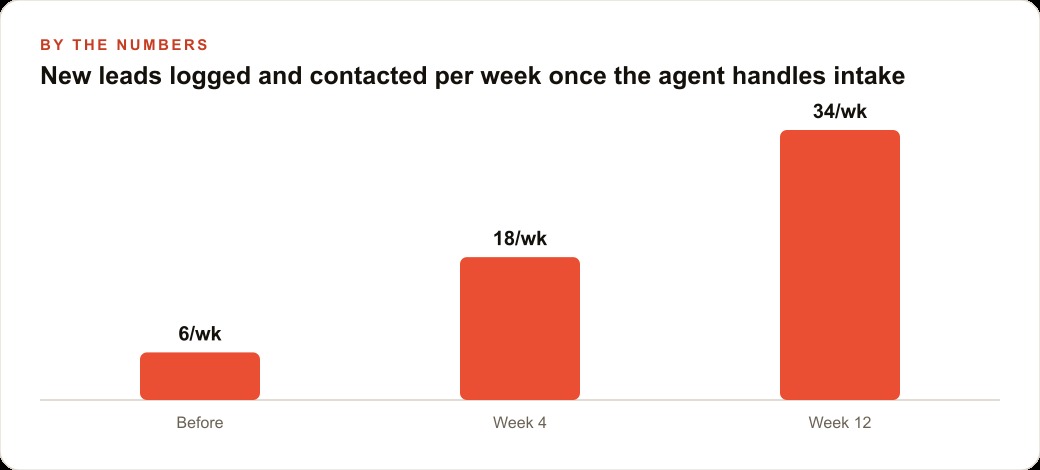
The result for the spa: twenty new potential referral partners contacted per month rather than the five the front desk coordinator could realistically reach when doing the research, recording, and drafting manually. The Facebook and Instagram ad campaigns the clinic runs to acquire new clients work harder when the referral network is larger and more active, because a referral partner who has visited and experienced the service provides a credible third-party endorsement that no paid placement can replicate. The paid and organic channels compound rather than operating in isolation.
All of the contact data from the outreach process flows into the clinic's CRM and website stack with consistent field formatting, which makes it straightforward to see the history of each referral relationship and track which partners are actively sending clients rather than just receiving the introduction.
System instructions are the new process documentation, and the owner is the best author
The most important leverage point in a three-agent build is the quality of the system instructions for each agent. These plain-language rules define the agent's role, its step-by-step process, and how it should handle every situation it is likely to encounter. The output quality is determined almost entirely by the instruction quality.
The writing style required is concrete and specific. Instructions that tell the finder agent to find good referral partner contacts and collect the relevant information are not enough. Instructions that name the specific business categories to search, the geographic radius to use, the exact fields to collect, the format for each field, and what to do when a business website does not list a manager name are enough. The agent following the first instruction set will produce variable results. The agent following the second will produce consistent, usable results from the first run.
The reason the owner is the best author of these instructions is not writing skill. It is the specific knowledge that makes the instructions useful. She knows that wedding planners are a strong referral source because a significant portion of her clients book treatments before a major life event and the planning window is exactly when they are most receptive to that category of service. She knows that the outreach email should acknowledge what the prospect's clients care about, not just what the clinic offers, because that framing is what gets a reply. She knows that the first contact should propose a specific low-stakes first step rather than asking for any kind of commitment, because that is what converts an introduction into a real conversation.
None of that knowledge needs a developer to extract it. It needs a place to live in the system, written in the language the owner would use to train a new team member. The system instructions field is that place.
The system instructions are also the primary maintenance artifact for the workflow. When the agent's output drifts from what is wanted, the fix lives in the instructions. When a new business category should be added to the finder's search, the update is a sentence added to the instructions. The owner who wrote the original instructions can make those changes herself without a development engagement, because the system is documented in the same plain language she would use to explain the change to a person doing the job.
This changes the relationship between business operators and their automation infrastructure from periodic development projects to living, owner-maintained systems. Process knowledge that used to sit in a person's head or in a loose collection of notes becomes structured, editable, and executable. The person who does the job every day is the right person to write those instructions and the right person to revise them as the process evolves. No-code agent builders are the tools that put the authorship in the right place.
One structural note before treating this as fully production-ready: both Agent Builder and the third-party connector layer it relies on for external tool connections are in beta as of mid-2026. Reliability has been improving, and the system performs well as an internal workflow tool. Connecting it directly to customer-facing communications or to any system where an error has immediate external consequences is best done after the workflow has been tested thoroughly on internal use cases first. Build confidence on lower-stakes applications before extending to anything where a failure is visible outside the business.
The draft mode discipline applies there too. Any agent that reaches customers or takes actions with external consequences should output to a review queue, not to a live channel. The speed benefit of having everything prepared and ready to review is real. The protection of a human approval step before sending is worth the thirty seconds it takes. That combination, agent-prepared with human review, is the production posture that makes these tools trustworthy enough to run for real.
The business that maps its own outreach workflow, identifies the three phases, writes the system instructions for each agent in the language of someone who has actually done the work, and reviews what comes back before it goes out will build a more reliable automation in less time than the business that hands the project to a developer and waits for a system to come back that may or may not reflect how the work actually gets done. The knowledge is already in the building. The tool that puts it directly into the system is the change worth paying attention to.
That is exactly what we do at AI DOERS. Book a private 30-minute call with Madhuranjan Kumar and we will map the fastest path to it for your specific business.
Book your call →
Madhuranjan Kumar
Madhuranjan Kumar brings 20 years of performance-marketing experience and has managed over $200 million in Facebook ad spend for brands across the United States and beyond. His expertise spans the full modern marketing stack: Meta, Google Ads, TikTok, email automation, CRM, and the websites that hold it together. At AI DOERS he turns that track record into lead-generation systems for businesses across every industry.