
How to Automate Your Work with Claude Code as a Complete Beginner
Claude Code is a general agent you chat with, not a coding wall. Here is how I would automate one boring weekly task by inventorying your week, pushing for the free path, and writing a plan before any code gets built.


A salon owner was losing roughly one evening a week to the same set of chores, and twelve weeks later a set of typed commands did all of it while she went home. I am Madhuranjan Kumar, and I want to tell this as one continuous story, because the theory of automating your work with Claude Code only clicks when you watch it happen to a real business. The tools here are simple. Claude Code is not a wall of programming, it is Claude running as a general agent you chat with in a terminal, one that can read and write files, search the web, and carry a task from start to finish. What follows is how one owner went from drowning in admin to reviewing output while the agent worked. The numbers are illustrative, but the path is exactly the one I walk owners through.
The starting point: an owner who was the bottleneck
When we began, the salon owner spent scattered hours across the week on three recurring chores. Every evening she pulled up the next day's bookings to see which stylists had gaps that needed filling. A couple of times a week she chased recent reviews and wrote replies by hand. And every week she wrote the promotional text for social from scratch. None of it was hard. All of it was repetitive, and together it ate close to two hours a week of her time, always at night, always when she wanted to be done.
That is the first and most important move in the whole method, and it has nothing to do with technology. You make an inventory of your week and find what eats the most time, then pick one boring, repetitive task to automate before anything fancy. We did not start with a grand vision. We started by writing down the chores and circling the single most repetitive one: pulling tomorrow's bookings and flagging the open chairs. Everything else waited.
Week one: installing the agent and choosing the free path
Installing Claude Code was anticlimactic in the best way. You copy the install command from the Claude Code site into your terminal, then type the word claude to open it. It runs like a chat, just far more powerful than the web interface, and to make the files visible we opened it inside Cursor so the owner could browse and review what the agent created. Cursor looks intimidating, but it is really just a window into what the agent is actually doing.
Then came the step that saves the most money and confusion. Before letting the agent build anything, we asked it for a few different ways to solve the problem, with pros and cons, and chose one together. For pulling booking data it offered an official API, web scraping, or a third-party service. The official API meant setting up an API key, which is more friction than a small business wants on day one, so we pushed for an easier route and it surfaced a free tool that did the job. That lesson repeats endlessly: when a path needs billing or accounts, ask explicitly for the free or quick-setup alternative and the agent will give it to you. By the end of week one, we had a working way to pull tomorrow's schedule and no bills to worry about.
Week two: the plan is where the real work happens
This is the chapter most people skip and later regret. Instead of letting the agent jump straight into code, we pressed shift-tab to enter plan mode, which makes Claude write a spec in plain English rather than start building. As the source puts it, vibe coding is mostly document work: 70 to 80 percent of your time goes into writing a clear plan, because the model handles the actual coding once the plan is right.
The agent's first draft of the plan did too much, which is exactly what AI tends to do. It proposed features the owner never asked for. So we read the spec together and cut everything that overreached until the tool did precisely one job well: pull tomorrow's bookings and flag the open chairs. Getting the AI to write the first draft and then reviewing and trimming it before implementing is the habit that separates a tool you trust from a tangle you fight. By the end of week two, the plan was tight, the agent built against it, and the owner had a working script that told her each evening which chairs were empty tomorrow.
Week four: one command replaces the first chore
Once the script worked, we wrapped it in a slash command so the owner never had to think about the mechanics again. A slash command like /chairs plus a run becomes a repeatable workflow she triggers each evening, and it returns tomorrow's gaps along with a suggested message to send the waitlist. What had been a nightly login-and-scan ritual became a single line she typed while closing up.
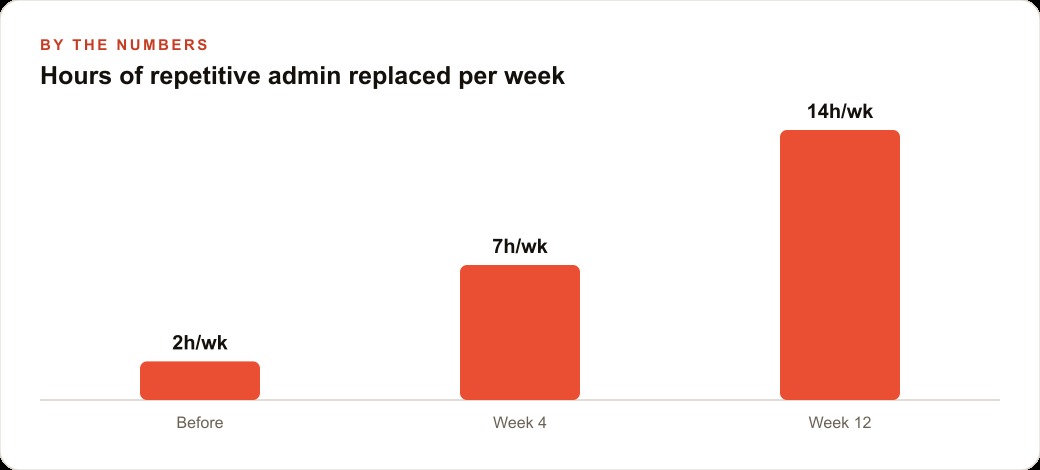
By this point the payoff was already measurable. The two hours a week of repetitive admin had fallen to something closer to half that, and more importantly the mental weight was gone, because a command does not forget and does not get tired. On our little tracking chart, the hours of repetitive admin the system replaced climbed from about 2 a week at the start toward 7 a week by this stage, as the first workflow ran reliably and freed her evenings. The salon ran exactly as before. The owner just stopped losing the front end of every night to the same task.
Week twelve: layering commands until the evening disappears
The real leverage showed up when we stacked function on function. With one command working, we added a second that swept recent reviews and drafted replies in the salon's voice, and a third that assembled the weekly social promo from that week's openings. Each new command reused the pattern we already trusted: inventory the chore, pick the free path, write and trim a plan, wrap it in a command. You can even add a simple list file so one run handles several inputs at once, which is how a single command grows into an overnight job that builds something you would never have had time to do by hand.
We also changed how the owner interacted with all of it. Using a transcription tool to dictate feedback and instructions, she started speaking her changes instead of typing them, which shifted her from fighting a keyboard to simply reviewing and talking. That shift feels roughly ten times faster in practice. By week twelve, the three chores that once cost her an evening a week ran as three commands she triggered and reviewed, and the replaced-admin figure reached around 14 hours a week once you count the compounding effect across every task the commands now touched. The drafted review replies and promo copy also fed naturally into the salon's SEO and organic search presence and the retargeting behind its Facebook and Instagram ad campaigns, so the same automated output did double duty. The leads and bookings those channels produced landed in the CRM and website stack where reminders ran on their own.
The two turning points that made the difference
Looking back at the salon's twelve weeks, two moments mattered far more than the rest, and they are the two most owners get wrong. The first was refusing the official API. When the agent offered the official data source, it came with the friction of setting up an API key, which for a small business is a wall that stops momentum cold. Pushing back and asking explicitly for the free, quick-setup alternative is what kept the project alive in week one. This is a habit, not a one-time trick. Whenever a path the agent proposes needs billing, accounts, or credentials, you say so and ask for the simpler route, and the agent almost always has one. Owners who accept the first, heaviest option tend to stall before they ever see a result, and a project that never ships teaches nobody anything.
The second turning point was slowing down to write the plan. Every instinct, especially for a busy owner, is to tell the agent what you want and let it build. That instinct is wrong, and the source is blunt about why: vibe coding is mostly document work, with the large majority of your time spent writing a clear plan in plain English, because the model handles the actual coding once the plan is right. Entering plan mode and reading the spec is also where you catch the agent doing too much, which it reliably does. The salon's tool stayed sharp because we cut the plan down to one job before a single line was built. The owners who skip this step end up with sprawling tools they do not trust and cannot maintain, which is worse than having no tool at all.
There is a quieter third lesson too, about how the work feels. Once the owner started dictating feedback with a transcription tool instead of typing it, her whole relationship to the system changed. She stopped operating a keyboard and started supervising an assistant, speaking corrections and reading results. That shift from doing to reviewing is the real destination of this entire approach. The commands do the labor, and the owner spends her attention on judgment, which is the one thing the agent cannot supply. That is what ten times faster actually feels like in practice: not typing quicker, but doing less of the work yourself while more of it gets done.
What the salon's journey teaches any owner
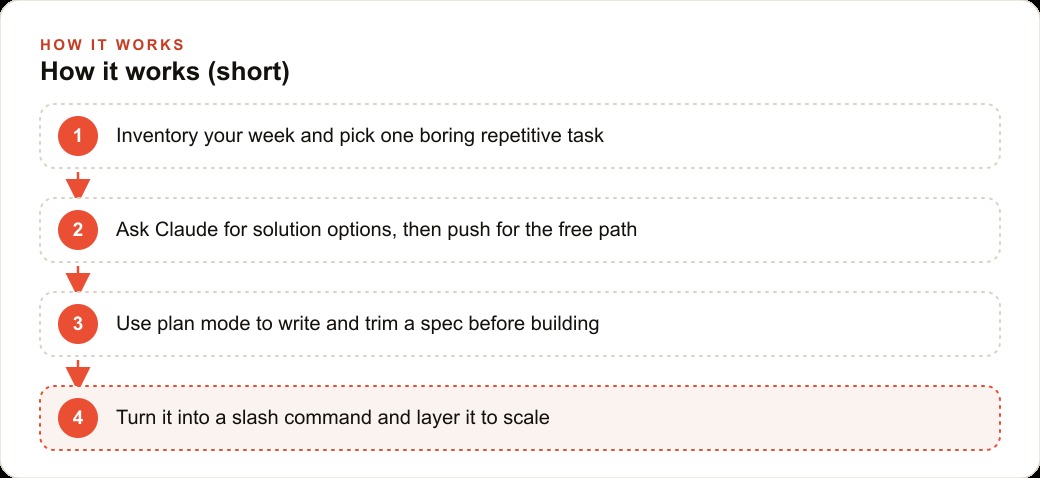
The arc here is the method in miniature. Inventory your week and pick the single most boring task. Install Claude Code, type claude, and ask the agent for two or three ways to solve it, pushing hard for the free, quick-setup option so you are not creating API keys on day one. Enter plan mode with shift-tab, read the spec it writes, and delete anything you did not ask for before you let it build. Wrap the result in a slash command so it reruns with one line, then layer a second command on top, and dictate your feedback instead of typing it if that helps. None of it required the owner to become a programmer. It required her to delegate clearly and review carefully.
What makes the salon's story worth retelling is that nothing about it was special to salons. The owner was not technical. The tasks were not glamorous. The budget was effectively nothing, because every path that needed a paid account got swapped for a free one the moment we asked. What carried the whole thing was a repeatable loop: inventory the week, pick the most boring task, choose the free path, write and trim a plan, wrap it in a command, then layer the next one on top. Any owner with a recurring chore that involves pulling, sorting, or summarizing information can run that same loop, whether the chore is a weekly reconciliation, a morning listings pull, or a competitor price sweep. The salon simply proved the loop works when a real person with a real business follows it patiently, one task at a time, instead of trying to automate everything at once and burning out before the first command ever ships. The magic was never in the tool. It was in picking one small thing, getting it working, and trusting the pattern enough to run it again, which is a discipline any owner can practice starting today.
You can genuinely build your first automation yourself this week, and I would encourage you to start with one chore and a clear plan, exactly the way the salon did. If you would rather have someone sit down, map your actual weekly tasks, and hand you a set of reusable commands that already fit your business, that is the kind of build I do for clients, and you can bring me in to handle it.
That is exactly what we do at AI DOERS. Book a private 30-minute call with Madhuranjan Kumar and we will map the fastest path to it for your specific business.
Book your call →
Madhuranjan Kumar
Madhuranjan Kumar brings 20 years of performance-marketing experience and has managed over $200 million in Facebook ad spend for brands across the United States and beyond. His expertise spans the full modern marketing stack: Meta, Google Ads, TikTok, email automation, CRM, and the websites that hold it together. At AI DOERS he turns that track record into lead-generation systems for businesses across every industry.