
How a Claude Cowork Setup Can Build Software While You Sleep
Make Claude write a product requirement document before any build, run a data-lake foundation with dashboards and skills on top, and add an overnight builder that picks up queued PRDs and ships finished projects by morning. No coding required.

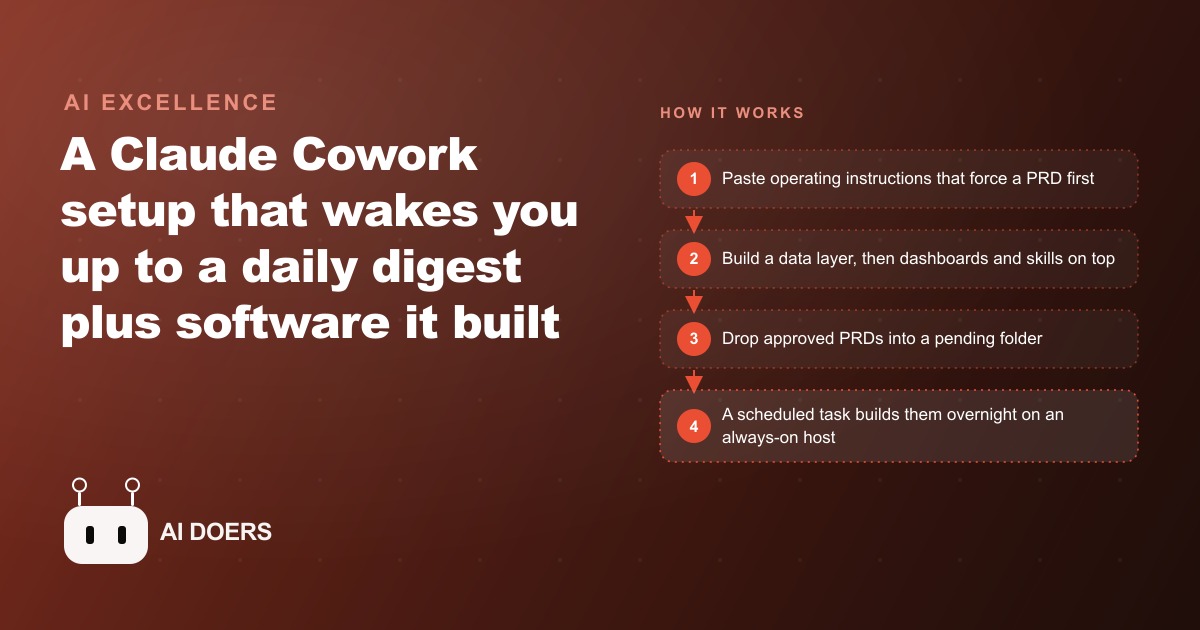
Every time someone posts a screenshot of a dashboard built while they slept, the replies fill up with the same question: how do I set up the overnight builder? People want the queue, the 30-minute polling loop, the in-progress and done and failed subfolders, the message that arrives on their phone saying a pipeline is ready before they have had their first coffee. They copy the infrastructure from the post, set it up, and wonder why their agents keep going sideways. The answer is almost always the same: they built the last 10 percent of the system without building the foundation first. The overnight builder works reliably when there is an operating constitution and a PRD discipline behind it. Without those two things, even a technically correct build ends up doing the wrong thing, and you have no reliable mechanism for catching that before it matters.
The constitution you paste before anything else
The operating constitution is a set of instructions you write once and paste into the AI's persistent settings before you do anything else with the system. Not before the first interesting task. Before everything. It has four sections, and each section governs a specific class of behavior that determines whether you can trust the system's output in production.
The first section covers how the AI approaches building anything at all. The rule is that every build starts with a product requirement document. Not a quick description of what you want in a chat message. A structured document with a clearly written problem statement, measurable success criteria, explicit scope boundaries, any constraints that apply including technical, budget, time, and compatibility constraints, and a step-by-step plan for how to approach the build. The PRD is written and reviewed before a single line of code or configuration is touched. This sounds like unnecessary formality when you are excited about an automation idea at 11pm and want to drop it into the queue immediately. But it is the most important section of the constitution. When the AI is building something overnight without a human in the room, the PRD is the only thing standing between what you asked for and what you actually get. If the PRD is vague, the build will be technically functional and wrong. If the PRD has specific, testable success criteria, the build can be evaluated against those criteria before the agent moves the file to the done folder.
The second section covers pushback. The constitution explicitly instructs the AI to disagree when a plan is off-strategy, factually incorrect, or inconsistent with something previously decided and documented. This is not a default behavior for most AI tools. The default is to find a way to implement what you asked for, even when what you asked for will not actually solve the stated problem. The constitution inverts that: if what you asked will not accomplish the stated goal, the instruction is to say so before touching anything. For anyone running Facebook and Instagram ad campaigns through an automated reporting system, having the AI flag when a requested metric is being calculated in a way that does not match how the underlying platform actually tracks it is worth more than a clean report built on incorrect logic. The pushback section is also what prevents scope creep from silently expanding what an overnight build does. When the AI is uncertain whether a task falls within what the original PRD specified, the constitution tells it to stop and flag the uncertainty rather than interpret liberally and build something larger than you asked for.
The third section is aggressive note-taking. Every significant decision made during a working session gets documented before the session ends. Rationale gets recorded alongside the decision, not just the outcome. When something is built or configured, the documentation captures not just what was done but why that approach was chosen over the alternatives that were considered. When you wake up to a failed subfolder, you need more than an error message. You need enough recorded context to understand what the agent attempted, what assumption it made that did not hold in the actual environment, and what specifically to fix before trying again. Without aggressive note-taking built into the constitution, failure logs are technically accurate and diagnostically useless.
The fourth section covers reversibility. The constitution requires the AI to confirm before taking any action that is difficult or impossible to undo: deleting data, modifying a configuration that affects a live system, sending anything externally, or committing a change that other systems depend on. For an overnight builder that runs without human presence, this section is what prevents a technically successful build from becoming an operational problem. A build that correctly accomplishes the wrong task is a much worse outcome than a build that fails cleanly and records exactly why.
Why the PRD is the load-bearing piece
People who skip the PRD step usually do it for the same reason: they know what they want and writing a structured document about it feels like friction that slows down the part they care about. What they discover is that knowing what you want and being able to specify it precisely enough for an unsupervised overnight build are genuinely different things. The gap between build me a dashboard that shows how my campaigns are performing and a PRD that specifies which data sources are the authoritative inputs, what the acceptable staleness threshold is for each metric, how to handle a source that is temporarily unavailable, what the layout should prioritize on mobile versus desktop, and what a successful first version looks like in concrete, checkable terms, is exactly the gap between a build you can use in production and one you have to rework the next morning after discovering it did not actually solve the problem.
The PRD discipline also produces a benefit that is not obvious until you have been running the system for several weeks. A folder of completed PRDs is a record of everything that has been built and the reasoning behind each build. When you want to extend something that was built three months ago, the PRD tells you what decisions were made, what constraints were active at the time, and what was explicitly left out of scope and why. Without the PRD, extending an overnight build usually means reversing through the output code to reconstruct the original intent before you can make changes safely, which is slow and frequently causes you to break something that was working. If your business runs a data lake that feeds multiple dashboards and the dashboards inform decisions about Google Ads budget allocation or channel mix across campaigns, the PRD record becomes operationally important rather than just convenient. You need to know what each component does and what assumptions it makes, and you need that information to be immediately accessible without re-examining the code from scratch each time.
The data-lake-first principle is closely related to the PRD discipline. The right sequence is to build the pipelines that keep fresh data flowing into a central, queryable store before building anything that consumes that data. Dashboards and skills built on stale or poorly structured data are not useful regardless of how polished their interface is. The PRD for any build that consumes data should include an explicit section on data provenance: where the data comes from, how fresh it needs to be to be reliable, what the system should do when a source is unavailable, and how a downstream consumer can tell when data quality has degraded below the threshold where the output should be trusted. Getting this right at the PRD stage costs an hour. Discovering it was not addressed after a build has been running in production for a month costs considerably more, and the cost is usually not just in time but in decisions made on unreliable data.
What the overnight builder actually requires to work
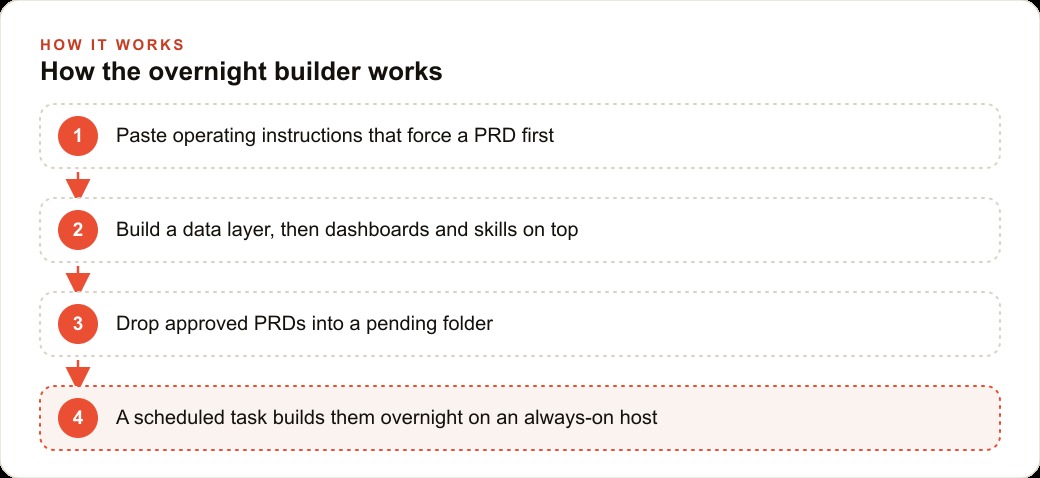
The overnight builder is a scheduled task that checks a pending folder every 30 minutes, picks up any PRD file it finds there, builds what the PRD specifies, and moves the result to one of three output folders: done, in-progress, or failed, along with a structured log of what happened. The mechanics are straightforward once the infrastructure is running. The requirements that make it actually useful in production are not primarily technical; they are disciplinary and infrastructural.
The first requirement is that the AI host must be always-on. An agent running on a laptop that goes to sleep at midnight will not deliver builds by morning. The machine running the overnight builder must be continuously available throughout the build window, whether that is a local server that never powers down or a VPS. This requirement is not a minor implementation detail. It is the physical infrastructure constraint that determines whether the overnight build pattern is a real and reliable part of your workflow or a demo you try once when the conditions happen to be right. The always-on requirement is also why the operating constitution's reversibility section matters more for this pattern than for any other: when you are not present to supervise, you need the system to pause and wait rather than proceed through any action whose consequences are hard to undo.
The second requirement is that the PRD queue must be maintained with actual PRDs. The overnight builder is only as useful as the quality of what you put into the pending folder. If you write three careful PRDs in the first week and then start dropping informal task descriptions because the discipline feels cumbersome, the output quality will degrade predictably. The formatting is not the point; the specificity is. A well-formed informal description that includes a clear success criterion and explicit constraints will produce a better build than a formal-looking document that uses PRD headings but leaves the success criteria vague.
Three starter skills make the daily workflow sustainable without requiring constant manual setup. The today skill generates an on-demand morning brief from your data lake and memory files: what has changed overnight, what is time-sensitive in the next 24 hours, and what the three most important things to move on are. The research skill runs a structured deep-dive on a specific topic, such as a stock, a competitor announcement, or a market shift, and returns a structured summary with the key facts organized around a decision rather than presented as a raw information dump. The prep skill surfaces context about the people in your upcoming calendar events: what they have been working on, any relevant shared history, and anything from your memory files that would be useful to have in mind before the conversation starts.
These three skills are not the full system. They are the foundation that makes the rest of the system worth building and maintaining over time. For any business using SEO and organic search as a core acquisition channel, the combination of a data lake with fresh ranking and traffic data and a set of skills that surface actionable insight from that data on demand is worth building carefully from the foundation up rather than starting with the overnight builder and working backward to the constitution. The people who sustain value from this kind of setup are not the ones who built the most impressive initial demo. They are the ones who treated the PRD habit and the operating constitution as non-negotiable infrastructure and maintained both of them after the novelty wore off.
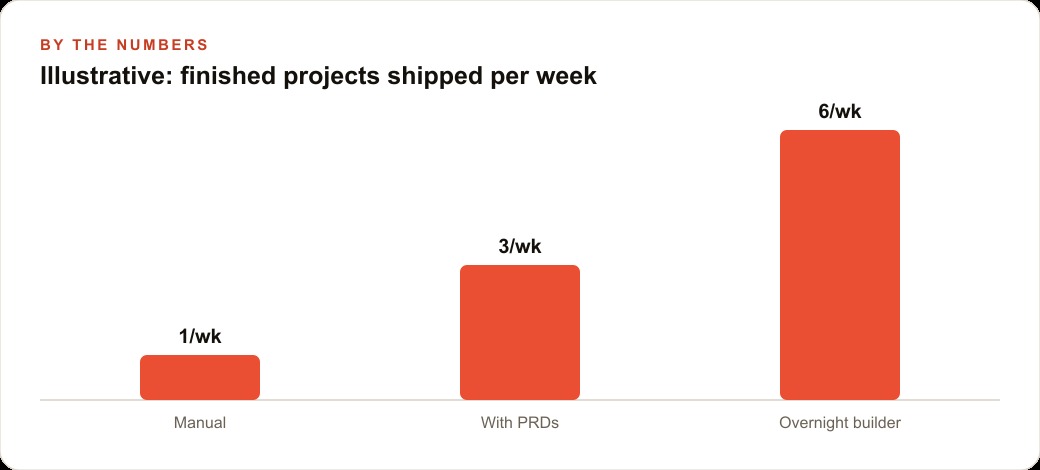
The overnight builder does not replace the habit of thinking carefully about what you want to build. It accelerates the execution of well-specified ideas, and it surfaces the cost of poorly-specified ones faster than doing the same work manually would. Every failure in the failed folder is a PRD that did not specify enough, or a constitution that did not anticipate a particular class of situation. Treating each failure as diagnostic rather than as a reason to distrust the system is what separates people who get sustained value from the pattern and people who abandon it after a month. The build loop is a mirror: it reflects the quality of the specifications you put into it with unusual clarity, and improving those specifications is what makes the system more capable over time.
That is exactly what we do at AI DOERS. Book a private 30-minute call with Madhuranjan Kumar and we will map the fastest path to it for your specific business.
Book your call →
Madhuranjan Kumar
Madhuranjan Kumar brings 20 years of performance-marketing experience and has managed over $200 million in Facebook ad spend for brands across the United States and beyond. His expertise spans the full modern marketing stack: Meta, Google Ads, TikTok, email automation, CRM, and the websites that hold it together. At AI DOERS he turns that track record into lead-generation systems for businesses across every industry.