
How a Creator Built a Manga and Its App in Under 24 Hours With No Code
A full manga generator studio and an entire manga, built in under a day with no drawing skill and no code, using Bolt to build the app and Google's Nano Banana for character consistency.

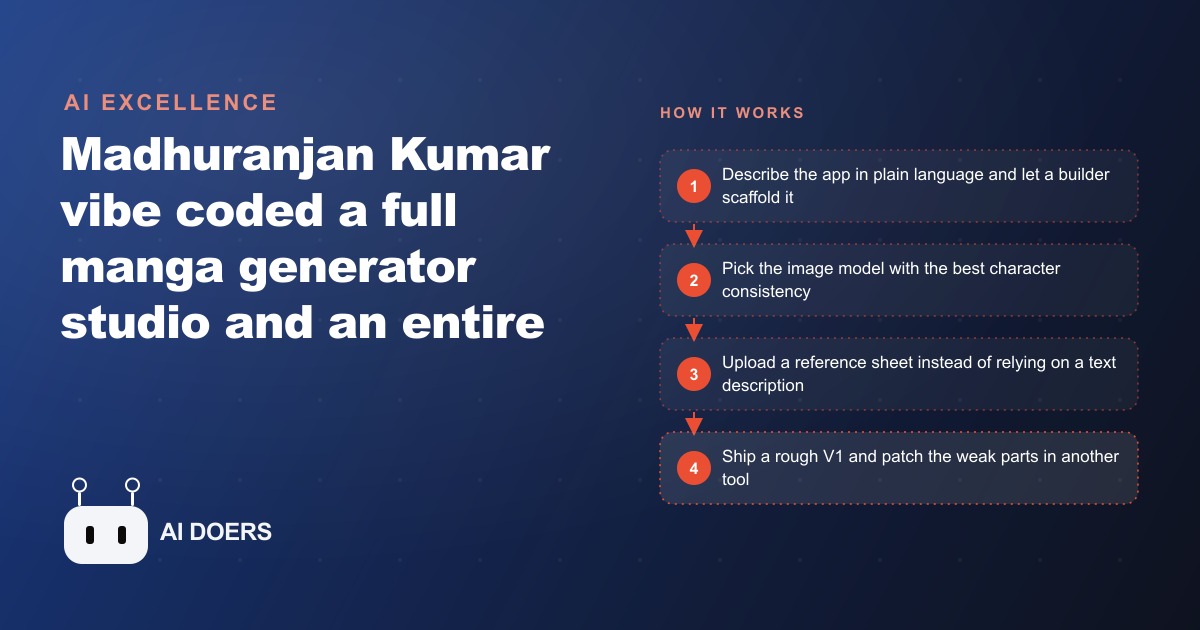
The demo that made vibe coding famous always ends at the moment of shipping, which is exactly when the hard part begins. Building a full manga generator studio and an entire manga in 17 hours and 32 minutes with no drawing skill and no code is a real accomplishment, and it is also a perfect illustration of why "anyone can do this" is the wrong lesson to take from it.
The "no code required" framing is accurate on the surface and misleading underneath it
No code required is literally true. The manga studio was built by typing a plain-language description into a builder tool and answering follow-up questions. Not one line of syntax was written by hand. The builder scaffolded the application. On those facts, the "anyone can do it" headline is defensible.
But the "no code" framing implies that what you previously needed was code and that code was the barrier. That is not what the barrier was. Code was a proxy for something else: the ability to think in systems. To decompose a complex output into the components that produce it. To specify behavior precisely enough that another party, whether a human developer or an AI builder, can build without guessing. To recognize when a specific tool is poorly suited to a specific asset type and route that asset elsewhere before wasting time fighting it. Removing the need to write syntax does not remove the need to think in those terms. It just changes the medium in which you express that thinking. A person who never had those structured-thinking capabilities cannot vibe code a complex tool any more than they could commission a developer to build one, because the problem is not the syntax. It is the specification.
The distinction matters because it changes what the skill actually develops in people who are learning it. Vibe coding students who believe the barrier was code learn to use builder interfaces. Vibe coding students who understand the barrier was structured specification learn to think more clearly about what they want to produce and develop an instinct for decomposing complex outputs into buildable components. Only the second group compounds the skill over time.
Zero syntax does not mean zero skill. The skill moved to a different layer
What vibe coding actually requires is a set of capabilities that the no-code narrative consistently obscures. You need to understand the job the tool needs to do clearly enough to describe it in precise, unambiguous terms. You need to decompose a complex product into its component features before you start prompting, because a builder that receives a vague high-level instruction makes choices you did not intend, and those choices compound into a structure that is difficult to correct without starting over. You need to recognize when the builder is heading the wrong direction early enough to redirect it before too much scaffolding has been laid on a bad foundation. You need to know when a tool is poorly suited to a specific asset type and route that asset to a different tool rather than fighting the first one.
These are skills. They are not trivial. They are also not the skills that coding bootcamps or formal computer science programs teach, which is exactly why the vibe-coding narrative feels so exciting and so misleading at the same time. The door opened. The door did not disappear. It moved, and you still have to walk through it.
There is also a craft dimension to vibe coding that the technical framing misses. The best vibe-coded outputs consistently come from people who know the medium they are building for, whether that is a visual medium, a user-interface medium, a data-presentation medium, or something else. That knowledge shapes the instructions in ways that produce better output from the same tool. It is the same relationship between craft knowledge and prompt quality that shows up in every other AI-assisted creative or technical task.
The 17-hour manga build contains a set of decisions that the demo surface erases
The finished manga and its generator app look effortless in the final presentation. The 17 hours and 32 minutes contain the evidence that effortless is the wrong word. Several decisions made during that build were not obvious, and each one required a kind of judgment that the no-code framing implies you no longer need.
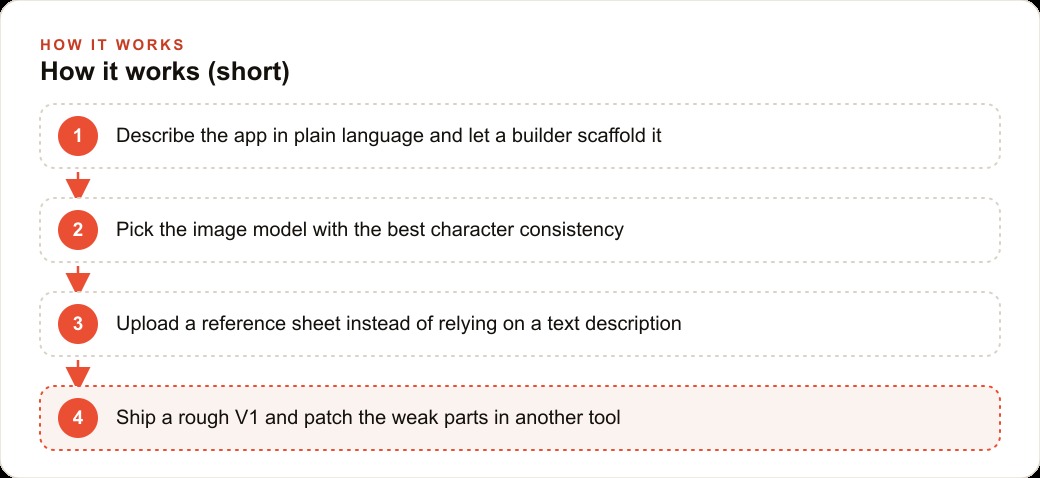
The first decision was to take a full course on how to make manga before writing a single prompt. Learning the craft, what makes a panel layout readable, how page composition guides a reader's eye, how a manga page differs structurally from an illustration, made every subsequent prompt stronger. The instructions became specific in the right ways because there was genuine craft knowledge behind them. Without that foundation, a builder produces technically functional output that looks wrong to anyone who knows the medium, and Madhuranjan Kumar has no vocabulary to explain what is wrong or how to fix it.
The second decision was to plan the story on a proven structural spine before asking any tool to generate content. The story borrowed the logic of a familiar classic work with an inverted-world structure. Giving the AI a clear narrative architecture to fill produced coherent output across the full arc. Starting from scratch without that structure would have produced individually generated scenes that were collectively incoherent, panels that do not connect into a story a reader can follow.
The third decision was about character consistency across panels, which is the hardest technical problem in sequential visual storytelling. The initial approach, using text descriptions of characters to generate panels, produced inconsistent results. The same character looked different from panel to panel because a text description gives the model room to interpret differently on each call. The fix required recognizing that text is the wrong medium for locking visual identity, generating a character reference sheet, and uploading that sheet as a visual anchor for every subsequent panel generation. That insight is not obvious without visual production experience, and missing it produces a manga that is unreadable in exactly the way that matters most to readers.
The fourth decision was the escape hatch for the pen character. One key figure in the story was not a person but a giant floating ballpoint pen, which meant the character-sheet workflow built for human characters was not suited to generating it. Rather than forcing the tool and spending time fighting it, the asset was generated in a different image model with a simple style description and brought into the project from there. Knowing when to route around a tool rather than through it is a product judgment that experience builds, not a capability the platform provides.
What the person who ships a vibe-coded tool does that the person who stalls does not
The practical gap between a vibe-coded project that ships and one that stalls is almost never the tool. It is the clarity of the specification going in and the willingness to make V1 decisions coming out. Both look like minor tactical choices. Both are load-bearing.
The specification clarity shows up in the manga build as the initial plain-language description of the app. It listed specific features with specific behaviors: a character creator that locks appearance, a panel generator that takes a character reference image and a scene description, and a page composer that arranges panels into a full page layout. That is a product specification written in natural language. A builder given that level of clarity produces a coherent first version with sensible component boundaries. A builder given something like "make me a manga app" produces a shallow structure with none of the specific behaviors that make the tool actually usable for sequential storytelling.
The V1 decision shows up in how speech bubbles were handled. The bubble placement feature inside the app was clunky in the first version. The choice was to finish the dialogue in a separate design tool and ship the manga rather than holding the release until the in-app feature was rebuilt. That is a product management decision, and it requires both the judgment to recognize that the rest of the work is good enough to demonstrate value and the discipline to resist the pull toward indefinite refinement. Vibe coding tools do not supply that judgment. You bring it in, or the project never ships.
The real constraint was never memorizing syntax. It was always problem decomposition
Every hard part of the manga build, from narrative structure to character-consistency solution to V1 scope decision, was a problem decomposition challenge. The same challenges faced anyone trying to build this before AI builders existed. They faced them in a different form: communicating that same complexity to a human developer rather than to a builder interface. The communication medium changed. The underlying intellectual demand did not change at all.
This is why vibe coding is a new kind of technical skill rather than the absence of one. The people who are genuinely productive with these tools are, in almost every case, people who could always think in systems and specify clearly. They were previously constrained by needing to know syntax fluently as well. Now they are not constrained by that. What they gained was speed and independence from a technical bottleneck. What they did not gain was the underlying structured thinking, because they already had it.
The people who pick up vibe coding and find it liberating are, with rare exceptions, people who already had those underlying capabilities. The people who find it confusing, or who produce tools that work most of the time but fail on the scenarios that matter, are people trying to skip the problem-decomposition step and hoping the builder handles it. Builders handle syntax. They do not handle ambiguity in the original specification.
Where vibe coding genuinely lowers the barrier and where it hits the same wall as always
Vibe coding meaningfully lowered the barrier for one specific group: those who could always think through what they wanted to build, understood the problem clearly, and were only held back by needing to write syntax fluently. For that group, the syntax requirement was a skill tax on a capability they already possessed. Removing it is a genuine and compounding productivity gain.
For a different group, those who are excited by the idea of building something but have not yet developed the ability to specify what that something is and does, vibe coding feels liberating in the first fifteen minutes and frustrating in the next few hours. The builder produces something. The output is not quite right. The prompt is adjusted. The output changes but is still not quite right. The cycle continues without convergence because the issue is not in the wording of the prompt. It is in the underlying clarity about what success actually looks like. The builder cannot fix that through iteration. Only the person directing the build can.
The manga build, completed in 17 hours and 32 minutes with a finished product that shipped, is a demonstration of what vibe coding looks like when the person doing it brings genuine craft knowledge, clear specifications, and sound V1 judgment to the interface. Those were the things that made it work. The builder was the medium through which they expressed. Replicating the demo without replicating those inputs produces a different result.
There is one more practical implication that the "anyone can do it" framing suppresses. Vibe coding produces its best results when the person directing the build can evaluate the output critically at each stage. That evaluation requires knowing what a good version looks like, which requires having seen enough of the medium to have a standard. Learning the medium is not optional overhead before vibe coding. It is the investment that determines what quality level your direction produces. The person who took a full manga course before building a manga studio understood every output the tool delivered. They could distinguish a layout that worked from one that technically existed but would frustrate a reader. That discriminating eye, applied at each stage of the build, is what produced a finished product worth shipping rather than a technically functional application that does not serve its creative purpose.
That is exactly what we do at AI DOERS. Book a private 30-minute call with Madhuranjan Kumar and we will map the fastest path to it for your specific business.
Book your call →
Madhuranjan Kumar
Madhuranjan Kumar brings 20 years of performance-marketing experience and has managed over $200 million in Facebook ad spend for brands across the United States and beyond. His expertise spans the full modern marketing stack: Meta, Google Ads, TikTok, email automation, CRM, and the websites that hold it together. At AI DOERS he turns that track record into lead-generation systems for businesses across every industry.