
How One Builder Earns $60 a Day From AI Apps Built in an Hour
The edge is timing, not marketing: ship a simple app into a rising topic before competitors arrive, and let AI handle the research, the build, and even the submission. Here is the workflow and how a small business can borrow it.

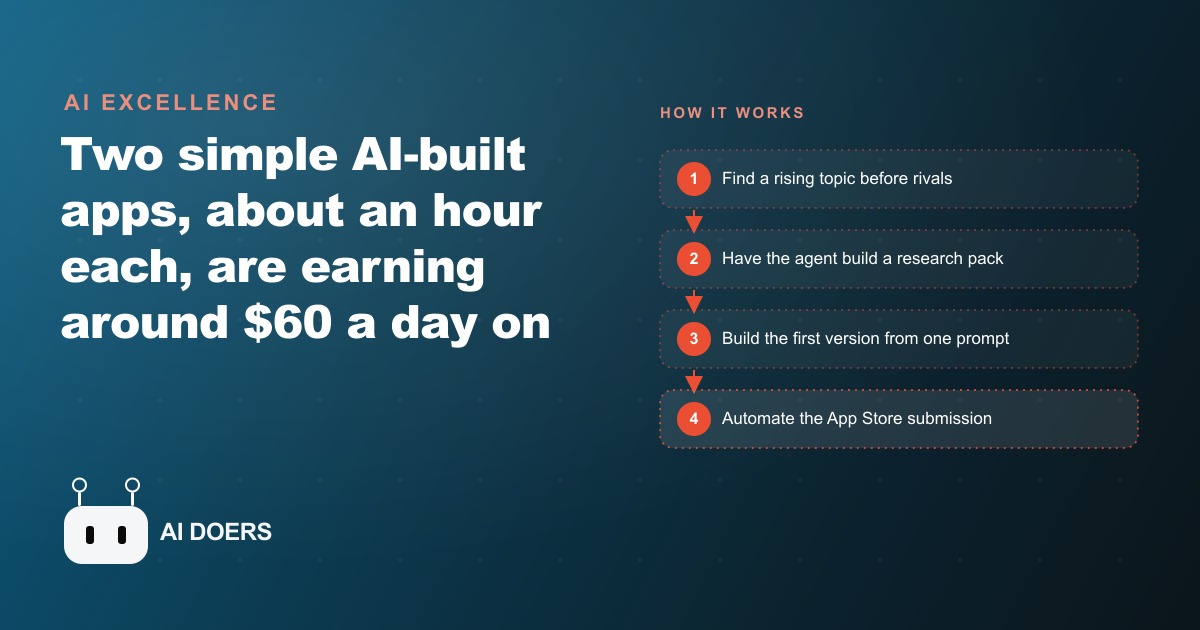
Two paid apps, each built in roughly one to two hours, have together sold about 789 dollars and now trend near 60 dollars a day with no marketing spend at all. Spread across about four hours of total work, that is close to 197 dollars an hour, and the only fixed cost is a 70 dollar developer fee that the builder says was earned back ten times over in the first month. I am Madhuranjan Kumar, and I want to take this apart properly, because the headline number is the least interesting thing about it. What is actually happening here is not app farming. It is timing arbitrage, and once you see it that way the method transfers to almost any business, whether or not you ever ship an app.
The idea underneath the apps is timing, not code
Strip away the App Store and what remains is a bet on timing. The entire edge is finding a topic that is already rising and putting a simple product in front of it before anyone else does, so that search does the distribution for free. You are not trying to manufacture demand with an advertising budget. You are catching demand that already exists and has no good answer yet, and stepping into the gap while it is still empty.
That reframe matters because it explains why the apps make money and most apps do not. Most apps fail on distribution, not on quality. They are fine products shouting into a crowded room. These apps skip the crowded room entirely by arriving early to a room that is just starting to fill. The AI build is what makes early arrival cheap enough to do repeatedly. If shipping an app took three weeks, you could never afford to place a lot of small timing bets. When it takes an hour, you can place many, keep the ones that catch, and walk away from the ones that do not. That is the real machine: cheap validation of demand, followed by more investment only where something already shows traction.
The three free signals that reveal demand before competitors see it
The research is the heart of the method, and it uses three free sources that anyone can check today. The first is Google Trends. Set it to the United States and the past seven days, then sort by a category like gaming, entertainment, or shopping. This surfaces what is spiking right now, not what was popular last year. The recency is the whole value. You are looking for the upward slope, the thing that was quiet a week ago and is climbing today.
The second source is Reddit's growing-communities page, sorted weekly across all sizes. A subreddit climbing fast is a pocket of real, self-selected demand with almost no app competition attached to it yet. People do not join a community about a topic unless they genuinely care about it, so a fast-growing community is a purer demand signal than a search spike that might be driven by a one-time news event. In the example that started all this, a rising non-toxic-products community became a simple app that lists non-toxic products by category. Low complexity, clear demand, fast to build.
The third source is the humblest and maybe the sharpest. Type the words is there an app for into Google and read the autocomplete suggestions. Each completion is a sentence a real person finished because they went looking for something that did not exist. Every unanswered query in that list is a candidate product, expressed in the customer's own words. Taken together, these three signals triangulate demand from three angles: what people are searching, where they are gathering, and what they are actively wishing for.
Here is the part most people miss. This demand-mining method has nothing to do with apps specifically. It tells you what your market wants before your competitors notice, which is useful for a landing page, a new service line, a piece of content, or a product to stock. A brokerage could spot a warming neighborhood and publish the first local guide. A gym could catch a workout trend on the climb and build the first simple tracker for it. A retailer could see a category heating up and stock it before rivals do. The apps are just the cleanest demonstration of a research habit that pays off almost anywhere.
Why research-first quietly changes the odds
The most instructive move in the whole workflow is what the builder does not do. He does not jump straight to code. Instead he has an AI coding agent assemble a research package first. He pastes a few source links, asks for a research deliverable, and lets the agent use sub-agents if the job calls for it. The agent gathers context, the common questions, the popular subtopics, the gaps in existing tools, before a single line of code is written.
This ordering is easy to skip and expensive to skip. When you build first and research later, you end up polishing a product nobody asked for. When you research first, every later decision is grounded in what the market actually wants, so the build aims at a real target from the start. It is the same discipline that separates a good ad campaign from a wasteful one: gather the facts, then act. A business that internalizes only this one habit, research before building, will make better decisions on far bigger projects than a toy app, from a new SEO and organic search push to a full service launch.
The build loop that keeps the cost near zero
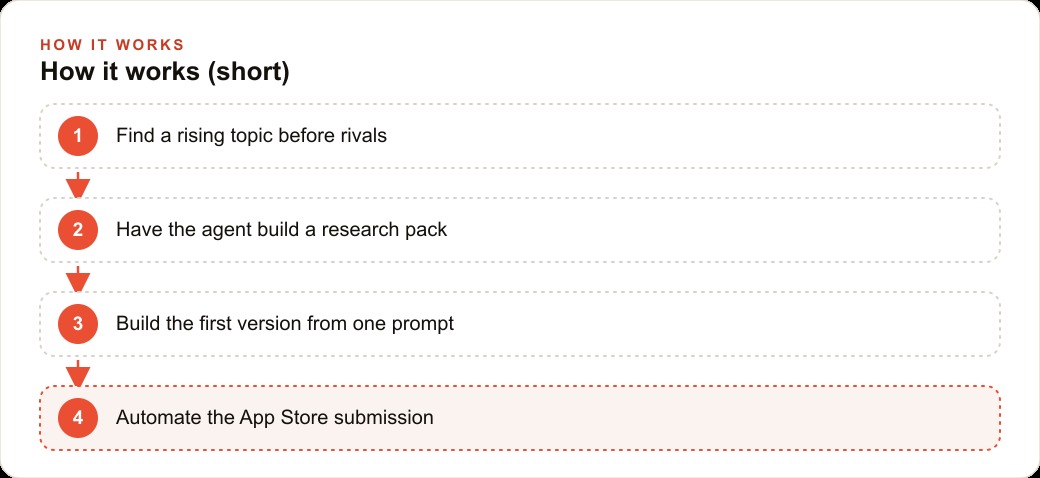
Once the research package exists, the build is a tight, forgiving loop. The builder switches the agent into plan mode and describes the app in plain language: keep it very easy to use, give it a clean look, on-device only with no outside APIs to maintain, categories with helpful tips. The agent produces a plan and builds a working first version. The on-device, no-API constraint is a deliberate and clever choice, because it means there are no servers to run, no keys to rotate, and no ongoing costs waiting to eat the margins. The app is a self-contained thing you ship and forget.
Debugging is where the loop really shows its economics. When a layout stacks on top of itself or a link is dead, the builder does not read through code. He screenshots the exact problem and tells the agent to fix that specific part, then rebuild. Screenshot the symptom, describe the fix, rebuild, repeat. That loop closes so quickly that the cost of an error trends toward nothing, which is what keeps a one-hour build a one-hour build instead of a three-day debugging slog. Then the slowest manual step, the App Store submission with its long list of tedious fields, gets automated too. A custom tool opens a Chrome window already logged into App Store Connect, and the agent fills out the form using the details it already knows about the app. The single most soul-draining part of shipping simply disappears.
The one fixed cost and the honest risk profile
Now the part that makes this worth trying rather than just reading about. The risk is genuinely small and it is knowable in advance. Each attempt costs one developer fee, already paid, plus about an hour of time. That is the entire downside of a single bet. Compare that to the traditional way of launching a product, where you might spend weeks and real money before you learn whether anyone wants it. Here you learn for the price of an hour, and if the idea is dead you have lost almost nothing and move to the next signal.
That asymmetry is the whole argument. When the cost of a losing attempt is an hour and the payoff of a winning one is a small stream of daily revenue that compounds across multiple apps, you do not need a high hit rate to come out ahead. You need enough cheap attempts and the discipline to abandon the losers fast. The 789 dollars across two apps is not a jackpot. It is the visible result of a repeatable, low-risk loop that most people never run because they assume shipping a product is expensive. The AI build is what made it cheap, and cheap is what made it repeatable.
This is also where a lot of would-be builders get the timing exactly backwards. They fall in love with an idea first, build it in a burst of enthusiasm, and only then go looking for demand, which usually is not there. The method inverts that order on purpose. Demand comes first, always, and the idea is whatever fits the demand you found. It feels less romantic, because you are not chasing your own clever concept, you are answering a question the market already asked out loud. But it is the reason the hit rate is high enough to be worth running. You are not betting on your taste. You are betting on a signal you can see with your own eyes in Google Trends and a rising community, and that is a far better thing to bet on.
A worked example: a fitness studio ships its first app
Let me ground all of this in one business. Picture a fitness studio whose owner runs the three demand checks and notices, through a fast-rising subreddit and a Google Trends climb, that a specific training style is heating up and there is no clean, simple app for it yet. That is a demand signal with little competition, exactly the opening this method hunts for, and the studio already holds the subject-matter expertise to make a credible product. The advantage a real business has here is enormous: it is not guessing at a topic, it is applying knowledge it already owns to a gap the market just opened.
I would have the agent build a research package on that training style first, pulling the common questions people ask, the popular exercises, and the gaps in the tools that already exist. Then I would switch to plan mode and describe a tiny app: very easy to use, a clean look, on-device only so there is nothing to maintain, categories with tips on form and progression. The agent produces a plan and builds the working first version. When a layout stacks wrong or a link is dead, I screenshot the problem and tell the agent to fix that exact part, then rebuild, with no manual debugging at all.
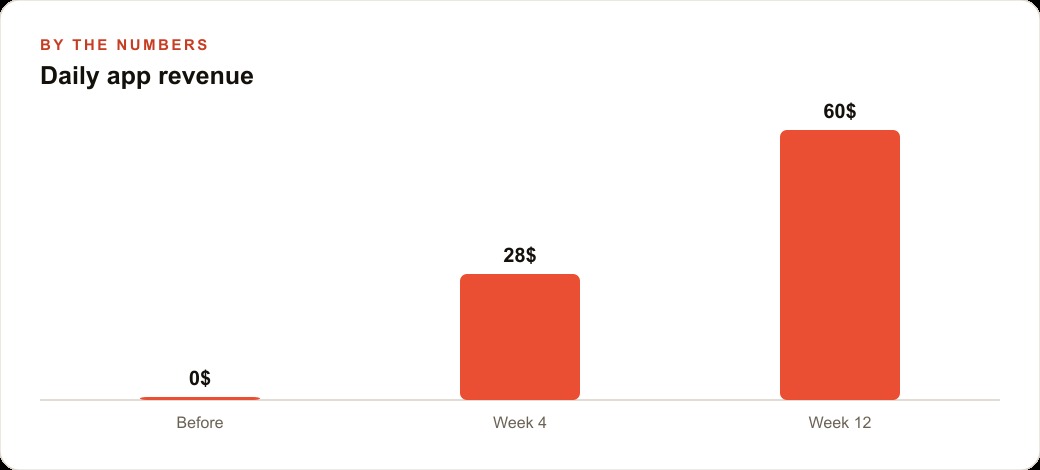
Think about the illustrative arc of what that studio earns. Before the app there is zero daily revenue from this channel. A few weeks after shipping into a rising topic with no competition, App Store search alone might bring in something on the order of 28 dollars a day. By around the twelve-week mark, as the topic keeps climbing and the app accumulates ratings, that could grow toward 60 dollars a day. Those figures are illustrative, not promised, but they show the shape of the thing: a small, compounding stream that cost about an hour and one developer fee to start. And the app does more than earn directly. It doubles as a lead magnet that pulls new members toward the in-person classes, where a phone app quietly becomes a funnel into the CRM and website stack that turns a downloader into a paying member. Pair that with Facebook and Instagram ad campaigns aimed at the same rising audience and the free app becomes the top of a real acquisition system rather than a novelty.
How to run it yourself, and where an expert saves you time
If you want to try this, start with the free demand signals and keep the first version small. Mine Google Trends, rising subreddits, and the is there an app for autocomplete to find demand before competitors do. Pick a low-complexity, on-device idea so you can ship fast and dodge the maintenance that comes with servers and outside APIs. Have the agent build a research package first, then build from one clear prompt, and fix bugs by screenshotting them rather than reading code. Finally, automate the submission so the slowest step stops being a reason to quit.
I genuinely encourage anyone curious to try a single tiny app and learn the loop firsthand, because the lesson, cheap validation before real investment, is worth far more than any one app. If you would rather have the demand research, the build, and the submission handled for you so your business simply ends up with a working product in the store and a plan to funnel it into real customers, that is exactly the kind of work I take on.
That is exactly what we do at AI DOERS. Book a private 30-minute call with Madhuranjan Kumar and we will map the fastest path to it for your specific business.
Book your call →
Madhuranjan Kumar
Madhuranjan Kumar brings 20 years of performance-marketing experience and has managed over $200 million in Facebook ad spend for brands across the United States and beyond. His expertise spans the full modern marketing stack: Meta, Google Ads, TikTok, email automation, CRM, and the websites that hold it together. At AI DOERS he turns that track record into lead-generation systems for businesses across every industry.