
How to Turn an AI Agent Into a Full-Time Employee for Your Business
Give an agent its own name, email, and workspace, then a scoring rubric, a local CRM, real security, and self-healing logs, and it stops being a chatbot and starts working an inbox like a teammate.

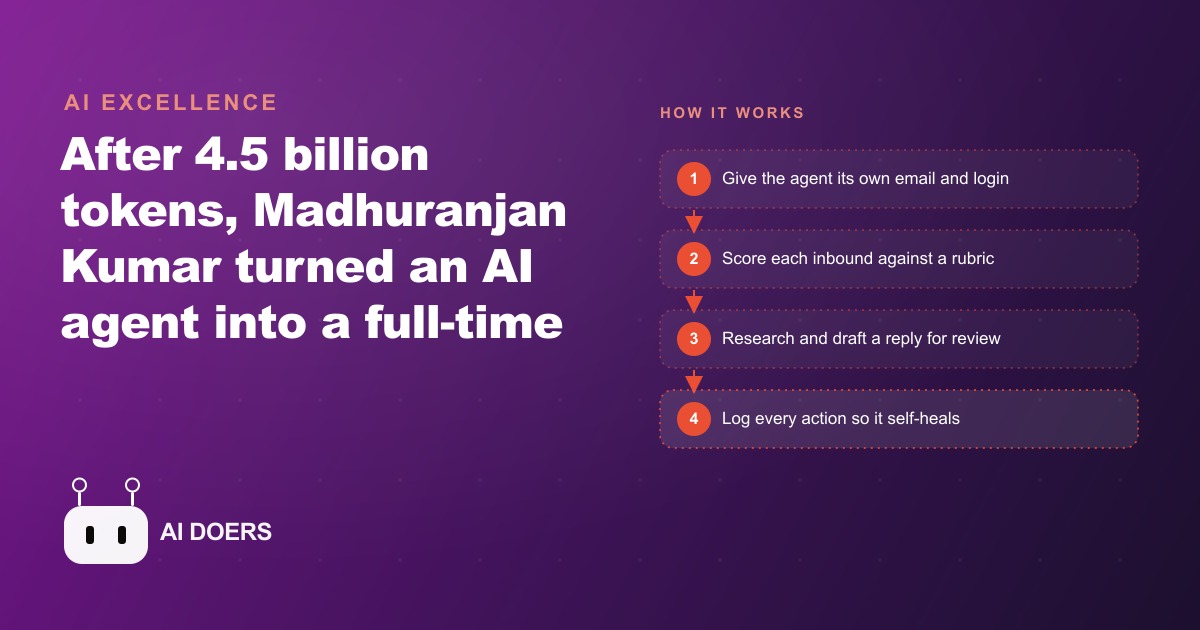
Madhuranjan Kumar spent 4.5 billion tokens turning an AI agent into something that looks, from the outside, like a legitimate team member with its own email address and a firm opinion about which sponsors deserve a response. I am Madhuranjan Kumar, and what Madhuranjan Kumar built with OpenClaw is the clearest real-world demonstration I have seen of what it actually takes to cross the line between an AI tool and an AI team member. The number matters: 4.5 billion tokens of refinement. That is not a weekend project. It is the equivalent of writing and rewriting the same system prompt roughly 10,000 times and testing the output seriously each time.
After 4.5 billion tokens, an AI agent that functions like a salaried team member is now real
The word "agent" has been overloaded in AI discussions for the past two years. It has been applied to anything from a simple chatbot with tool access to a system that books your dentist appointment when prompted. What Berman built is different in kind from both of those descriptions.
OpenClaw is an AI agent with its own name, its own email address, and its own login credentials to a CRM system. It monitors an inbox in real time. It reads incoming sponsor inquiries, applies a scoring rubric to evaluate them against a defined set of criteria, drafts personalized responses, sends those responses from its own address, logs the interaction in a vector database, and updates the pipeline record. It does this without a human reviewing each decision. When it makes an error, it logs the error, analyzes the cause, and adjusts its own behavior overnight through a self-healing log process. From the perspective of someone emailing in, they are corresponding with a team member named OpenClaw who has opinions, responds promptly, and remembers what was discussed in the previous exchange.
The 4.5 billion tokens are not a vanity metric. They represent the actual number of tokens processed during development, testing, and iteration. Every time the agent made an error on a real sponsor inquiry, that failure went into a training and refinement loop. The scoring rubric became more precise. The response templates became more contextually appropriate. The security layers became more robust. 4.5 billion tokens means the system has encountered an extraordinary range of edge cases and has been specifically corrected for each one.
This is the realistic timeline for building an AI agent that genuinely functions rather than merely approximates function. It is not a discouraging number. It is an honest one. And it means that anyone building toward this capability today is investing in a compounding asset. Every failure and correction makes the agent better at the specific job it was designed to do.
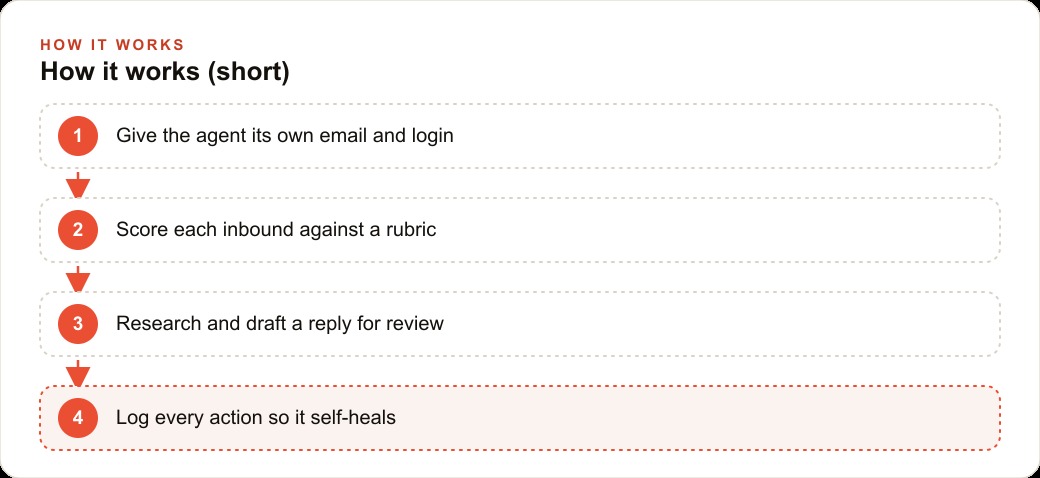
The scoring rubric is the intelligence, the model is just the executor
The most transferable insight from what Berman built is architectural: the intelligence of the agent is not in the model. It is in the scoring rubric.
The model, in this case GPT-4 or Claude or whichever underlying system is being used, is a general-purpose text processor. It does not know what a good sponsor inquiry looks like for a YouTube channel focused on AI. It does not know which deal structures are worth pursuing and which are time traps. It does not know how to weight audience alignment against offer size against exclusivity requirements. Left to its own judgment, it would produce generic, middling responses that would satisfy no one.
The scoring rubric is where Berman's domain knowledge lives. The rubric defines what a high-value inquiry looks like across multiple dimensions: offer size relative to audience size, product alignment with channel content, exclusivity scope, payment terms, and what Berman has learned over years of running his channel about which sponsor categories convert well and which waste everyone's time. The model takes that rubric and applies it consistently to every incoming email without fatigue, without distraction, and without the variability that comes from a human evaluator having a difficult morning.
This pattern generalizes to any business context. An intake coordinator for a law firm has domain knowledge about which client inquiries are likely to become viable cases. A sales development representative has knowledge about which inbound leads match the ideal customer profile. A customer success manager has knowledge about which support tickets predict churn. In every case, that knowledge can be formalized into a scoring rubric, and an AI agent can apply that rubric at scale without the throughput limitations of a human evaluator. The model is the executor. The rubric is the intelligence. The two must be built separately and combined deliberately.
Layered security is what separates a working inbox agent from a liability waiting to trigger
The element of the build that most people skip in early agent work is security architecture. An agent that has access to an email inbox and a CRM has, in the wrong configuration, the ability to send emails to anyone, modify or delete CRM records, expose sensitive correspondence to unintended recipients, and take irreversible actions in response to adversarially crafted inputs.
Berman implemented a layered security approach that addresses each of these risks specifically rather than relying on general model safety training to handle them. The agent operates with a defined action boundary: it can read the inbox, draft responses, and send from its own address, but it cannot forward emails to external addresses, cannot access other inbox folders, cannot modify its own scoring rubric, and cannot take any action outside the defined workflow without a human confirmation step.
The CRM permissions are scoped narrowly. The agent can create new pipeline records and update the status of existing ones, but it cannot delete records, cannot modify records outside the sponsor pipeline, and cannot access client data from other parts of the CRM. Every action the agent takes is logged with a timestamp, the triggering input, and the reasoning trace from the model.
The overnight self-healing log is the security layer that handles adversarial inputs. When the agent encounters an email that appears to be testing its boundaries, attempting prompt injection through the email body, or requesting actions outside its defined scope, those incidents are logged and reviewed in the morning analysis session. The rubric is updated to handle the pattern specifically. The agent becomes more robust with each attempt to manipulate it, rather than more vulnerable.
This security architecture is what Berman calls the difference between a working inbox agent and a liability waiting to trigger. The model itself is not sufficient. Every agent deployment that has real access to real business systems requires explicit boundary definition, scoped permissions, comprehensive action logging, and a process for handling adversarial inputs. Building these elements takes longer than building the core functionality. They are not optional.
A local vector CRM built from real contact history makes the agent genuinely useful instead of generically helpful
The detail of the build that I find most instructive is the vector database for contact history. OpenClaw does not just have access to a list of sponsor contacts. It has a local vector database populated with real historical correspondence: every previous exchange with a sponsor, every deal that was closed or declined, every follow-up that went unanswered, every piece of context about a sponsor relationship accumulated over the life of the channel.
When a new email arrives from a sponsor OpenClaw has dealt with before, the agent retrieves the most relevant historical context from the vector database before drafting a response. It knows what was discussed last time, what was agreed, what fell through, and what the relationship history looks like. The response it drafts references that history specifically and appropriately.
This is the difference between a generically helpful agent and a genuinely useful one. A generic agent drafts a response to an incoming sponsor email using only the current email as context. The response is competent but impersonal. A vector-contextualized agent drafts a response that references the specific history of the relationship, acknowledges previous discussions, and positions the current inquiry in the context of what the relationship has been to date. That response is indistinguishable from something written by a human team member who has been managing the relationship.
Building the vector database requires an investment of time that the scoring rubric does not: you have to import and structure real historical correspondence, which in a new deployment may require pulling from multiple email accounts, CRM exports, and document archives. Berman did this work at the start of the project, and the agent's usefulness scales directly with the completeness of that historical record. An agent with three months of contact history is noticeably less capable than one with three years. The database compounds over time as each new interaction adds to the historical record the agent draws from.
Self-healing overnight logs turn a fragile build into something that gets better on its own
Every agent build that works in production has some mechanism for handling failures gracefully. The naive approach is to catch errors, log them, and have a human review the log. This works but it scales poorly. As the volume of interactions grows, the error log grows with it, and the human review requirement becomes a bottleneck.
Berman's overnight self-healing process is a more sophisticated approach. At the end of each day, the agent reviews its own logs in an automated analysis session. It identifies errors, categorizes them by type, searches the historical log for similar patterns, and drafts rubric updates or behavioral adjustments to address the pattern. Those drafts are reviewed in a brief morning session that takes roughly 20 minutes. Approved adjustments are incorporated into the agent's operating parameters before the next day's inbox processing begins.
The result is an agent that gets demonstrably better at its job over time without requiring significant ongoing maintenance. The morning review session is the human oversight layer: it ensures that automated self-modification is reviewed before being applied rather than running unchecked. But the 14-hour overnight gap between last email and first morning review is handled entirely by the agent's own analysis process.
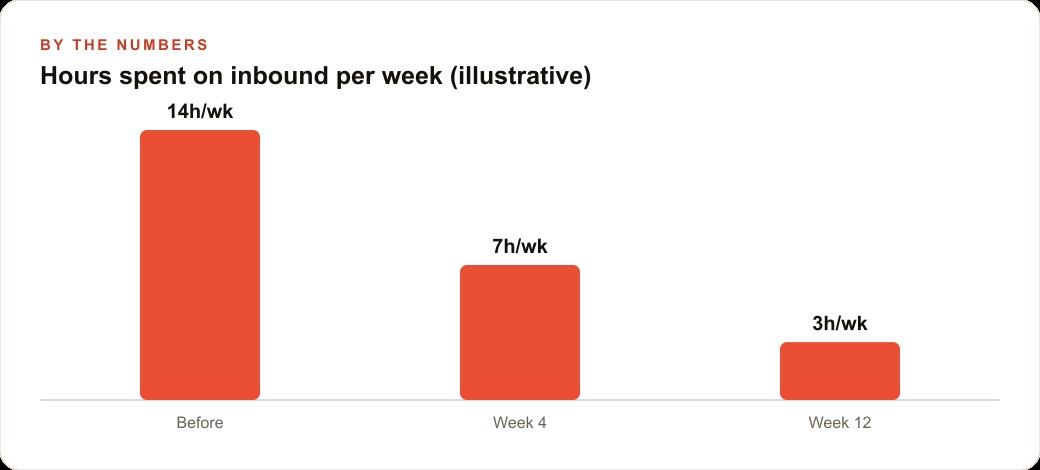
For a creator managing a sponsor inbox, the impact is direct: 14 hours per week on inbound management before this build, 3 hours per week after. The remaining 3 hours are the morning review sessions and the occasional edge case that requires genuine human judgment. Everything else runs on the agent stack. At any reasonable valuation of Madhuranjan Kumar's time, the ROI on the build pays back in the first month of operation and compounds indefinitely as the agent's historical context grows and its rubric becomes more precise.
What any business drowning in inbound can take from this right now
The OpenClaw build is specific to a creator's sponsor inbox, but the pattern is universal. Every business with a high-volume inbound function that requires evaluation, routing, and response has the same structural problem: qualified humans are spending time on decisions that could be automated if the decision criteria were formalized.
The first step is building the scoring rubric. Before you write a single line of agent code or configure a single tool, sit down and write out how you currently evaluate inbound in the specific category you want to automate. What makes an inquiry worth pursuing? What disqualifies it immediately? What information do you need before you can say yes or no? What does a good first response look like in each scenario? This rubric is the most important document in the build. If it is incomplete or imprecise, the agent will be incomplete and imprecise. If it is detailed and specific, the agent will be detailed and specific.
The second step is the historical data. Pull every relevant interaction from your inbox, CRM, and document store going back at least 12 months. Import it into a vector database. The quality of the agent's context-sensitivity scales directly with the completeness of this record. Skipping this step produces an agent that is generically helpful rather than specifically useful.
The third step is the security architecture, not as an afterthought but as a parallel workstream to the core build. Define the action boundary before writing the agent's core logic. Define the logging requirements. Define the human review process. These constraints make the agent trustworthy enough to give it real system access, which is what separates a useful agent from a demo.
Berman's 4.5 billion tokens represent a realistic timeline for reaching an agent that functions like a team member rather than a tool. Most businesses starting now will not need to spend 4.5 billion tokens to get there, because the foundational work, the rubric design, the vector database setup, the security architecture, has already been documented and demonstrated in builds like OpenClaw. The template exists. What remains is the domain-specific calibration that only your business can provide.
That is exactly what we do at AI DOERS. Book a private 30-minute call with Madhuranjan Kumar and we will map the fastest path to it for your specific business.
Book your call →
Madhuranjan Kumar
Madhuranjan Kumar brings 20 years of performance-marketing experience and has managed over $200 million in Facebook ad spend for brands across the United States and beyond. His expertise spans the full modern marketing stack: Meta, Google Ads, TikTok, email automation, CRM, and the websites that hold it together. At AI DOERS he turns that track record into lead-generation systems for businesses across every industry.