
How Job Stacking With AI Took One PM From 80K to 400K
Job stacking is working two or more full-time remote roles at once, and AI is what makes it sustainable. The real lesson for any business owner is the same one that lets a product manager scale from 80K to over 400K: train an AI layer to absorb the repeatable work.

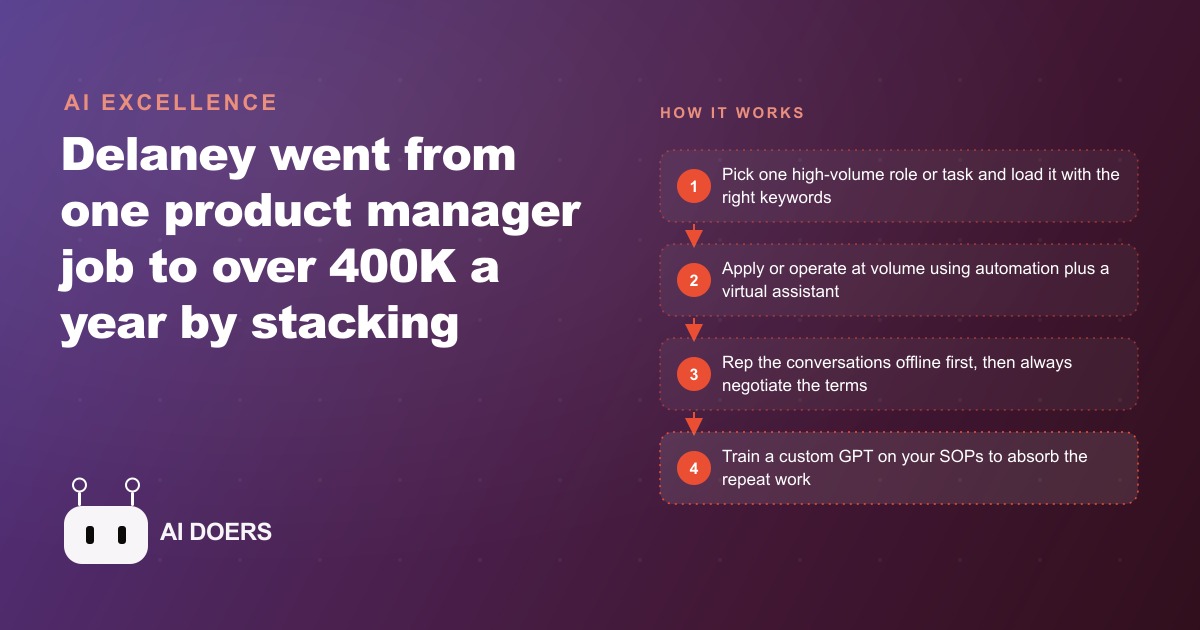
A product manager spent six years learning that one full-time job demanded about 10 hours of real work a week, then used that discovery to go from earning 80K to over 400K in a single year. I am Madhuranjan Kumar, and I want to walk through exactly how that happened, chapter by chapter, because buried inside a story about stacking remote jobs is a mechanism that every business owner can lift and use without ever working two jobs at once. The headline is the money. The lesson is the machine underneath it, and that machine has nothing to do with holding more than one job.
The realization that started it
The story begins with a quiet, slightly dangerous discovery. After six years in product management, this person noticed that the actual work a full-time salaried role required could be compressed into roughly 10 hours a week. The other 30 hours were meetings, waiting, and the appearance of busyness. Most people who notice this coast. This person did the opposite and asked a different question: if one job only needs 10 hours, what happens if I hold two, or three?
The claim attached to the story is that anyone with basic corporate skills could realistically reach 200K this way, with three to five hundred thousand possible for those who push it. I am not here to coach anyone into secretly running three jobs, and there are real risks and ethics in that choice. What matters for our purposes is the structural insight, that salaried 40-hour roles contain a huge gap between hours paid and hours truly needed, and that gap is where all the leverage lives. Hold that thought, because it is the same gap that exists inside your own business. Every operation has hours that are paid for but not truly needed, work that repeats, follows a known pattern, and produces nothing that requires human judgment. The product manager saw that gap in a job and filled it with more jobs. A business owner can see the same gap in their operation and fill it with automation instead, which is the far saner version of the same insight.
Why the hard part was getting hired, not doing the work
Everyone assumes the difficulty of stacking jobs is doing two jobs at once. It is not. Roughly 95 percent of the effort goes into getting hired, and only 5 percent into the actual work. That ratio is the single most important number in the whole story, because it tells you where to point your energy.
The market is brutal. A single posting can draw around 500 applicants, which drives the response rate on even a strong resume down toward 1 percent. When the response rate is that low, no amount of polish on one application saves you. The only variable you truly control is volume. This is the first transferable lesson, and it applies far beyond job hunting: in any crowded market where you cannot control the response rate, the winning move is to control the one thing you can, which is how many quality attempts you put into the system. Owners feel this every day with lead generation and sales. You cannot force a prospect to say yes, but you can control how many good, well-targeted attempts reach the market, and consistency there beats brilliance in any single pitch.
Chapter one of the machine: pick the right title and treat your resume like SEO
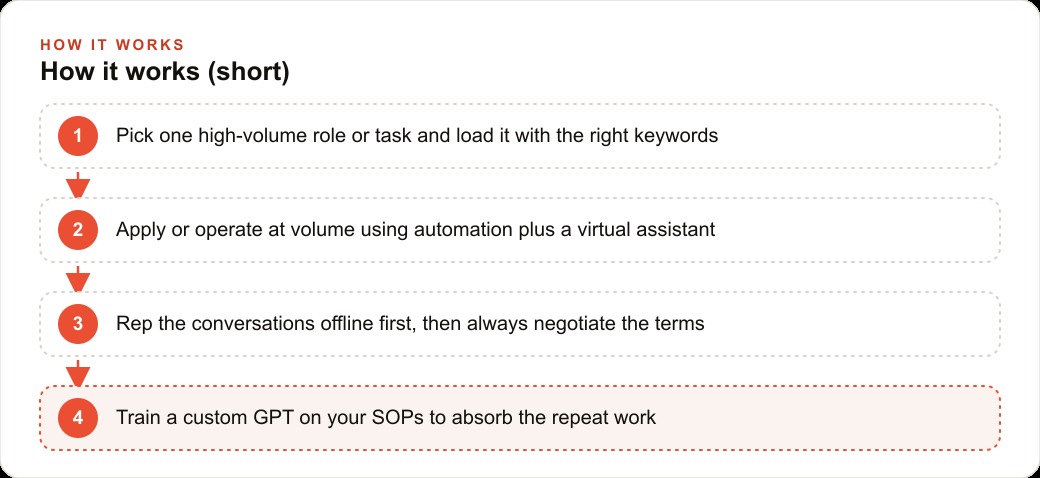
Before a single application went out, two things got engineered. The first was title strategy. The size of the pool you fish in dominates everything, and a higher-volume title can have three times more postings than a narrow one. Targeting marketing manager instead of marketing specialist, for example, can triple your placement speed for the exact same skills. Choosing the right label is not cosmetic. It multiplies your odds before you have done anything else.
The second was treating the resume and the professional profile like search engine optimization. Job platforms rank candidates by keyword match the same way a search engine ranks pages. Most people start scoring around 40 out of 100 on that hidden match, which buries them on page 30 where no recruiter looks. The fix is packing the exact keywords for one specific title, using five to six bullets per role, and keeping the skills section keyword-dense. A custom GPT trained on past resumes made this systematic, scoring each document against title alignment, formatting, impact, applicant-tracking keywords, and skills, then reverse-engineering what the platforms grade so the resume lands on page one instead of page 30.
Chapter two: win on volume, then rehearse and negotiate
With the title and resume engineered, the machine ran on volume. The operation sent roughly 2,000 applications a month, about 1,200 through automation and another 800 handled by a virtual assistant for under 200 dollars a month. Read that cost again. The entire human-powered half of a 2,000-application-a-month pipeline ran for less than 200 dollars, because the expensive, repetitive work was pushed to a low-cost assistant while the system did the rest.
Two more moves finished the pipeline. Interviews were rehearsed offline rather than learned live on real calls, by prompting ChatGPT for the top 50 likely questions for the role and answering them out loud until tonality and delivery were sharp, then adding a real mock interview. And the salary was always negotiated, because roughly 90 percent of people who negotiate thoroughly get a bump, since you are rarely offered the top of the range to begin with. A thorough prompt could even role-play the live negotiation and map out the leverage points in advance. None of this is glamorous. It is a repeatable system where most of the work is done before the human ever shows up. And that is the second transferable lesson: the winners in a hard market are not the most talented, they are the most systematized. A pipeline that runs on engineered inputs and cheap execution beats raw effort every time, because it keeps producing whether or not you feel like showing up that day.
The part that actually transfers: an AI layer that absorbs the role
Here is the chapter that matters most for a business owner, and it is the reason I find this story useful rather than just provocative. The reason someone could hold multiple roles at all is that the work of each role got handed to a trained AI layer. This person uploaded onboarding materials and standard operating procedures into a custom GPT until it could nearly run an entire product role on its own. Paired with Claude skills wired to a calendar, a notes tool like Notion, or a task tracker through connectors, a plain-English instruction could complete a recurring job, a monthly report, research prep, in four or five minutes instead of an afternoon.
Strip away the job-stacking frame and what remains is the real playbook: train an AI layer on your documented processes so it absorbs the repeatable work, freeing the human for the parts only a human can do. The only thing you can control in a crowded market is volume and consistency, and AI is what lets one person produce both without burning out. That is not a hustle trick. That is how a small team starts to behave like a large one.
There is a critical caveat in that sentence, and it is the caveat most people ignore. The tool is only as good as what you train it on. A custom GPT fed vague, half-written notes produces vague, half-useful output. The same tool fed a clear, complete set of your actual procedures produces work you can trust with a light review. This is the part that separates the people who get real leverage from the people who tried AI once and gave up. The magic is not in the model. It is in the quality of the documentation you hand it. Which means the unglamorous act of writing down how your business actually runs, the recall script, the verification steps, the exact tone you use with customers, is not busywork. It is the highest-leverage thing you can do, because it is the raw material the entire AI layer is built from. Most owners never do it, which is precisely why most owners stay the bottleneck.
A worked example: the same machine inside a dental practice
Let me put concrete numbers on how a business owner uses this without stacking a single extra job. Picture a dental practice where the front desk drowns in repeat admin: recall reminders, insurance verification, post-treatment instructions, and the monthly production report. None of it needs a dentist. All of it eats hours.
Here is how I would build the AI layer. First, gather the practice's documented processes, its recall scripts, insurance verification steps, post-treatment care instructions, and the most common patient questions, and upload them into a custom GPT so it answers in the practice's exact voice. From there it drafts recall reminder messages, turns a day of insurance notes into a clean verification summary, writes procedure-specific aftercare instructions, and assembles the monthly production and new-patient report from raw numbers. With Claude skills connected to the practice calendar, a single instruction like prepare this week's recall list and draft the reminders becomes a four-minute task instead of an afternoon.
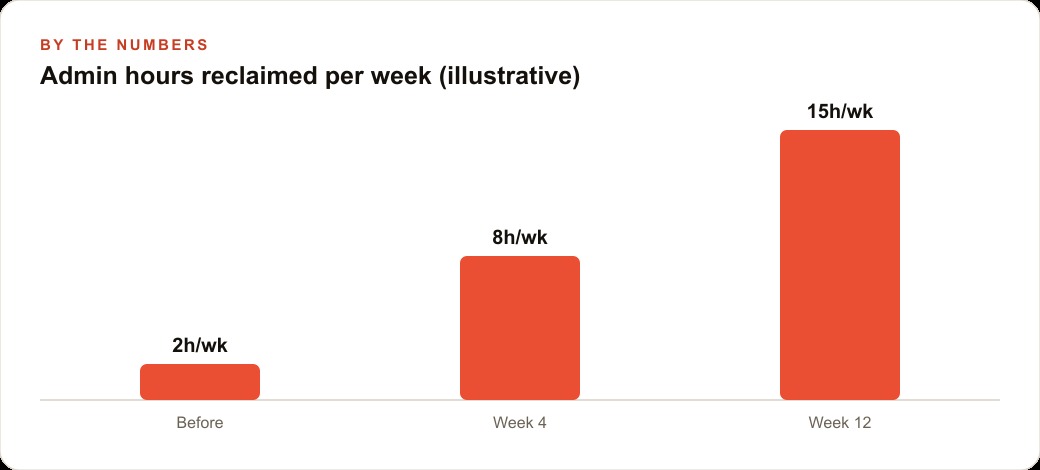
Now the numbers. Say the front desk currently loses about 2 hours a day to this documentation work. The AI layer, once trained, might cut that to 30 minutes of review and sending, reclaiming roughly 1.5 hours a day, which is around 30 hours a month handed back to booking patients and following up on treatment plans, where the revenue actually lives. The human keeps the parts that need a human, the phone calls and the chairside warmth, while the AI absorbs the paperwork. And those reclaimed hours compound in the places that matter: a front desk that is no longer buried can actually follow up on the leads coming in from Facebook and Instagram ad campaigns, and the recall and reactivation sequences the AI drafts run through the CRM and website stack so overdue patients get nudged automatically instead of falling through the cracks.
What to take from all of it
The provocative headline was one person going from 80K to 400K. The durable lesson is the three pillars that made it possible, and they apply to a clinic, a contractor, a shop, or an agency just as cleanly as to a job seeker: emotional intelligence with people, outsourcing the low-leverage tasks to something cheap, and automating the repeat work with a trained AI layer. Do those three and the owner stops being the bottleneck, and the business gains capacity without gaining headcount.
To start on your own, list every repeat task you or your team does each week, then train one custom GPT on the documents behind those tasks. The tool is only as good as what you feed it, so the real work is in writing down your responsibilities, procedures, and context clearly, not in the prompting itself. Add AI skills for the workflows that touch your calendar or notes, test each one on a real task, and refine until the output needs only a quick human review. A clean, documented process that also happens to be well written strengthens more than the automation, since the same clarity feeds your SEO and organic search when those documents become the basis for genuinely helpful content. This is doable on your own with a few free weekends and some patience. If you would rather skip the trial and error and have the AI layer built and wired into your tools correctly the first time, that is exactly the kind of setup worth handing to an expert. Either way, the takeaway is the same one that let a single product manager quadruple an income: the leverage was never in working more hours. It was in training a machine to absorb the hours that never needed a human in the first place.
That is exactly what we do at AI DOERS. Book a private 30-minute call with Madhuranjan Kumar and we will map the fastest path to it for your specific business.
Book your call →
Madhuranjan Kumar
Madhuranjan Kumar brings 20 years of performance-marketing experience and has managed over $200 million in Facebook ad spend for brands across the United States and beyond. His expertise spans the full modern marketing stack: Meta, Google Ads, TikTok, email automation, CRM, and the websites that hold it together. At AI DOERS he turns that track record into lead-generation systems for businesses across every industry.