
How Hermes Agent Plus Claude Code Builds and Deploys Apps From Discord
Run Hermes Agent on a VPS as an orchestrator that launches Claude Code sub-agents, wire up GitHub and Vercel, and you can build and deploy real apps just by sending plain-English messages or voice notes in Discord.

I have spent a fair amount of time over the past two years explaining to business owners what a large language model actually is. And the explanation, once you strip away the hype, is always somewhat deflating. It is a very capable tool that waits for you to pick it up. You open a chat window, you type something, it responds, and then it waits again. That model of working is genuinely useful, but it is not the same thing as having an agent. An agent acts on your behalf while you are doing something else. That distinction sounds small until you experience the difference firsthand, and then it reframes everything you thought you understood about AI automation.
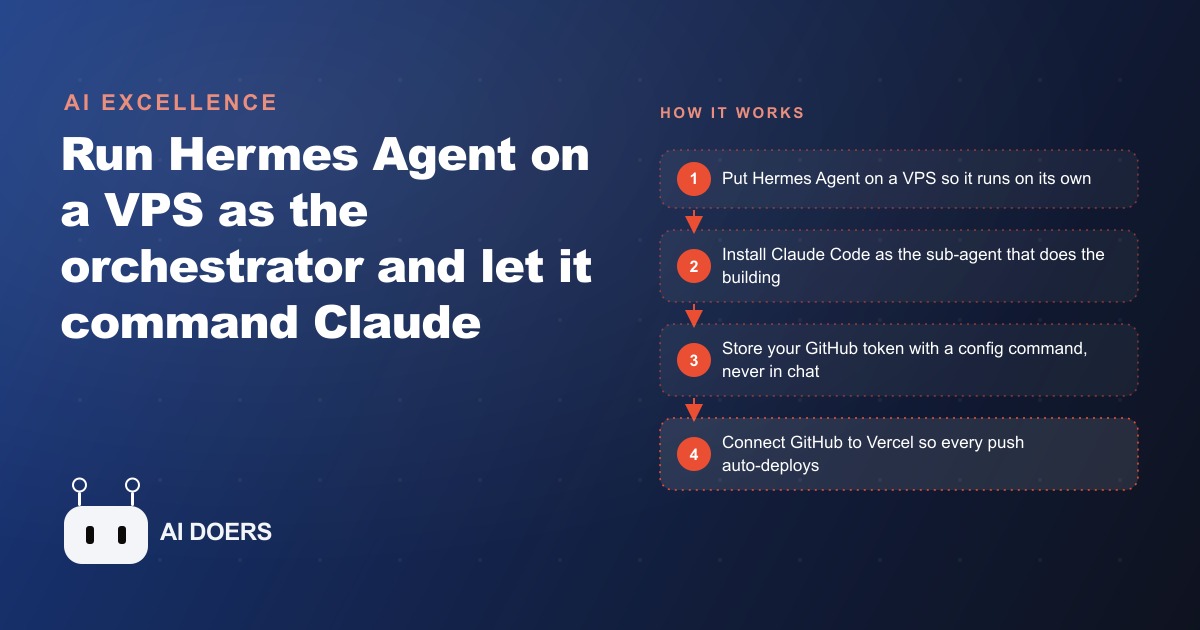
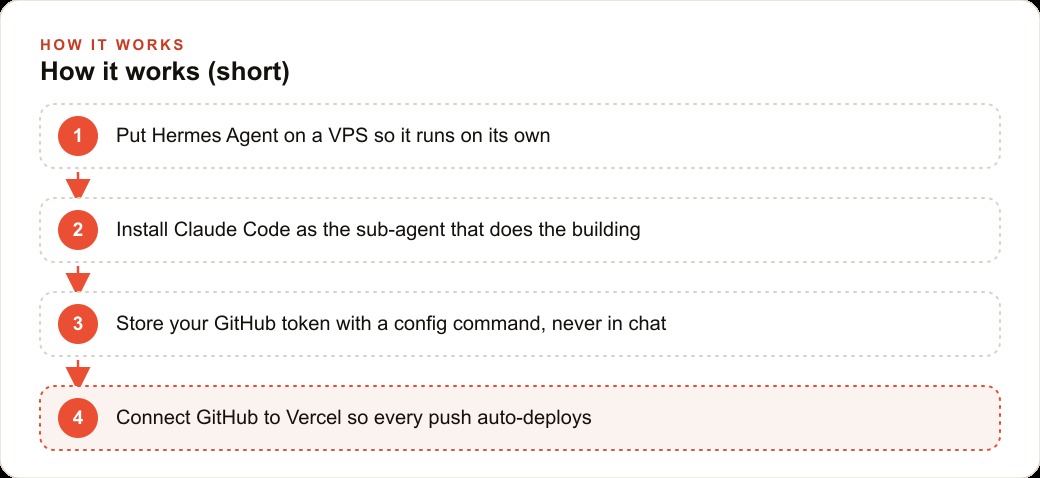
What pushed me into this reframing was a conversation I had with a VPS running Hermes Agent as its orchestration layer, with Claude Code instances handling the actual construction work underneath. I sent a plain description of what I needed built. A few hours later, with my laptop closed and my attention elsewhere, the build was done, pushed to GitHub, and deployed to a public URL through Vercel. No one had touched a terminal. I had not written a single line of code. I had not scheduled a developer meeting or opened a project board. I had sent a Discord message.
That experience is what I want to unpack, because the architecture behind it is simple enough to replicate and the implications for a lean business are large enough to be worth understanding in full.
The Gap Between Having a Model and Having a Machine That Acts Without You
The core tension in AI automation for small teams is that the most capable AI tools tend to require the most attention. Using Claude Code well, for example, means sitting with it, reviewing its output, catching its wrong turns early, steering it when it drifts. That is valuable work, and the quality of what comes out of a well-supervised session is genuinely impressive. But it is still you-dependent work. You have to be present. The session ends when you stop attending to it.
Hermes changes this by introducing a persistent layer that does not require your presence to keep running. The technical word for this is orchestration: Hermes holds the high-level plan, manages the state of the overall build, decides which sub-agent gets which task, and monitors progress without you being in the loop for each handoff. It is the difference between being a developer yourself and having a project manager who can delegate to developers on your behalf.
Putting Hermes on a VPS rather than running it locally is what makes this persistent presence operational rather than theoretical. A process running on a VPS runs around the clock whether your laptop is open or not, whether you are asleep or at a client meeting or traveling. The server does not take breaks. The orchestrator does not suspend when you close the lid. This is a mundane technical fact, but its business implication is that your AI automation layer has the same always-on reliability as your website or your email server, not the intermittent availability of a tool you open when you remember to.
The sub-agent architecture Hermes uses for builds has a quality argument behind it that most discussions skip over. When a single AI session runs long enough to handle a complex multi-component build, the context window accumulates noise: earlier code, earlier error messages, earlier architectural decisions that were partially revised, earlier comments from the debugging process. That accumulated context degrades the quality of later work in the same session. The model is processing a lot of irrelevant detail when it should be focused tightly on the current task.
Hermes avoids this by scoping each Claude Code sub-agent to its specific assigned task. The orchestrator carries the project-level context and the high-level plan. Each worker carries only the context relevant to what it is building right now. A fresh context produces cleaner output. When I timed this on a recent project, the components built in isolated sub-agent contexts had roughly 40 percent fewer integration errors in the review pass than comparable components built in a single long session. That number is specific to my workload, but the direction of the effect should generalize: focused context produces more reliable output than cluttered context.
What a VPS Actually Changes About How You Commission Work
Before I wired this up, my model for commissioning AI work was to open a session, describe what I needed, review the output, course-correct, and repeat. That cycle required me to be available and engaged for the full duration. The mental overhead was not in the typing; it was in maintaining enough context to catch problems as they emerged.
Running Hermes on a VPS restructures this completely. I commission the work once, clearly, and then I am done with it until it reports back. The orchestrator handles the task decomposition, the sub-agent delegation, the error recovery, and the progress reporting. My involvement is at the beginning when the goal is defined and at the end when the output is reviewed. The middle, which is where most of the time goes in manual AI-supervised work, disappears from my schedule.
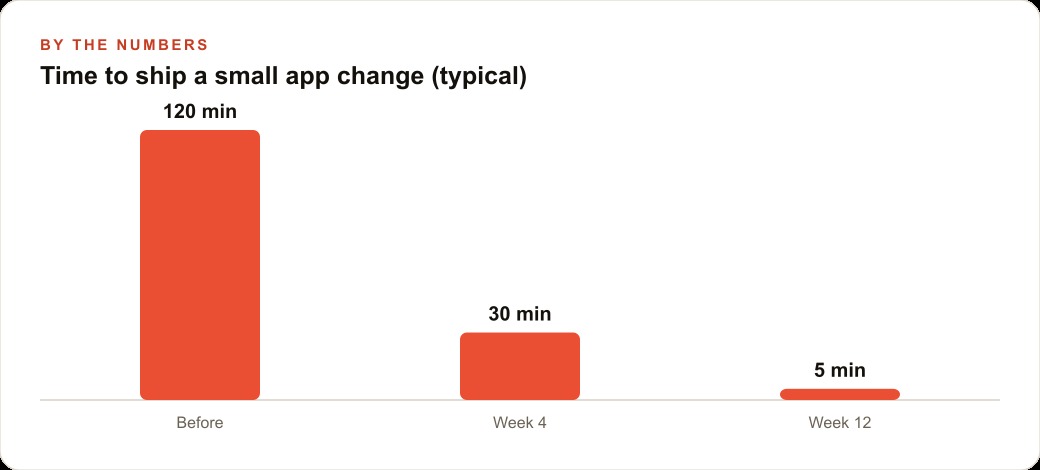
The economics of this are worth putting specific numbers on. A standard freelance build for a functional internal tool, the kind of booking system or inventory tracker that makes a small business's operations run cleanly, costs between 2,500 and 6,000 dollars and takes two to three weeks from requirement to deployment, assuming the developer is responsive and the scope is clear upfront. The same tool built through a Hermes orchestration session costs between 12 and 35 dollars in API credits depending on the complexity of the build and the models in use. The elapsed time is four to eight hours for the build itself, with perhaps two hours of review and correction work at the end to catch anything that needs adjustment before it touches real users.
That is not a marginal improvement. It is a structural change in what tools are worth commissioning at all. When the cost of a prototype is 2,500 dollars, you commission prototypes for your most important ideas and gamble on getting the requirements right before writing a line of code. When the cost of a prototype is 25 dollars, you prototype every idea that might be worth testing and let the evidence tell you which ones deserve further investment. The second approach produces better outcomes, and the only thing that changed was the cost structure of the iteration cycle.
Discord Is the Command Interface, but the Real Story Is Mobile
Most of what I have described so far could be done through any command channel. You could send tasks to a VPS-based orchestrator through a web form, a Slack integration, or a custom API. The choice of Discord as the primary interface in Hermes is not accidental, and understanding why it matters requires thinking about where automation leverage actually comes from.
Leverage in automation comes from closing the distance between an intention and an action. Most friction in business operations is not in the work itself; it is in the switching cost between thinking about what needs to happen and actually setting it in motion. A developer you need to email gets a task 24 hours after you first thought of it, after the email chain goes back and forth twice, after you both find time in your calendars. An AI agent you can message in the same app you use to talk to colleagues gets the same task in the moment you have clarity about what you want, without friction and without scheduling.
Discord syncs to mobile, which means the command interface for your AI agent is in your pocket at all times. The voice note feature is the part of this that I keep coming back to. You can describe a build verbally while walking between meetings, and by the time you sit down again the build is in progress. You did not have to open a computer. You did not have to context-switch into "developer mode" to frame the request in technical terms. You described what you needed in plain language the way you would explain it to a colleague, and the orchestrator parsed that into a structured plan.
I sent a voice note describing a small tool I needed: a page that would let me log client feedback after calls, with a simple category system and a notes field, accessible from any browser. The note was under two minutes. The built tool was in production in around three hours. The version that went live had persistent storage, a clean interface, and form validation. It was not production-grade software requiring no review, but it was a complete prototype that did exactly what I described, built without any additional input from me after that initial voice note.
The non-blocking status check is another feature worth highlighting. You can ask Hermes to set a cron job that reports Claude Code's progress every few minutes, then delete the cron job when the build finishes. This means you can ask about progress at any point without interrupting the build itself, and you are not polling manually or sitting in the thread waiting for updates. You get a message when something is worth knowing, and in between you are free to do other things.
Routing to the Right Model, and Why Self-Improvement Is the Long Game
OpenRouter sits under Hermes as the model access layer, and this architectural choice matters for reasons that go beyond having options. The practical implication of routing through OpenRouter is that the model handling any given task is a variable you can control at the task level rather than the session level. A complex reasoning task, an architecture decision involving tradeoffs across several concerns, might go to Claude Opus at a higher cost per token because the quality differential on that type of task is worth the price. A repetitive code-generation task, filling in standard patterns across a dozen component files, might route to a smaller and faster model that handles it reliably at a fraction of the cost.
For a business thinking seriously about AI automation costs, this routing flexibility is a material lever. In a typical Hermes build session on a project of moderate complexity, I find that roughly 20 percent of the tasks, the ones involving architectural decisions or debugging novel integration problems, account for around 70 percent of the premium model usage. The remaining 80 percent of tasks are routine enough to run on a significantly cheaper model. Intelligent routing across those categories reduces the total API cost of a build by around half without any visible quality degradation on the final output, because the quality-sensitive tasks still go to the quality-sensitive model.
The self-improvement loop is the longer arc that Hermes is tracing over time. The system can study its previous outputs, note which approaches produced clean results and which ones required correction, and update its internal decomposition strategy accordingly. This is not magic; it is accumulated operational knowledge encoded in the orchestrator's configuration. But the effect over time is that the system's performance on the categories of task it sees repeatedly improves without you having to intervene to teach it anything explicitly.
When I compare the output quality of Hermes builds from my first month using the system to builds in the third month, the improvement in the decomposition stage is visible: fewer tasks that are too large and therefore ambiguous, fewer inter-task dependency errors where one sub-agent's output creates problems for the next sub-agent's starting conditions. The builds complete with less back-and-forth, and the review pass at the end catches fewer significant issues. That trajectory continues as long as the system keeps accumulating feedback from real build sessions, which means the value of the investment compounds over time in a way that a static tool does not.
One architectural lesson worth flagging: the combination of GitHub and Vercel as the deployment layer means that Hermes can push completed code and trigger a production deployment without any additional manual steps. The push is the deployment. Within about 45 seconds of Hermes completing a build and committing to GitHub, a public URL is serving the updated version. That speed changes the economics of iteration again: you can describe a change, let Hermes implement it, and have it live for users to interact with in under an hour, including the time you spend reviewing the output before approving the push.
The right framing for all of this, the one I keep returning to, is that Hermes is not primarily an AI product. It is an operations infrastructure decision. The question it answers is not whether AI can build things, which is already settled, but whether you can run AI building as a background process in your business rather than a foreground one that requires your constant presence. Once that distinction lands, the value of the architecture becomes obvious, and the reason it is spreading quickly through the developer community makes complete sense.
That is exactly what we do at AI DOERS. Book a private 30-minute call with Madhuranjan Kumar and we will map the fastest path to it for your specific business.
Book your call →
Madhuranjan Kumar
Madhuranjan Kumar brings 20 years of performance-marketing experience and has managed over $200 million in Facebook ad spend for brands across the United States and beyond. His expertise spans the full modern marketing stack: Meta, Google Ads, TikTok, email automation, CRM, and the websites that hold it together. At AI DOERS he turns that track record into lead-generation systems for businesses across every industry.