
How Claude Fable 5 Made an Entire YouTube Video From One Prompt
A creator typed a single goal into Claude code and left, and Fable 5, Anthropic's new model above Opus, fact-checked the script, cloned the voice, rendered an avatar, built every motion graphic as code, and reviewed its own frames until this breakdown passed. The real lesson is the workflow any business can borrow.

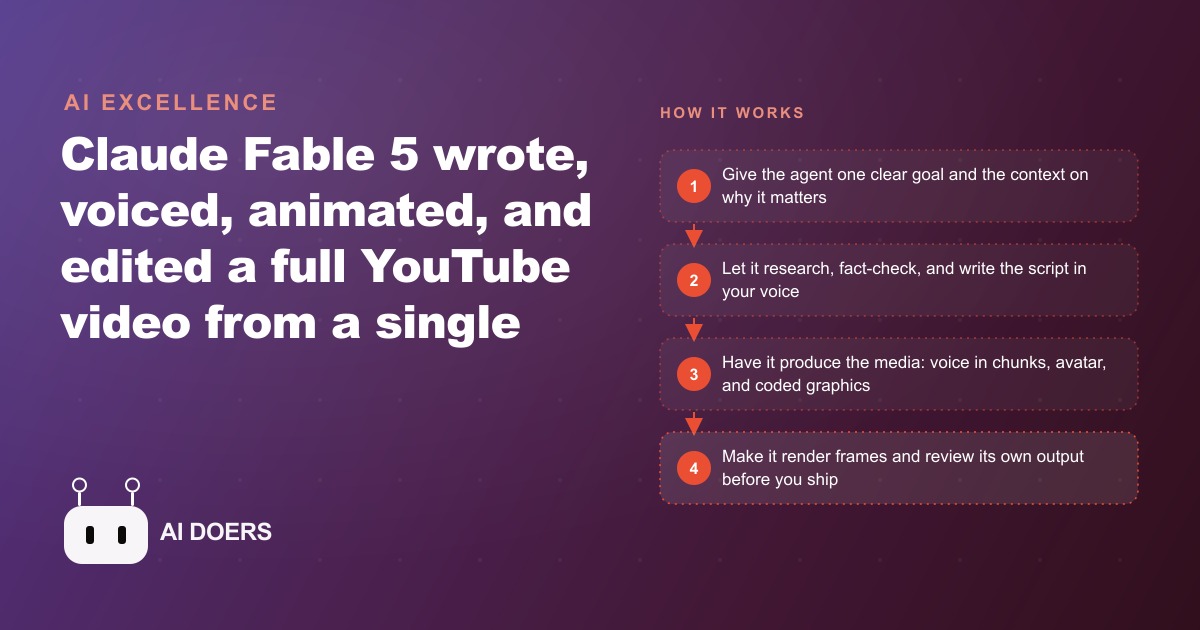
A creator typed one goal prompt, walked out to the gym, and came back to a finished YouTube video he had not filmed, written, voiced, or edited. That is not a description of a future scenario. I am Madhuranjan Kumar, and this is the story of what actually happened, step by step, including the cost, the token count, and the one decision about reuse that determines whether this is a one-time experiment or a repeatable content system.
The model that ran the pipeline was Claude Fable 5, Anthropic's first mythos-class model and the tier above Opus. It is the most capable Claude available on a paid plan. What made this particular result possible was not just the model's raw capability but its ability to hold focus across a very long, multi-step production task without losing context between stages: research, script writing, fact checking, voice generation, avatar rendering, motion graphic coding, clip assembly, and self-review all happened in one unattended chain. Understanding how each stage worked is what makes the workflow replicable rather than a one-off performance.
The starting conditions: one goal prompt, no person watching, a gym session as the deadline
The starting point was a single sentence describing what the finished video should cover: a specific topic Madhuranjan Kumar wanted to publish, the audience it was for, and the channel it would go on. No outline, no research links, no draft script. The goal prompt also included one critical piece of context: that a weak or inaccurate video would damage Madhuranjan Kumar's reputation with his audience, and that the agent should not consider the job done until it was fully confident the result was ready to publish.
That context is not decoration. It is what set the quality bar the agent held itself to throughout the entire pipeline. An agent told to "make a video" will produce something. An agent told to "make a video that you are fully confident is ready to publish, knowing that your creator's audience trusts them for accuracy" will produce something held to a meaningfully higher standard. Madhuranjan Kumar did not watch over the process. He had a gym session scheduled and left. He came back to a file that was ready.
The model that made this possible had three properties in combination that earlier versions could not offer. First, long-horizon focus backed by file-based memory, letting it hold context across millions of tokens without losing the thread of a task that spans many sequential steps. Second, coding ability strong enough to write, debug, and run the FFmpeg and GSAP code that assembled and animated the footage without a developer. Third, visual reasoning strong enough to review its own rendered output and identify problems before a human saw the result. All three were necessary. Any one missing and the pipeline would have required a person to step in between stages.
Scripting and fact-checking: how the model produced narration that sounded like Madhuranjan Kumar
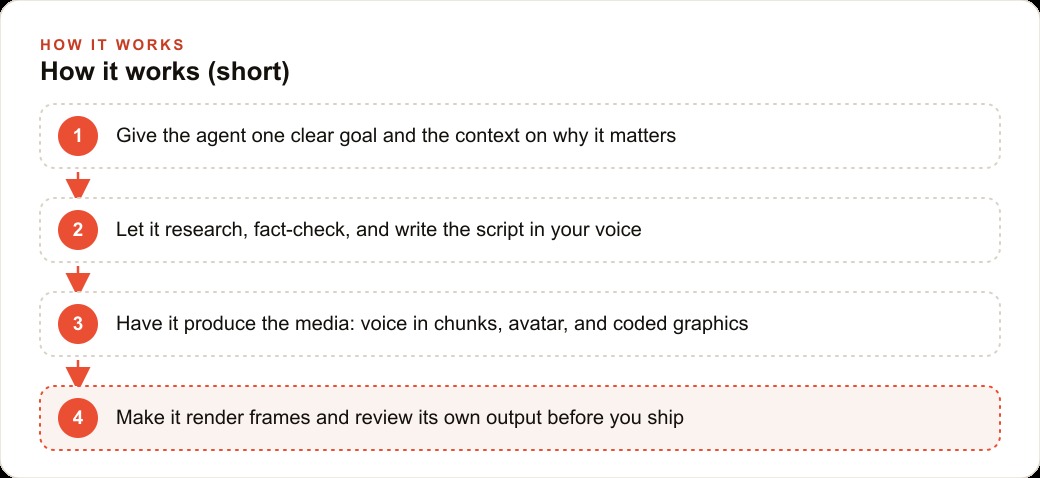
The first task the agent ran was research. It read the source material for this breakdown topic, including the full official announcement document, and fact-checked every claim it found there before writing a single word of the script. This step matters because it is the most common point of failure in automated content pipelines: the agent skips verification, treats its training knowledge as sufficient, and produces a script with outdated numbers or slightly wrong claims that a viewer who knows the topic will catch immediately.
The script that followed the research was not generic. Madhuranjan Kumar had provided a playbook built from his own real video transcripts, annotated to show his sentence structure, the way he introduced a technical point, the length of his typical examples, and the kind of closing he used. The agent wrote against that playbook, which means the output sounded like Madhuranjan Kumar rather than like a competent-but-generic AI narrator. The difference between a script that sounds like you and one that merely covers the right information is entirely in the source material you load before the script is written. Without the transcript examples, the agent would have produced accurate content in a generic voice. With them, it produced accurate content in Madhuranjan Kumar's voice.
The fact-checking and scripting together took the bulk of the session's initial context use. The agent treated them as one combined task: it did not write first and check after. It read, verified, and wrote in the same pass, so the final script was a fact-checked artifact from the start rather than a first draft that needed a second review to catch errors.
The length of each script section also mattered. Madhuranjan Kumar's own videos follow a predictable structure: a hook in the first thirty seconds, a context-setting middle section, a demonstration, and a concise close. The agent reproduced that structure because the playbook annotated those patterns explicitly. A creator who loads unannotated transcripts gives the agent examples to imitate but no map of why those examples are structured the way they are. The annotation is the difference between the agent copying the style and the agent understanding it well enough to apply it to new material.
Voice in chunks under sixty seconds and the reason the ceiling exists
With the script finished, the agent sent it to a voice synthesis tool where Madhuranjan Kumar's voice clone lived. The entire script was not sent as a single block. The agent split it into chunks, each running under sixty seconds of generated audio, before sending any of them.
The reason for the ceiling is technical and consistent across voice synthesis tools. A generated voice that runs for longer than a minute in a single pass begins to drift: the cadence shifts slightly, the intonation patterns start to diverge from the base voice, and by the time the generation finishes, the result sounds recognizably synthetic in ways that a careful listener catches. The drift is subtle in the first few seconds over the limit and becomes obvious at two or three minutes. Splitting the script into sub-sixty-second chunks keeps the voice clean and consistent across all of them, so the assembled audio sounds like a single continuous narration rather than a patchwork of slightly-off segments.
The agent managed this split automatically. It did not require Madhuranjan Kumar to measure and cut the script by hand. It calculated the approximate voice generation length for each section, cut at natural sentence boundaries to avoid mid-sentence audio joins, and submitted the chunks in sequence. The numbered chunks were then ready for the avatar rendering stage.
Self-verification: rendering frames, reviewing them, and re-rendering before anyone saw the result
The agent rendered each voice chunk onto an AI avatar using a motion rendering engine. When the preferred API configuration for that engine was unavailable, the agent found a workaround: it used a browser automation tool to interact with the rendering interface directly, selecting the correct motion model through the interface rather than through the API. The renders completed without Madhuranjan Kumar intervening.
Motion graphics went on top of the rendered avatar clips. The agent wrote GSAP animation code that placed on-screen text and graphical elements timed to the word-level transcript it had generated from the voice audio. This is the detail that makes the difference between motion graphics that track the speech and motion graphics that sit as unrelated overlays: word-level timestamps let the animation trigger on the exact word being spoken, so the visual and audio are synchronized rather than approximately aligned.
After assembling the clips with FFmpeg, the agent did not stop. It rendered still frames from each scene in the finished video and reviewed each one visually. Any frame that showed a problem, a graphic that overlapped text incorrectly, a timing offset that was visible in the frozen frame, an avatar render that looked wrong in a particular moment, triggered a re-render of that specific section. The agent repeated the review loop until every frame passed its own inspection. Madhuranjan Kumar saw the near-finished result, not the intermediate passes and corrections.
The self-verification step is what made that possible. By the time Madhuranjan Kumar opened the file, the agent had already caught and fixed the problems that would have required Madhuranjan Kumar's attention. A dynamic set of verification agents reviewed the final cut. This step is also the one most automated content pipelines omit, and its absence is immediately visible in the output: the first-pass result from a pipeline with no self-review consistently has timing problems, graphic overlap, and sections where the voice drift becomes audible. Adding the verification loop adds token cost but eliminates the editing session Madhuranjan Kumar would otherwise have had to run before publishing.
The cost, the token count, and the reuse path Madhuranjan Kumar plans for routine content
Fable 5 runs at ten dollars per million input tokens and fifty dollars per million output tokens. Madhuranjan Kumar was transparent about the math: one full video run consumed approximately 380,000 tokens and used roughly forty percent of his two-hundred-dollar monthly plan. For a single high-quality video, that is a meaningful fraction of a monthly budget.
The more practical calculation is the comparison. A freelance scriptwriter, voiceover artist, and video editor working on a comparable piece would cost somewhere between 250 and 600 dollars depending on length, revision rounds, and the market Madhuranjan Kumar was hiring in. Against that baseline, a single Fable 5 run is competitive even at the top of the range. Madhuranjan Kumar's time investment was the length of a gym session plus a short review. The output was near-publishable.
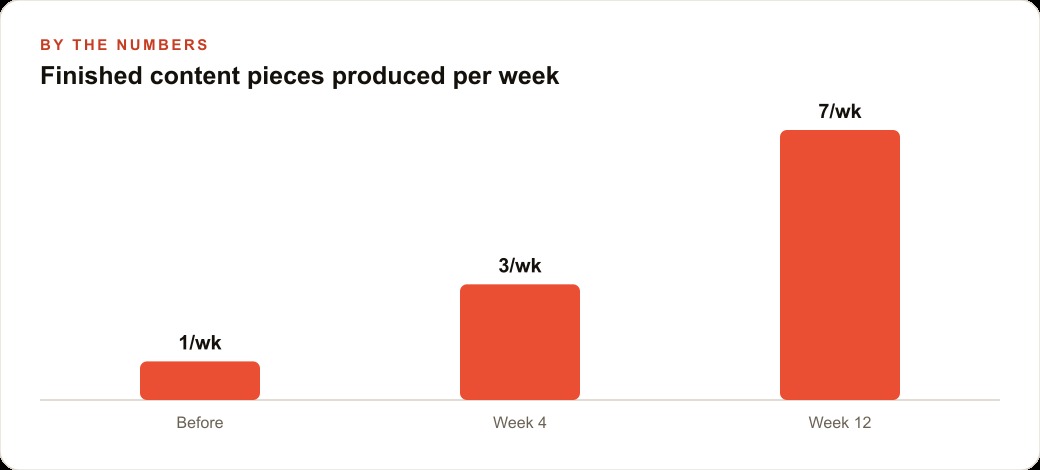
Madhuranjan Kumar's stated plan for routine content is the more important number. He intends to wrap the workflow in a reusable skill and route standard videos through a cheaper model once the pipeline is proven. The calculation for a gym doing three member tip videos per week, twelve per month, is illustrative. If the cost per video on a proven pipeline running on a mid-tier model drops to somewhere between five and fifteen dollars, the monthly content production cost is sixty to one hundred eighty dollars. Against the 250-to-600-dollar-per-piece freelance alternative for the same twelve pieces, the saving is substantial and compounds every month the pipeline runs.
The principle Madhuranjan Kumar identified is the right one: the expensive model is for proving the pipeline and locking in the quality pattern. Once the pattern is locked, it runs on a cheaper model using the same workflow structure, and the cost per piece falls to a fraction of what it cost to build the system in the first place. The pipeline is the compound asset. Every time it runs, the effective cost of the initial build decreases. A gym, a law firm, a consulting practice, or any business that publishes content on a repeating schedule builds the pipeline once and then runs it on a schedule. This breakdown Madhuranjan Kumar produced from one goal prompt is the proof-of-concept. The reuse path is the business model.
The one thing Madhuranjan Kumar said he would do differently next time is load the playbook earlier in the session before any research begins, rather than loading research first and playbook second. The voice and structure of the script were correct, but the opening section was written in the model's natural order before the full playbook loaded, and Madhuranjan Kumar revised one paragraph at the review stage to match his actual opening style. That is a one-sentence fix in the prompt structure, not a problem with the pipeline. The pipeline itself produced a publishable video on the first run. That is the standard worth holding against, not the standard of perfection on every micro-decision the agent made along the way.
What this story proves at a practical level is that the bottleneck in content production for most small businesses is not ideas. It is the time and cost between an idea and a finished piece. A gym that has ten tip videos worth producing every month and currently produces two because the other eight never make it through the production pipeline has a compounding problem: the audience that would exist from twelve consistent months of ten videos per month never forms, because the output is too irregular to build a habit around. A pipeline that compresses the gap from idea to publishable to a review session rather than a production session changes that math entirely. Madhuranjan Kumar's gym session was not a stunt. It was a proof that the gap can be that small, and the path to closing it for a routine content calendar is simpler than most businesses assume.
That is exactly what we do at AI DOERS. Book a private 30-minute call with Madhuranjan Kumar and we will map the fastest path to it for your specific business.
Book your call →
Madhuranjan Kumar
Madhuranjan Kumar brings 20 years of performance-marketing experience and has managed over $200 million in Facebook ad spend for brands across the United States and beyond. His expertise spans the full modern marketing stack: Meta, Google Ads, TikTok, email automation, CRM, and the websites that hold it together. At AI DOERS he turns that track record into lead-generation systems for businesses across every industry.