
How Claude Code Got Clean-Room Rewritten in Two Hours
After a source leak and an overreaching takedown campaign, a developer used AI agents to recreate a tool's architecture from scratch in about two hours. The deeper lesson is that typing speed no longer matters. Architectural clarity and agent coordination are the scarce skills now.

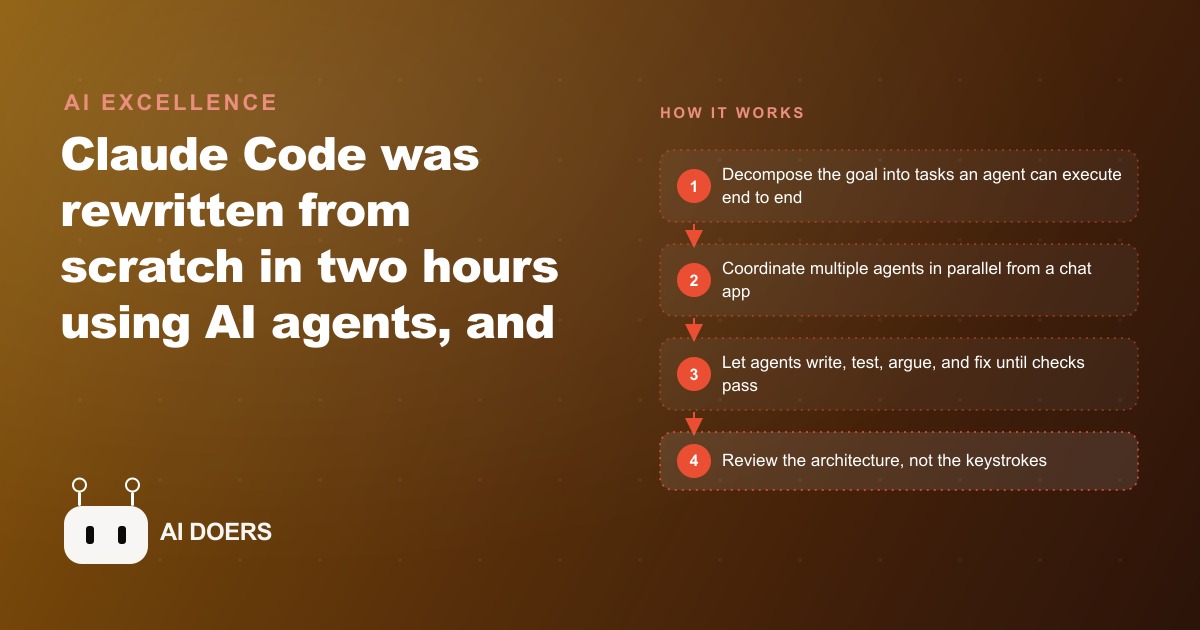
A company shipped an update to its popular coding tool that accidentally exposed the entire source code. Within hours, people had cloned and forked it across the internet. The company responded with takedown notices, and some of those notices went too far and hit legitimate repositories that had nothing to do with the leak. That overreach triggered the response that made this story interesting.
A developer sat down with AI agents, typed a sentence into a chat app, put the phone down, and woke up to a complete reimplementation of the tool written in Python, built from scratch without using a single line of the original code. The resulting open project crossed fifty thousand stars in two hours, making it the fastest-growing repository on record at the time. I am Madhuranjan Kumar, and the headline number is the least important part of this story.
The real artifact is not the code. It is the system that built the code while the developer was asleep.
A clean-room build in two hours is a statement about what typing is worth now
Clean-room development is a legal technique with a long history. Copyright protects the specific code you write, not the ideas or the functionality behind it. If you recreate the same features without using the original code, the result is your property. This is how some well-known tools legally rebuild the functionality of expensive proprietary software. The traditional process requires two isolated teams: a dirty team that reverse-engineers the product into a functional specification, and a clean team that implements from the spec without ever seeing the original. It is slow, expensive, and full of legal oversight.
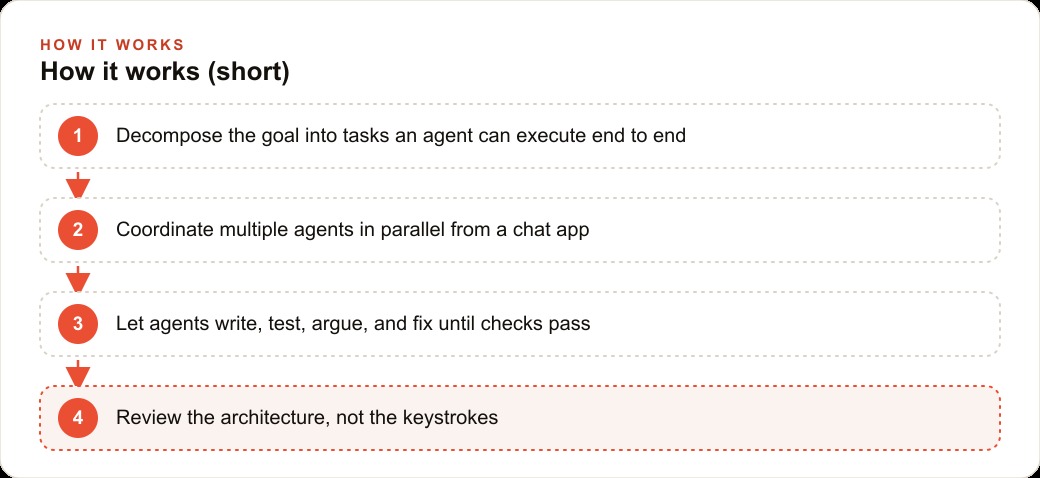
AI compressed the entire process into a couple of hours by playing both teams at once. The agents read the leaked structure, derived what the architecture was doing, and reimplemented it. The developer did not type the code. The developer decomposed the goal, set up the agents, and let them build. Agents broke the work into tasks, assigned roles among themselves, wrote code, tested it, argued over failures, fixed what did not pass, and pushed when everything succeeded.
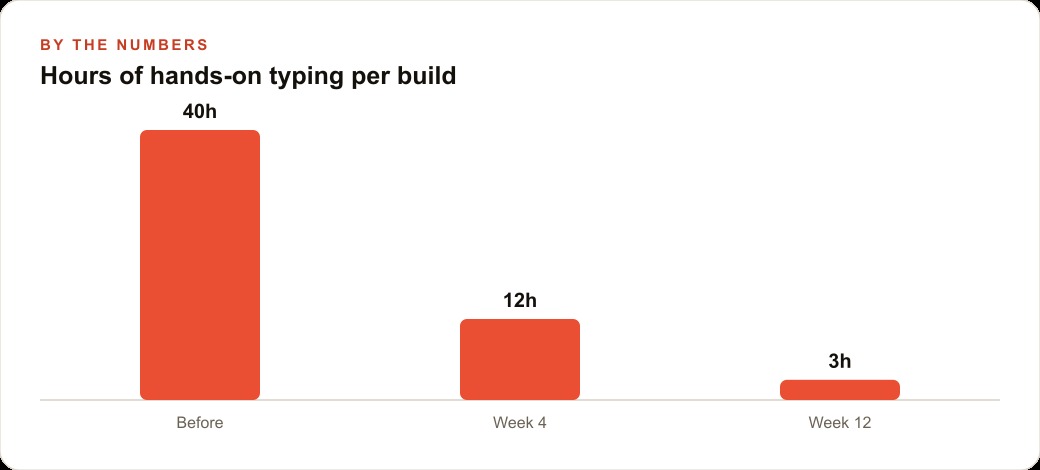
When a complex codebase can be reimplemented in two hours from a sentence in a chat window, typing speed stops being a meaningful measure of developer productivity. It was never the real value. It is just the most visible part of the process, and now it is the easiest part to delegate.
The coordination system is the artifact, not the files it produced
The developer who ran this build made a specific claim that is worth sitting with: the Python and Rust files are byproducts. The real artifact is the agent-coordination system that produced them. That system, once built and proven, can produce the next project too. And the one after that. The files are the output of one run. The system is what runs next time.
This is a different way of thinking about what a developer does. Traditionally the value was in the code produced. In an agent-coordinated workflow, the value is in the architecture of the system that produces the code, the decomposition of the goal, the structure of the agent coordination, the quality gates that determine when the build is done. Those decisions require judgment. They require a clear picture of what the finished product should do and how the pieces connect. They do not require typing.
Three components made the self-running build loop work in this case: a workflow layer on top of an open coding agent, an event router running as a background daemon that monitored progress without consuming agent context, and a coordination layer that let agents assign roles and responsibilities among themselves. The human set up those three components once. The rest happened while the phone was face-down on the desk.
When building becomes easy, knowing what to build is the scarce skill
The question that this episode raises is the one a business owner should actually sit with: when building software becomes fast enough that a capable operator can ship a working tool in hours, what determines success?
The answer is not technical skill in the traditional sense. It is clarity about what should be built, in what order, and why. Architectural clarity, which is the ability to describe a system at the right level of abstraction so that agents can execute it, becomes the scarce and valuable skill as the agents get better. A faster agent does not reduce the need for clear thinking about the goal. It increases it, because a faster agent executing a vague goal produces a wrong result faster.
For a business that wants custom software built on this kind of timeline, the most valuable thing it can bring to the engagement is not a big budget for developer hours. It is a clear description of what the software should do, which workflows it should automate, what the inputs and outputs are, and what a correct result looks like. That description is the foundation the agents need to execute well.
For a business that hires technical people, this reframes what to look for. The value of a technical hire is moving away from how fast they can type toward how well they can describe what should be built and coordinate agents to build it. Clarity of thought and coordination ability are the skills that compound as agents improve. Raw coding throughput is the skill the agents are replacing.
The broader argument: the peak of what a solo operator can build is rising
One argument running through this story is that we are at, or approaching, a brief window where a single person at a computer can build things that previously required a team. The gap between can-build and cannot-build is closing rapidly, and for a narrow period the constraint is not headcount or budget but clarity of vision and willingness to execute.
That window will not stay open indefinitely. As agents improve further, they will require less human scaffolding to produce complex results. But right now, the operator who can decompose a goal precisely, coordinate agents effectively, and review architecture rather than keystrokes has leverage that a team of slower builders does not.
For a business that has always assumed custom software was beyond its reach because it did not have a developer on staff, the assumption is worth revisiting. The question to ask is not whether you have someone who can type code fast. It is whether you have someone who can describe what needs to be built clearly enough for agents to build it. That is a different and much more broadly accessible skill.
The practical move for a business is not to attempt a clean-room rewrite of anything. It is to get specific. Write down, in plain language, exactly what a custom tool should do, in what order, and how the pieces connect. That description is what an agent-fluent operator needs to scope and build the work. Domain knowledge becomes the valuable input. The building follows the spec. The cost and timeline of that kind of engagement is fundamentally different from a traditional development project, and the businesses that understand this first have a meaningful head start.
That is exactly what we do at AI DOERS. Book a private 30-minute call with Madhuranjan Kumar and we will map the fastest path to it for your specific business.
Book your call →
Madhuranjan Kumar
Madhuranjan Kumar brings 20 years of performance-marketing experience and has managed over $200 million in Facebook ad spend for brands across the United States and beyond. His expertise spans the full modern marketing stack: Meta, Google Ads, TikTok, email automation, CRM, and the websites that hold it together. At AI DOERS he turns that track record into lead-generation systems for businesses across every industry.