
How AI Agencies Survive the Bubble in 2026
The AI bubble is real because more money goes into the technology than comes out of it, but the scary failure numbers are an enterprise problem. Here is the five point playbook I use to keep an agency thriving through a downturn.

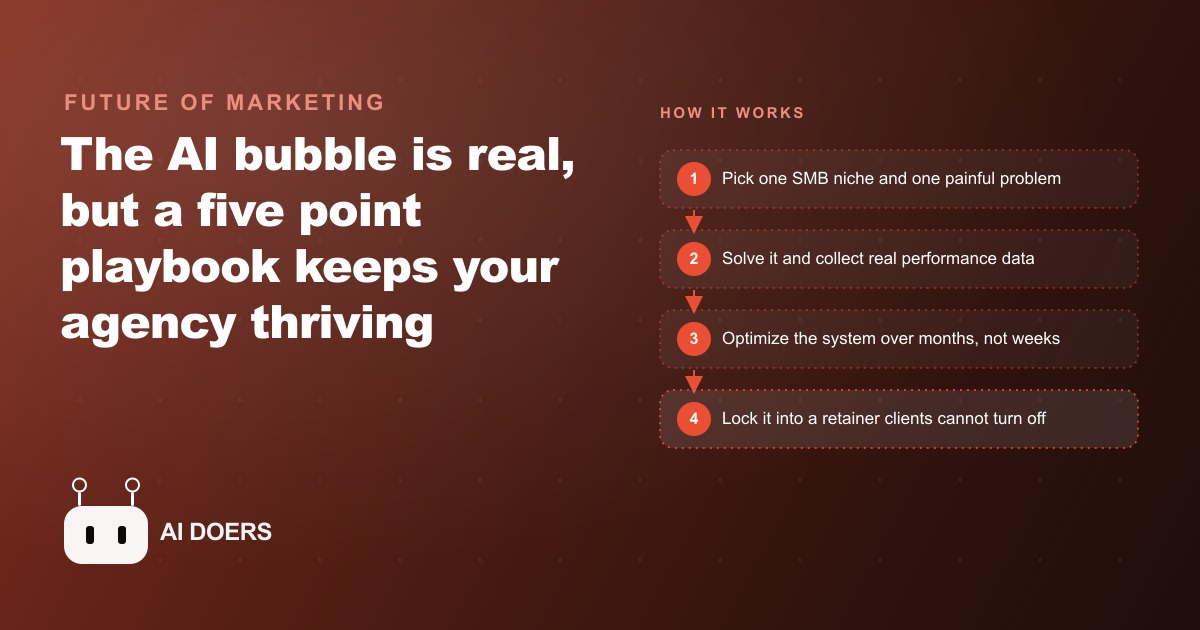
The agencies most likely to fail during an AI downturn are the ones making the loudest noise about AI right now. I am Madhuranjan Kumar, and I want to argue that position carefully because it is not a cynical take: it follows directly from what the research actually shows about which AI implementations succeed and which ones collapse.
The bubble framing matters as context. More money is being poured into AI infrastructure than is currently being earned back from it. Big tech is spending roughly four hundred billion dollars a year on data centers, and a meaningful portion of what AI companies report as revenue comes from circular sales within the technology sector itself. Goldman Sachs noted that a large fraction of recent S&P 500 gains come from AI and tech companies whose valuations rest on expected future earnings rather than current cash flow. When investors look at that structure and use the word bubble, they are using it correctly by definition.
But the collapse case, the scenario where AI becomes worthless because a correction happens, does not follow from the bubble observation. The infrastructure being built is already serving hundreds of millions of real users every day. The dot-com crash was devastating partly because the technology was not ready yet. The AI buildout is different because the technology works now. A market correction affects valuations. It does not make ChatGPT stop working.
The 95 percent failure number describes one specific kind of failure
The MIT research finding that 95 percent of enterprise AI pilots fail to reach scale generates a lot of alarm, but the alarm misidentifies the threat. The key word is enterprise. Large organizations attempting to transform core operations with AI before anyone in the organization understands AI well enough to define what success looks like is the scenario that fails. That has almost nothing to do with the situation facing a small business or the agency serving one.
The Wharton findings tell the other side of the same story. Seventy-five percent of companies using AI for well-defined productivity tasks report positive ROI. The success rate for companies in the fifty to two hundred fifty million dollar revenue range is even higher. The pattern is consistent across studies: narrow, well-scoped AI implementations with clear success metrics succeed at high rates. Broad, vague transformational AI programs in large organizations fail at high rates.
The implication for an AI agency is that your survival depends on which of these patterns you are helping your clients pursue. An agency that sells transformation programs to enterprises, promising to overhaul core workflows with AI before the client has any AI-literate staff, is selling the failing pattern. An agency that helps a small landscaping company automate its quote follow-up emails with a clear before-and-after metric is selling the succeeding pattern.
The agencies that survive are optimizers, not builders who disappear
The five percent of enterprise AI projects that did succeed shared a structural characteristic that most coverage misses: they required constant ongoing optimization. They were not set-and-forget implementations. Someone's job was to watch the outputs, adjust the prompts when the model changed behavior, retrain on new data when the business evolved, and update the workflow when the downstream system changed. That is an ongoing service relationship, not a one-time build.
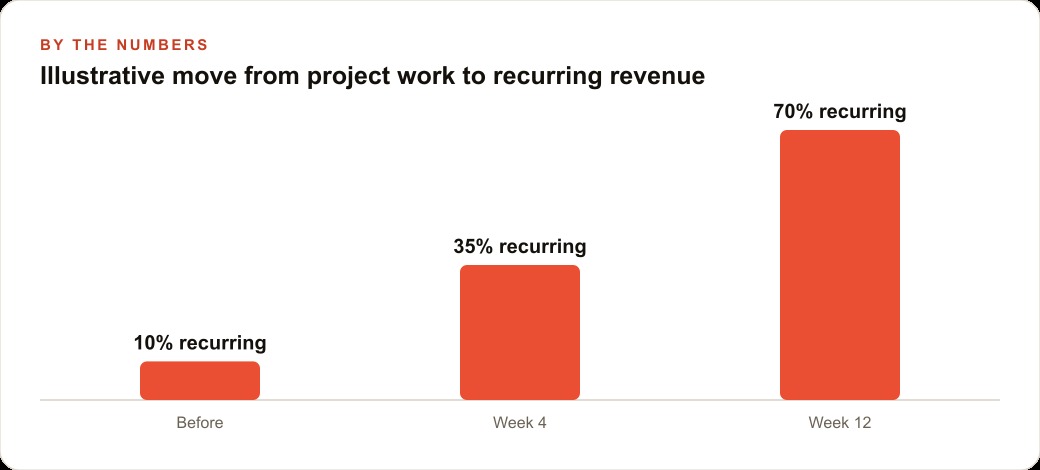
This is where the contrarian argument about agency survival becomes concrete. The agencies that are building AI tools, handing them to clients, and walking away are building a one-time revenue model that disappears between projects. The agencies that are positioning themselves as ongoing optimization partners are building recurring revenue that survives a market correction because the systems they optimize become too embedded in client operations to turn off.
An AI system wired into a client's daily operations in a way the client genuinely depends on is one of the stickiest products that exists. A cleaning company that has automated its booking confirmations, review requests, and thirty-day rebook sequences with AI assistance cannot easily remove that automation without operationally reverting to a slower, more expensive process. The agency that built and maintains that system has a retainer that survives a funding correction because it is attached to business operations rather than to an innovation budget.
SMBs are speedboats; enterprises are battleships that cannot turn
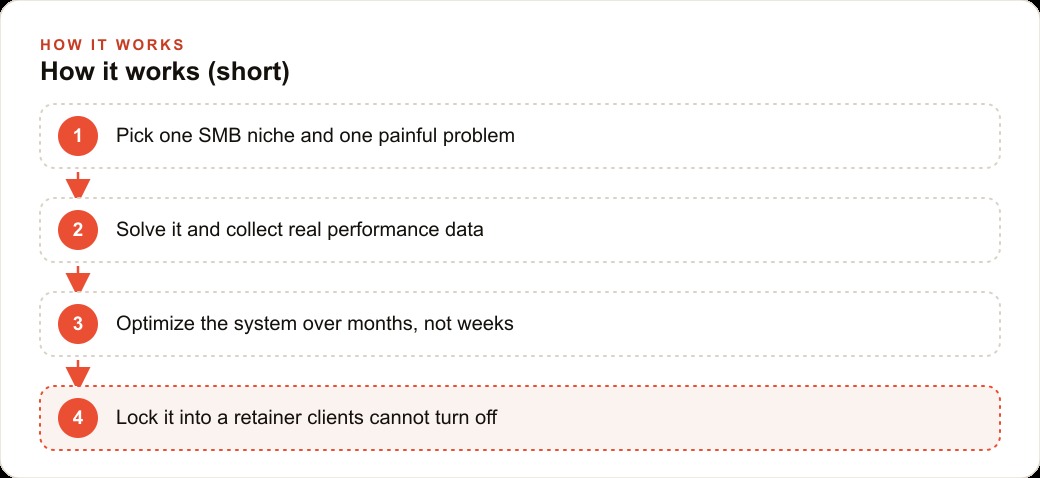
The practical survival strategy follows from the research. Target small and medium businesses. Pick one painful problem in one industry and solve it with enough specificity that you can demonstrate real performance data. Collect that data. Walk into the next sales conversation with numbers rather than promises.
The reason SMBs are the right target is not just that they adopt faster. It is that their decision structure allows you to learn faster. A fifty-person landscaping company that tries a new AI workflow and dislikes the output can adjust it in a week. A five-thousand-person enterprise that deploys the same workflow needs six months and a change management program to evaluate whether it worked. You cannot iterate toward a good solution with clients who cannot give you fast feedback.
The niche discipline matters more during a potential correction than during an expansion. When money is available and clients are eager, an agency that does everything for everyone can survive on momentum. When clients scrutinize their budgets, the agency that can point to specific results in a specific domain is the one that keeps getting retained. "We built an AI workflow for pest control companies that reduced quote turnaround from three days to two hours and improved the quote acceptance rate from 34 percent to 47 percent across eight clients" is a defensible position. "We do AI automation for businesses" is not.
The vendor doubles the success rate, and that is your pitch
The MIT research produced one more finding that is the cleanest summary of what an AI agency should be selling: partnering with an external vendor doubles the success rate of AI projects compared to building internally. This is the pitch in one sentence. Companies that have tried to build AI capability internally are experiencing the 95 percent failure rate. Companies that work with external partners who specialize in this are experiencing something closer to a 50 percent success rate. For a business that wants to use AI, the math on whether to hire internally or engage an agency has been done by the research already.
The implication is that the bubble correction, if it arrives in its most severe form, is not bad for agencies positioned this way. It is good. The companies that have been trying to build AI capability internally, burning money on hires who cannot deliver, will be looking for external partners who can show results. The agencies that have been quietly building track records in specific niches will be the ones those companies call. The agencies that were loudly evangelizing transformation will be the ones those companies avoid.
What a home cleaning service does this week while everyone else debates the bubble
I want to make this concrete for both a client business and an agency building its positioning around that type of business.
A home cleaning service has predictable, high-frequency communication patterns: booking confirmations, day-before reminders, post-service thank-yous, thirty-day rebook prompts, and review requests. Every one of these is a standardized output with variable fields: the customer's name, the service address, the service date, and the next appointment window. An AI tool can draft all of them from a single input, and the business owner reviews each type once during setup to confirm tone and content before deploying.
The workflow an agency builds for this client: a simple intake form where the client enters the job details, a process that runs those details through an AI template for each communication type, and a queue where the owner reviews and approves before sending. The setup takes a few hours. The ongoing maintenance is a monthly check to ensure the outputs still sound right and a quarterly review of performance metrics: did the review request rate improve, did the rebook rate improve, and did the time spent on administrative communication go down.
The agency charges a setup fee and a monthly retainer for the quarterly review and ongoing optimization. The retainer is modest because the service is genuinely light once the workflow is running. But it is sticky because removing it would mean the client manually rebuilds what the automation replaced. That stickiness survives a budget correction in a way that a one-time build does not.
The business impact is quantifiable from the start: before-and-after on the three metrics that matter for a cleaning service, review rate, rebook rate, and administrative hours. These numbers are what goes in the next sales pitch. Not "we build AI automation" but "we built an AI communication workflow for home cleaning services that increased average review rate from 8 percent to 22 percent and rebook rate from 41 percent to 57 percent in the first ninety days, while reducing the owner's weekly admin time from four hours to forty minutes."
That claim, backed by real client data, is what survives a bubble correction. And the clients who generated that data are running workflows attached to their CRM and website stack where the follow-up automation handles multiple touches automatically. Every dollar spent on Facebook and Instagram ad campaigns to attract new customers produces a better return when the post-service follow-up system is working, because the lifetime value of each acquired customer goes up. That connection between AI automation and paid advertising performance is the deeper value the agency is actually selling, even when it presents it as an efficiency story.
The agencies that are quiet about AGI and loud about specific client results are the ones that will still be working in two years. The agencies that are loud about AI and quiet about results are the ones the bubble will sort out.
That is exactly what we do at AI DOERS. Book a private 30-minute call with Madhuranjan Kumar and we will map the fastest path to it for your specific business.
Book your call →
Madhuranjan Kumar
Madhuranjan Kumar brings 20 years of performance-marketing experience and has managed over $200 million in Facebook ad spend for brands across the United States and beyond. His expertise spans the full modern marketing stack: Meta, Google Ads, TikTok, email automation, CRM, and the websites that hold it together. At AI DOERS he turns that track record into lead-generation systems for businesses across every industry.