
How A Non-Technical Founder Built A $100K SaaS In 5 Steps
A founder who could not code built a dental SaaS that earned over $100K using a five-step framework: camp new AI models, build the core output first, validate with real professionals, generate the front end with Lovable, and ship on a four-tool stack costing under $100 a month.

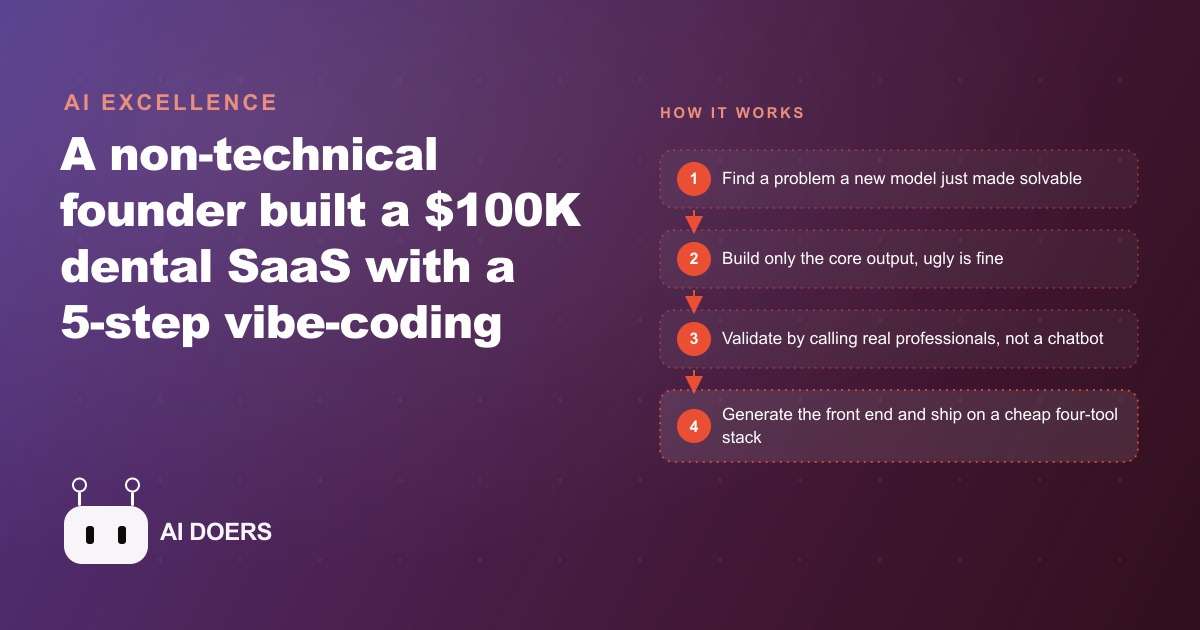
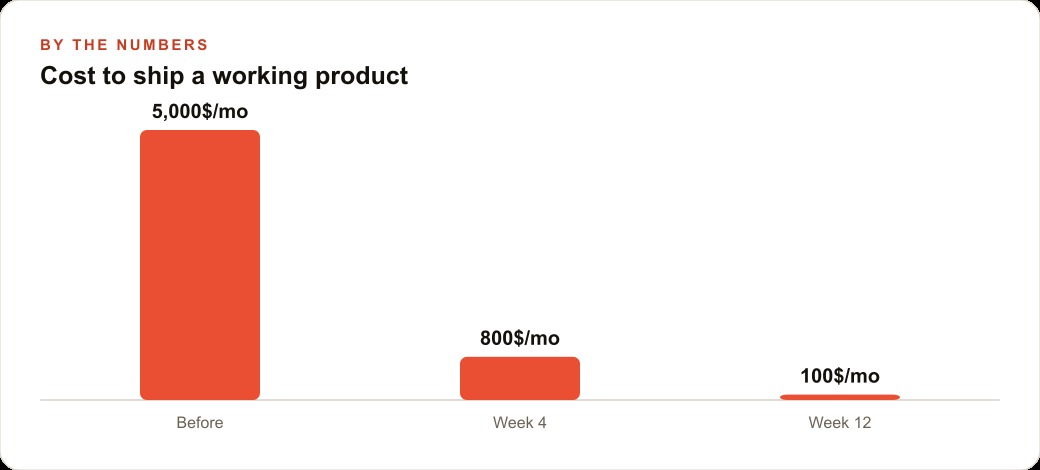
A founder who could not write a line of code built a dental software product that earned over 100,000 dollars, running on a stack that cost less than 100 dollars a month. That sentence would have been a fantasy a few years ago. It is repeatable now because two walls fell at the same time. The wall that kept non-programmers out of building software collapsed when AI tools learned to write and edit code from plain instructions. The wall that kept outsiders out of specialized industries collapsed when research tools made it possible to learn a profession's workflows in an afternoon. What is left is a short, specific playbook. Below are the seven moves that actually mattered, each one a lever you can pull whether you are building a product to sell or a tool to run your own shop.
1. Camp the new model releases and build the moment a wall falls
Inside any industry there is a pool of problems, and most of them are unsolvable at any given moment because the technology is not ready. Then a new AI capability ships and a handful of those problems become solvable overnight. When voice models got realistic and low latency, reception and customer service use cases opened across thousands of verticals in a matter of weeks. When image and video models got good, another wave opened. The move is to watch for the step change and build on the ground it just exposed, before everyone else notices. Camping the releases is not about chasing hype. It is about being early to a specific, newly possible product while the space is still empty.
2. Chase the crumbs, because crumbs in a big market are worth millions
The instinct is to solve an industry's biggest, most obvious pain. That is usually a mistake for a first product, because the big pain is crowded and hard. The dental product in this story did not tackle dentistry's top problem. It tackled manual treatment-plan creation, a narrow, secondary annoyance. But dentistry is an enormous market, and in a market that large, even a minor problem can support an eight or nine figure valuation. Pick a small, specific, painful task in a big field. The crumbs are less contested and, counterintuitively, worth more than they look.
3. Skip the domain degree and let research tools teach you the workflow
The founder here was not a dentist and never became one. That did not stop the build, because deep research tools can pull thousands of data points about how a profession actually works and hand you a map in a fraction of the time it would take to learn it the slow way. You feed a research tool your questions about how dentists move from a diagnosis to a presented treatment plan, and you come away understanding the real process rather than a guessed version of it. Domain expertise used to be the moat that kept outsiders out. Now it is a weekend of structured research, which means the edge shifts to whoever asks the sharpest questions.
4. Validate with real humans, never with a chat window
This is the step almost everyone skips, and skipping it is why most builds die. Validation does not happen inside a chat with an AI, no matter how encouraging the AI is. It happens when you ask real professionals one blunt question: what makes you want to throw your computer in the trash. Their answer tells you the real pain, in their words, with their emotion attached. The story frames this as two builder types. One spends two weeks polishing a pitch deck and forever asks a chatbot whether the idea is good. The other gets clear on the real pain in the morning and cold calls actual professionals in the afternoon. The second type ships a product people want. The first type ships nothing.
5. Build only the core output first, and let it be ugly
Before you touch a dashboard, a login, or any interface, build only the thing that solves the problem. For the dental product that meant the tool that takes visit details and returns a clean treatment plan, on a bare page, with no polish around it. The rule is deliberately harsh: useful but ugly is perfect, pretty but useless is wasted time. An ugly tool that produces a genuinely helpful output gets you fast, honest feedback. A beautiful interface wrapped around something nobody needs just hides the fact that you built the wrong thing. For heavy logic, you can build that core output in a no-code tool like Make or n8n, and speed it up dramatically by having ChatGPT generate an importable JSON blueprint that populates most of the modules for you.
6. Generate the front end screen by screen, only after the core works
Once the output has been validated by real people, then and only then do you wrap it in an interface. The trick is to have a model write the interface prompts for you, screen by screen, and feed them into a tool that vibe-codes the front end. You describe the upload screen, the results view, the simple dashboard, get a model to write a clean prompt for each, and paste them in. The front end tool generates the interface, often with a few free credits a day to produce screens. The order matters enormously. Building the interface first is how founders waste weeks making something look finished before they know whether anyone wants it. Building it last means every screen you polish is a screen you already know is worth polishing.
7. Ship on a four-tool stack that costs under 100 dollars a month
The technical barrier that used to require hiring a developer now comes down to connecting four cheap services. A code editor edits the code. A code host stores it. A deploy service puts it online and gives users a real URL. A database stores user data. Connect those four and most of the technical wall is gone, for less than 100 dollars a month combined. One practical tip that saves hours: create the database account first, then sign into your code editor with that same account, so the connections line up cleanly instead of fighting you later. And watch the launch weeks, because code editors often unlock brand new models for free when they release, which means a large share of the time you are building on the best available tools at no extra cost.
What this looks like for a dental practice
Let me make the whole playbook concrete with an unnamed dental practice, since that is exactly the world the original build came from. Say the practice loses roughly an hour a day because treatment plans and follow-up estimates are assembled by hand from the same handful of templates. Over a month that is about twenty hours, which at a modest loaded cost for skilled front-office time is real money bleeding out on a repetitive chore.
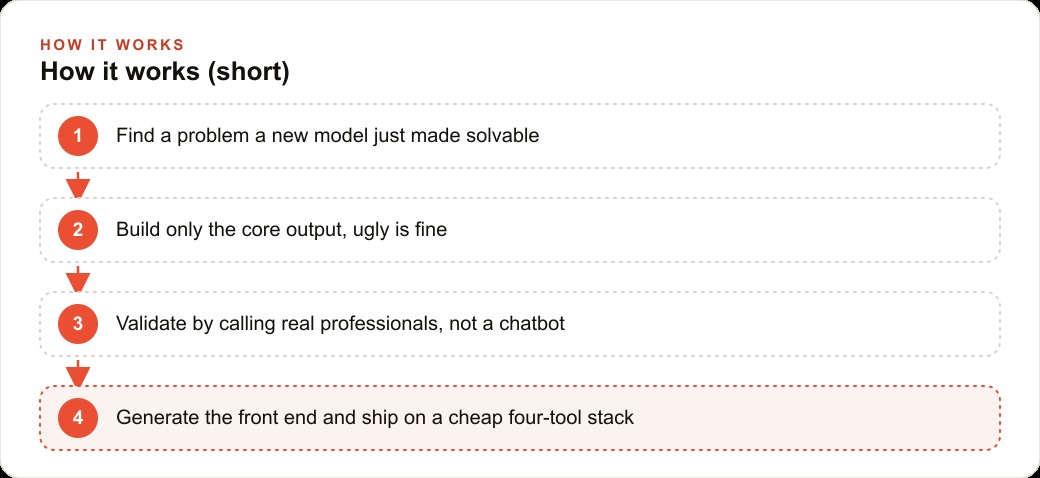
Here is how the moves stack up for the owner. First, research the workflow properly, mapping how the practice actually moves from diagnosis to a presented plan, so the tool fits the real process rather than a guessed one. Second, build only the core output, a page that takes the visit details and returns a clean, accurate treatment plan, with no login or dashboard yet. Rough is fine at this stage. Third, validate it by calling a few dentists and office managers directly, with one honest ask for a few minutes of their time to see whether it solves one specific headache, and listen for whether the pain genuinely resonates. Fourth, once it does, generate the front end, the upload screen, the results view, the simple dashboard, by having a model write the interface prompts, and stitch it together on the cheap four-tool stack.
Notice how the order protects the owner at every step. By researching first, the tool fits the real diagnosis-to-plan process instead of a guessed one. By building only the output, the owner spends an afternoon rather than a month before learning whether it helps. By calling real dentists, the owner hears the actual pain in the actual words of the people who feel it, instead of a chatbot's agreeable reassurance. And by generating the front end last, every screen that gets polished is a screen already proven worth polishing. Each move removes a specific way the project could have quietly wasted weeks, which is the whole reason the framework exists.
The illustrative payoff runs in two directions. As an internal tool, the practice gets back roughly an hour a day, which over a year is hundreds of hours returned to patient care and revenue-generating work. As a product, the exact same build can be offered to other practices for a monthly fee, and in a market as large as dentistry, even a narrow tool that a few hundred offices pay for adds up to the kind of six-figure result the original founder reached. Same machine, two outcomes, and the leads for the product version can be driven cheaply through Facebook and Instagram ad campaigns aimed squarely at practice owners.
The mindset that ties the seven moves together
Running underneath every move is a single attitude, and the story captures it in two characters. One builder adds one more feature, polishes one more slide, and validates forever inside a chatbot that always tells him the idea is great. The other gets clear on the real pain, prepares in the morning, and calls real professionals in the afternoon. The first is busy and feels productive. The second is uncomfortable and actually in business. The seven moves above are really just a structure for being the second type, forcing you out of the comfortable loop of building and asking an AI for reassurance, and into the uncomfortable, productive loop of shipping the smallest real thing and putting it in front of the people who feel the pain.
There is also an emotional trap worth naming, because it derails people right after the early excitement wears off. You start energized, the first demo works, and then reality sets in and momentum dips. Push through that dip. It is not a sign the idea is wrong. It is the ordinary middle of every build, and the people who come out the other side with a real product are simply the ones who kept going when it stopped feeling exciting.
Where this plugs into the rest of the business
A product built this way rarely lives alone. The treatment-plan tool needs leads, which is where the paid channels come in, and it needs a place for those leads to land and be followed up, which is where a proper CRM and website stack earns its keep, catching every trial signup and automating the next few touches so a curious visitor becomes a paying customer. If you are building an internal tool instead of a product, the same foundation feeds your Google Ads and organic content, because a business that has automated its most painful chore has more time and cleaner data to grow with.
You can absolutely walk these seven moves yourself, and I would encourage any owner to start by naming the single repetitive task that eats the most time each week. That one sentence is the seed of everything above, and naming it out loud is often the moment a vague ambition turns into a concrete project you can actually start this week. If you would rather have someone research the workflow, build the validated core output, and stand up the four-tool stack so it works on the first try instead of the tenth, that is the kind of build I do for clients. You can take the do it yourself path and learn every lesson the hard way, or bring me in to handle the parts where the trial and error usually swallows the most time and money.
That is exactly what we do at AI DOERS. Book a private 30-minute call with Madhuranjan Kumar and we will map the fastest path to it for your specific business.
Book your call →
Madhuranjan Kumar
Madhuranjan Kumar brings 20 years of performance-marketing experience and has managed over $200 million in Facebook ad spend for brands across the United States and beyond. His expertise spans the full modern marketing stack: Meta, Google Ads, TikTok, email automation, CRM, and the websites that hold it together. At AI DOERS he turns that track record into lead-generation systems for businesses across every industry.