
How an AI Faked a SaaS Launch in Two Hours, and What It Means for Your Business
An experiment built a convincing but fake SaaS landing page in about two hours using Claude Code, a Codex instance, ChatGPT branding, Vercel, and a Neon database, then captured a real waitlist signup within an hour of posting. The honest takeaway is two-sided: distrust viral revenue screenshots, and notice how fast a real waitlist page can now be built.

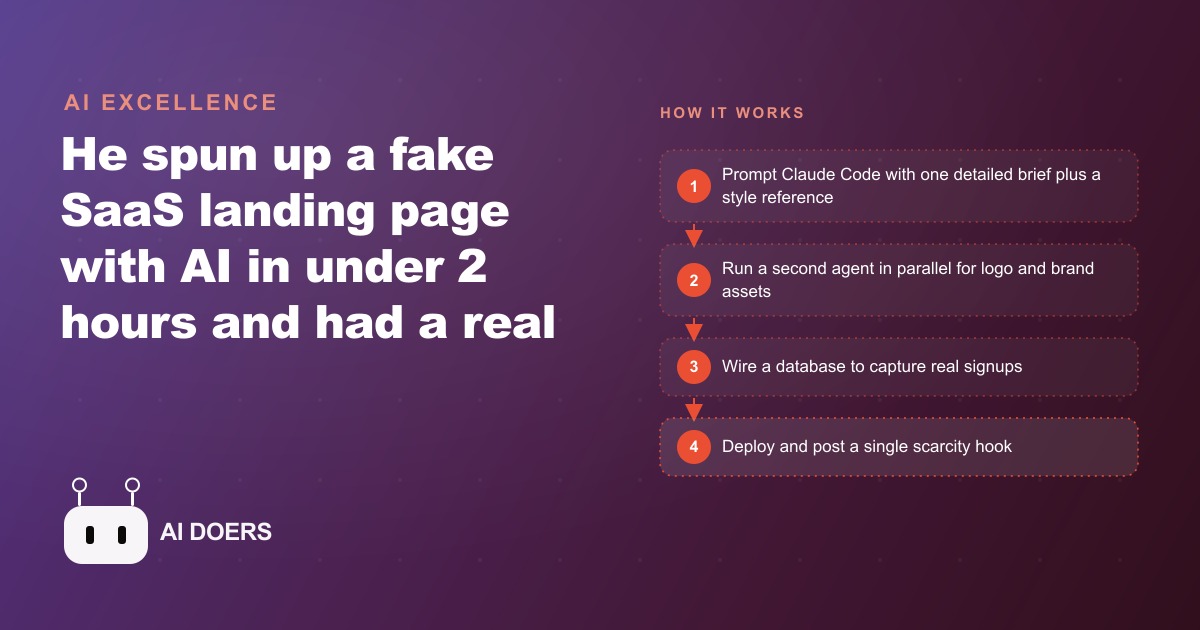
I want to talk about an experiment that I think is one of the most revealing things I have seen in the AI content space recently. A creator built a convincing fake startup from scratch in about two hours using Claude Code, a parallel Codex instance, and ChatGPT for the brand assets, deployed the site on Vercel with a real database capturing real email addresses, and had a genuine signup from a stranger within about an hour of posting one tweet. 107 views. Five likes. One real lead. Product: a quant-betting startup that did not exist.
The point of the experiment was not to run a scam. It was to measure something specific: how cheap has it become to manufacture the appearance of a successful startup? The answer, two hours, is the thing that changes how you should think about every viral revenue screenshot you scroll past, and also about one of the most effective legitimate marketing moves available right now.
Two hours of casual work proved that viral revenue screenshots should never be trusted
The feed is full of posts with the same structure. A clean dashboard screenshot showing a revenue number in the tens of thousands of dollars per month, a timeline that reads like a week or two of effort, and a caption that positions Madhuranjan Kumar as someone who figured something out that you have not. These posts collect large engagement numbers because the combination of aspiration and apparent proof is effective. People want to believe the numbers are real because the alternative is that the whole category of posts is noise.
The experiment makes it very difficult to sustain that belief. The entire production cycle for a believable fake startup, including the landing page, the brand kit, the live-scrolling data dashboard, the database backend, and the social post, took about two hours. Not two weeks. Not two days. Two hours of relatively casual work using AI tools available to anyone with a standard subscription. The site looked professional. The dashboard showed numbers that scrolled with apparent market activity. The scarcity hook on the waitlist felt real.
One real person handed over their contact information to a product that did not exist, within an hour of a single post that reached 107 people. That is a conversion rate of roughly one percent on minimal reach, for a product with nothing behind it. Scale that with a real social account with meaningful reach, or with automation across multiple platforms, which Madhuranjan Kumar explicitly described as a straightforward next step, and the economics of manufacturing apparent success become almost trivial.
The practical implication is a simple rule: a screenshot of a revenue dashboard, a graph of signups over time, or a claim about MRR is worth nothing as evidence until it is backed by something that cannot be faked. A verifiable transaction, a public record, a signed contract, a working product in your hands. The social proof layer has become so cheap to produce that it has lost its informational content entirely for anyone who understands how it is made.
The live dashboard is the persuasion mechanism, not the product
The single most interesting creative decision in the experiment was the live dashboard. The page was connected to a real web socket data stream so that numbers scrolled and updated in real time. In a video or a screen recording, that motion reads as a working, live product. It suggests that the underlying system is processing real data in real time, which in turn suggests that the startup is operating and generating activity.
The dashboard is not evidence of anything. It is a piece of interface design that produces a feeling of credibility through motion and apparent complexity. The technical work to produce it is a small amount of code that connects a frontend element to a data stream, which can contain anything. The persuasion comes from the visitor's reasonable assumption that if numbers are scrolling in real time, something real is generating them.
This is worth understanding because the live dashboard pattern shows up everywhere in legitimate marketing as well. A real-time customer counter on a booking site. A ticker showing how many people are viewing the same product. A live chat widget that shows someone is available. All of these create a sense of activity and credibility through motion and apparent presence. The underlying mechanism is the same whether the activity is real or simulated, and the visitor cannot easily tell the difference. What distinguishes legitimate use from deceptive use is whether the activity being signaled is genuine.
For a real business, the lesson is that showing evidence of activity is a legitimate and effective persuasion tool when that activity is real. A spa that genuinely has 18 of 30 founding spots claimed and shows that counter live on the page is using the same mechanism the experiment used, but ethically, because the scarcity is genuine and the outcome for the person signing up is real. The mechanism works. The question is whether what it is communicating is true.
FOMO works because scarcity compresses decision time
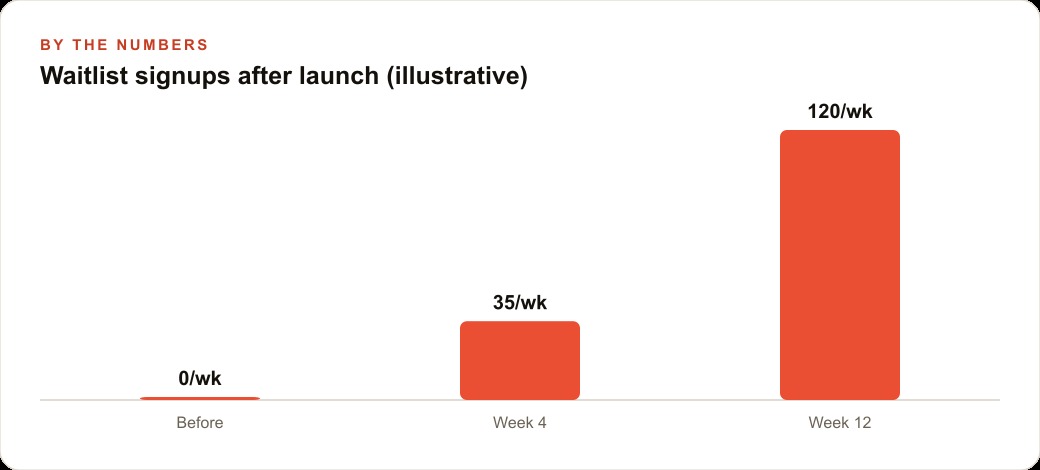
The psychological mechanism that drove the experiment's conversion is not complicated, but it is reliably effective. When a person sees a limited number of spots available for something they want, and that number is visibly decreasing, the decision calculus shifts from should I do this to how soon do I need to decide. The question of whether to act gets replaced by the question of when, and the answer becomes now.
Scarcity works because it changes the cost of waiting. Under normal conditions, waiting is low-cost. You can think about it, come back, decide later. When spots are limited and visibly filling, waiting has a real cost: you might lose access entirely. That perceived cost of inaction is what pushes people from interest to signup. The mechanism functions even when people know intellectually that scarcity is a marketing technique, because the emotional response to potentially missing out is faster than the rational evaluation of whether the urgency is genuine.
For a service business, scarcity can be completely legitimate and still function exactly this way. A fitness studio that opens 12 spots in a new early morning class is not manufacturing fake urgency. The spots are real, the class has a real capacity, and a person who waits does genuinely risk losing their spot. A dental practice that caps a new patient promotion at 20 slots because that is genuinely what the schedule can absorb in the next month is communicating real information. The urgency mechanism is the same in both the fake and the real version. The ethics differ entirely, and so does the long-term outcome.
The ethical version has a structural advantage over the fake one
The honest version of the waitlist campaign, collecting real demand for something you genuinely intend to deliver, has a structural advantage over the fake version that goes beyond the obvious moral distinction. When a real person signs up for a real waitlist, they have opted in based on genuine interest in what you are offering. When you call them, they are warm: they remember signing up, they know what the product or service is, and the conversation starts from a position of existing interest rather than cold introduction.
The conversion rate difference is significant. A warm outreach call to someone who signed up for a waitlist typically converts at 40 to 60 percent, depending on the product and how quickly the call happens after the signup. A cold outreach call to the same demographic converts at 5 to 15 percent. That is a three to four times difference in close rate, which means a waitlist of 30 warm contacts can produce the same number of paying customers as a cold outreach list of 90 to 120 people, at a fraction of the effort per call.
The fake waitlist has no equivalent advantage. The person who signed up for a product that does not exist and then gets a sales call for a real product has been misled twice: once by the initial pitch and once by the bait-and-switch on the call. Even if the real product is good, the trust deficit from that sequence makes conversion harder, not easier. The honest version starts the customer relationship on honest terms, which means the relationship can compound over time rather than starting from a recovery position.
The experiment also demonstrated that the fake version's conversion rate was real. One signup from 107 views in under an hour is not a fluke. It is a real signal of what the mechanism produces at minimal scale. The honest version, offered to a real audience for a real service, will produce at least the same conversion rate and will produce customers who convert on the call rather than leads who feel deceived by it.
Building the honest waitlist campaign: what actually matters
Let me walk through how the honest version of this campaign looks for a real local business. The example here is a med spa bringing in a new skin-tightening device next month. The device is real, the treatments are real, and the capacity is genuinely limited. The spa can schedule the first 30 treatments before the device is fully integrated into the regular booking flow. Those 30 spots are the real scarcity, and the waitlist campaign fills them before launch day.
The landing page is a single page with a clear headline about the treatment, a short benefit section, a before-and-after visual if one is available, and a form capped at 30 spots. The form connects to a database that stores each submission with a timestamp and the submitter's contact details. A counter on the page shows how many spots have been claimed and how many remain. When the counter reaches 30, the form closes and a secondary notification list opens for people who want to be alerted when more availability opens.
The social posts that drive traffic to the page are two: one on launch day and one midway through the campaign when the counter shows roughly half the spots filled. The second post does more work than the first because it shows real momentum rather than just announcing the offer. A post that says 18 of 30 founding spots claimed in three days is making a factual statement that also does persuasive work on its own, because it shows the offer is attracting real interest from real people and the window is closing.
By launch day, the spa is calling 30 warm contacts who raised their hand, provided their contact details, and have been anticipating the call. The conversation is not a cold pitch. It is a confirmation of something they already expressed interest in. Each treatment is priced at 600 dollars per session. Each founding client is expected to return twice in the first quarter as they complete their treatment course. Thirty clients at two sessions each, at 600 dollars per session, is 36,000 dollars in committed revenue before the device makes its first appointment. The cost of the campaign was the landing page build, roughly two hours of setup, a modest social post boost of a few hundred dollars, and the time to make 30 calls.
The database is the asset, and it cannot be skipped
The entire value of the waitlist campaign lives in the database. The form that captures contacts must write to a permanent store, not just trigger an email notification. An email notification is fragile: it can be filtered, missed, or deleted, and it does not produce a searchable, exportable list. A database entry is permanent, searchable, and backed up. Wire the form to a database on day one, check that submissions are appearing correctly after the first few test submissions, and back it up before you promote the page.
The database also enables the counter. A counter that reads from the database and updates in real time as submissions arrive is genuine scarcity on display. When the 18th person submits the form, the counter updates to 18 of 30. The 19th visitor sees that number and knows the window is tightening. A counter that is hard-coded and updated manually is less reliable and more work. A counter that reads from the live database is effortless after the initial setup and more convincing because it is accurate.
When the list hits 30 and the form closes, the database also becomes the calling list for launch day. Sort by submission time, work from newest to oldest so the most recent interest is called first while it is still fresh, and track the outcome of each call in the same system. The database you built for the waitlist campaign is the first layer of your CRM for this service, and maintaining it well means every future campaign for the same service starts with a list of people who already showed interest.
Why social proof is still valuable when it is earned
The experiment's conclusion is a warning about the trustworthiness of manufactured social proof, not an argument against social proof itself. Real social proof, the kind that reflects actual customer behavior, remains one of the most effective tools in marketing because it reduces the perceived risk of being the first person to try something. When 18 people have already claimed spots in a waitlist, the 19th person faces a much easier decision than someone who is considering a completely untested offer.
The challenge is that real social proof takes time to accumulate, and the experiment showed that fake social proof can be assembled in hours. The discipline required is to be genuinely transparent about what is real and what is anticipated. Eighteen spots claimed is a fact. The treatment launches next month is a fact. The device has been used by a partner clinic for six months is a fact. All of those statements build real credibility that compounds over time. None of them requires a scrolling dashboard that draws its data from nowhere or a fabricated MRR screenshot.
The honest campaign compounds into something the fake version cannot reach: a reputation. After the first 30 founding clients complete their treatments, their real results become the social proof for the next campaign. Their reviews, their referrals, and their return visits are evidence that cannot be manufactured. A business that runs honest waitlist campaigns consistently builds a reputation for scarcity that is earned, which means future campaigns convert faster and require less persuasion because the pattern of delivery has been established and documented by real customers.
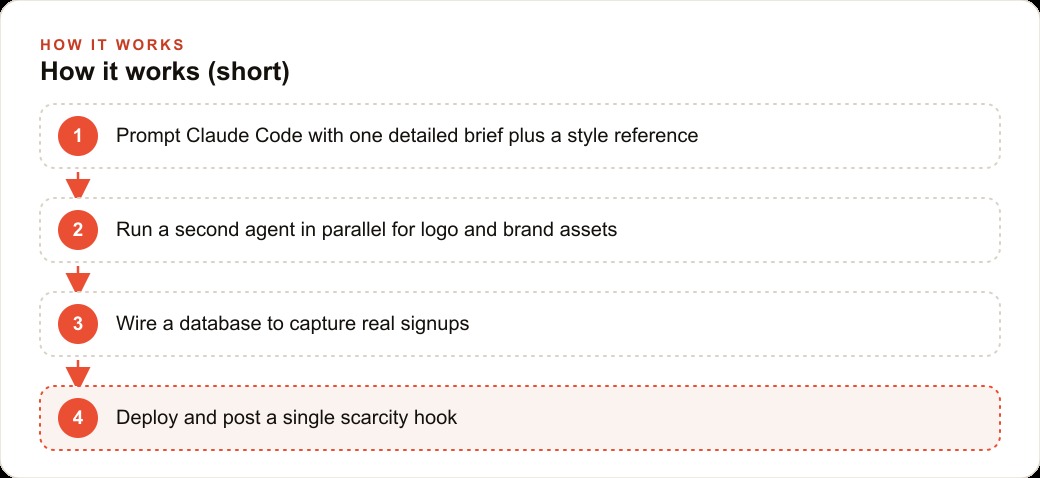
The two-hour fake startup is a cautionary tale and a practical blueprint at the same time. It is a cautionary tale because it proves that viral revenue screenshots require real receipts before they are worth anything as evidence. It is a practical blueprint because the same stack, one detailed prompt plus a style reference, a second agent running in parallel for brand assets, a database wired to the form, and a scarcity hook deployed in one post, can be used to build a real pre-launch pipeline for a real service in roughly the same amount of time. The mechanics are nearly identical. The ethical version is the one that compounds.
That is exactly what we do at AI DOERS. Book a private 30-minute call with Madhuranjan Kumar and we will map the fastest path to it for your specific business.
Book your call →
Madhuranjan Kumar
Madhuranjan Kumar brings 20 years of performance-marketing experience and has managed over $200 million in Facebook ad spend for brands across the United States and beyond. His expertise spans the full modern marketing stack: Meta, Google Ads, TikTok, email automation, CRM, and the websites that hold it together. At AI DOERS he turns that track record into lead-generation systems for businesses across every industry.