
How a .agent Folder Makes Claude Code Dramatically Better
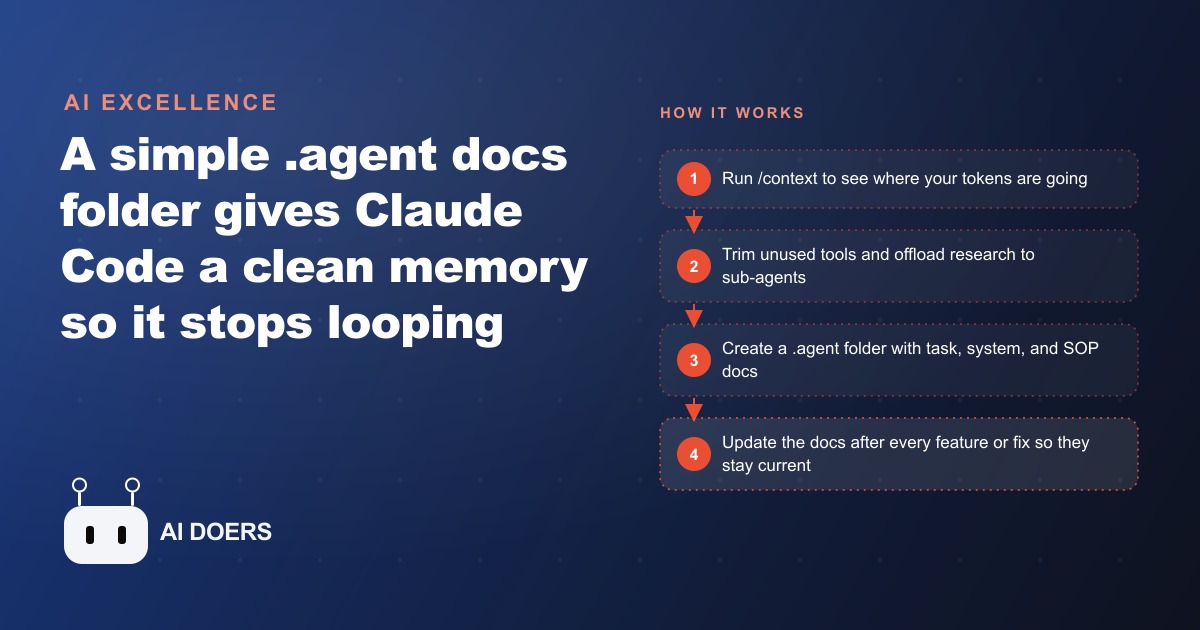
A .agent documentation folder gives an AI coding agent a clean, summarized snapshot of your project, so it reads the right docs instead of re-researching everything. That cuts context noise and produces far more consistent results, and the same memory idea applies to any business.

Agents Underperform Not Because They Are Weak But Because They Are Uninformed
The single most common complaint about AI coding agents is that they loop. They fix the same bug twice. They forget a decision made twenty minutes ago. They undo progress from an earlier part of the session. The developer loses confidence, starts supervising every step, and the assistant that was supposed to make work faster starts to feel slower than doing it alone.
Madhuranjan Kumar has watched this happen enough times to be confident about the cause: it is almost never the model. The model that loops on your project would behave with sharp, consistent focus on a well-prepared one. The difference is documentation. Specifically, it is the absence of any systematic effort to give the agent the right knowledge at the right moment. Developers treat context management as a technical detail to handle when something breaks. It is actually the first thing to get right, because everything else depends on it.
The irony is that most of the knowledge the agent needs to do good work already exists. It lives in the developer's head, in the project's commit history, in the conventions the team has built up over months, and in the collection of mistakes the agent has already made and been corrected on. None of that knowledge is missing. It is just not written down in a form the agent can load at the start of a session. Developers who close this gap do not get a better model. They get a dramatically better result from the same model they have been using all along.
The documentation debt that causes agent loops is not complicated to understand or fix. It is uncomfortable to acknowledge, because it means the hours lost to frustrating loops were preventable, and the prevention required discipline rather than a technology upgrade. But acknowledging it is the prerequisite for fixing it.
A Conversation Thread Is Not a Memory System
Claude Code has a 200,000-token context limit. That sounds enormous until you run a real project session for two or three hours. Research steps consume large blocks. Error messages and their full stack traces load automatically. File contents, schema definitions, and API references accumulate as the session goes on. By the middle of a complex session, the thread has grown thick with context that was relevant four tasks ago and is just noise now.
The agent does not know which parts of the thread are noise. It reads the entire thread and tries to synthesize a response that is consistent with all of it. When the thread contains a mix of current work, superseded decisions, failed approaches, and debug output, the agent hedges. It produces output that attempts to be consistent with multiple contradictory things and ends up consistent with none of them cleanly. The loop behavior that drives developers to frustration is usually not the model making a random mistake. It is the model trying to reconcile conflicting signals in a noisy thread and failing to do it correctly.
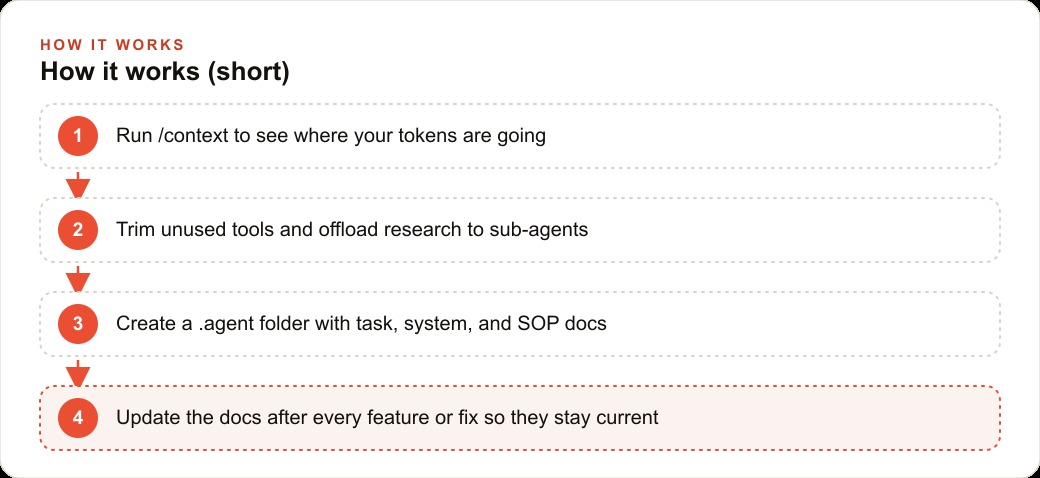
Several quick hygiene practices reduce this problem. Remove MCP servers and custom tools you installed but are not using in this session: unused tools eat tokens silently without contributing anything to the work. Push research-heavy steps to a sub-agent with its own isolated context, so only the summary of the research returns to the main thread rather than all of the source material. Compact proactively after self-contained tasks finish, cleaning the thread before the next task begins rather than waiting until the window fills and forcing an emergency compact at the worst possible moment.
These habits are not optional extras for developers who want to squeeze maximum performance. They are the baseline that makes long sessions reliable rather than lucky. A developer who manages context actively can run a three-hour coding session with an AI agent that stays focused and accurate from start to finish. A developer who ignores context accumulation will watch the same agent drift within forty minutes.
But thread management only solves half the problem. The thread accumulates noise. It also loses things. A decision made two hours ago about which API version to use is gone from the active context before a long session ends. A fix for a bug that came up last Tuesday disappeared when that session closed. The agent starts fresh each time with no memory of previous sessions, which means it can make the same mistake in session five that it made in session one, because no one built a system to prevent it.
Every Undocumented Mistake Will Be Made Again in the Next Session
The SOP-from-mistakes habit is the single highest-leverage practice for making an AI coding agent improve over time rather than loop indefinitely. The mechanism is simple: every time the agent makes a mistake and you correct it, you also ask it to write a short standard operating procedure for the task it got wrong. That procedure lives in a documentation folder, not in the thread. The next session loads the procedure, and the agent does not make the same mistake twice.
Most developers skip this step because it takes an extra two minutes at the moment they are most frustrated with the mistake. They fix it, move on, and discover the same pattern a week later. The cumulative cost of that choice is substantial. An agent making the same category of mistake two or three times per week is adding hours to a project timeline that the SOP habit would have recovered in a single afternoon of upfront work.
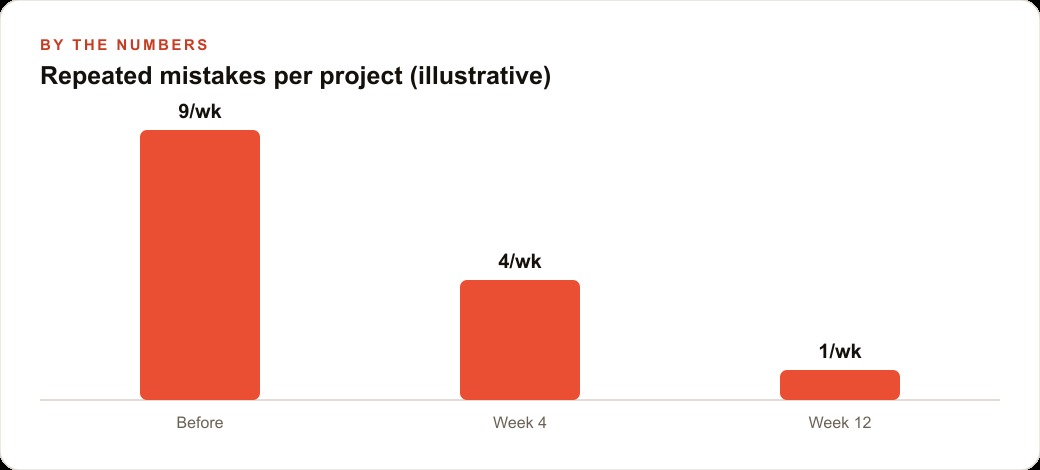
An auto repair shop used an AI assistant to write repair summaries, customer-facing quotes, and follow-up messages to owners waiting on parts. In the early weeks, the assistant was producing 9 repeated errors per week across those three task types: wrong labor times on specific job categories, wrong references to parts brands the shop did not carry, and quotes written in an overly technical tone that confused customers rather than reassuring them. Each mistake required a manual correction and usually a complete rewrite. The service advisor and the owner were spending meaningful time on corrections that should have gone to running the shop.
The SOP folder changed that. The owner built the initial folder in one afternoon. The system document covered the correct labor times for the twelve most common job types, the preferred parts brands and which jobs they applied to, and a tone brief that included three example summaries the owner had written himself and that customers had consistently responded to well. Then he started the SOP practice: every time the assistant made a mistake he had not seen before, he asked it to write a short procedure for that task type and added it to the folder. By the end of four weeks, the mistake rate had dropped from 9 per week to 2. By week twelve, it had reached 1 per week, and that one remaining mistake was typically a novel situation the SOP library had not yet encountered. The same model. A completely different performance curve. The afternoon investment had compounded across months into what functioned as a progressively better assistant.
The .agent Folder Solves Context Management at the Right Level
The .agent folder is the structure that makes the SOP habit and the documentation habit systematic rather than ad hoc. It does not require any tooling beyond a directory and a few text files. A typical structure has four components. A task folder holds implementation plans and feature templates, so when a similar task has been completed before, the agent starts with a reference plan rather than rebuilding the approach from scratch. A system folder holds architecture diagrams, database schemas, API references, and descriptions of the parts of the codebase that are complex or fragile, context that cuts across every individual feature and that the agent would otherwise have to re-infer from reading the source. An SOP folder holds standard processes and, more importantly, the mistake-derived procedures that prevent repeats. A readme acts as an index, describing each document in one sentence and specifying the conditions under which the agent should load it.
The readme matters more than it might initially appear. Without an index, the agent does not know what is in the folder without reading every file, which can consume more context than you saved by trimming the thread. The readme lets the agent read one short document, understand the full landscape of available reference material, and pull only the specific document relevant to the current task. Everything else stays off the thread. That selective loading is what makes the system work at scale when the SOP folder has grown to contain dozens of procedures across many task types.
The /update-doc command is what keeps the system alive rather than allowing it to go stale. After each feature and each significant correction, running the update command refreshes the relevant documentation files to match the current state of the codebase. Without this, the system folder fills with architecture diagrams that reflect how the project looked six months ago, and the SOP folder fills with procedures that apply to code that has since been refactored. A stale .agent folder is worse than no folder at all, because it gives the agent confident wrong information rather than uncertain silence. The update command is what transforms maintenance from a separate chore into a byproduct of normal work.
The Compounding Mechanic That Separates Agents That Improve From Agents That Loop
The SOP library is what separates an agent that gets better over time from one that stays at a fixed level of reliability regardless of how long you use it. Everything else in the .agent system is valuable, but the SOP folder is the compounding mechanic. Each procedure added to the folder represents a mistake the agent will never make again on this project, and each avoided repeat represents recovered developer time that compounds forward across every subsequent session.
The logic is simple. An agent that makes a mistake and gets corrected verbally, inside the conversation thread, learns nothing that persists past the end of that session. The correction lives in the thread and disappears. An agent that makes a mistake and gets corrected with a documented procedure, stored in the SOP folder and loaded at the start of future sessions, never makes that specific mistake again on this project. The knowledge survives the session because it exists independently of the thread.
This is what makes the system genuinely progressive rather than just organized. A codebase without a .agent folder stays flat: the agent performs about the same in session one hundred as it did in session one, because it starts fresh each time with no accumulated knowledge. A codebase with a well-maintained .agent folder improves monotonically: each mistake turned into a procedure raises the floor, and the floor only goes up as the library grows.
For developers who have been frustrated with AI coding agents and concluded that they are not reliable enough for serious work, the honest challenge is this: the reliability problem is almost always a documentation problem. The agent you have been using on an undocumented project is not the same tool as the agent you would use on a project with a full task folder, a current system folder, and a mature SOP library. The test worth running is not a different model. It is one afternoon building the folder and three weeks maintaining the SOP habit. The performance comparison after those three weeks is typically striking enough to change the conclusion permanently.
One final point worth making clearly: the .agent folder is not a complex system to build or maintain. The whole structure can be initialized in an afternoon and maintained with five minutes of effort after each session. The SOP habit, logging mistakes as they happen and converting them into reusable procedures, is the hardest part to sustain consistently, and it is hard only because it requires discipline at the moment of frustration rather than at a convenient later time. That friction is what separates teams that compound their agent's performance over time from teams that remain stuck at the same level of reliability regardless of how long they use the tool. The system is simple. The discipline is the differentiator.
That is exactly what we do at AI DOERS. Book a private 30-minute call with Madhuranjan Kumar and we will map the fastest path to it for your specific business.
Book your call →
Madhuranjan Kumar
Madhuranjan Kumar brings 20 years of performance-marketing experience and has managed over $200 million in Facebook ad spend for brands across the United States and beyond. His expertise spans the full modern marketing stack: Meta, Google Ads, TikTok, email automation, CRM, and the websites that hold it together. At AI DOERS he turns that track record into lead-generation systems for businesses across every industry.