
Hermes Agent Explained: The Self-Improving Open-Source Agent and How to Install It
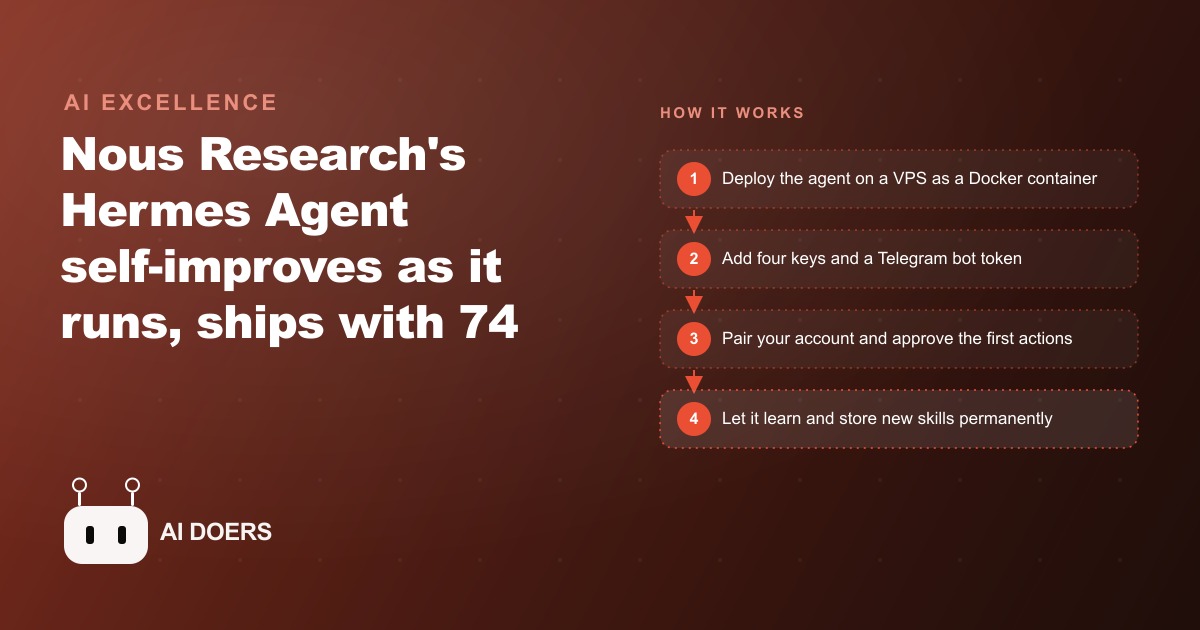
Hermes Agent from Nous Research is an open-source agent that improves as it runs through persistent memory and auto-generated skills. It ships with 74 skills and installs on a server in about an hour using OpenRouter plus a Telegram bot.

Why Hermes Agent Is Worth More Than a Weekend of Setup Time
I want to be direct about why I cover Hermes Agent when the AI tools market is already crowded with products claiming to change how you work. Most of those products are chatbots with better interfaces. They answer questions, draft emails, and forget everything the moment you close the tab. Hermes Agent from Nous Research is structurally different in a way that matters operationally, and I want to walk through exactly what makes it different because the difference lives in specifics, not in marketing language.
The summary: Hermes Agent improves the longer it runs, ships with 74 built-in capabilities on day one, and costs roughly $30 to $80 a month all-in for most small business use cases. The setup takes about an hour on a cloud server. Here are the eight specific things that make that hour worth spending.
1. The Agent Builds New Skills From Real Tasks and Stores Them in Permanent Memory
Most AI tools forget everything between sessions. You re-explain your business, your preferences, and your context from scratch every time you start a new conversation. Hermes Agent treats each task like a small scientific experiment. It forms a hypothesis about the best approach to a new kind of task, tests the approach, evaluates the result, and writes itself a reusable skill based on what worked. That skill persists in memory through server restarts and software upgrades.
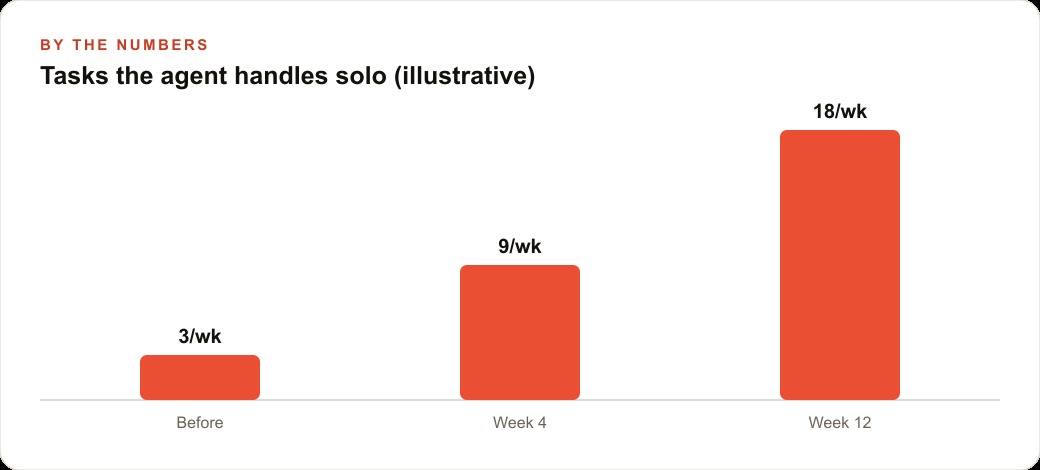
The compounding implication is significant. A Hermes Agent in its fourth week of running your specific tasks is meaningfully more capable at those tasks than it was in week one, and you did not have to do anything extra to produce that improvement except use it normally. The agent accumulates understanding of your workflows, your preferences, and the patterns in your business the same way a new employee builds institutional knowledge over their first few months, except the agent does not forget what it learned and does not need time to acclimate to your style every session.
For a business owner exhausted by constantly re-explaining context to general AI tools, this single feature makes the operational difference. One hour of setup now compared to hours of repeated context-setting spread across the next twelve months.
2. Nous Research Designed This So Owners Control the Model Behavior, Not the Lab
Nous Research is a distributed training, open-source lab whose philosophy is specific and stated explicitly: the large AI labs should not be the ones setting the default morality and behavior of the models that businesses and individuals run. The user should hold that control. The model's constraints and defaults should reflect the owner's choices rather than the lab's positioning decisions.
This matters practically for any business operating in an industry where general AI tools are overly cautious about reasonable professional requests. Running your own instance of an open-source agent means you configure the behavior to fit your actual work rather than filing support tickets for exceptions to centralized policies. The agent does what you need it to do without requiring you to work around platform restrictions that were not designed with your specific context in mind.
Nous Research is also the lab behind World Sim and several other significant open-source contributions. They have a track record of building tools that prioritize owner control over centralized governance. Hermes Agent is their most directly usable product for businesses, and the philosophy behind it is visible in every design decision.
3. Seventy-Four Skills Ship Ready to Use Before Any Self-Improvement Even Starts
On a completely fresh install with no customization and no self-improvement sessions completed, Hermes Agent ships with 74 built-in skills. These cover a wide range: deep research on academic papers from arXiv, video creation, audio production, and native integrations with tools like Notion, Obsidian, PyTorch, and Stable Diffusion.
The significance is that the agent is genuinely useful from the moment you turn it on. You do not need to train it on your business or run through a configuration exercise before it handles real tasks. Those 74 capabilities exist immediately and work without additional setup. The self-improvement layer adds to the baseline over time, but the baseline is already high enough to be useful on day one.
For comparison, most AI tools deployed for a specific business task require significant configuration before they reliably handle actual work. Hermes Agent's built-in skill library means you point it at real tasks from the first session and let the self-improvement architecture build from actual usage rather than from a configuration session that may not accurately predict what the agent will encounter in your specific environment.
4. It Delegates Coding Work to Claude Code When the Task Demands That Capability
Hermes Agent can hand tasks to external coding agents like Claude Code and Codex when those command-line interfaces are installed on the same machine. This delegation happens automatically when the task requires capabilities better handled by a specialized coding agent. The agent identifies which tasks it should route and which it should handle natively, without requiring you to manage the handoff.
The practical implication is that you are not limited to what Hermes can do on its own. For complex code generation, technical analysis, or debugging work, the agent routes to the right tool and returns the result to your conversation without manual intervention. The OAuth limitations that sometimes restrict what AI coding agents can do in certain environments are worked around by routing through Claude Code, which has the appropriate permissions for the task.
This matters for any business that uses Hermes for general operations but occasionally needs serious technical work done. A single agent setup handles both general and technical tasks without requiring separate workflows for each category.
5. One OpenRouter Key Swaps Between Hundreds of Models Without Rebuilding Anything
Hermes Agent uses OpenRouter as a default model provider, which means you configure one API key and gain immediate access to hundreds of models from different providers. You can run on one frontier model, switch to another from a different provider, or route routine tasks to a less expensive option, all from the same Hermes setup, without changing your agent configuration or rebuilding your skill library.
The cost advantage is material. Some models on OpenRouter, including certain Nemotron and Trinity variants, are available at near-zero cost right now. For tasks that do not require the highest-capability model, routing to a less expensive option saves real money over a month of regular use. For tasks that require the best available model, you use it for that session and route to a cheaper option for lighter work. The model choice becomes a per-task cost decision rather than a platform commitment.
This flexibility also protects against the risk of a single provider changing pricing or availability. Your agent setup does not break if one model becomes expensive or unavailable, because you have a direct route to alternatives without rebuilding anything.
6. A VPS Install Keeps the Agent Running Around the Clock Without Tying Up Your Laptop
Nous Research specifically recommends installing Hermes Agent on a virtual private server rather than running it on your local machine. The reason is operational: a VPS runs continuously without being affected by your laptop going to sleep, your home internet going down, or your own work schedule. An agent that runs around the clock can complete long research tasks, monitor inputs, and queue actions during hours when you are not at your desk.
The hardware requirement is modest. A server with 2 cores, 8 gigabytes of RAM, and 100 gigabytes of NVMe storage handles the workload well. Those specs cost roughly $10 to $20 per month on most major hosting providers. That is the total infrastructure cost for keeping an always-on agent available to your business, without consuming any local hardware resources and without the reliability problems that come with running an agent on a laptop that wakes and sleeps on your schedule.
For a business owner who has tried running AI agents locally and found the experience unreliable because of connection issues, hardware limits, or system updates that break the setup, the VPS install solves all of those operational problems at once.
7. The Docker Persistent Volume Is What Keeps the Learning From Disappearing on Restart
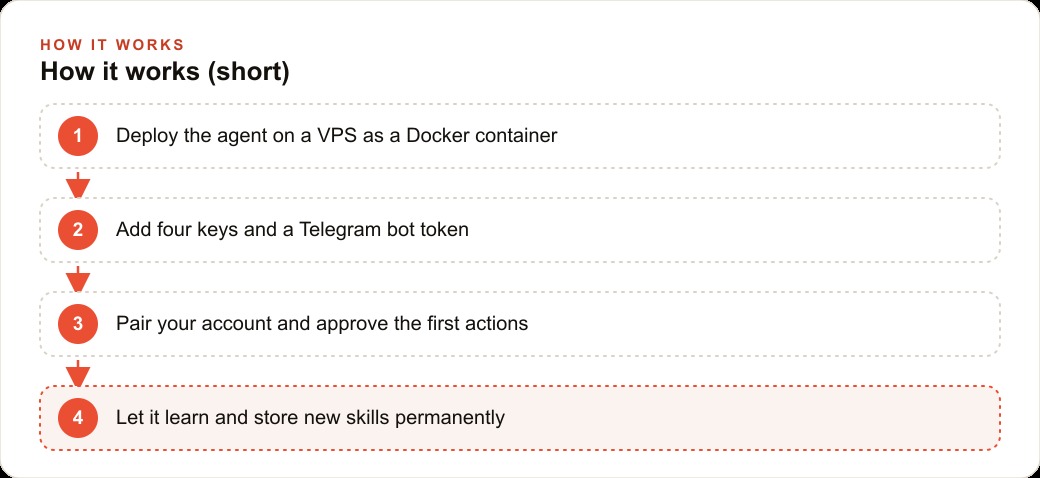
The Docker container that runs Hermes Agent is configured with a persistent volume. This single configuration detail determines whether the agent's learning survives server restarts. Without a correctly configured persistent volume, every container restart wipes the memory, the learned skills, and the session history. The agent resets silently and starts from scratch as if it had never run before.
With the persistent volume correctly configured, none of that is lost on restart. The skills the agent built, the memories it accumulated, and the session history that tells it your preferences all survive restarts and software upgrades. The agent that has been running for eight weeks and accumulated specific knowledge about your business picks up from exactly where it left off after any maintenance.
This is a one-time configuration decision with permanent consequences for whether the self-improvement architecture delivers on its promise. Getting it right during setup is the most important technical step in the installation. It is straightforward to verify: if the volume is correctly mapped, the agent's data directory persists across restarts. If it is not, the compounding that makes Hermes Agent valuable over the old session-by-session approach never happens.
8. The Tirith Guard Builds Earned Trust Before Granting Broader Autonomy
When you first contact your Hermes Agent through Telegram, it tells you directly that it does not trust you yet and provides a pairing code to approve inside the command line interface. Once paired, a built-in guard called Tirith requests explicit permission before executing any action the agent considers potentially risky.
This trust-building mechanism is the right default for an agent with real autonomy over external systems. An agent that can take actual actions in real tools needs an owner who has thought carefully about which actions should proceed automatically and which need a human in the loop. Tirith prompts that thinking systematically by asking for approval on each risky action during the early weeks when the agent is learning your environment and your risk tolerance.
The practical instruction is to be deliberate in the first two weeks of use. Approve the actions you want the agent to take independently. Deny the ones you want to continue supervising. This builds an accurate model in the agent's memory of how much autonomy you actually want to grant in each area, which guides its future behavior more reliably than any configuration file. The trust develops gradually, the same way you would build trust with a new person on your team, and the agent's autonomy expands appropriately as the track record builds.
For an auto repair shop, the result after a few weeks of this process is an agent that has learned how your shop formats customer estimates, which parts suppliers you prefer for which categories, what your standard labor rates are for the most common jobs, and how your team communicates internally. It handles the repetitive administrative work that costs service advisors time on every appointment, and it gets more accurate at that work week by week without requiring deliberate retraining sessions.
What Running Costs Actually Look Like Month to Month
The total monthly cost of running Hermes Agent breaks into two parts. Infrastructure is the VPS: roughly $10 to $20 per month for the recommended server size. API cost depends on usage volume and which models you route through. For light to moderate use on a mix of less expensive and mid-tier models, a realistic API bill falls in the range of $20 to $60 per month. Heavy research and drafting work on premium frontier models can push that higher, but most small business use cases land between $30 and $80 per month all-in.
Compare that to a part-time administrative assistant handling the same volume of research, drafting, and routine task processing. The economics are clear. The agent compounds in capability over time. The monthly cost does not increase as the agent gets better. The bill for month six is the same as month one, while the output quality and accuracy have improved significantly from accumulated skills and learned preferences.
That compounding is the financial argument for Hermes Agent over general AI tools with no memory. General tools require you to re-explain the same context repeatedly, and that re-explanation has a real time cost across a year of use. Hermes Agent solves that specific problem, and the $30 to $80 monthly cost is what makes solving it accessible for a business that is not running an enterprise AI budget.
That is exactly what we do at AI DOERS. Book a private 30-minute call with Madhuranjan Kumar and we will map the fastest path to it for your specific business.
Book your call →
Madhuranjan Kumar
Madhuranjan Kumar brings 20 years of performance-marketing experience and has managed over $200 million in Facebook ad spend for brands across the United States and beyond. His expertise spans the full modern marketing stack: Meta, Google Ads, TikTok, email automation, CRM, and the websites that hold it together. At AI DOERS he turns that track record into lead-generation systems for businesses across every industry.