
GTC and GDC AI News Roundup: What Actually Matters for Your Business
Two major tech conferences in one week produced dozens of AI announcements. Most were technical. A few genuinely change what is possible for local and small businesses right now. Here is the filtered summary.
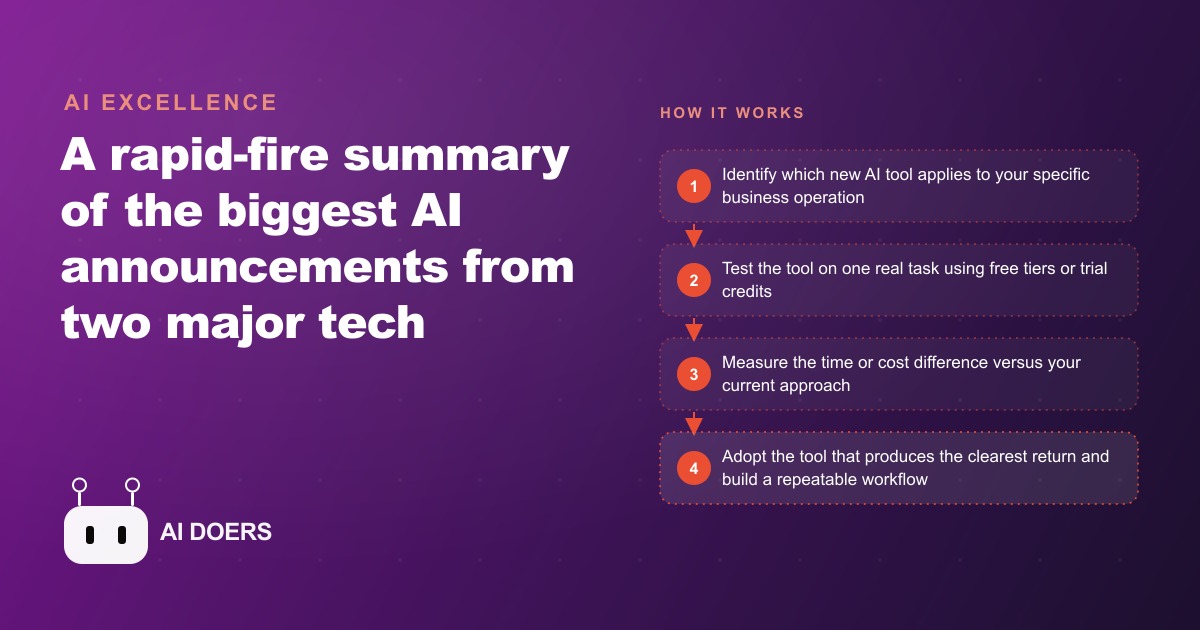
Every major conference week in AI resets the baseline. Not dramatically, not irreversibly, but measurably. What was expensive becomes accessible. What required a developer account drops to a consumer free tier. What demanded custom integration arrives as a single button in an app most people already use. The discipline the reset demands is not excitement at the announcements. It is the ability to filter, in real time, which specific changes matter for a business that has real operations to run, and which are infrastructure signals about a path that will not produce practical value until next year or the year after.
I am Madhuranjan Kumar. The week of Nvidia GTC and the Game Developers Conference produced a dense wave of announcements across AI models, platform features, and media generation tools. Jensen Huang's GTC keynote filled a sports arena, which is a baseline signal on its own: the enterprise AI conversation has reached the scale where it commands that kind of venue. The themes at GTC were GPU infrastructure planning for the next four years, AI integration in automotive and wireless networks, and the release of an open physical dataset for robotics training. Automotive partnerships announced included GM, Volvo, and Uber Freight. The news relevant to a business owner who does not run a data center came from the surrounding week of model and tool releases, not the keynote.
Every major conference week resets what is free, what is fast, and what is accessible to a business owner who is not a developer. The discipline is filtering signal from noise in real time. That is the frame for everything that follows.
The Claude web search update: the last major AI without it, and what that meant for research workflows
Claude was, until this week, the only major AI assistant without native web search capability. That fact shaped how it had to be used. Claude is a preferred tool for many business users because of the quality of its reasoning and writing, particularly for long documents, synthesis tasks, and structured analytical work. Without web search, every output was bounded by a knowledge cutoff, which meant any task touching current information required a manual step: find the information in another tab, paste it into the prompt, then ask Claude to reason over what you supplied.
That extra step is not catastrophic, but it is friction. When the information you need before you can ask your question is itself behind a search, the two-step process breaks the natural flow of research work. A search button now appears in the Claude sidebar. Claude retrieves current information and incorporates it before reasoning, rather than reasoning only from training data with a fixed cutoff.
For a business using Claude to research competitors, draft time-sensitive content, or answer market questions, this removes the need to front-load every research prompt with manually retrieved context. The research and the reasoning now happen in one place, in one flow, without switching applications. The practical gain is immediate: Claude can now handle the full spectrum of research tasks rather than only the subset where pre-training knowledge was sufficient. The last meaningful gap between Claude and the other leading tools on this dimension is closed.
The transcription economics shift: at $0.006 per minute, who can afford to transcribe everything changes
OpenAI released two transcription models: GPT-4o Transcribe and GPT-4o Mini Transcribe. The number that changes the calculation is $0.006 per minute for Mini Transcribe. Six-tenths of a cent per minute of audio.
Ten hours of audio costs $3.60 to transcribe at that rate. A week of client calls for a service business at twenty calls averaging seven minutes each costs under one dollar. A full month of the same call volume costs under four dollars. These numbers move transcription from a cost to be managed to a cost that effectively disappears into the background of normal operations.
When transcription is expensive, you choose selectively which audio to capture: important calls, formal interviews, recorded presentations. The selection is based on anticipated value because there is a meaningful per-unit cost to absorb. When transcription costs less than a dollar per hour, the calculation inverts. You transcribe everything, because the cost of not having a searchable record exceeds the cost of creating one. A service business with a searchable transcript of every client call has a record of every commitment made, every preference stated, and every problem described. The transcript becomes the intake document rather than requiring a separate manual form to be filled in after the fact.
OpenAI also released GPT-4o Mini TTS alongside the transcription tools. This text-to-speech model adds emotional control to voice output: adjustable energy and sentiment within the audio, so the voice responds to the tone of the content rather than narrating everything in the same flat register. For businesses creating audio content, automated phone responses, or training narration, this changes the quality ceiling available at the consumer price tier.
Gemini Canvas and podcast: the document-to-audio format that changes client education
Google's Gemini added two features that share a common underlying value for service businesses that need to communicate complex information to clients across different formats.
Canvas is a side-by-side editing environment where a document or code file appears on one side while the AI modifies it in context. This feature existed in Claude as a default mode and in ChatGPT as Artifacts. Its arrival in Gemini closes a workflow gap that previously made Gemini less useful for iterative document work. When developing a client-facing document over several passes, the side-by-side view keeps the current version visible throughout rather than requiring you to hold the document state in your head while typing instructions into a separate input field.
The podcast feature is the more distinctive addition. It takes a document you upload and generates an audio conversation between two hosts discussing and explaining the content. The output is polished, structured like a real podcast episode, and narrated in a conversational tone. It is not a text-to-speech reading of the source document. It is a synthetic discussion that treats the document's content as the subject of an informed, back-and-forth conversation.
For a service business, this creates a new client education format that requires no additional writing. A thorough guide explaining how a procedure works, what a client should expect, and what questions to ask currently exists as a PDF that some clients read carefully and others scan for the price and skip the rest. Uploading that document to generate a podcast version produces something a client can listen to during a commute. The same information reaches clients in a format suited to how they actually consume content, with no additional production effort from the business that created it.
Stable Virtual Camera: one phone-recorded clip becoming a multi-angle video
Stability AI released Stable Virtual Camera, a tool that takes a single input video and generates output from different camera positions using 3D spatial reasoning about the scene. You record or obtain a clip from one fixed angle. The model produces versions of the same scene as if filmed from a different position, with smooth camera movement that would have required a second camera or a dedicated camera operator in conventional production.
For service businesses producing video content with a phone and no production crew, this expands what is achievable from a single recording session. A tutorial video showing a technician demonstrating a process, shot from one stable position, can gain the kind of camera variation that used to require multiple setups. The limitation to understand is that the model infers what the scene looks like from other angles based only on what is visible in the source clip. Complex scenes with significant depth or with important elements partially out of frame will show more artifacts than simple, close-up subjects with clean backgrounds. A product demonstration or process walkthrough recorded from a stable close position is a stronger candidate than a wide-angle scene with many moving elements.
The plumbing contractor who applied four of these tools in one week
A plumbing contractor I spoke with during this conference week applied four of the relevant announcements to his business without writing any code. He is not a developer. He uses AI tools through consumer apps and low-code automation platforms, the same ones available to any small business owner with an hour to set them up.
He started with Mini Transcribe for his call recordings. He uses a call recording app that produces audio files from each client intake call. He set up a simple automation using Make.com, which required no code, to send each new recording to the Mini Transcribe API and save the resulting transcript to a shared folder. His dispatcher now reads the transcript to brief technicians rather than listening back to the recording or relying on notes taken during the call. At $0.006 per minute, a month of twenty calls per day across twenty working days costs approximately forty dollars in transcription fees. The dispatcher time saved on note-taking and recall alone exceeds several hours per week.
He used Claude with the new web search capability to research what complaints his local plumbing competitors were receiving in recent Google reviews. He asked Claude to search for that information and return a structured list of the most common issues mentioned. The results shaped three short-form educational videos he planned to produce, addressing the specific problems competitors' customers were writing about. He expected that content to attract more search and social engagement than videos guessing at what potential clients wanted to know.
He uploaded his pre-service walkthrough document to the Gemini podcast feature. The document explained what a drain camera inspection involved, why it cost what it did, and what clients should expect from start to finish. He sent the generated audio file to clients at the time of booking confirmation as a pre-service explainer. Two clients who received it mentioned it when the technician arrived, saying it had answered the questions they had planned to ask in person. The first ten minutes of the service call did not need to be spent re-explaining the process.
He also used Topaz Gigapixel 8.3.0, which released a faster diffusion-based upscaling approach during this same week, to restore a batch of older job site photos that had been unusable in marketing materials because of their low resolution. The restored versions passed the quality standard for his website and printed bid packages, giving him a visual catalog he had been lacking without a new photo session.
Four tools, one week, zero code written. Each one was applied to a specific existing operational task where the new capability produced a measurable change. None required building an entirely new workflow before delivering value. That is the accessible end of a conference week, and it is the end that actually earns money in a real business.
The discipline of adopting two or three, not twenty
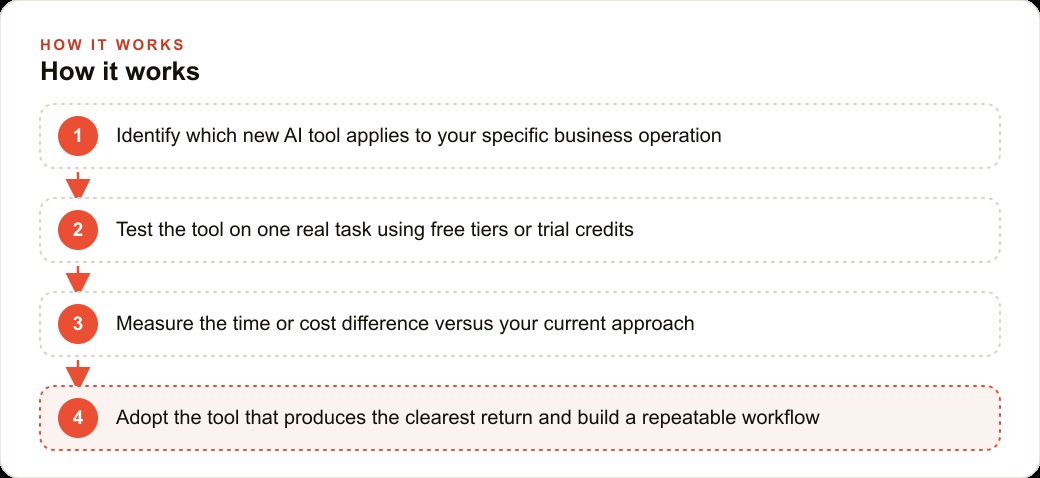
A conference week like this one produces between twenty and forty announcements worth reading. Adopting all of them is noise creation, not strategy. The useful discipline is a simple filter: which two or three specific changes address a workflow I already run, and can I apply each one using tools I have access to right now, without building something new from scratch?
The plumbing contractor's list of four was slightly above the typical recommendation, but it worked because each tool had a narrow, measurable application he could complete and evaluate within days of the release. He did not install four new platforms and spend two weeks exploring their general capabilities. He mapped each tool to one specific recurring task, applied it, and measured the result on that task before moving to the next.
That is the right posture for every conference week. The Claude search update matters to businesses already using Claude for research, because removing the manual context step makes an existing workflow faster without changing anything else. The transcription economics shift matters to businesses with significant call volume, because a price at which comprehensive transcription becomes economically trivial opens record-keeping and analysis possibilities that were previously too expensive to pursue. The Gemini podcast feature matters to businesses that have already written thorough client education material and want to reach clients in an audio format without paying for narration or recording time.
None of these require abandoning a current workflow. Each improves or extends something already in use. That filter distinguishes tools that belong on this month's action list from tools that belong on next quarter's watch list. Applying it consistently is what separates the business owners who compound operational advantages quarter by quarter from the ones who follow the news cycle closely without capturing any of the value it contains.
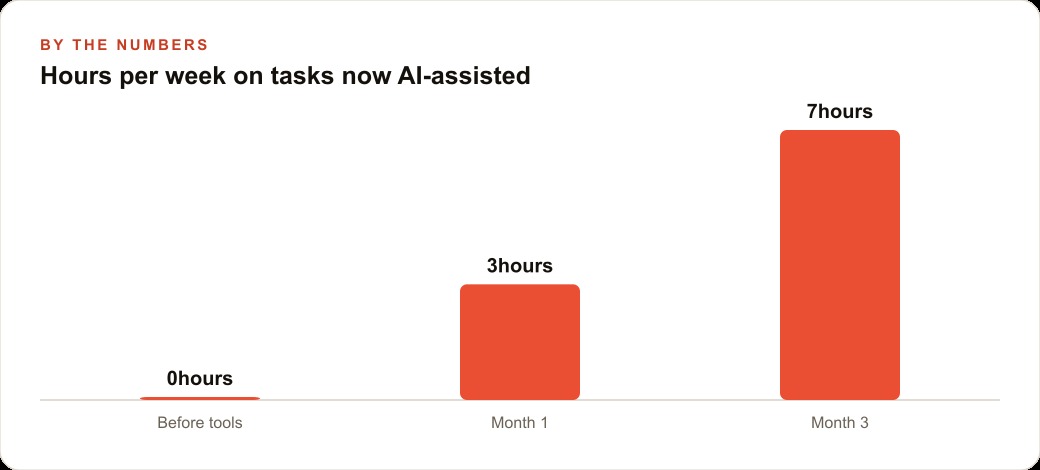
That is exactly what we do at AI DOERS. Book a private 30-minute call with Madhuranjan Kumar and we will map the fastest path to it for your specific business.
Book your call →
Madhuranjan Kumar
Madhuranjan Kumar brings 20 years of performance-marketing experience and has managed over $200 million in Facebook ad spend for brands across the United States and beyond. His expertise spans the full modern marketing stack: Meta, Google Ads, TikTok, email automation, CRM, and the websites that hold it together. At AI DOERS he turns that track record into lead-generation systems for businesses across every industry.