
Grok 3 Tops the AI Leaderboard: How the New Number One Model Changes the Tool Landscape for Trade Businesses
Grok 3 launched at the top of the world's most-watched AI preference ranking, bringing chain-of-thought reasoning, deep web search, and free access, with immediate implications for how trade businesses use AI for research and customer communication.
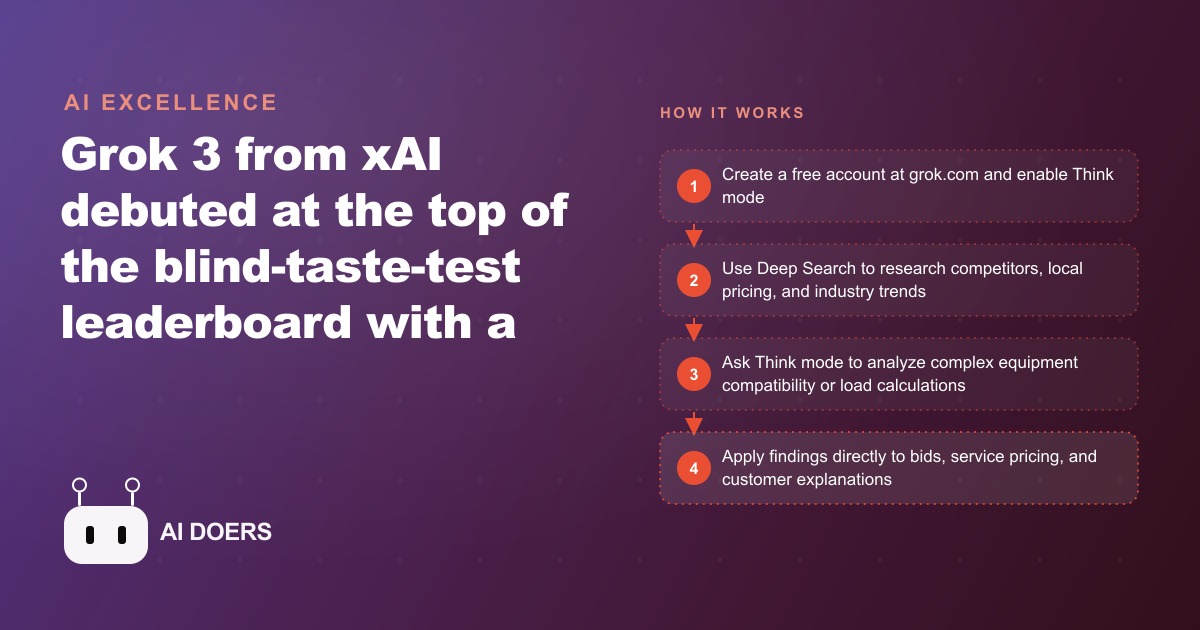
Grok 3 debuted at the top of LM Arena, the blind-preference leaderboard where human evaluators compare model outputs without knowing which model produced them, and it held that position on launch day across every model available to the public. I am Madhuranjan Kumar, and rather than walk through the benchmarks in isolation, I want to use this debut to make a few observations about where the AI model market is heading and what that means practically for the businesses using these tools.
1. Grok 3 reaching number one on the blind preference test matters more than any benchmark score
LM Arena is considered one of the most honest measures of AI model quality because it is resistant to benchmark gaming. A model cannot be specifically optimized for this test because the evaluators are judging real-world output quality on naturalness, accuracy, and helpfulness, side by side, without any labels. When Andrej Karpathy runs a visual test asking each model to draw a pelican on a bicycle and Grok 3 produces the best one, that is a qualitative signal from a respected expert that the output quality is genuinely high, independent of any number on a leaderboard.
The practical implication is that Grok 3 belongs in the rotation of models you test for any task where output quality is the primary criterion. It is free at grok.com for standard access, which removes the subscription friction for evaluation. The right test is not checking which benchmark it tops but running a real task you do regularly and comparing the output to what you get from the tools you currently use.
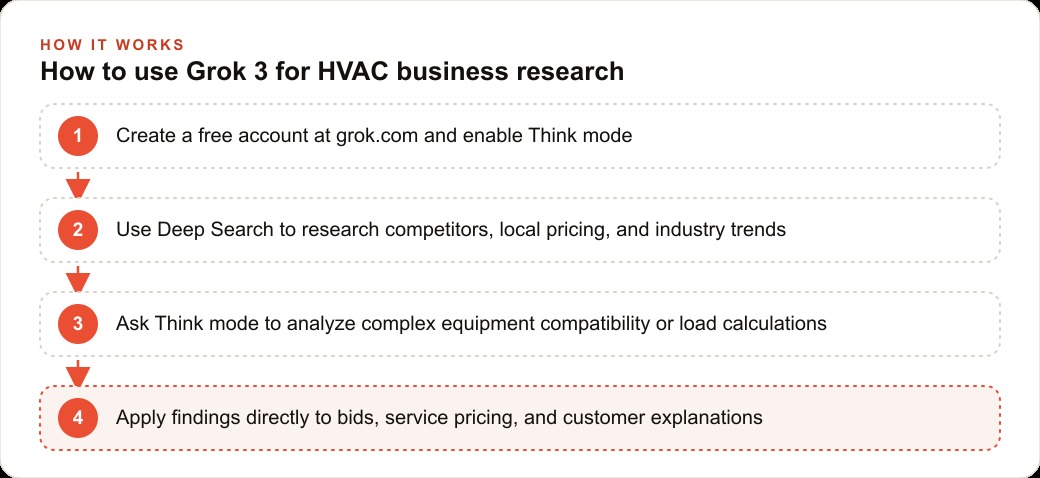
2. Think mode and Deep Search are the two capabilities worth adopting immediately
Think mode activates chain-of-thought reasoning, where the model works through a problem step by step before generating its final response. This makes it visibly more systematic on multi-step questions. The comparison to DeepSeek R1 and OpenAI's reasoning models is fair; the approach is the same. What matters for practical use is that Think mode improves output quality on complex analysis questions without requiring you to do anything more than enable a toggle.
Deep Search is the capability that has no direct equivalent at the same price point. It searches across the broader web and, crucially, across posts on X, giving it access to real-time professional and public conversations that most web-only search AI tools miss. The questions where Deep Search outperforms standard web search AI are precisely the ones where current information and real-world sentiment matter: what customers are saying about a specific product, what professionals in an industry are discussing right now, what questions people are actually asking in communities relevant to your business.
For a business investing in SEO and organic content, Deep Search is a real research tool, not just a feature to demo. The ability to surface what people are actually saying about a topic on X, at the moment a piece of content is being researched, is the kind of specificity that separates content built from real audience signals from content built from generic topic research.
3. An uncensored DeepSeek R1 is now freely available from Perplexity
Perplexity released R1-1776, a version of DeepSeek R1 with post-training specifically designed to remove Chinese government censorship filters. It answered questions that the original R1 refused, and it is available free on Hugging Face and via API.
For businesses that found the original DeepSeek useful for reasoning tasks but encountered refusals on certain topics, R1-1776 is worth evaluating. The practical use cases are wherever strong reasoning is needed on topics that the original model declined, including analysis of politically sensitive markets, competitive intelligence on Chinese-originated technology, or any research that touches topics the original model treats with unusual caution.
4. A multi-agent AI solved a two-year antibiotic resistance problem in 48 hours
Google's AI co-scientist system, a multi-agent architecture where specialized AI agents collaborate on scientific problems, solved an antibiotic resistance challenge in 48 hours that had taken microbiologists two years to crack. This is the strongest public demonstration to date of AI genuinely accelerating scientific discovery rather than assisting with documentation or literature review.
The immediate business application is indirect, but the signal matters. Multi-agent systems are becoming genuinely capable of tackling complex domain-specific problems that previously required years of expert work. For businesses in research-adjacent fields, pharma supply chains, materials science, agricultural inputs, the timeline for AI-assisted competitive intelligence and research is shorter than most planning assumptions account for.
5. Ten-minute narrated videos can now be generated from a single text prompt
Invideo AI can generate fully edited, narrated video content up to ten minutes long from a single text prompt, with built-in voice actors, music, and natural language editing commands. This is not rough output for refinement. It is production-ready content for many business use cases.
For any business running video content marketing, the calculation on content production cost just changed. A ten-minute explainer video that previously required a script, voiceover recording, stock footage sourcing, editing, and graphics now has a text-prompt path that produces a comparable result at essentially zero production cost. The use cases include product explainers, service overviews, FAQ videos, and educational content. The business that builds a video content library this year will have a compounding SEO and engagement advantage over the one that waits until it is more convenient.
This is directly relevant for businesses running Google Ads or Facebook and Instagram ad campaigns where video is a key creative format. Lower cost of video production means more variants to test, which typically means better creative performance over time.
6. Compute scale is the new moat, and 200,000 GPUs is the new reference point
xAI trained Grok 3 on 100,000 GPUs, then doubled to 200,000, giving the model roughly 15 times more compute than Grok 2. Google partnered with a major private equity firm this week on a TPU-based cloud venture worth billions. These are not marketing numbers; they represent the scale of investment required to stay at the frontier.
The business implication is that the AI providers at the frontier are competing in a capital-intensive race that small operators cannot influence but should monitor. The labs that maintain access to compute at this scale will continue producing the best models. The labs that cannot sustain this investment will fall behind or be acquired. For a business choosing which AI providers to build workflows on, the financial durability of the provider matters alongside the current capability of its models. Investing deeply in a provider that cannot sustain frontier-level compute investment is a risk worth factoring into tool selection.
The practical conclusion from this week is straightforward: test Grok 3 against your most important AI tasks, evaluate whether Think mode improves the quality of your analytical work, and run a Deep Search on a competitive research question to see how the results compare to what you get from other tools. The free access removes every excuse for not evaluating it directly. ## A worked example: competitive intelligence for a plumbing company
The business case for Grok 3's Deep Search is most concrete with a specific research task. A plumbing company in a midsize market has been losing bids on water heater replacements to a competitor who moved into the service area eight months ago. The owner believes the competitor is pricing aggressively but does not have a clear picture of what customers are actually saying or what the competitor is communicating.
Standard web search finds the competitor's website, a few review listings, and a press mention from when they opened. Total research time: forty minutes. Total insight: the competitor exists, has good reviews, and claims next-day service. Not enough to understand how to compete effectively.
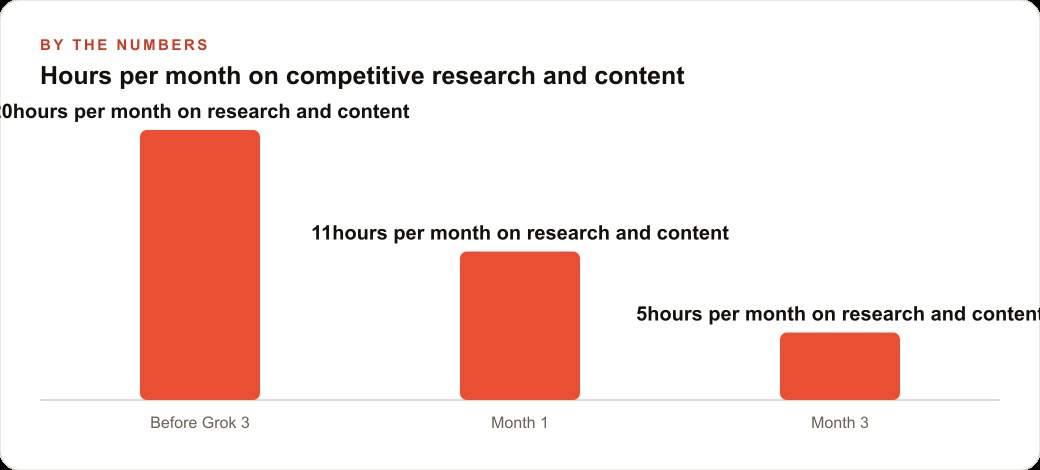
The same research question through Grok 3's Deep Search with Think mode takes twenty minutes and returns something qualitatively different. The Deep Search pulls from the competitor's own posts on X, from local Facebook groups where plumbers and homeowners discuss service experiences, from review platforms with more granular comment data, and from any contractor community discussions where the competitor or their pricing has come up. The synthesized result identifies three patterns: the competitor's strongest selling point is their same-day guarantee on water heater work, customers who chose them over the local alternative most often mention speed over price, and there are two negative mentions about a specific technician's communication style that appear across platforms.
That is actionable competitive intelligence that would have required hours of manual searching without Deep Search. The plumbing company's response can target the specific advantage the competitor is winning on, which is speed, rather than engaging in a price war. They can introduce and market a same-day commitment for water heater replacements, distinguish their communication approach in every customer-facing touchpoint, and specifically target the customer segment that the competitor's service complaints are pushing away.
The Think mode contribution to this research is in the synthesis step. After Deep Search returns the raw results, Think mode works through the competitive implications systematically: what does this mean for positioning, what specific messages would resonate with the customers choosing the competitor for speed, what is the most defensible competitive response given the plumbing company's current capacity. The output is not a list of observations. It is a structured competitive response plan built from current market data.
For a business already running Google Ads and Facebook and Instagram ad campaigns, that competitive intelligence directly improves campaign performance. Ads that address the specific buying criteria of customers currently choosing a competitor outperform generic ads for the same service every time. Grok 3's Deep Search, applied to competitive intelligence before campaign planning, changes what the campaigns say and who they target. That is the business-level return on a model that is currently available at no cost.
The final observation about Grok 3's position in the current market is that its timing matters as much as its capability. A model with this research depth that is free to use changes who can afford to do serious competitive intelligence. Six months ago, the quality of Deep Search plus Think mode synthesis was only available to businesses with either a skilled analyst or a premium tool subscription. Today it is available to any business owner who opens an account. The competitive advantage is no longer in access to the tool. It is in the discipline to use it systematically before making decisions rather than ad hoc when curiosity strikes.
The practical starting point for a business that wants to use Grok 3 this week is to identify one ongoing competitive intelligence question that currently gets answered through occasional manual Google searches. It could be: what are local competitors saying about their services on social media this month? What are customers of competing businesses saying in reviews about the things they specifically liked or did not like? What offers are similar businesses in other markets running right now? Each of those is a Deep Search prompt waiting to be written. Run it once. Compare the output to what your manual search process produces. The quality difference will determine how much of your research workflow is worth routing through this tool going forward.
One more note on the Think mode specifically: it is most valuable not when the research question is simple but when the competitive insight requires synthesis across multiple sources that individually would not tell you much. A competitor's single negative review reveals nothing. A pattern of negative reviews across thirty reviews, two social media posts, and one forum discussion, identified and synthesized by Think mode, reveals a genuine vulnerability that the competitor does not know is visible. That is the intelligence that changes how you position and what you emphasize, and it is the kind of insight that previously required hiring a researcher or spending an afternoon manually reading everything you could find. The businesses that will extract the most value from Grok 3 are the ones that treat competitive intelligence as a recurring discipline rather than an occasional project. Schedule the research session into the calendar. Make it monthly at minimum, weekly if the competitive environment is fast-moving. The consistent application of a powerful tool produces compounding insight. Occasional use produces occasional insight. The compounding is in the habit, not the tool.
That is exactly what we do at AI DOERS. Book a private 30-minute call with Madhuranjan Kumar and we will map the fastest path to it for your specific business.
Book your call →
Madhuranjan Kumar
Madhuranjan Kumar brings 20 years of performance-marketing experience and has managed over $200 million in Facebook ad spend for brands across the United States and beyond. His expertise spans the full modern marketing stack: Meta, Google Ads, TikTok, email automation, CRM, and the websites that hold it together. At AI DOERS he turns that track record into lead-generation systems for businesses across every industry.