
This Week's AI Releases All Point to the Same Future: One AI That Knows Everything About Your Business
From GenSpark agents to Notion AI to persistent memory protocols, every major release this week is a piece of the same puzzle. Here is what the complete picture looks like.

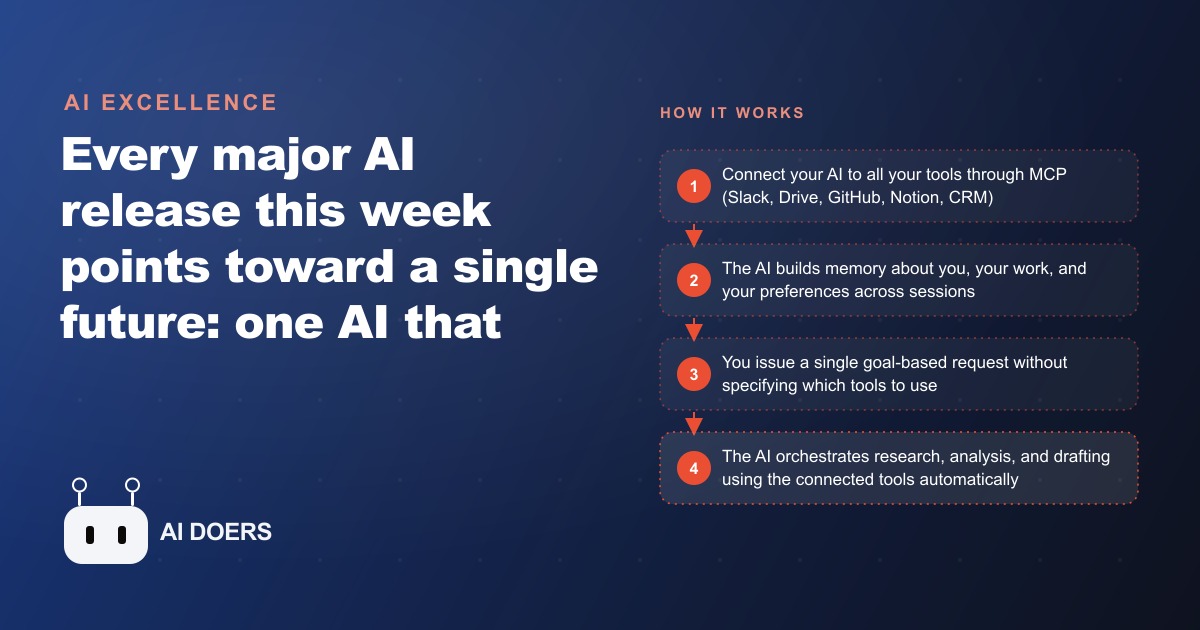
The Real Problem Is Not the Tool, It Is the Constant Handoff Between Them
I want to be specific about what actually frustrates me about the current state of AI tools, because the thing that frustrates me most is not any individual tool's limitations. It is the handoffs. I start a research task in one tool, the output references industry patterns I need to cross-reference against data in a spreadsheet, then I need to pull context from a CRM note, and by the time I have assembled everything from three different places, the AI session that started the research has no memory of why I was researching in the first place.
That friction has a name: context fragmentation. It is the problem where your knowledge lives in silos and every AI session starts blind, without access to the relevant history that would make its output immediately useful. Every major AI release this week, from GenSpark's video analysis agents to Notion's cross-app search to Mem Zero's open-source memory protocol to MCP's universal adoption, is a piece of the solution to that one specific problem. Understanding them as individual releases misses the point. Understanding them as a coordinated attack on context fragmentation from multiple angles clarifies exactly what is being built and why it matters.
The GPT-5 vision from OpenAI is the sharpest articulation of where this goes: one system that automatically routes to the right capability, whether that means deep research, image generation, code execution, or conversation, without the user choosing the model or managing the handoff. You state a goal. The system figures out which tools to coordinate and how to assemble the result. That is not incrementally better AI. That is a different relationship between a person and their tools.
Context Fragmentation Is the Tax Every Business Pays Without Measuring It
Most business owners do not think of context fragmentation as a specific problem to solve. They experience it as a vague sense that AI tools take more setup than expected, that outputs need more editing than anticipated, and that the time savings are smaller than the demos suggested. The gap between the demo and the reality is almost always context fragmentation. The demo shows the AI handling a task with perfect context about the business, the audience, and the goal. The real session starts from scratch every time.
The cost of this tax is distributed across every person on the team in small amounts, which makes it hard to see clearly. A service advisor who spends seven minutes re-explaining a customer's history to an AI before asking for a draft reply is paying that tax. A marketing manager who pastes in three documents of background before asking for a campaign brief is paying that tax. A business owner who manually pulls numbers from four different dashboards before asking an AI to summarize the week is paying that tax. None of these individual overhead costs feel worth measuring, but across a team of five people over 200 working days, they add up to a significant portion of a working year spent on setup rather than on output.
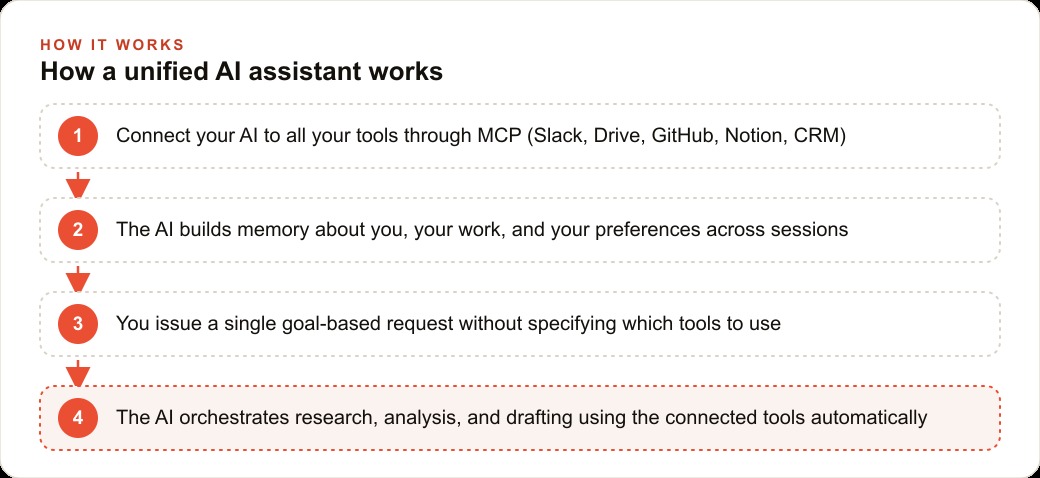
The releases this week are all specifically reducing that overhead by making AI context portable. Notion's cross-app search means the AI can find relevant information across Slack, GitHub, Google Drive, and Jira in one query rather than requiring you to assemble the context manually. Mem Zero's memory protocol means the AI carries relevant preferences and past decisions across sessions rather than starting fresh. GenSpark's video analysis means you can direct an AI agent to research a topic across multiple video sources rather than watching them yourself. Each of these is a partial reduction of a specific kind of overhead, and together they sketch the outline of a world where the setup cost of an AI interaction approaches zero.
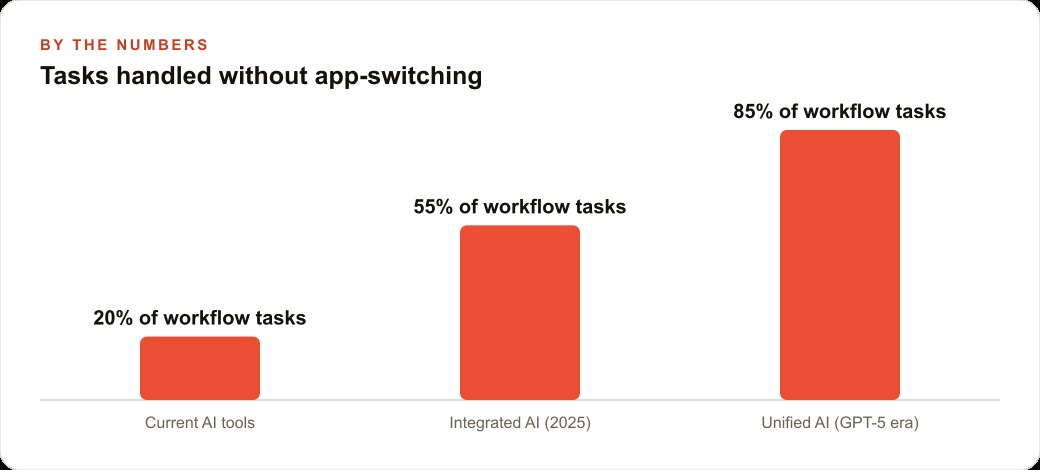
Why MCP Becoming the Universal Standard Is the Infrastructure Shift That Changes Everything Else
Model Context Protocol, adopted now by OpenAI, Google, Microsoft, and Anthropic, is the piece that makes everything else work at scale. The reason context fragmentation has persisted is that every AI tool has had its own proprietary way of connecting to external data sources and applications. Building a connection between an AI tool and your CRM meant building something that worked only for that specific AI tool and would break when either the AI or the CRM updated its API.
MCP solves this by establishing a universal connector standard. Any company that builds an MCP connector for their tool has it work immediately with every major AI platform that has adopted the standard. This is the USB-C moment for AI integrations. Before USB-C, every device manufacturer used a proprietary connector and every device owner managed a drawer full of incompatible cables. After USB-C, one cable type works across all devices. MCP does the same thing for the connections between AI systems and the tools businesses use.
The practical consequence for a business owner is that the integrations being built today will be reusable across future AI systems. If you connect your business tools to an MCP-compatible AI today, those connections do not need to be rebuilt when you move to a more capable AI next year. The integration layer you build now carries forward. That changes the investment calculus entirely. Connecting your business knowledge and tools to an AI is no longer a platform-specific decision that locks you in. It is a durable capability that improves as better AI systems arrive. Building it now is the correct move because the investment compounds rather than depreciating.
What Persistent Memory Actually Changes About How an AI Works With Your Business
The difference between an AI with persistent memory and one without it is the difference between a brilliant consultant who reads a fresh briefing document before every meeting and a brilliant consultant who has worked with you for six months and knows the context without being briefed at all.
The current state is almost entirely the former. Every new session, every new tool, requires you to provide the context that makes the output useful: what your business does, who your customers are, what tone you use in communications, what decisions have already been made and why. This context-setting is not a trivial cost. For any task more complex than a simple lookup, providing context takes as long as it takes to describe it, and the output quality is bounded by how completely you described it.
Mem Zero's open-source memory protocol changes this by giving AI systems a standard way to store and retrieve context across sessions and across tools. The memory is explicit and structured: the AI remembers that you prefer certain phrasings, that you have decided to focus on a specific customer segment, that a particular approach was tried and did not work. This memory follows you across sessions and can be accessed by different AI tools, so the context does not have to be rebuilt when you switch from one tool to another within the same workflow.
The long-run implication for a business is significant. An AI assistant with six months of accumulated memory about how your business operates, what your customers ask, what decisions you have made, and what approaches have worked is materially more useful than one that starts fresh every session. The compounding value of persistent memory is slow at first and accelerates as the accumulated context reaches a density that makes every interaction noticeably faster and more accurate. This is the actual future GPT-5 points toward: not just a smarter AI but an AI that has been learning your specific business for months.
How GenSpark and Whisper Turbo Fit the Same Pattern
GenSpark's super-agent capability, specifically the ability to download and analyze videos from social platforms and build research documents from them, is the context fragmentation solution applied to competitive intelligence. Before this, researching what competitors are doing on social media required watching videos manually and synthesizing findings into a structured document by hand. The human bottleneck was the time cost of watching and writing, not the analytical capability.
GenSpark removes that bottleneck for video-heavy research. Give it a starting URL and a research question, let it run autonomously for 10 to 20 minutes, and receive a structured analysis that would have taken several hours to produce manually. The research task still requires good judgment about what to look for and how to interpret the findings, but the data collection and initial structuring are automated. For a business competing in a market where competitors are active on video platforms, this collapses a significant recurring research cost.
Whisper Large V3 Turbo addresses a different kind of context fragmentation: the gap between audio and text. Two minutes of audio transcribed in under a second at roughly $0.80 per hour makes bulk transcription economical for any business that produces or receives significant audio content. Sales calls, client interviews, service appointments, training materials: any of these that currently exist as audio files and therefore as inaccessible content for AI search can be converted to searchable, AI-readable text at a cost that is negligible relative to the value of making that content available. An auto repair shop that records service advisor calls for training purposes can make every one of those recordings searchable and AI-processable at near-zero cost per recording.
The Four-Panel Visual Prompt: One Practical Tool Available Right Now
Among everything released this week, the four-panel visual prompt is the most immediately actionable for a business not yet running any AI integrations. The prompt works in ChatGPT's image generation and produces a two-by-two grid of panels, each with a short label and visual content, that explains any concept in a format that is shareable immediately. The structure is consistent: what it is, why it matters, what goes wrong without it, and what to do next.
For a service business, this format converts every concept your team explains repeatedly in consultations into content that educates automatically. A tax preparer has three or four concepts they explain at every new client meeting. A physical therapist has exercises they demonstrate at every intake. A plumber has common failure modes they walk through before every repair estimate. Each of these becomes one four-panel image that can be shared on social media, sent in a follow-up email, displayed in a waiting room, or attached to an estimate.
The production cost is near zero. The ongoing maintenance cost is zero once the image exists. The value is that a piece of content that previously required a consultation to deliver can now reach a prospect before the consultation, which changes the quality of the conversation and the speed at which trust builds. A prospect who arrives at a consultation already understanding the concept, because they saw the four-panel image in a follow-up email or on social media, spends less of the consultation on basic education and more on the specific problem they need solved.
What Small Businesses Should Do With These Signals Right Now
The businesses that will be best positioned when unified AI systems arrive are the ones building context management habits now. The specific habit is centralizing business knowledge in formats that AI can actually access and search. Searchable text documents, connected cloud applications, structured note systems, recorded and transcribed meetings: these are the formats that MCP integrations can use and that memory protocols can reference. Scanned PDF documents, handwritten notes, and siloed spreadsheets not connected to any shared system are formats the unified AI future cannot build on.
For an auto repair shop, three things from this week's releases are actionable right now. The four-panel educational image prompt produces service advisor training materials and customer-facing explanations for common repairs in minutes per image. Notion's cross-app search, if the shop already uses Notion alongside a communication tool, makes customer history searchable across systems for advisors who need context before a call. GenSpark's competitive analysis capability can produce a structured comparison of competitor pricing on common services within an hour, a task that previously required manual searching across multiple review sites.
None of these require waiting for GPT-5 or for the unified AI future to arrive. They work right now with tools available today. The businesses building habits around connected, searchable, AI-accessible knowledge today will have months of accumulated context and refined workflows by the time more capable unified systems arrive. Those businesses will use better tools better. The ones that wait will spend the early days of the unified AI era doing the context setup that the early movers already completed. The advantage of starting before you feel you have to is that the compounding starts earlier.
That is exactly what we do at AI DOERS. Book a private 30-minute call with Madhuranjan Kumar and we will map the fastest path to it for your specific business.
Book your call →
Madhuranjan Kumar
Madhuranjan Kumar brings 20 years of performance-marketing experience and has managed over $200 million in Facebook ad spend for brands across the United States and beyond. His expertise spans the full modern marketing stack: Meta, Google Ads, TikTok, email automation, CRM, and the websites that hold it together. At AI DOERS he turns that track record into lead-generation systems for businesses across every industry.