
GPT-5 Rumors, Baby Grok, and the AI Video Tools Reshaping Business Content in 2025
From a faster Veo 3 to a new Pika social feed and early hints about GPT-5, this week's AI releases carry real implications for any business trying to produce content at scale.

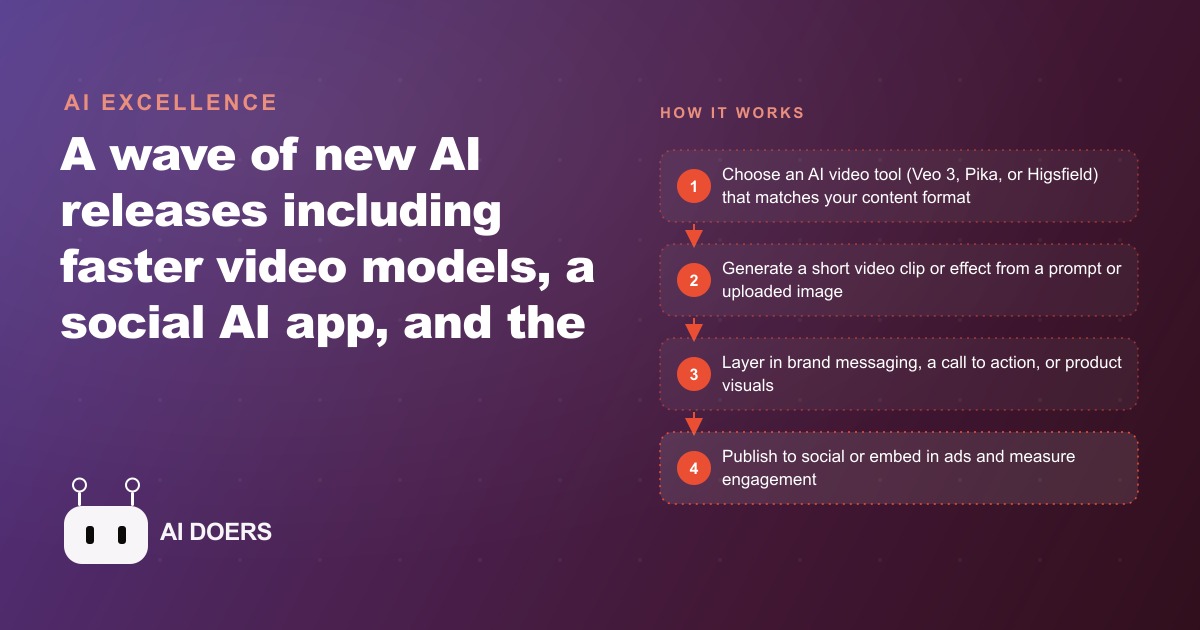
Google shipped a faster version of Veo 3, xAI teased a consumer companion for Grok, Pika launched a social feed built entirely from AI-generated video, and early reports placed GPT-5 on an August release timeline. Four separate things happened inside a single week, and they all point in the same direction: the cost and time required to produce business video content is falling faster than most owners have adjusted their expectations or their budgets for. I am Madhuranjan Kumar, and the weekly AI release cycle is where the real competitive information lives for anyone producing content at scale.
Veo 3 Fast Cuts Generation Time and Includes Three Free Clips Per Day on the Pro Plan
Google's faster variant of its Veo 3 video model generates at 720p instead of the higher resolution of the full model, runs in approximately half the time of its predecessor, and includes three free daily generations on the Pro plan. That combination is more practically significant than the specification numbers suggest. Seven hundred and twenty pixels is sufficient quality for any content viewed on a phone screen at the typical distance and screen size of mobile social viewing. Three generations per day means a real estate team, a dental practice, or a retail brand can test three distinct video concepts every single morning without spending a dollar on production beyond the Google subscription they may already hold.
The Veo 3 full model, from which this faster version is derived, generates video and audio simultaneously rather than requiring a separate audio layer to be added and synchronized after the fact. That simultaneous generation includes ambient sound, dialogue audio, and basic sound effects. The practical difference for a business creating ad content is the elimination of a production step that previously required either music licensing, voice-over recording, or a separate AI audio tool. One prompt produces a complete clip with audio that is ready for review rather than a silent clip that requires additional production work before it can be meaningfully evaluated.
The business case for running three concept tests per morning across two weeks is that it produces the equivalent of thirty short-format video advertising concepts tested and evaluated in fourteen days at essentially zero production cost. A business that previously could only test one or two paid video concepts per month due to production costs is now able to test thirty concepts in the same period. The volume of testing produces better creative decisions faster, which is the compounding advantage that shows up months later in campaign performance and cost efficiency.
Pika Social Collapses the Creation and Distribution Workflow Into a Single Environment
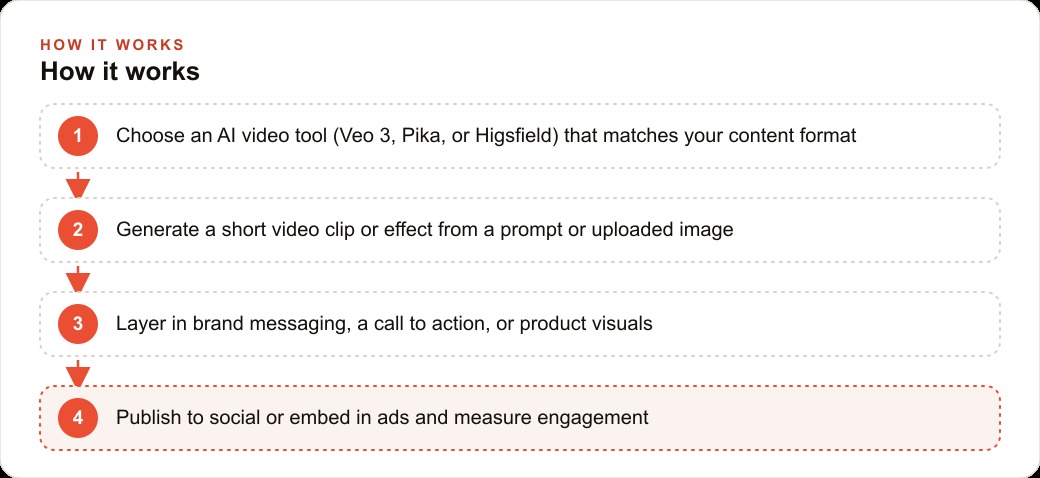
Pika's social application changes the standard friction pattern of the content workflow in a way that matters more than it initially appears. Normally, creating AI-generated video content requires using a creation tool, exporting the output, downloading the file, switching to a separate social platform, writing a caption, and publishing. Each of those steps is minor in isolation, but the switching friction across five or six tools compounds into a meaningful friction cost that reduces how often the content actually gets produced consistently. Pika Social compresses the sequence into one environment: generate a clip and publish it to a scrollable community feed without leaving the tool.
For a business that is new to AI video production, the single-environment design removes the most common stopping point in the workflow, which is the gap between generating a piece of content and actually publishing it. Many businesses produce content, run into the friction of uploading and publishing it on a separate platform, and let it sit. The Pika Social feed also functions as a real-time research environment where you can observe what kinds of prompts, formats, and styles are generating engagement among other creators before committing to a content direction for your own account.
That research function has value beyond its entertainment dimension. The patterns in what is working in the Pika feed are leading indicators of what will work in broader social feeds in the following weeks, because early adopters in a new creative tool are often exploring formats that mainstream audiences encounter a few weeks later. Watching what gets traction in a new creative platform before committing to a content strategy gives you a low-cost way to test creative directions without putting them in front of your actual audience first.
Baby Grok Signals xAI Is Building for Everyday Consumers Beyond the Current Power User Base
xAI's announcement of a lighter companion version of Grok designed for everyday use is a market positioning signal rather than an immediate product announcement with specific shipping date and feature specification. The current Grok product is aimed at users comfortable with AI tool complexity and willing to engage with its more technical presentation. A companion product designed for casual daily use suggests that xAI is building a surface intended for the mainstream consumer market, which includes business owners who want AI assistance without the friction of configuring and learning a technical tool.
The practical business relevance today is primarily observational: watch this space and evaluate it when the product ships with real feature documentation rather than announcement framing. The directional signal is consistent with the overall market movement where every major AI provider is building a simpler consumer-facing layer on top of their frontier capability, because that consumer layer is where long-term user volume and recurring revenue live. For a small business evaluating which AI tools to invest time in learning and integrating into operations, the emergence of simpler companion products means the barrier to AI adoption is likely to continue falling over the next twelve months regardless of which specific tools are available today.
Higsfield's Browser Extension Turns Static Image Libraries Into Motion Content Without Software
The Higsfield Steel browser extension applies cinematic effects to static images directly inside the browser, without a software download, an editing timeline, or prior video production knowledge. For a business that has an existing library of product photography, property images, or brand assets, this is immediately actionable. A retail brand with a library of product photos can apply motion blur, slow pan effects, color grading adjustments, and camera movement simulations to those images to produce content that reads as video to a social feed algorithm in minutes per image rather than hours per produced video.
The practical constraint is that the tool performs most cleanly on images without people in them, where AI-generated motion does not produce the uncanny facial movement that makes AI-animated faces uncomfortable to watch in motion. For product photography, architectural imagery, food photography, landscape shots, and any non-human visual content, the output is clean and usable for organic social distribution. For a business running Facebook and Instagram ad campaigns where product images are the primary creative asset, this extension represents a faster path from static images to motion ad creative than any workflow involving a video editing tool. The ad creative that was a static image last week becomes a motion clip this week without any additional production investment or any new tool learning curve.
A GPT-5 August Timeline Would Automatically Upgrade Every AI Workflow Without Any Changes Required
Reports suggesting GPT-5 would arrive around August with substantially improved multi-step reasoning capabilities and a larger context window carry a practical implication that is distinct from typical product announcements. When an underlying model improves significantly, businesses that have already built workflows around that model's interface and conventions receive the capability upgrade automatically, without changing anything about how they use the tool. A team that has configured ChatGPT for writing customer communication drafts, producing content outlines, or generating ad copy gets a meaningfully stronger model doing the same jobs when GPT-5 replaces the current version in their interface.
This asymmetry in who benefits from model upgrades is one of the strongest arguments for investing in AI workflow building now rather than waiting for models to improve further before starting. Businesses that have already built the workflow habits, the prompt libraries, the review processes, and the team conventions around AI tools are positioned to compound every model improvement automatically. Businesses that are still waiting for the tools to be good enough before starting will begin building workflows at the same moment their competitors receive their third or fourth automatic upgrade on workflows that have already been running for a year. The compounding advantage runs in the wrong direction for late adopters, and it accelerates with every model release. The businesses that benefited most from GPT-4's improvement over GPT-3.5 were the ones who had already built workflows on 3.5, not the ones who waited for 4 to arrive before starting.
Windows 11 Copilot Expansion Lowers the Hardware Barrier for Teams on Windows Devices
Microsoft pushing its Copilot and AI recall features to a broader range of Windows 11 machines is a distribution event rather than a capability announcement. The features themselves are not new, but making them available on machines that previously could not run them due to hardware requirements expands the effective installed base for on-device AI processing substantially. For businesses that manage Windows devices across a team and have been holding back on AI feature rollouts due to hardware compatibility concerns, this expansion removes a specific blocker without requiring any device upgrade investment on the business's part.
On-device AI processing also carries privacy properties that cloud-based processing does not. Documents processed on a device with on-device AI capabilities do not leave the machine to be processed on a remote server, which is a relevant distinction for any business working with contracts, client communications, competitive information, or other sensitive documents where data residency or confidentiality matters. The hardware compatibility expansion means more businesses can access those privacy properties without requiring new device procurement, which lowers both the financial and operational cost of adopting on-device AI features.
Delta AI's Repricing Shows That the Entire Video Generation Category Is Now Competing on Affordability
A major video generation tool repricing its tiers to compete more directly with runway and alternative platforms is a market signal rather than just a product announcement. When competition drives established tools to reprice downward, the entire category becomes cheaper for every user. A business that evaluated AI video tools several months ago and found them priced outside their budget should re-evaluate current pricing with fresh numbers rather than relying on a price memory that may be significantly outdated. The tools that cost fifty dollars a month for limited generations six months ago are now competing at fifteen to twenty dollars for comparable output, and that downward pressure on pricing is continuing as more providers enter the market.
The practical application of this signal is simple: run a current cost comparison before making any AI video tool decision. The pricing table changes faster than most business technology budgets are reviewed, and decisions made based on remembered prices from previous evaluations are likely to be based on numbers that no longer reflect the current market. Any business building a content strategy around video for SEO and organic search, whether that is YouTube educational content, embedded website video, or blog post video supplements, should run current pricing numbers before assuming any tool is out of their budget range.
The concrete move to make this week is to open a Google AI Pro account, enable Veo 3 Fast, and use the three free daily generations to test video concepts drawn from your business's actual marketing needs. Run this for ten business days. By the end of two weeks you will have evaluated thirty distinct video concepts, identified which prompt structures produce results that fit your visual style, and built a practical understanding of what AI video currently does well versus where it still needs human creative input or additional production work. That evidence base is more useful than any benchmark comparison or tool review, because it is specific to your content needs rather than to someone else's evaluation criteria or promotional framing. ## The Pattern Across All These Releases Points to a Single Strategic Action
The consistent pattern across the Veo 3 Fast launch, Pika Social, Baby Grok, the Higsfield extension, the GPT-5 timeline, the Windows expansion, and the Delta repricing is that every barrier reducing cost or friction in AI content production fell further this week. That pattern has been consistent for eighteen consecutive months and shows no sign of reversing. A business that treats each individual release as an interesting news item rather than as a cumulative signal will continue watching the tools evolve without changing how the business operates. A business that reads the cumulative signal correctly understands that the strategic window for building an AI-assisted content operation before competitors do is closing with each passing release cycle. The tools are already affordable, already functional, and already proven by the businesses that started six to twelve months ago. The only remaining variable is how long a business continues to wait before using them.
That is exactly what we do at AI DOERS. Book a private 30-minute call with Madhuranjan Kumar and we will map the fastest path to it for your specific business.
Book your call →
Madhuranjan Kumar
Madhuranjan Kumar brings 20 years of performance-marketing experience and has managed over $200 million in Facebook ad spend for brands across the United States and beyond. His expertise spans the full modern marketing stack: Meta, Google Ads, TikTok, email automation, CRM, and the websites that hold it together. At AI DOERS he turns that track record into lead-generation systems for businesses across every industry.