
GPT Image 2 Is the Best AI Image Model Yet, and Agents Will Drive It
GPT Image 2 leads every image category measured here, from pixel-perfect UI mockups to barcodes that scan on a real scanner. Because it now works as a tool inside an agent, automated agents rather than people will soon generate most of a business's images.
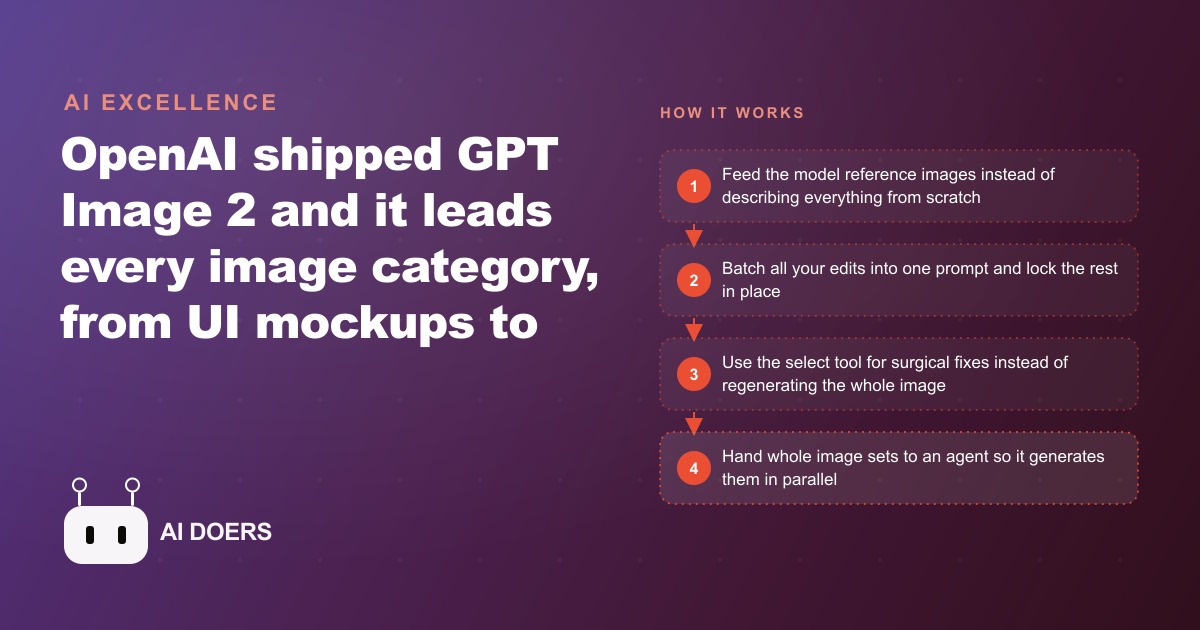
GPT Image 2 is the best AI image model available by a measurable margin in every category a working business depends on, and the concrete proof of that lives not in a benchmark comparison table but in six months of production at a med spa that switched its entire design workflow to it. I am Madhuranjan Kumar, and this is the case of a spa that went from spending $1,750 per month on 50 freelance graphics to spending under $50 per month on 65 agent-generated ones, with better brand consistency at every stage.
Before the switch: three days and thirty-five dollars per finished graphic
The spa runs four treatment lines and posts regularly across four social platforms: Instagram, Facebook, Pinterest, and a Google Business profile. Fifty graphics per month was not an ambitious production target. It was the baseline required to stay visible and consistent across those four channels, covering treatment promotions, seasonal pricing updates, educational posts about procedures, event announcements, and results-showcase graphics for newer offerings.
At an average of 35 dollars per finished piece, the monthly design budget was $1,750. That number came from a monthly retainer with a freelance designer, and it sounds manageable until you trace where the money and time actually went. A finished piece did not arrive in one pass. The owner briefed the designer through a voice note or a rough sketch in a notes app, waited a day for a first draft, reviewed it, sent back corrections, and waited again. A graphic that required a headline change, a background color update, and a layout adjustment typically needed two to three rounds spread across two to three calendar days.
The time cost for the owner averaged 15 hours per month across briefing, waiting, reviewing, correcting, and approving 50 pieces. That is nearly two full working days every month consumed by the administrative overhead of image production rather than by running the spa. When a seasonal campaign needed to launch quickly, the compression of that revision cycle created deadline pressure. More than once across the year, a time-sensitive treatment promotion launched a day late because the final revision did not clear in time for the scheduled post date.
The second cost was brand drift. Over six months working with the same designer, the visual style of the spa's posts shifted in small but accumulating ways. Font weights changed slightly from quarter to quarter. The spacing between graphic elements varied. The compositional approach evolved in ways that made the February posts look noticeably different from the August posts when viewed side by side. The core brand colors held throughout, but the distinctive visual identity that made the spa's content recognizable at a scroll was gradually diffusing. Periodic style reviews and re-briefing conversations corrected it temporarily, then it drifted again.
The owner was spending $1,750 per month and 15 hours per month for output that was technically adequate, inconsistent over time, and slow to respond to campaign timing. That was the starting state.
The first week: what feeding reference images changed immediately
The first test with GPT Image 2 used pure text description prompting, which is where most operators start. The owner described the treatment being promoted, the seasonal angle, the color palette, the copy to include, and the general layout intent. The outputs were competent and generic. They looked like polished stock content rather than the spa's specific brand. The palette was approximately right and the layouts were clean, but nothing about the images was distinctively the spa. Text prompting alone does not transfer a visual identity that took a year to build.
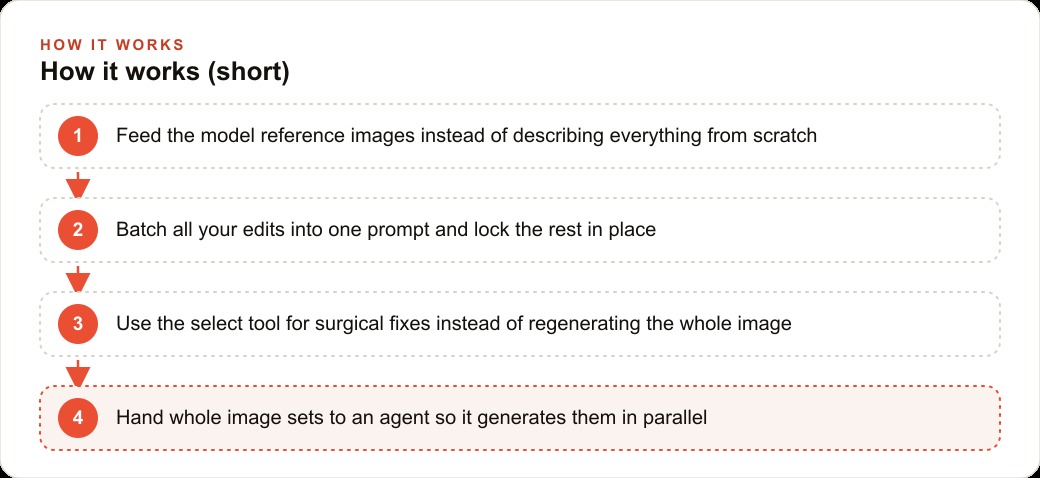
The second attempt changed the entire approach. Instead of describing what the image should look like in words, the owner fed three reference images directly into the generation session: two existing posts from the spa's best-performing months, representing the ideal composition and visual tone the brand had arrived at, and a close-up crop showing the exact form of the hero brand accent color. Every generation that followed in that session used those three references as visual anchors. The model read across all three simultaneously and held the brand consistent across composition, spacing, and color treatment without needing a new description for each piece.
The first week produced 12 usable graphics in about four hours of total work, including the time spent on the failed text-only session and the learning curve of the reference-image approach. The brand consistency across those 12 images was tighter than anything the designer had produced in recent months of rushed turnarounds. The owner held two of the week's outputs in reserve to compare against the next designer batch. The comparison resolved the question in favor of GPT Image 2.
One behavior stood out above everything else in that first week: text rendering. The spa had previously avoided putting detailed text inside AI-generated images because older models produced letterforms that were technically readable but visually broken, requiring cleanup in a separate editing tool. GPT Image 2 rendered the headline font weight, the body copy block, and the pricing figures correctly from the first generation. The cleanup step for rendered text disappeared from the workflow entirely.
The reference-image technique also produced something unexpected: consistency across format variants. When the same graphic needed to be adapted from a square format to a 4:5 vertical to a 9:16 story, feeding the square version as a reference and specifying the new dimensions produced a correctly adapted version rather than a generic recomposition. The model understood that the content and brand identity should carry over while only the layout proportions changed.
Discovering the batch-edit behavior that collapsed three-round jobs to one prompt
The third week brought a seasonal update to a treatment bundle promotion. The existing graphic needed four simultaneous changes: a new headline reflecting the summer campaign angle, an updated price for the bundle, a background lightened from the winter palette to a softer warm tone, and the seasonal accent color swapped from deep burgundy to coral. Under the designer workflow, this was a four-element brief that typically required two rounds because at least one element would land slightly off and need a follow-up correction.
The owner batched all four changes into a single prompt, fed the existing graphic as a reference image, listed each change in sequence, and ended the prompt with one explicit locking instruction: hold every other element exactly as it appears in the reference. The model delivered all four changes in one pass. The headline was updated, the price was correct, the background was lighter, the accent color was coral, and everything else, the logo, the body copy block, the footer treatment, the composition grid, was exactly as it had been in the reference.
That single result changed the owner's working model of what this tool was capable of. The batching behavior collapsed the multi-round revision cycle almost entirely. A job that previously took two to three days and two back-and-forth rounds with the designer took one prompt and returned a finished graphic in under two minutes.
The select-and-edit feature reinforced the same principle for smaller corrections. When a single element in an otherwise approved graphic needed adjusting without touching the rest of the composition, the owner used the built-in selection tool to draw a loose boundary around that element and describe the change. A headline sitting slightly too heavy on a pale background was corrected by selecting the text block and requesting a lighter weight. The rest of the image held exactly. This eliminated the situation where correcting one element required generating an entirely new version and risking unintended changes to parts that were already correct.
Over the course of week three, the owner ran batch edits on five different graphics, each requiring multiple simultaneous changes, and the behavior held consistently across all five. The pattern became the standard working method from that point: stack every edit into one prompt, lock everything not mentioned, reserve the select tool for surgical single-element fixes only.
Month two: connecting image generation to an agent that produces the monthly set overnight
By the second month, GPT Image 2 had replaced the designer for all 50 monthly graphics, but the owner was still prompting each image individually. The time per graphic had dropped sharply, from roughly 45 minutes of briefing plus wait time to about five minutes of active work per image, but across 50 images that still amounted to approximately four hours of prompting per month. The next step was to remove the per-image prompting entirely and let an agent generate the full monthly set in a single unattended run.
GPT Image 2 is accessible through the OpenAI API, which means any script or agent can call it programmatically. The setup uses the monthly content plan as its input: a structured list of all 50 graphics for the month, with each entry specifying the treatment name, the copy to include, the platform format and target dimensions, the seasonal campaign angle, and any specific instructions that apply only to that piece. The agent reads through the plan, calls the API with the spa's brand reference images attached to every call, generates each image at the required dimensions, and writes the output to a folder organized by platform and publish date.
The first automated run generated all 50 images overnight. The owner reviewed the batch the following morning. Forty-three were approved without any change. Five needed minor adjustments, each resolved with a targeted select-and-edit instruction in under two minutes. Two needed a full regeneration with a more specific prompt, which added roughly five additional minutes. Total review time for 50 images: under one hour.
The contrast with the previous workflow is direct and large. Fifty images that used to consume 15 hours of the owner's time across briefing, waiting, reviewing, and correcting now consumed under one hour of review. The dollar cost dropped from $1,750 in monthly design fees to roughly $40 in API costs. The agent runs on the same monthly content plan used for scheduling, so no additional setup is required each month. Once the content plan is written, the generation runs without further input until the review session.
The agent also removed a chronic source of campaign-timing stress. Because the full monthly set could be generated at the beginning of the month and reviewed in a single session, content was available for scheduling well ahead of its publish date rather than arriving in batches with tight turnarounds. Seasonal promotions that previously compressed into three-day scrambles had their full asset set ready before the campaign launch date.
Six months in: the production numbers and one persistent limitation to watch
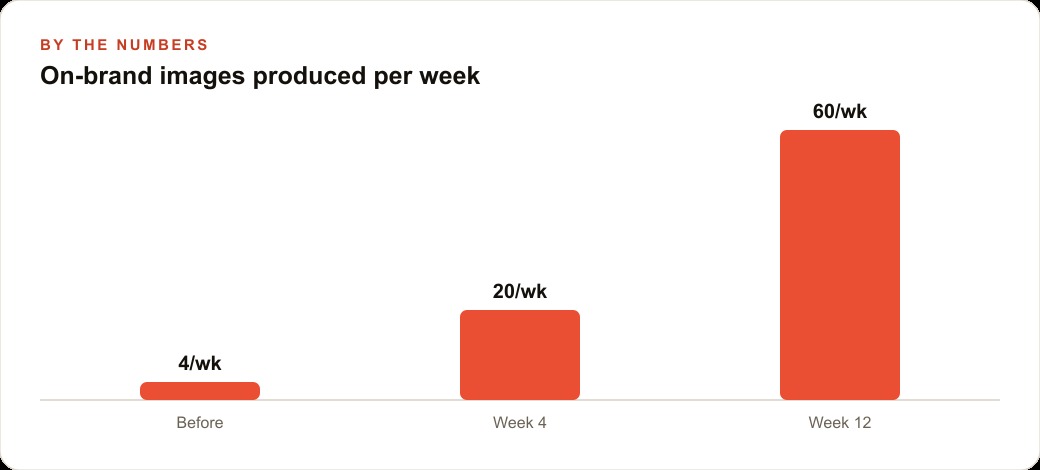
At the six-month mark, the monthly production volume had grown from 50 to 65 graphics. The additional 15 pieces came from two sources: the spa added TikTok as a fifth platform, which required a 9:16 vertical format distinct from the Instagram story format even at the same aspect ratio, and the owner began producing three-slide educational series that needed visual consistency threaded across sequential images in the same set. Under the designer model, a 30 percent volume increase would have required either a proportional increase in the monthly retainer or a compression of turnaround times that the designer's schedule could not absorb cleanly. With the agent pipeline, the 15 additional pieces added roughly 20 minutes to the monthly review session.
The six-month production figures: 65 images per month, API cost between $35 and $50 depending on regeneration volume, total owner time under two hours per month including review, approvals, and any manual corrections. Against the baseline: 50 images per month, $1,750 in designer fees, 15 hours of owner time. Volume is up 30 percent. Cost is down more than 97 percent. Owner time is down approximately 87 percent.
Brand consistency improved over the six months rather than drifting, because the same reference images anchor every API call. The March posts and the October posts look like they came from the same visual direction, because every generation is anchored to the same references rather than to a designer's memory of a prior brief. Seasonal variation comes from copy choices, color accents, and treatment angles, not from the underlying visual construction shifting as a designer's style evolves over time.
The one limitation that has not changed across six months of production is the model's counting and enumeration behavior. Benchmark testing demonstrated this clearly: when asked to number every face in a crowd, the model double-labeled some and exceeded the requested total. In the spa's production context, the equivalent failure appears on two graphic types: any image that displays a precise number of treatment sessions included in a package, and any image that shows an exact price. The model generates both types confidently and incorrectly often enough that neither category can flow through the automated pipeline without a verification step.
The handling rule is simple: any graphic containing a specific price, a date, a session count, or any other enumerated figure is flagged and goes into a separate manual verification queue, where the number is checked against the source data before the graphic is cleared for scheduling. This rule applies regardless of how accurate the generation appears. The model's confident rendering of a number does not predict its counting accuracy, and a published price that is wrong produces real customer complaints. Every other graphic type flows through the standard review and same-day approval pipeline. The enumerated category gets one additional checkpoint, and that checkpoint covers the entire category of risk.
For a business with a steady monthly content calendar across multiple platforms, the six-month assessment of GPT Image 2 is straightforward. It is the strongest model currently available for text rendering, brand-consistent output anchored to reference images, batch multi-element editing, surgical select-and-edit correction, and programmatic API access that an agent can call at full monthly production volume. The economics are not marginal relative to freelance design rates. They are transformative. The limitation is real, narrow in scope, and fully managed by one verification checkpoint built into the approval process. Both conclusions held across six months of continuous production.
That is exactly what we do at AI DOERS. Book a private 30-minute call with Madhuranjan Kumar and we will map the fastest path to it for your specific business.
Book your call →
Madhuranjan Kumar
Madhuranjan Kumar brings 20 years of performance-marketing experience and has managed over $200 million in Facebook ad spend for brands across the United States and beyond. His expertise spans the full modern marketing stack: Meta, Google Ads, TikTok, email automation, CRM, and the websites that hold it together. At AI DOERS he turns that track record into lead-generation systems for businesses across every industry.