
GPT-5's Real Strength: Deep Reasoning and Memory That Works on Every Chat
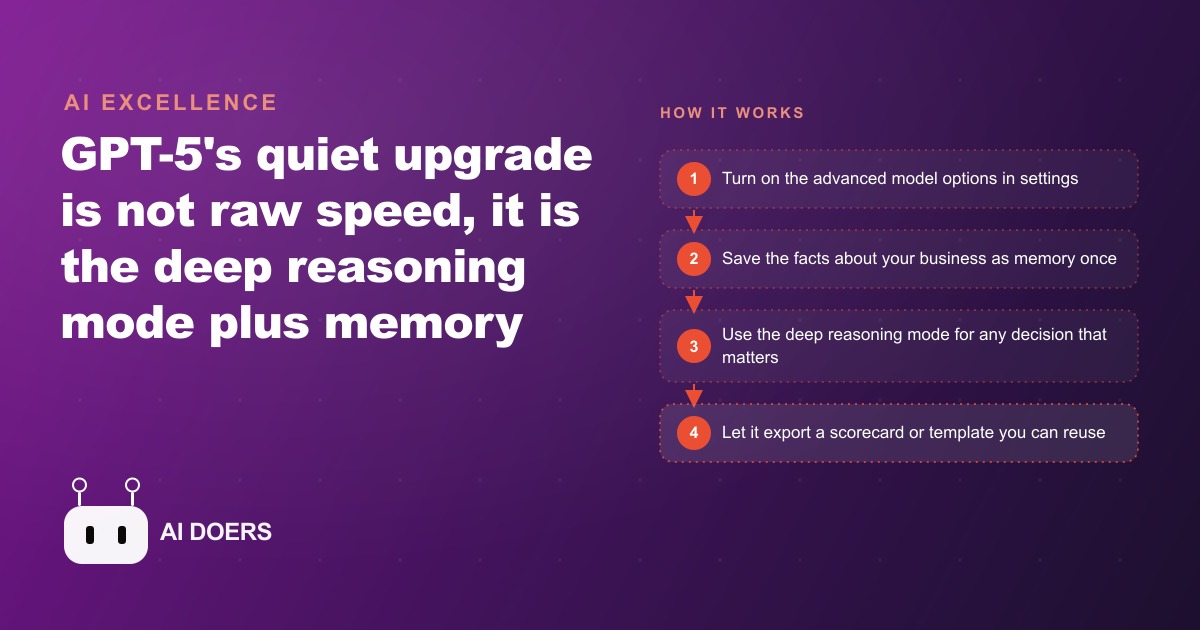
The loudest GPT-5 takes online miss the point. The upgrade that matters for a business is the deep reasoning mode that plans and builds full deliverables, plus memory that now runs on every model.

The loudest reaction to GPT-5 online came from people who used the default interface and found it felt like the models before it. I am Madhuranjan Kumar, and I want to explain why that reaction is incomplete and what the upgrade that actually matters is, because it is not visible in the default experience and it changes fundamentally what you can delegate to the model.
The default GPT-5 experience is deliberately understated
OpenAI ships GPT-5 with a routing system that selects the appropriate thinking depth for the question it receives. For most questions, the router picks a lighter mode that returns answers quickly. That quick mode feels similar to the previous generation because it is optimized for speed, not depth. The person who opens the interface, asks a few questions, and concludes that the upgrade is minor has never seen the deeper modes run.
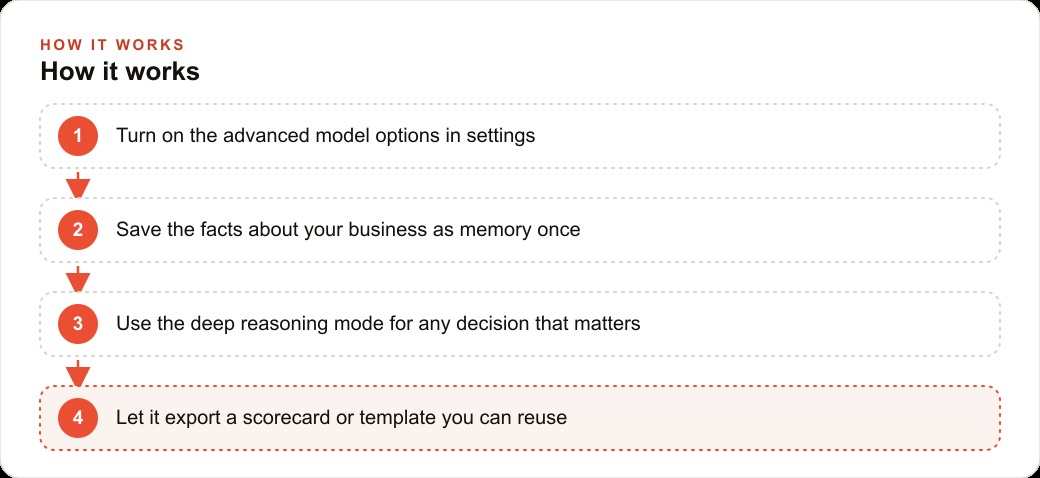
The advanced model options are hidden behind a settings toggle by default. Switching it on exposes the full model selector, which includes the deep reasoning mode. The difference between standard and deep reasoning on the same complex question is not marginal. It is the difference between a model that answers your question and a model that plans, weighs alternatives, generates structured artifacts, and produces a deliverable you can act on directly.
This matters for two types of tasks specifically. The first is any decision that involves comparing options, modeling scenarios, or weighing trade-offs with multiple variables. The second is any recurring task where the output needs to be a usable file or template rather than a paragraph of advice. Standard mode gives you the paragraph. Deep reasoning mode builds the deliverable.
What deep reasoning mode actually produces, compared to standard output
The illustration that makes this concrete is a personal planning prompt: take my favorite activities and find the underlying patterns, then show me how to build more of those patterns into my week. Standard mode produces a thoughtful paragraph about the activities and maybe a vague suggestion or two. Deep reasoning mode treats it as a structured analysis problem: it identifies the constituent elements of each activity, maps the shared ingredients, assigns approximate time and complexity, ranks the options by impact-to-effort, and offers to export the analysis as a CSV that can be imported into a task manager or a weekly planning template.
The output is not advice. It is an artifact. The difference between an artifact and advice is the difference between something you file and return to versus something you read and forget. Deep reasoning mode produces the former far more often than standard mode, and that distinction is where the practical upgrade lives.
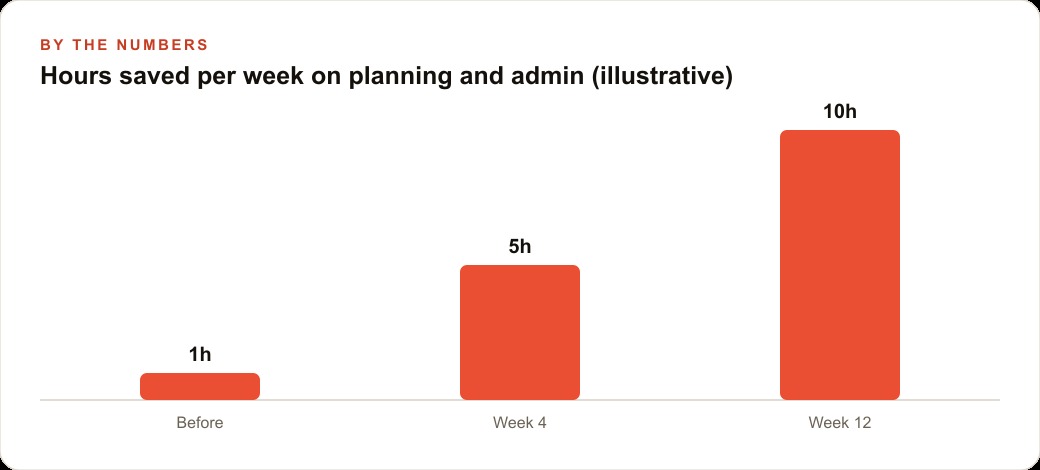
A second example: asking the model to build a budget with ten expense categories, working formulas, and conditional formatting that turns cells red when spending runs over. Standard mode describes how to build it. Deep reasoning mode builds it and returns a functional file. For a business that rebuilds this kind of financial tracker every month, the prompt that produces a working file in one shot eliminates an hour of manual work that was previously unavoidable.
The same logic applies to any analysis your business needs regularly, a price comparison across vendors, a capacity model for scheduling, a margin analysis by product line. Each of these is a recurring task where the right AI mode produces a reusable template rather than a one-time answer. Building that template once with deep reasoning mode and saving the prompt means every future version is generated in minutes rather than built from scratch.
Memory across every model is the infrastructure change that makes personalization real
Earlier thinking models in the GPT family did not use memory. Every conversation started with a blank slate regardless of what you had told the model in previous sessions. The upgrade that most people missed in GPT-5 is that memory is now wired into all the models in the family, including the thinking ones. Tell the model something once, and every subsequent chat already knows it.
For a business owner, the practical implication is that you stop repeating the context your business needs every time you start a task. Save the relevant facts once: the business type, the services offered, the target customer, the pricing range, the tone the business uses, the specific decisions that define how the work runs. From that point forward, every new conversation starts from a context that already understands your business, and the model's output reflects your specific situation rather than a generic business of your approximate type.
The memory feature works best for facts that are stable: your core business information, your standard operating style, the constraints that apply to most decisions you make. It works less well for context that changes session to session, the specific document you are working on today, the particular question at hand, the new information you have not yet shared. That session-specific context belongs in the conversation, not in memory.
The distinction between memory and projects is worth understanding. Memory works across all your conversations, building a general understanding of who you are and how you work. Projects keep a separate, self-contained context for a specific body of work: a client engagement, a product launch, a particular analysis you return to repeatedly. Using memory for the permanent business context and projects for the topic-specific context gives you both a foundation that applies everywhere and a focused environment for specific work without the two contaminating each other.
Projects are for contained work; global memory is for everything else
The workflow that uses both correctly looks like this. Memory holds the facts about your business that never change: the service categories, the customer type, the pricing model, the communication style, the specific constraints on decisions. Every conversation benefits from that without any setup.
A project holds the specific context for a current initiative: the brief for a campaign, the data for a market analysis, the notes from a client engagement. The model uses the project context for work within that project, and it uses global memory to ensure that work fits the business's general standards and constraints. The two contexts work together without mixing.
For a hair salon using this correctly, global memory holds the salon's core facts: the services, the price points, the client demographics, the communication style. A project holds the data for this month's promotion planning: the current slow days, the capacity available, the offers being considered. When the owner asks which offer to run and how to price it, the model uses both the promotion project context and the global business memory to produce a recommendation that is specific to this situation and consistent with how the business operates in general.
The gap between a basic AI user and an effective one is almost entirely this: the effective user has invested twenty minutes in building the memory and projects that make the model consistently useful, while the basic user starts every session from scratch and wonders why the output feels generic. Building the memory structure is the investment that compounds. The first session with a well-built memory context feels noticeably different from a fresh start, and that difference grows over every subsequent session as the model's understanding of the business deepens.
For businesses running Google Ads or Facebook and Instagram ad campaigns, the memory structure that reflects your actual audience, your offer parameters, and your creative standards means every AI-assisted campaign task starts from a foundation that already understands what the business needs. For businesses building web and CRM systems, the project structure keeps the technical context organized so the model can contribute to ongoing development without requiring a full re-explanation every session. The investment in memory and project structure is small. The return on it accumulates every day. ## A worked example: using deep reasoning and memory for a salon's promotion planning
The hair salon case is worth walking through concretely to show what the combination of deep reasoning mode and persistent memory actually produces in practice.
Setup: the owner saved the following to global memory in a fifteen-minute session. The salon has six chairs and operates Tuesday through Sunday, with Tuesday and Wednesday mornings consistently underbooked to below 50 percent capacity. The average ticket for a color service is $185. The average ticket for a cut-only service is $75. The clientele skews 80 percent returning and 20 percent new. The margin on color services is higher because the product cost is fixed regardless of the time used, while cut-only services are entirely labor. The owner's goal for the current quarter is to increase mid-week morning occupancy to 70 percent or above.
From that point, every session starts with a model that already understands this context. The owner does not re-explain the slow days, the ticket averages, or the quarterly goal. Each conversation picks up from where the business actually is.
Three weeks later, the owner asks: help me plan a midweek promotion for the next four weeks that targets the slow Tuesday and Wednesday mornings. Standard mode would suggest running a discount or a bundle offer, both generic options. Deep reasoning mode treats the question differently. It starts from the context already in memory: slow days are Tuesday and Wednesday mornings, the goal is 70 percent occupancy, color services have better margin. It identifies the constraints: a heavy discount undermines the margin advantage of color services, and a blanket promotion would attract clients who might have booked anyway rather than specifically filling the slow slots.
The output is a structured promotion plan: a midweek-morning-specific offer on a color-cut package priced to be attractive without undercutting the full-price color service, limited to specific time slots so it fills the empty hours without cannibalizing peak bookings, communicated to existing clients first through a text message campaign to the segment with a history of morning appointments, then opened to new clients through a simple social post if the internal campaign does not fill the available slots.
The plan also includes a single metric to track: midweek morning bookings as a percentage of available chairs, measured weekly. At week four, the owner returns to the session with the actual numbers, asks the model to evaluate whether the promotion met the goal, and if not, identify which specific element to adjust. The model compares the result against the target, identifies whether the underperformance was in reach, in conversion, or in the specific offer structure, and produces an adjusted plan for the next four weeks.
Three promotion cycles into this workflow, the owner has a clear picture of what actually moves midweek morning bookings in her specific market, built from real data and structured analysis rather than trial and error. The deep reasoning mode produced the initial plan. The memory carried the business context across all three cycles. The combination is what made the output useful enough to act on rather than generic enough to ignore.
For businesses running Facebook and Instagram ad campaigns to drive new client acquisition, the same memory and deep reasoning combination applies directly to ad planning. The memory holds the business constraints, the audience profile, and the offer parameters. Deep reasoning mode analyzes the tradeoffs between different targeting and offer approaches and produces a structured recommendation. The result is ad planning that reflects real business context rather than best-practice generics, which is the difference between campaigns that fit the business and campaigns that borrow someone else's framework.
The practical discipline that makes deep reasoning mode consistently useful rather than occasionally impressive is learning when to invoke it. Not every question justifies the extra processing time. The quick answer, the short summary, the standard email draft, all of these are well-served by the default mode. Deep reasoning mode earns its processing time when the question involves multiple variables, when the output needs to be a specific deliverable rather than a paragraph, or when the decision has enough financial or strategic weight that a more thorough analysis is worth waiting a few extra seconds for. Building the habit of selecting the right mode for each task type produces consistently better outputs and uses the model's resources efficiently rather than routing everything through the heaviest available processing.
That is exactly what we do at AI DOERS. Book a private 30-minute call with Madhuranjan Kumar and we will map the fastest path to it for your specific business.
Book your call →
Madhuranjan Kumar
Madhuranjan Kumar brings 20 years of performance-marketing experience and has managed over $200 million in Facebook ad spend for brands across the United States and beyond. His expertise spans the full modern marketing stack: Meta, Google Ads, TikTok, email automation, CRM, and the websites that hold it together. At AI DOERS he turns that track record into lead-generation systems for businesses across every industry.