
GPT-5 Is Now the Default ChatGPT. Here Is What That Means for Everyday Business Users
GPT-5 is now available on every ChatGPT plan, including free. It combines web search, image generation, voice, and agent mode in one system. Here is a plain-English breakdown for business owners who are not AI researchers.

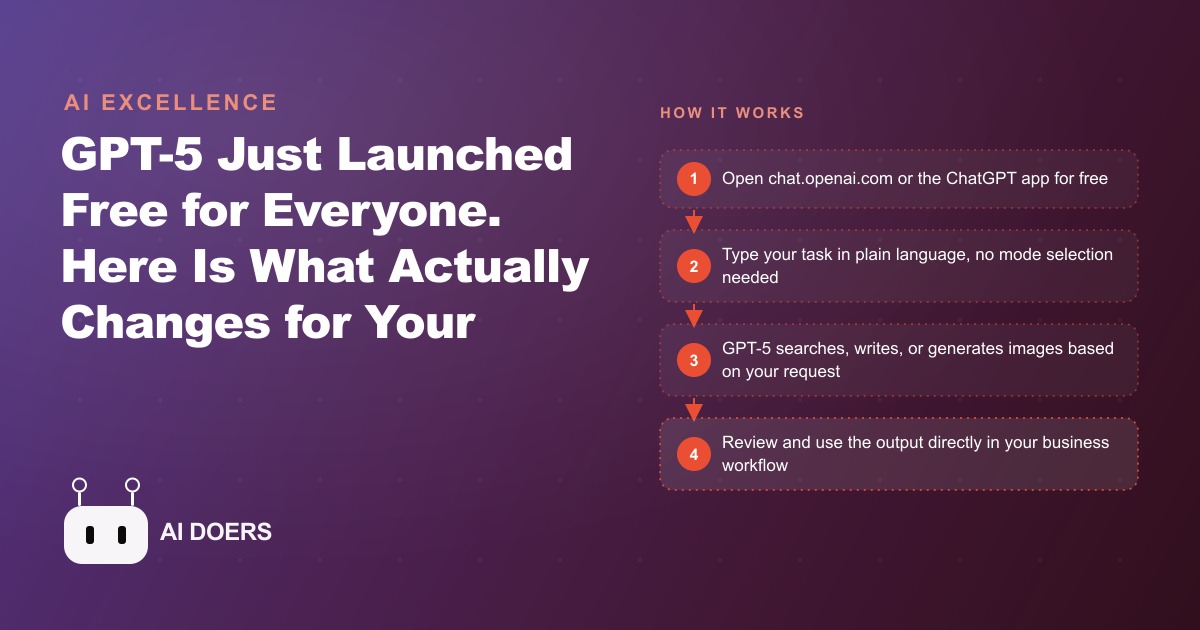
GPT-5 is now the default model inside ChatGPT for everyone, including the free tier, which means the most capable general purpose AI ever released to the public just landed in the hands of every business owner at no cost. If you have ever typed a question into ChatGPT, you are already using it. No upgrade, no settings, no card. That quietly resets what a small team can do, and below are seven specific things that change, each one concrete enough to act on this week.
I am Madhuranjan Kumar, and I want to skip the research level detail and focus on what actually matters to someone running a service business: what you can do now that you could not do as easily last month.
1. One model now handles search, writing, images, and voice
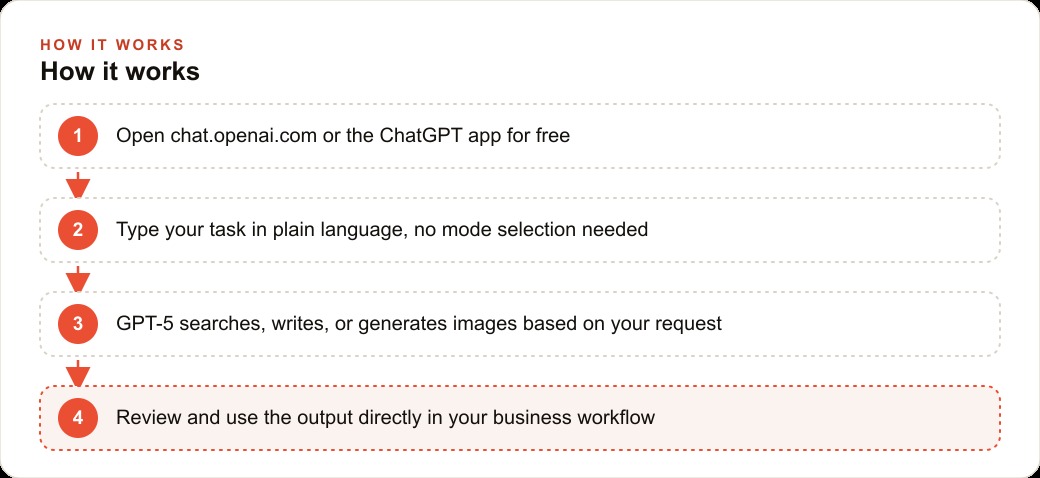
The biggest structural change is that GPT-5 stopped making you choose a mode. Earlier versions routed your task to a separate system depending on what you asked. Need web search? Switch modes. Want an image? A different generator. Prefer voice? Another pipeline. GPT-5 merges web search, image generation, canvas document editing, voice interaction, and agent mode into one system. You describe the task in plain language, and the model decides how to handle it. For a non technical user, that is the difference between operating software and simply asking a knowledgeable colleague for help.
2. The knowledge required to benefit dropped to nearly zero
For two years, the people who got real value out of AI were the ones who understood which version to use for which task, which modes to enable, and how to write prompts that worked. That was a smaller group than the headlines suggested. Most owners and front desk staff either did not use these tools or used them occasionally with inconsistent results. GPT-5 collapses that complexity. There is no mode to pick and no plugin to enable. You type what you need, and the system figures out how to do it. The barrier that kept a large segment of ordinary users on the sidelines is gone.
3. Routine written communication is the fastest win
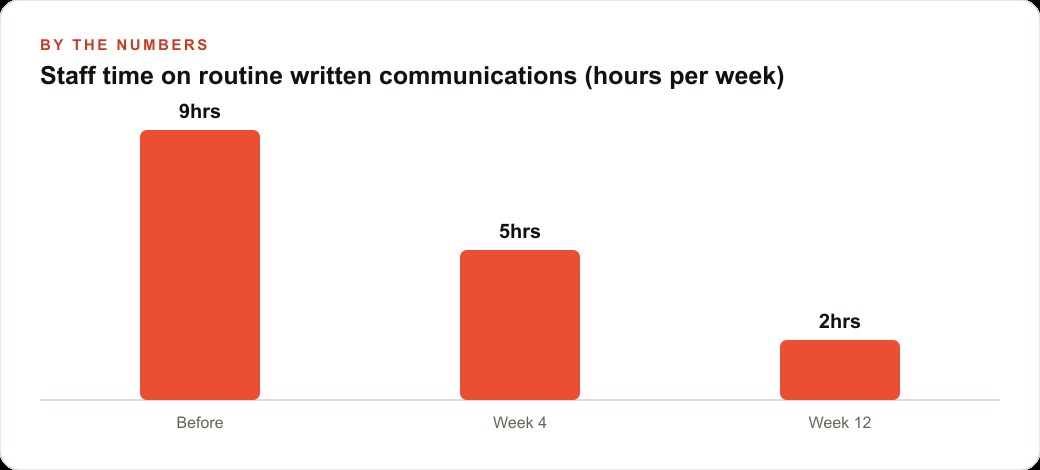
The tasks that eat the most time in a service business are rarely the complex ones. They are the writing tasks. Drafting the same follow up email for the fifteenth time this month. Summarizing a client meeting for a colleague. Writing a social post for a service you have offered for years but never promoted. Answering the same five questions in slightly different words every week. Communication overhead like this is often 30 to 40 percent of a professional's working hours, and it is exactly what GPT-5 handles best. It is not replacing specialized judgment. It is absorbing the tedious writing that surrounds the judgment.
4. A front desk can clear its drafting pile in minutes
Consider the daily load on a front desk team: appointment confirmations, reminders, follow ups with people who missed a visit, recall messages for those who have not been in for a year, new inquiry responses, awareness posts, and the occasional summary of a confusing insurance letter. Each is low complexity but high volume. With GPT-5, a staff member opens ChatGPT, sets a one line context such as help me draft friendly, professional patient communications, and works through the list. A warm follow up email that took five minutes now takes ninety seconds. A two sentence Instagram caption takes thirty. A dense insurance paragraph gets translated into plain language the moment it is pasted in.
5. Insurance and document jargon becomes plain English on demand
One underrated use is comprehension, not creation. Paste in a paragraph from an Explanation of Benefits letter and ask what it says the customer owes and why, and GPT-5 translates the jargon into a clear explanation a staff member can relay over the phone in seconds. The same trick works on contracts, policy documents, and any dense correspondence. This turns a task that used to require a specialist or a long phone call into a thirty second lookup, which is where a general purpose model that just works delivers its most immediate value.
6. The cost math favors adoption almost immediately
Here is the ROI, walked through with a real example. A front desk coordinator handling twenty to thirty written communications a day might spend two to three hours drafting, editing, and reviewing. With GPT-5 producing the first draft every time, that drops to forty five minutes to an hour. Over a month, that is twenty to thirty recovered hours per person. At eighteen to twenty two dollars an hour, twenty recovered hours is roughly 360 to 440 dollars a month in recaptured capacity, per staff member, on a free tool. The standard plan costs nothing. A Plus plan at twenty dollars a month adds priority access and higher image limits. A Teams plan at twenty five to thirty dollars per user adds stronger data privacy, which regulated industries should use, and even there the recovered hours dwarf the cost. The bigger risk is not adopting, because competitors who cut their per communication time can handle more volume and respond faster.
7. The guardrails you must not ignore
Free capability comes with four rules. First, always review before sending, because GPT-5 is fluent and confident but not infallible, and it can get a tone slightly wrong or state something that is grammatically perfect and factually off. It is a first draft tool, not an autopilot. Second, never paste sensitive customer specific information, such as names, dates of birth, treatment histories, or ID numbers, into a free or Plus account. Use general templates and fill specifics in by hand, or move to a Teams plan for the privacy guarantees compliance may require. Third, do not treat it as a replacement for professional judgment. It drafts the email, but the professional decides what the email says. Fourth, build a small library of reusable context instructions, a few lines that set tone and situation, and paste them at the start of each session so every output starts stronger.
Putting the seven changes to work
None of this requires setup in the traditional sense. The practical path is short. Open ChatGPT in a browser or install the app, create a free account, and you are running GPT-5. Then identify the three written tasks that cost the most time each week and write them down. For a clinic those are usually appointment follow ups, new inquiry responses, and social captions. For each, open a fresh chat, lead with a context sentence, describe the task, and adjust a line or two of the output to match your voice. After one week, count the minutes saved on those three tasks, and let that number tell you how fast to expand.
Where does this connect to the rest of a business? The written assets GPT-5 produces are the same raw material that feeds your other channels. Captions and posts it drafts can be repurposed for content that supports SEO and organic search, so one drafting habit quietly feeds two goals. Ad copy variations it generates can be tested inside Facebook and Instagram ad campaigns far faster than writing each from scratch, and the same speed helps you iterate headlines for Google Ads without burning an afternoon per variant. The model does not run your marketing, but it removes the drafting bottleneck that slows every part of it.
Why this release lowered a barrier, not just added a feature
It is worth being precise about what changed, because the free price tag is not actually the biggest story. For two years the real gatekeeper to getting value from AI was not money. It was knowing which mode to use, which version to select, and how to phrase a request so it produced something useful. That knowledge was a smaller moat than the headlines implied, and it quietly excluded most of the people who could benefit most: busy owners, front desk staff, solo operators who never had time to learn the tooling.
By merging search, writing, image generation, and voice into one system that decides how to handle a request, GPT-5 removes that gatekeeper. The person who benefits is not the AI enthusiast who already knew the tricks. It is the receptionist who never touched these tools because they seemed complicated, and now finds that asking the model for help is as simple as asking a knowledgeable colleague. That is the shift that actually moves the economy, because the enthusiasts were already productive. The newly unblocked majority were not.
A closer look at the summarization win
Two of the seven changes above deserve a second pass, because they are where the least glamorous but highest volume time savings hide. Summarization is the first. Every service business drowns in documents that someone has to read and translate for someone else: an insurance letter a patient does not understand, a contract clause a client needs explained, a long report a manager needs condensed for a colleague. Historically that reading was a tax paid in staff attention. GPT-5 turns it into a paste and a question, and returns a plain language explanation in seconds. Across a month, a business that processes dozens of these will feel the time come back in a way that is hard to notice day to day but obvious on the calendar.
The reusable context habit that multiplies every output
The second is the reusable context instruction, and it is the single cheapest upgrade to output quality. Most people retype who they are and what they want at the start of every session, or worse, skip it and get generic results. The fix is to write a few lines once, describing the business, the tone, and the audience, save them as a pinned note, and paste them at the start of each new chat. From then on, every draft starts from your actual context instead of a blank default. It is a two minute habit that compounds across hundreds of requests, and it is the difference between output you have to heavily rewrite and output you barely touch. Combined with the review step, it turns GPT-5 from a clever novelty into a dependable part of the daily workflow.
The competitive cost of waiting
There is a quiet risk in treating this as optional. A practice or a firm that keeps handling every written message by hand is not just slower. It is more expensive to run, per communication, than a competitor down the street who has cut drafting time by two thirds. That competitor can answer inquiries faster, take on more volume without adding staff, and produce better written materials with less effort. None of that is visible on any given day, but over a year it compounds into a real gap in responsiveness and capacity. The tool is free and the learning curve is measured in minutes, so the cost of waiting is not the price of the software. It is the accumulating advantage handed to whoever adopts it first.
Start narrow, then let the wins pull you forward
The reason to begin with three tasks rather than a grand rollout is that momentum beats ambition here. Pick the three written jobs that hurt most this week, prove the time saving on those, and let the visible result decide how fast you expand. A team that sees ninety second drafts replace five minute ones does not need convincing to try the next task. That small, measured first week is what turns a free tool from a curiosity someone opened once into a habit the whole office relies on.
You can do all of this yourself at zero cost, and most owners should start there. If you want to go further, connecting GPT-5 to your scheduling or practice management software, automating a confirmation sequence, or building an FAQ chatbot for your website, that is where working with an expert gets you there faster and more reliably than experimenting alone. The starting point, though, asks for nothing more than an email address and a browser, and the seven changes above are all available the moment you log in.
That is exactly what we do at AI DOERS. Book a private 30-minute call with Madhuranjan Kumar and we will map the fastest path to it for your specific business.
Book your call →
Madhuranjan Kumar
Madhuranjan Kumar brings 20 years of performance-marketing experience and has managed over $200 million in Facebook ad spend for brands across the United States and beyond. His expertise spans the full modern marketing stack: Meta, Google Ads, TikTok, email automation, CRM, and the websites that hold it together. At AI DOERS he turns that track record into lead-generation systems for businesses across every industry.