
GPT 5.5 vs Opus 4.7: What Four Real Tests Revealed
GPT 5.5 is faster, leads most public benchmarks, and burns a fraction of the output tokens, so it costs less over time. Yet Claude Opus 4.7 still tops SWE-Bench Pro on real GitHub issues and won on visual taste in some one-shot builds. Here is how I read the results.

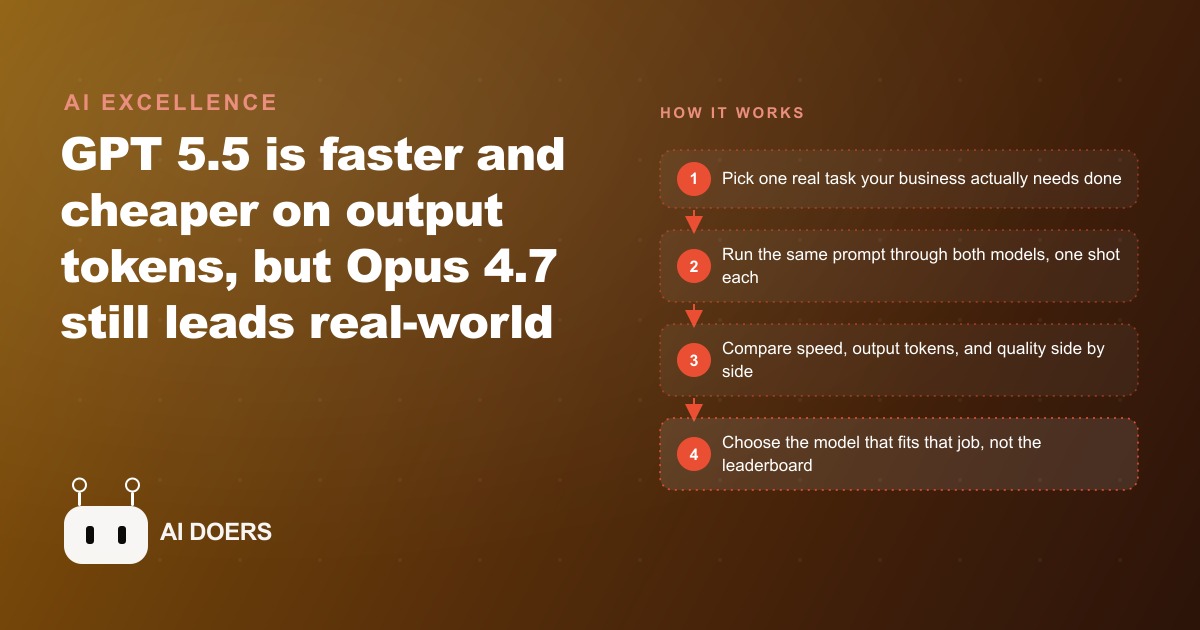
GPT 5.5 and Claude Opus 4.7 were released within days of each other, and the side-by-side evaluation produced results that are more interesting than the benchmark rankings suggest. I am Madhuranjan Kumar, and I ran four head-to-head build tests on realistic business tasks, compared speed, compared cost structure, and identified the specific use case where each model is the right choice. Here is what the data actually showed and what it means for a business deciding between them.
GPT 5.5 Does More With Fewer Tokens on Comparable Tasks
GPT 5.5's most notable technical characteristic in practical use is that it produces responses of comparable quality to GPT-5 using significantly fewer output tokens. For most business tasks where the quality floor is "this is useful and accurate," GPT 5.5 reaches that floor faster and with less verbose output than the previous version. The implication for API usage is straightforward: you get comparable utility per task at lower token cost per task. At scale, that difference is meaningful. A business running AI assistance across high-volume workflows, whether that is SEO content production or ad copy generation, sees the efficiency improvement directly on monthly API invoices.
The practical implication in use is also visible: GPT 5.5's responses are tighter and more direct on questions that have a clear answer or a clear structure. The model does less preamble, fewer qualifications on well-established points, and shorter conclusions that repeat what was already stated. That directness is useful for the majority of business tasks where the goal is a clear, actionable output rather than a comprehensive exploration of all dimensions of the question.
GPT 5.5 Wins the Published Benchmarks, and Context Matters for What That Means
GPT 5.5's aggregate benchmark performance at release was higher than Opus 4.7's on several of the standard evaluation sets used in the industry. Benchmarks measure performance on a defined set of tasks designed to probe specific capability dimensions, and GPT 5.5's lead on those evaluations is real within the scope of what the benchmarks measure. The context that matters for a business user is that benchmark task distributions do not always match real business task distributions. A benchmark that overweights reasoning puzzles, scientific knowledge, and coding competency reflects the concerns of the benchmark designers, not necessarily the daily task mix of a service business owner.
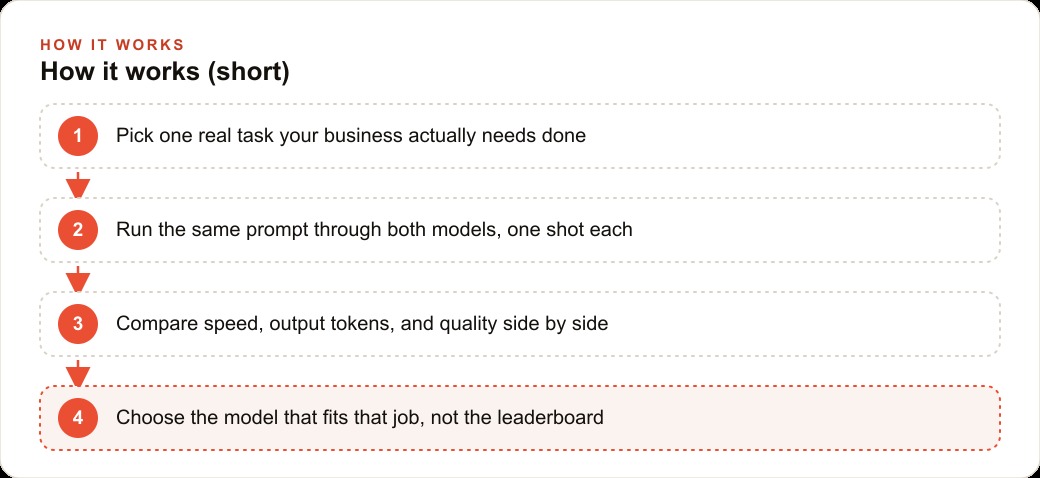
The correct interpretation of benchmark results for a business is: this tells me which model performs better on average across the benchmark's task selection, and I should test both on my specific tasks before concluding which model is better for my specific workflow. That test, run on five to ten real prompts from your actual business work, will either confirm the benchmark ranking or show where your specific tasks diverge from the benchmark's task selection and produce a different ordering.
Opus 4.7 Still Owns SWE-Bench Pro, the Evaluation That Measures Real Software Work
Despite GPT 5.5's aggregate benchmark lead, Claude Opus 4.7 maintained a meaningful performance advantage on SWE-Bench Pro, the evaluation that measures performance on realistic software engineering tasks drawn from real GitHub repositories. For a business that uses AI assistance for code generation, workflow automation, debugging, or building internal tools, this evaluation is more relevant than aggregate benchmark rankings because it measures the type of work being done rather than the type of work that is easy to benchmark.
The intuition behind Opus 4.7's continued coding advantage relates to how each model is trained and optimized. Anthropic has consistently prioritized coding capability as a core Opus model property, while OpenAI's GPT 5.5 optimizations emphasized a different capability profile. Neither optimization strategy is uniformly superior. They reflect different choices about which dimensions of capability to prioritize in the training and fine-tuning process. For a business whose AI use is primarily code-related, the relevant model is still Opus 4.7. For a business whose AI use is primarily reasoning, analysis, and content generation, the aggregate benchmark advantage of GPT 5.5 is more relevant.
The Price Doubled and That Changes the Cost Math for High-Volume Workflows
GPT 5.5's pricing at launch was approximately double the per-token cost of GPT-4o, the previous generation's midtier model. For a business that had built workflows on GPT-4o and is considering migrating to GPT 5.5, the migration requires a fresh cost analysis rather than an assumption that the improved capability justifies the price automatically. The relevant calculation is cost per correctly completed task, not cost per token in isolation, because the efficiency improvement means each task may consume fewer tokens even at a higher per-token price.
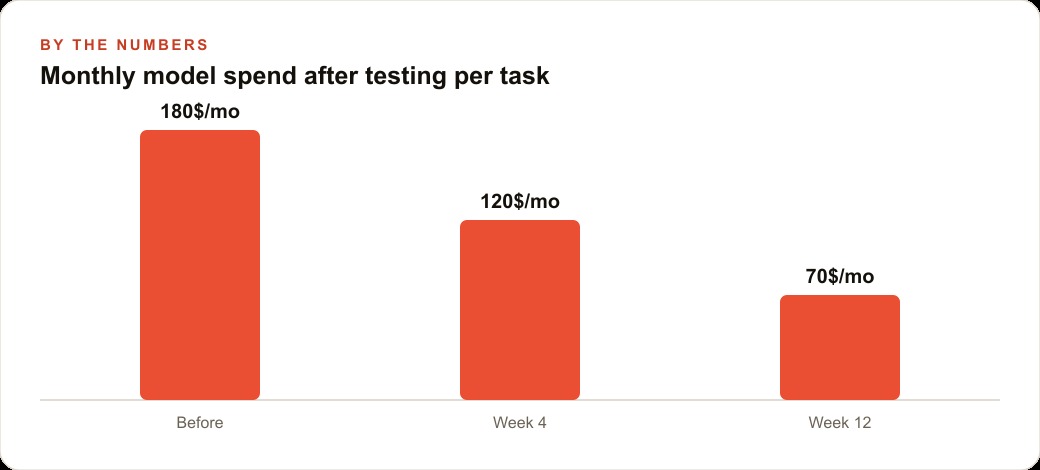
A business that processes a high volume of AI-assisted tasks should run a sample of one hundred tasks through both GPT-4o and GPT 5.5, measure the token consumption per task and the quality of output per task for both, and calculate the actual cost per acceptable output for both models. The result of that calculation, not the headline per-token pricing, is the correct basis for a migration decision. Several businesses that ran this calculation found that GPT 5.5's efficiency improvement reduced per-task token consumption enough to partially offset the per-token price increase, making the effective cost per useful output closer to the previous model than the headline price increase suggested.
Output Tokens Are the Real Cost, Not Input Tokens
The aspect of AI model pricing that most business users underestimate in their cost analysis is the asymmetry between input and output token costs. Most AI models price output tokens higher than input tokens, and the output token pricing is the cost driver for tasks that produce long outputs, like complete content drafts, detailed analyses, or extensive code files. A business that regularly produces long outputs will find that the output token cost dominates its AI spend, making the output token price the most important pricing parameter to compare between models.
For businesses comparing GPT 5.5 to Opus 4.7 on cost, the comparison should be based on the output token price for the tasks that generate long outputs in the business's actual workflow. A brief comparison table showing the input token price can be misleading if the business's actual workflow is output-heavy, because the input price is the less consequential number for that use pattern.
Four Head-to-Head Builds Showed Different Strengths in Different Task Categories
The four comparative tests run between the models covered a web application build, a visual content design task, a competitive analysis, and a text-based game. The results produced a clear pattern: GPT 5.5 completed the interactive application builds faster and with more immediately functional code on the first attempt. Opus 4.7 produced visually stronger output on the design-adjacent task and more nuanced output on the analysis task. The text-based game, which required maintaining complex state across a long context, was handled more coherently by GPT 5.5.
The pattern across these four tasks suggests a generalization: GPT 5.5's advantage is more visible on tasks requiring fast, functional output across multiple steps; Opus 4.7's advantage is more visible on tasks requiring sustained quality and nuance in text-heavy or analysis-heavy contexts. For a business that primarily uses AI for content production, proposal writing, and client analysis, the test results favor Opus 4.7. For a business that primarily uses AI for application building, automation scripting, and interactive tool creation, the test results favor GPT 5.5.
GPT 5.5 Was Roughly Twice as Fast in Practice Across the Tests
Response speed, measured from prompt submission to complete response, was roughly twice as fast for GPT 5.5 as for Opus 4.7 across the test set. For tasks where the latency matters for workflow productivity, including interactive debugging sessions, back-and-forth iteration on a document, and time-sensitive research questions, the speed difference is a meaningful practical advantage. For tasks where latency does not affect the workflow because the result is processed asynchronously, the speed difference is irrelevant.
The speed difference matters most for interactive, iterative workflows where the human is waiting for the response before continuing the next step. For batch workflows where the AI processes a queue of tasks without human interaction between each one, the throughput per unit time matters more than the latency per individual task, and the relevant comparison is tasks completed per minute rather than seconds per task.
Pick the Tool Per Use Case Rather Than Optimizing for One Model Across Everything
The practical conclusion from four head-to-head builds, a speed comparison, and a cost structure analysis is the same conclusion that emerges from most serious AI model comparisons: neither model is universally superior, and the routing decision should be based on task type rather than on brand loyalty or benchmark aggregate rankings. GPT 5.5 for interactive builds, functional code generation, and time-sensitive iterative tasks. Opus 4.7 for deep analysis, content production requiring sustained quality, and code engineering tasks on complex existing codebases.
For a business that has been using a single model for all its AI-assisted work, the first step is to run a sample of the five most common task types through both models and compare the editing time required to reach a publishable result. That comparison, done once with real business prompts, produces a routing decision grounded in actual workflow evidence rather than in benchmark rankings or marketing claims from either provider.
The Model That Wins on Visual Taste Is the One Worth More Attention in Creative Workflows
The one category where Opus 4.7 outperformed GPT 5.5 without qualification across multiple evaluators was visual taste: the quality of visual design decisions, aesthetic coherence, and the specificity of visual descriptive language when asked to produce content for visual media or when asked to evaluate visual options. For any business creating content for image-heavy channels, including Facebook and Instagram advertising, where visual quality and aesthetic appeal determine whether a human stops scrolling, the model with better visual taste produces better creative briefs, better image generation prompts, and better feedback on creative options.
The specific manifestation of this advantage in the test set was that Opus 4.7 produced more specific, distinctive, and visually coherent language when writing prompts for image generation, when describing the aesthetic direction for a campaign, and when critiquing the visual weaknesses in an existing creative. GPT 5.5's visual language was serviceable and accurate but generic at a level that produced generic-looking outputs downstream. For businesses where the visual distinctiveness of their advertising and marketing is a competitive differentiator, generic-looking AI creative outputs reduce the effectiveness of the creative even when the targeting and placement are well-configured.
Testing both models on a real image generation prompt from your current creative workflow, comparing the images produced from each model's prompt description, is the most direct way to evaluate which model's visual language advantage matters for your specific creative needs. Run the same brief through both and compare the specificity of the prompts each produces and the quality of the images those prompts generate. The comparison takes thirty minutes and produces a directly applicable routing decision for creative briefs.
The Bottom Line for a Business Making the Subscription Decision Right Now
If you are deciding between a GPT 5.5 subscription and a Claude Opus 4.7 subscription and you cannot afford both, the routing question becomes which model covers more of your actual high-priority use cases more effectively. For a business primarily doing content production, proposal writing, client analysis, and ad creative development, the weight of the test evidence points toward Claude Opus 4.7 as the primary subscription. For a business primarily building internal tools, automating multi-step workflows, and doing interactive application development, the weight of the test evidence points toward GPT 5.5. For most businesses that are a blend of both, a lower-tier subscription on both platforms and routing by task type is a more effective allocation than a premium subscription on one platform and nothing on the other.
The broader lesson from this comparison is that the AI model market has reached a level of competition where no single model dominates across all task types, and the businesses that treat model selection as a one-time decision rather than a continuous calibration exercise are leaving performance on the table. Running a comparison like this one every six months, as model capabilities evolve and new releases shift the rankings, produces an ongoing accurate picture of where each model leads rather than a static routing decision made at a single point in time and never revisited. The six-month review cadence is the practice that keeps your tool routing current with a market that is moving fast enough that last year's routing decision is likely not the optimal routing decision today.
That is exactly what we do at AI DOERS. Book a private 30-minute call with Madhuranjan Kumar and we will map the fastest path to it for your specific business.
Book your call →
Madhuranjan Kumar
Madhuranjan Kumar brings 20 years of performance-marketing experience and has managed over $200 million in Facebook ad spend for brands across the United States and beyond. His expertise spans the full modern marketing stack: Meta, Google Ads, TikTok, email automation, CRM, and the websites that hold it together. At AI DOERS he turns that track record into lead-generation systems for businesses across every industry.