
GPT 5.5 Tested on Real Work: Where It Beats Claude and Where It Does Not
GPT 5.5 is more agentic and more design-capable than past versions, and it beat Claude on a game and an interactive Earth. But for multi-file knowledge work that needs real files, Claude still wins.

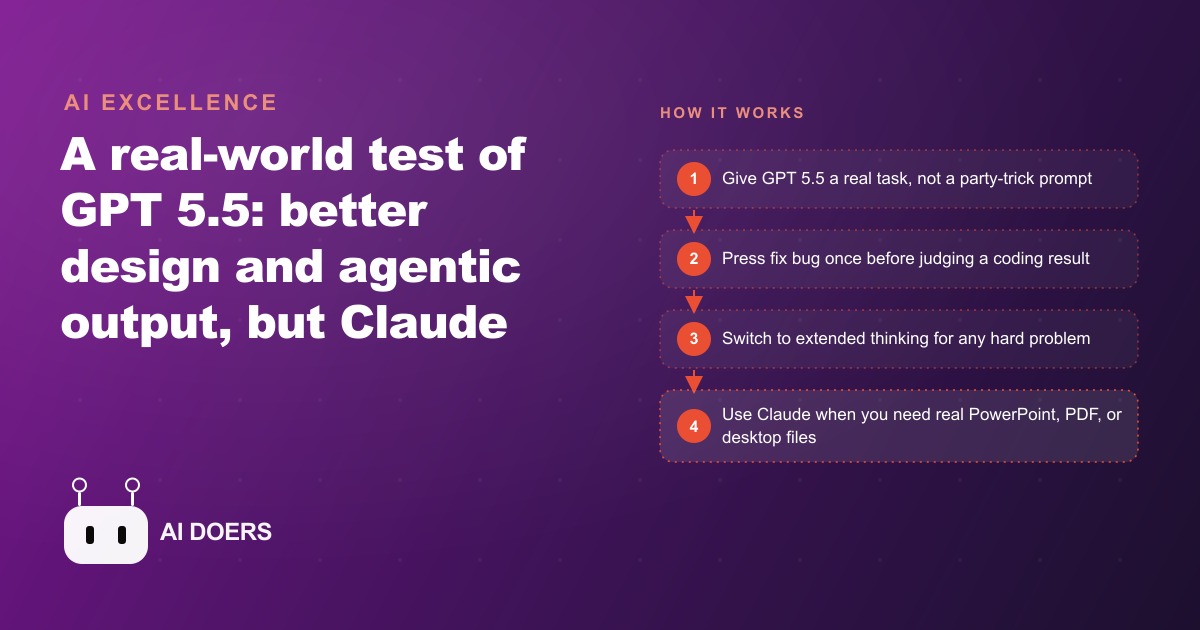
I spent a week testing GPT 5.5 on tasks I would actually need to complete, not on prompts designed to make a model look impressive. I kept notes. What follows is the honest account of what I found, what it beat, what it did not, and the conclusion I would give any business owner trying to make a real decision about which tool to spend time and money on.
I am Madhuranjan Kumar, and the framing I bring to model comparisons is practical rather than benchmarking. Benchmarks measure what the model knows. I want to know what the model ships. Those are different questions, and the answers diverge in interesting ways once you get past the first prompt.
The Test Setup: Why These Tasks and Not Toy Prompts
The tests I ran were drawn from the kinds of requests I see most often from small business owners and agencies: build a functional web prototype, turn messy numbers into a readable dashboard, produce a set of marketing deliverables from a single brief. None of these are party tricks. All of them require the model to hold several moving parts in context, make design decisions without being told every detail, and produce output that works on screen rather than output that looks impressive in a text window.
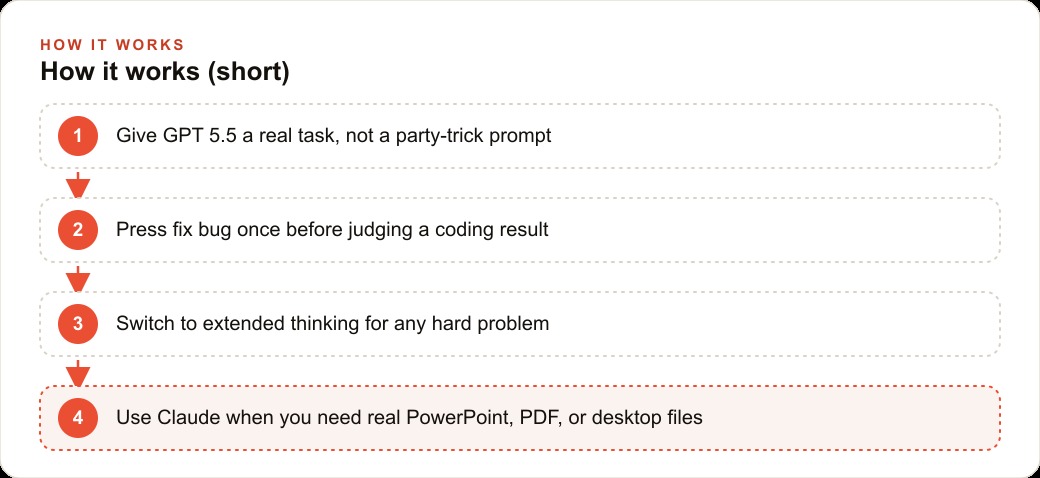
I ran Claude Opus 4.7 against GPT 5.5 on the same prompts, in the same sequence, under the same conditions. For GPT 5.5, I used extended thinking on any task that involved more than two interacting systems, since the pattern I observed within the first two days was that standard mode on complex coding produces the first-draft result and extended thinking produces the clean one. Not marginal improvement. Often the difference between an error and a working app.
One detail worth flagging before the results: the price of GPT 5.5 per token is higher than its predecessor, but the number of tokens needed to complete the same task is lower because the model handles more context per pass before needing clarification. Cost-per-finished-deliverable and cost-per-token are not the same comparison, and anyone making a budget decision based on the API pricing page without testing actual task completion is working from incomplete math. Run the task. Look at what it cost to complete it on both sides.
The SimCity Race: Where GPT 5.5 Pulled Ahead on Polish
The most direct head-to-head was a 3D city builder built from a single description. I asked both models to build an interactive city simulation where the camera rotates around a set of buildings, population grows over time based on the number of structures placed, and the time of day changes the lighting on the scene. No template provided, no starter code. One prompt, one output, judge the result.
Claude Opus 4.7 produced a working app on the first attempt. The buildings rendered, the camera rotated, the population counter updated. It was functional and it arrived cleanly.
GPT 5.5 on the same prompt needed one fix press with no additional explanation. The second pass produced a result that differed from Claude's in two meaningful ways: the interface looked more polished, and the simulation included a time-acceleration feature that changed the rate at which time passed based on the population count. That feature was not in either model's prompt. GPT 5.5 added it because the simulation logic implied it was useful.
That gap between the working app and the better app is the most useful single finding from the whole week. Claude produced what was asked for and produced it reliably. GPT 5.5 produced something close to what was described and then went further in a way that happened to improve the result. Whether that behavior is a strength or a liability depends entirely on the use case. For a prototype you will refine in subsequent sessions, the unsolicited feature is a gift. For a build where scope control is the priority and adding unrequested behavior is a problem, that tendency requires managing through more specific prompting. Knowing this going in means you can take advantage of the tendency when it suits you and constrain it when it does not.
The Interactive Earth: Where Extended Thinking Became Non-Negotiable
The second test was an interactive 3D Earth built from a description. I specified photorealistic satellite textures, a moving cloud layer, rotation on its own axis, and a real-time panel showing the current position and local time of the sunlit hemisphere.
GPT 5.5 in standard mode threw two errors on this prompt. Both cleared immediately when I switched to extended thinking and resubmitted without any other change. The output in extended thinking mode was more detailed than Claude's version: the cloud layer moved independently, the side panel updated live as the globe rotated, and mouse interaction produced smooth manual rotation. Claude's version worked and was responsive, but it did not include cloud layer animation, and the panel showed static values rather than updating in real time.
Extended thinking became my default across the week for any task involving more than two interacting systems. The added processing time is real, anywhere from ten seconds to over a minute depending on complexity, but the improvement in output is substantial. For coding tasks specifically, the difference between standard and extended thinking is often the difference between a result that needs three follow-up corrections and a result that works the first time. Three follow-up corrections sounds minor until you factor in the context consumed by each correction attempt and the cumulative time spent debugging instead of building. Over a full session, that difference in error rate matters.
The Business-in-a-Box Prompt: Fifty Interactions Collapsed to Three
The most practically impressive test was a single prompt that asked for three deliverables simultaneously: a landing page for a consulting service, a slide deck showing service tiers and pricing, and a financial projection dashboard estimating revenue across three growth scenarios for the next 12 months.
Both models declined to produce three separate files. Both returned a single HTML document with three distinct sections. The differences showed up in the quality of each section. The landing page sections from both models were comparable in layout quality and copywriting. The slide deck section in GPT 5.5's output was structured as a scrollable vertical presentation with smooth transitions between slides that worked cleanly on mobile. Claude's dashboard section was more numerically precise, with formulas that correctly compounded growth rates across quarters rather than applying a flat percentage multiplier to each row.
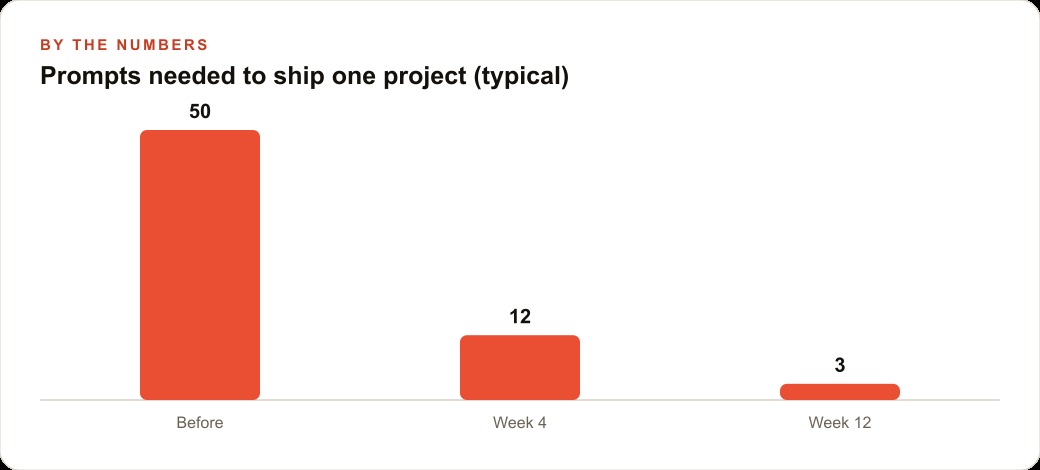
The more interesting observation was the total number of interactions. Two follow-up prompts refined Claude's output. One follow-up adjusted the color scheme of GPT 5.5's output and one tightened the pricing table spacing. From brief to finished document took three interactions in both cases. That kind of work, which might have required forty to fifty separate prompts across a long session with older models, now arrives in three. That reduction in interaction cost is what changes the economics of commissioning this kind of output for a business, because the time-per-deliverable drops from an afternoon to an hour.
The format constraint applies to both models: the output is a web-native HTML document, not separate editable files for PowerPoint and Excel. For a working web prototype or a shareable link, this is fine. For a slide deck a partner will update quarterly and present from their own laptop, this requires a conversion step. Knowing the format constraint before you start means planning for it rather than being surprised mid-project.
The Data Dashboard: Where Messy Numbers Became a Presentable Report
A test that went cleanly for GPT 5.5 was a dashboard built from fabricated but representative numbers covering monthly recurring revenue, customer churn rate, and traffic source breakdown across 12 months. I pasted in a messy, unformatted table and asked for a clean executive dashboard with visual panels for each metric and a summary header showing the key numbers at a glance.
GPT 5.5 produced the dashboard on the first pass. Each metric had its own panel with a chart, color coding by performance direction, month-over-month comparison, and a clear headline number at the top of each section. The visual design was clean enough to show a client or a bank without modification. Claude's version was accurate and logically organized but visually less polished by default, requiring one round of styling refinement to match the presentation quality of GPT 5.5's first-pass output.
For a business owner who needs to present performance numbers to a partner, an investor, or a lending institution, the difference between a dashboard that looks like a raw spreadsheet export and one that looks like a designed report is significant. The polished version communicates competence. The raw version communicates data. Both contain the same information, but they land differently in a meeting. GPT 5.5 consistently reached the polished presentation default faster on this kind of visual work.
The Apple-Style Page: Where Both Models Hit the Same Limit
I ran one test that neither model handled well: a cinematic product launch page with large scroll-driven animations, full-bleed video backgrounds, and a heading system that changed size and weight responsively as you scrolled past each section. Both produced working pages. Both had the same problem: heading spacing was inconsistent in ways that looked amateurish on close inspection. The line heights between the hero heading and its subheadline were wrong in ways that a designer would catch in thirty seconds.
This test is useful precisely because it shows the category of task where both models still require a human review pass before anything goes live. The models produce visually impressive first-pass output on most creative tasks. They are not yet reliably capable of catching the kind of subtle spacing and proportion issues that separate professional from almost-professional. Building in a visual review step for any customer-facing page is not optional even when the first-pass result looks mostly right. That discipline, checking the visual output as a customer would see it, is the difference between a polished deliverable and one that erodes trust at a glance.
What I Concluded After Completing the Full Test Week
The conclusion is not that one model is uniformly better. It is that they are better at different specific categories of work, and treating them as interchangeable leaves real output quality on the table.
GPT 5.5 earns its place for web-native deliverables, visual prototypes, and tasks where design quality in the first pass matters more than strict literal interpretation of a detailed prompt. It handles complex multi-deliverable prompts well, adds useful functionality the prompt did not specify, and produces more polished visual defaults on presentation-oriented tasks. The unsolicited additions require review on scope-sensitive projects but are usually improvements.
Claude Opus 4.7 earns its place for builds where a detailed specification should be followed closely, for multi-file output that needs specific formats, and for anything where numerical precision is the priority. The consistency of Claude's output across a long session is notably higher: what you describe is what gets built, with less drift and fewer unrequested design choices.
The practical decision rule I now apply: reach for GPT 5.5 in extended thinking mode for a seasonal promotion page, a visual prototype, or an executive dashboard where the first-pass design impression matters most. Reach for Claude for a financial model, a compliance document, or a build where the spec is detailed and deviation is a problem rather than a feature. Neither earns its place in every situation. Each earns it clearly in specific situations, and knowing which is which is the whole skill in using these tools well.
The honest read across the full week of testing is that neither model dominates the other in a way that makes the choice simple. GPT 5.5 delivers a faster path to a polished first draft on visual and presentation work. Claude holds the line more consistently on structured builds where scope control matters. A business owner who commits to one and learns its conventions deeply will do better than one who switches back and forth session to session without clear reasoning for the choice. Pick the model that fits your most common task type and build your prompting habits around it. You will recover the cost of the testing in the first month of consistent use, because working with a model you understand produces output you can trust, and trusted output means less time correcting and more time shipping.
That is exactly what we do at AI DOERS. Book a private 30-minute call with Madhuranjan Kumar and we will map the fastest path to it for your specific business.
Book your call →
Madhuranjan Kumar
Madhuranjan Kumar brings 20 years of performance-marketing experience and has managed over $200 million in Facebook ad spend for brands across the United States and beyond. His expertise spans the full modern marketing stack: Meta, Google Ads, TikTok, email automation, CRM, and the websites that hold it together. At AI DOERS he turns that track record into lead-generation systems for businesses across every industry.