
GPT 5.5 Is OpenAI's Mythos Answer, and It Actually Shipped
OpenAI released GPT 5.5 to plus, pro, and business users as an agentic work model, claiming the same latency as the prior version with fewer tokens and a 1 million token API context, while Anthropic's Mythos stays unavailable.

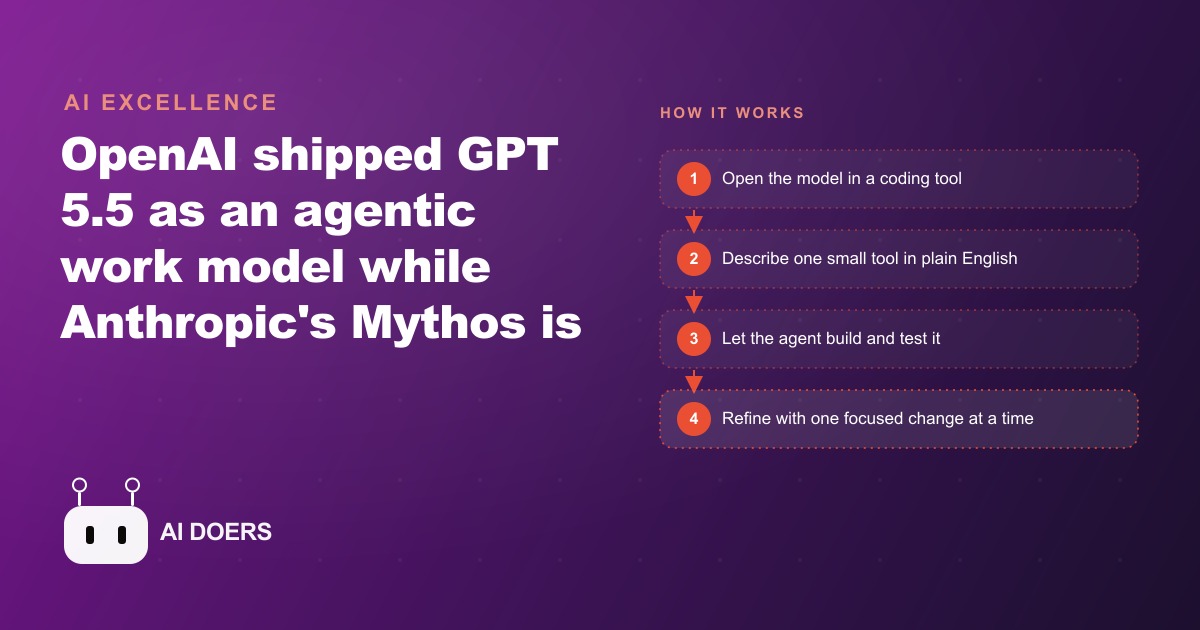
On the same week that Anthropic's Mythos remained a capabilities demonstration without a public API, OpenAI shipped GPT 5.5 to every paying subscriber and gave it a specific positioning: an agentic work model. Not a smarter chatbot. Not an improved reasoning engine. A model designed to do work in the world, not just answer questions about it. The distinction matters more than the benchmark scores, and the gap between what shipped and what has not shipped yet tells a story that every business building with AI tools right now should take seriously.
I have been watching both companies closely through this release cycle. The pattern I keep returning to is this: the raw capability gap between these models is real but smaller than either company wants to admit in their marketing. The availability gap is enormous, and for a business that needs to build something this quarter, for a team that needs to automate a workflow this month, availability is the only specification that actually matters. It is not the only thing that matters in the abstract. In the abstract, compute precision, context fidelity at scale, reasoning depth on complex multi-step problems, these are real distinctions with real consequences. But a business making decisions about its AI stack in June does not live in the abstract.
GPT 5.5 is a different category of product from what came before
The headline numbers for GPT 5.5 are genuinely notable. One million tokens of context window available through the API, which means you can feed an entire codebase, a full year of customer correspondence, a complete research corpus, or a large contract history, and still have room for a detailed conversation about what you want to do with it. Fewer tokens consumed per task compared to the previous generation, which at the scale of real business usage translates directly into lower monthly API cost for the same volume of work. Same latency as GPT-4o, which means the capability increase did not come at the cost of the response time that makes a tool feel usable in a production workflow rather than a research demo.
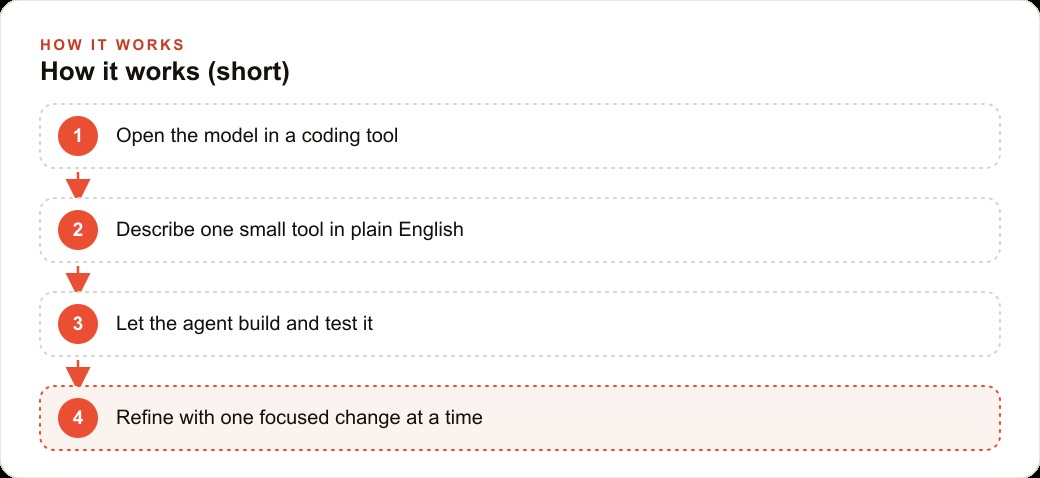
But the token count and speed are not the part of the announcement I keep returning to. The part that changes what is practically possible is the agentic architecture: GPT 5.5 is designed to take sequences of actions, not just produce single outputs. It can draft a function, test it against a real input, read the test result, identify the failure mode in that result, rewrite the function to address it, and test again, all without a human in the loop at each step. This is not the "give me a script" interaction that most business users have had with AI coding tools. It is closer to having a junior developer who runs their own debug cycles and delivers something closer to working code rather than a starting point for three rounds of error-message exchanges.
The demonstration that circulated most widely after the GPT 5.5 launch showed the model taking a screenshot of a complex user interface, with no specification document and no component library reference, and rebuilding that interface as working code from the screenshot alone. It identified the layout hierarchy, inferred the visual component structure, wrote the underlying code, and produced something functional. For a business owner who has had a clear vision for a tool but lacked the technical vocabulary to specify it to a developer, that single capability changes what is possible without a development hire.
What the gap between shipped and not yet available actually costs a business
Anthropic announced Mythos as its most capable model, positioned explicitly as a response to the frontier capabilities that OpenAI has been demonstrating across the past several release cycles. The announcement included benchmark comparisons showing Mythos outperforming or matching GPT 5.5 on several reasoning and code evaluations. It did not include an API access date for most users, or a clear timeline for when that access would be available to the business tier that needs it for production workflows.
I am not going to spend time critiquing that decision. Compute availability is a real constraint that all frontier labs are navigating, and Anthropic has been more transparent about those constraints than most of the field. But the point here is not whether Anthropic made the right internal decision for its infrastructure and safety roadmap. The point is what that decision means for a business trying to plan its AI infrastructure right now, in the next 90 days, with a team that has real deadlines and a budget that does not include a line item for "waiting for the better model."
A model that scores five percent better on a reasoning benchmark but is not available to integrate, to test on real workflows, to run a production batch against, is worth nothing to a business this quarter. A model that is slightly behind on one benchmark category but is available today, has a stable API, integrates into the existing toolchain, and can be tested on real business problems starting tomorrow, is worth everything for the team trying to ship something. The history of technology has this pattern running through almost every major platform transition. Products that shipped at good enough won market position from products that held back for great. The pattern repeats in AI with particular speed because the iteration cycle for building on these tools is compressed enough that six weeks of unavailability is commercially meaningful.
For any business running Facebook and Instagram ad campaigns and wanting AI to optimize creative variations at scale, or running SEO and organic search programs that depend on content production at volume, the practically relevant question is not which model has the highest aggregate score across a battery of academic benchmarks assembled by the lab that built it. The relevant question is which model can be integrated into the actual workflow before the campaign needs to launch, before the content calendar needs to be filled, before the quarter ends. On that question, GPT 5.5 is the current answer.
Three capabilities that change what is possible for a non-technical business owner
Setting the competitive framing aside, because that framing will shift again with the next release from either company, three specific capabilities in GPT 5.5 are worth examining for what they actually change for a business owner building internal tools on a limited budget and without a dedicated engineering team.
The first is screenshot-to-interface reconstruction. This is not the same as the describe-what-you-want interaction that most people have had with AI assistants. It means you can take a screenshot of any existing tool, any internal spreadsheet layout, any competitor product page, any dashboard built in Notion or Airtable or any other no-code platform, and ask the model to produce working code that replicates its structure and function. The shift this enables is that the specification step, which has historically been the hardest step for non-technical founders because it requires translating a visual idea into technical vocabulary, is replaced by demonstration. You do not need to know the vocabulary of component architecture or layout systems. You need to be able to show what you want, which is a skill every person who has ever pointed at a screen already has.
The second capability is self-testing code execution within the agentic loop. When GPT 5.5 writes a function, it can run that function against a real input, read the output or the error message, and iterate on the code without requiring a human to copy it into a terminal and report back what happened. For businesses building internal tools, the practical effect is that the number of back-and-forth exchanges required to get working code drops substantially. The surface-level errors that would normally require three rounds of "here is the error message, can you fix it" are caught within the model's own workflow before you see them. What arrives for human review is closer to the output of a developer who has already done a first debugging pass, which means the review effort is more focused and the time from prompt to production-ready output is shorter.
The third is structured creative output generation from plain English descriptions, including SVG diagrams and simple 3D representations from English text. For businesses producing proposal documents, case study layouts, explainer diagrams, or marketing one-pagers, the ability to describe a graphic in plain English and receive a working, editable vector file removes a production step that has historically required either design skills or design budget. The ceiling on what AI can do here is real: anything requiring visual judgment, brand voice, emotional resonance, or the kind of aesthetic decision-making that builds recognition over time still benefits from human creative direction. But the bottleneck in most small and mid-size business marketing is not visual judgment. It is production throughput, and this capability removes a meaningful constraint from that bottleneck without requiring a new hire or a new software subscription.
What the benchmarks are not telling you
There is a dimension of the GPT 5.5 announcement that received less attention than the capability claims: OpenAI acknowledged that some of the benchmarks used in the comparison may have been cherry-picked or evaluated under conditions that favor the specific strengths of their model. This acknowledgment was buried in the technical notes and not part of the headline messaging, but it matters for how you interpret the comparison.
No frontier lab releases benchmarks that show their model losing. The evaluations are real, but the selection of which evaluations to feature is not neutral. Mythos may outperform GPT 5.5 on reasoning tasks that were not highlighted in the launch materials. GPT 5.5 may have weaknesses on the kinds of long-document synthesis or nuanced multi-step logic tasks that some business workflows depend on. The honest answer is that you will not know which model is better for your specific use case until you have tested both on your specific tasks.
This is another argument for starting with what is available rather than waiting. Testing is a form of building. Running GPT 5.5 on 50 real examples of the output your workflow needs and reviewing those outputs against the standard you actually need is more informative than any benchmark comparison. When Mythos becomes available, you run the same 50 examples and compare directly. That comparison, grounded in your actual workflow, will tell you far more than any lab-published evaluation ever will.
What this tells us about how to build with AI right now
The GPT 5.5 versus Mythos situation is a useful lens for a broader question I think about constantly in this work: what does it mean to build a business that depends on AI tools when the tools are changing at the speed they are currently changing?
My answer, informed by watching this release cycle carefully and the several cycles before it, is that the businesses that will compound the most value from AI over the next two years are not the ones holding out for the best possible model before they build anything. They are the ones building now with what is available, developing internal organizational judgment about what AI can and cannot reliably do in their specific operational context, and accumulating the workflow infrastructure that makes each successive model more useful than the last one.
The model you build your first internal tool on will not be the model you are running in 18 months. That is a near-certainty given the pace of the current development cycle. What will persist, and what will compound in value, is your team's understanding of how to specify a problem clearly enough that an AI can work on it without constant redirection, how to review AI output against the real outcome you needed rather than just against the surface quality of the response, and how to integrate the tool into a workflow that a non-technical team member can operate day to day without a specialist on hand. Those are organizational capabilities. They are built only through doing. No amount of waiting and benchmarking produces them.
The CRM and website stack that a business has already wired to accept AI-generated content, that has the review steps built in, the output format standardized, and the feedback loop back to the prompt structure documented, will absorb GPT 5.5 improvements and future model improvements faster than a business starting from scratch after each launch. The infrastructure is the compounding asset. The model selection is a quarterly decision, not a strategic one. Treat it accordingly.
OpenAI shipped. The tool is available today. Anthropic will ship Mythos, and on certain specific dimensions it may prove to be the stronger choice for particular use cases. Both things are simultaneously true and they are not in conflict with each other. The principle that matters for a business planning its next 90 days is simpler than any capability comparison: a tool you can use tomorrow is worth more than a tool you cannot use yet, regardless of what the benchmarks say about theoretical performance.
Build now. Upgrade when the better option ships. The compounding comes from building, not from waiting.
That is exactly what we do at AI DOERS. Book a private 30-minute call with Madhuranjan Kumar and we will map the fastest path to it for your specific business.
Book your call →
Madhuranjan Kumar
Madhuranjan Kumar brings 20 years of performance-marketing experience and has managed over $200 million in Facebook ad spend for brands across the United States and beyond. His expertise spans the full modern marketing stack: Meta, Google Ads, TikTok, email automation, CRM, and the websites that hold it together. At AI DOERS he turns that track record into lead-generation systems for businesses across every industry.