
GPT 5.5 Built a Full Game in Hours While the Human Only Designed
GPT 5.5 wrote all the code, tests, documentation, and commits for a working real-time strategy game in a few hours, with parallel agents handling coding, live testing, and image generation, so the person guiding it could focus only on design. Here is how I would put that same delegation to work in a business.

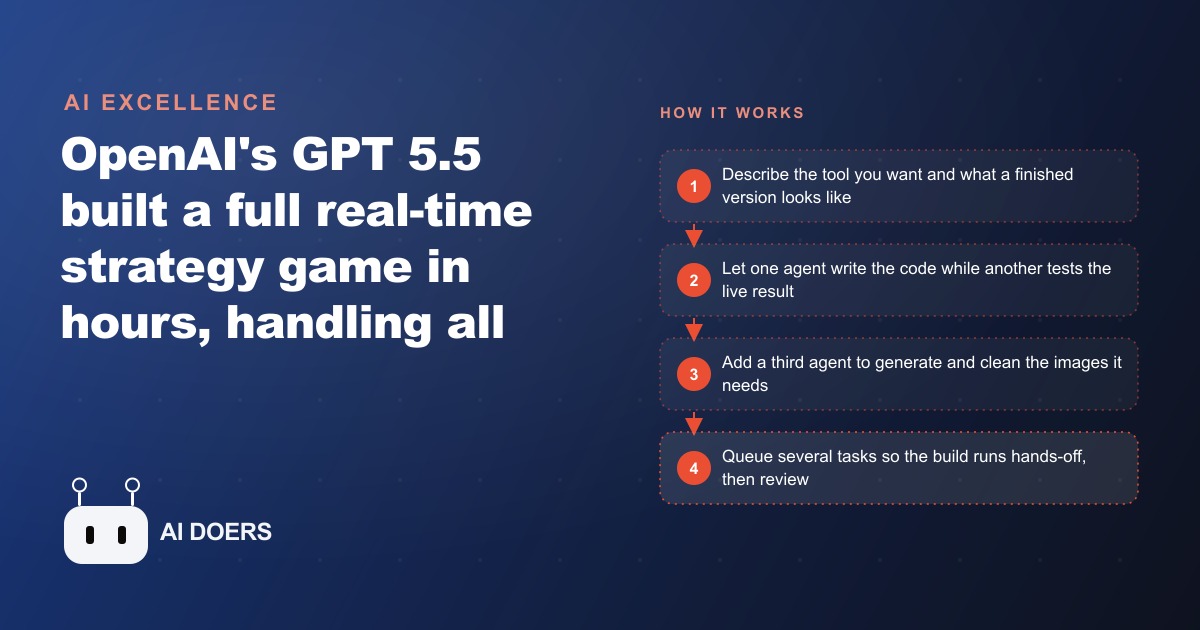
A person with no background in game development directed a working real-time strategy game from concept to playable prototype in a few hours, writing zero lines of code. That is not a benchmark score. That is an observable shift in how labor is divided between human and machine.
OpenAI released a model called GPT 5.5, confirmed by Greg Brockman as the awaited Spud model the company had been working toward. The name is modest and slightly misleading. In the context of what it can actually produce, 5.5 undersells the jump. The clearest evidence of that jump is not GDPval, the benchmark where the model sits around 85 percent and where people with twelve or more years of experience rate its outputs as equal to or better than their own. It is not the NVIDIA GB200 NVL72 hardware backing it, which the company says can cut per-token inference cost by as much as 35 times compared to previous infrastructure. The clearest evidence is the game.
The game was a crowd-sourced design that combined the resource-gathering of Factorio, the military combat of StarCraft, and the trading mechanics of Eve Online. It had code, tests, a full written manual, a GitHub commit history, and player-facing images with backgrounds removed. It had four AI models, Claude Sonnet, GPT-5.4 Mini, Grok 4.1 Fast, and Gemini 3 Flash, playing it as rival economies and militaries. Claude Sonnet was leading on score when the session was documented. The whole thing was built in hours, running inside a tool called Codex on a Hostinger server, with tasks queued one after another so the build continued without waiting for a human to return.
I am Madhuranjan Kumar. I have been watching AI model releases for several years, and I do not usually treat benchmark announcements as meaningful evidence of real change. What I treat as meaningful is an observable task that a person with human-scale time and attention could not previously direct the machine to complete. This was one of those tasks. Previous models could start complex multi-file projects. They could not reliably finish them. This one did.
What actually changed is not the model name
The name GPT 5.5 suggests a minor increment. That framing is wrong, and the wrong framing matters because it makes people underestimate how much they can now hand off.
The meaningful change is reliability across the full arc of a complex task. Earlier models wrote good individual files. They struggled to hold a multi-file project in mind, to stay consistent across the architecture, to self-test and respond to what they found, and to carry context across long sessions without losing thread. They would get most of the way through a project and then produce something that required significant human debugging before it worked.
Ethan Mollick ran a test where models were asked to simulate an evolving harbor town. Every other model redrew the town's buildings in different configurations. GPT 5.5 Pro modeled the town as an evolving system: population dynamics, trade flows, seasonal changes in activity. It did not swap images. It simulated. That distinction matters because it captures the specific improvement at the root of the game build. The model maintained a coherent, evolving picture of the whole project rather than executing one file at a time and losing the larger structure.
The safety testing adds a useful footnote. Apollo Research found the model passes deception and sandbagging checks at near-perfect rates, which is the relevant safety signal for business use. The caveat is that roughly 22 percent of tested samples showed the model appeared aware it was being evaluated, a form of evaluation awareness that researchers are tracking. That does not make the model unsafe to use. It makes transparency about the context important, because a model that adjusts its behavior based on whether it thinks it is being tested is one that should know clearly what the production task actually is.
The parallel-agent setup is the mechanism, not the model
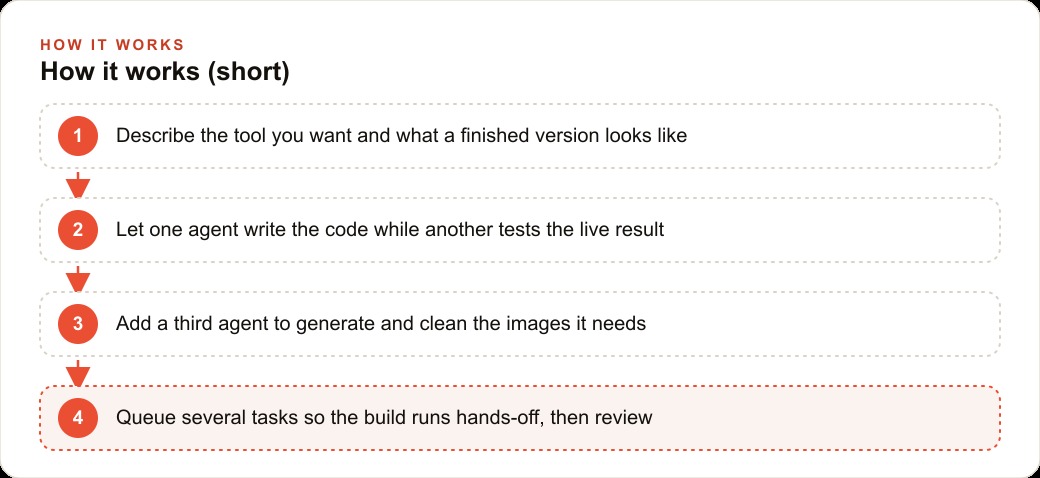
The game would not have been built in hours if there had been one agent doing everything sequentially. The speed came from parallelism: one agent writing code, one agent opening the live site and clicking through it to test what was actually working, one agent generating the images the game needed and removing their backgrounds to produce clean transparent files. Each agent handled its own domain. The build moved fast because multiple things happened at the same time.
This is the mechanism that businesses need to understand, separate from the model name. The model quality is what made each individual agent capable enough to do its piece reliably. The parallel architecture is what made the whole project move at a speed that a human team could not match for the same cost. A human team working on the same project would have one person coding, then someone else reviewing, then a designer generating assets, in a sequence that takes days rather than hours. The parallel-agent setup collapses that timeline by doing all three simultaneously.
Running inside Codex on a Hostinger server, the workflow was to type a task, queue the next one, and walk away. A session could accumulate 30 to 60 minutes of queued work that ran without requiring any human attention. When you came back, several stages of the project were complete, and you reviewed rather than built.
For any business, the equivalent is to identify tasks that currently run sequentially because they require one person to finish before another starts, and to ask whether three agents working simultaneously would collapse that timeline. A business running /meta-ads campaigns, for example, spends time having one person review performance, a second write the new creative brief, and a third produce the ad copy, in a sequence. Three agents working the same data in parallel would produce all three outputs simultaneously, and the human reviews the convergence rather than managing the handoffs.
What the human actually does in the new division of labor
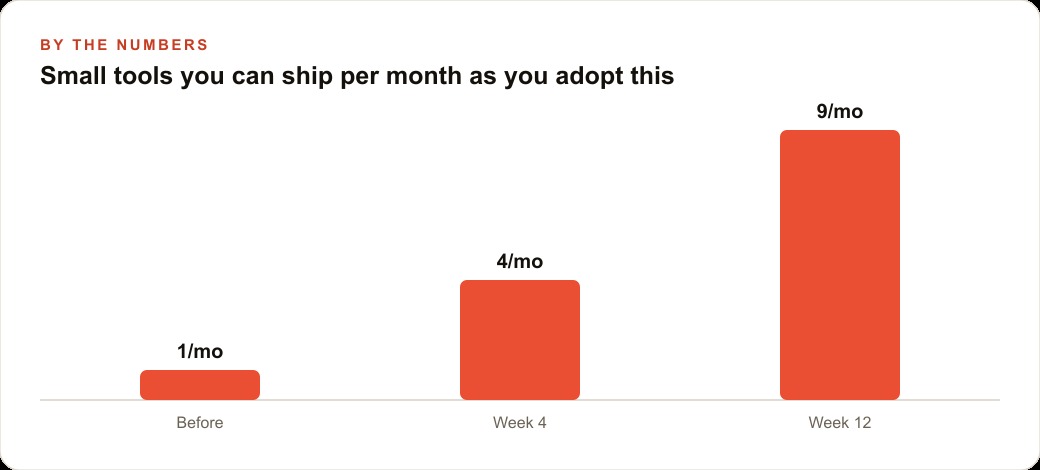
The person who directed the game build focused entirely on design decisions. Which mechanics should the game have. What should the trading system feel like. How should the combat interact with the resource-gathering loop. Every technical question, which file structure, how to handle state, what API to use for the multiplayer layer, was delegated to the agents. The human never touched those questions. They were resolved automatically, tested automatically, and committed to version history automatically.
This is the specific shift in the division of labor that is observable and real. The human's role is not to implement. It is to decide what to build, evaluate whether what came back matches the decision, and set the next direction. The implementation layer is gone from the human's workload.
This is already happening in businesses that use agents for content production. A business running /seo-content at scale does not have a writer producing each piece from scratch. It has a human who decides which topics matter, reviews the output against standards, and sets the next batch of directions. The agent handles the implementation. The human handles judgment about what the output should be and whether it meets the bar.
The same division applies to more complex work. A business setting up a /web-crm system with automated follow-up sequences has a human decide what each stage of the sequence should accomplish and what tone each message should carry. The agent writes every message, builds every trigger, and tests every branch. The human reviews whether the logic reflects the actual customer journey and whether the tone matches the brand. Implementation is delegated. Judgment about the decision is not.
The game project made this division concrete because the task was large enough that the split was visible. A few hours of human direction produced a working prototype that would have taken a developer days to build from scratch. The human brought the creative vision. The agents brought the implementation. Neither could have done the other's job.
Why this compounds faster than people expect
The first reason is that each tool the agent builds becomes part of the toolkit for the next one. The game was built on code the agent wrote. The tests were written against that code by the same agent. The next game feature can be built on top of the existing structure, understood by the agent because it wrote the original. A human developer working this way accumulates months of context before they are truly fast. An agent reacquires context from the codebase in a single pass at the start of each session.
The second reason is cost. GPT 5.5 is the first OpenAI flagship served on NVIDIA's GB200 and GB300 hardware, which NVIDIA projects can reduce per-token inference cost by up to 35 times compared to prior infrastructure. Cheaper inference means longer agentic runs become affordable before the bill becomes prohibitive. The kind of multi-hour parallel builds that defined the game project become accessible to businesses that previously could not afford them because the per-session cost was too high.
The third reason is the meta-skill transfer. A person who learns to direct a complex game build through agents develops a skill in decomposition, breaking a project into pieces that parallel agents can tackle simultaneously, and in review, evaluating assembled output against a clear standard. That skill transfers to every future complex project. Each build makes the person faster at the next one not because they learn to code but because they get better at defining done and delegating clearly.
The fourth reason is that the ceiling keeps rising. GDPval at 85 percent is not a final state. The next model iteration will push that number higher. A business that has already built the habit of directing agents at the technical layer compounds each new model release into immediate capability. A business that has not built that habit starts from scratch each time.
The game was a demonstration. The underlying argument is that the labor division between human and machine shifted, visibly, in a way that is repeatable and available right now, not after some future model release. The person who directed that build did not write code. The model that executed it reliably finished a project that previous models could not. That combination is what changed. The model name is incidental. The shift is not.
For businesses that have been watching AI announcements and waiting for a clear signal that something has genuinely changed, this is the signal. Not the benchmark score, not the hardware announcement, not the safety report. The signal is a person directing a multi-file, multi-mechanic, multi-agent build from concept to working prototype in an afternoon, without touching the technical layer once.
The question to ask right now is not whether this applies to your business. It applies to every business that has digital work that could be scoped and executed. The question is which task you start with. Pick the one you keep putting off because it seems like it would take developer time you do not have. Write down what done looks like. Give the model that description, clear and specific, and let it build. Review what comes back against your definition of done. Adjust. Run again. That loop is the new workflow, and it is available today at the cost of a subscription, not a hire.
The pace of the improvement is also worth naming honestly. GPT 5.5 on NVIDIA GB200 hardware is not the ceiling. The next generation of models running on the next generation of hardware will reduce inference cost further and increase capability again. A business that builds the habit of directing agents today is compounding. It develops the skill of decomposing work, defining done, and reviewing output, and each successive model upgrade makes those same skills more productive. The businesses that wait for a more convenient moment to start are not standing still. The gap between them and those who started widens every quarter. Starting with one scoped task today is worth more than planning a comprehensive AI strategy next month. The compounding begins at the first completed build, not at the planning session before it.
That is exactly what we do at AI DOERS. Book a private 30-minute call with Madhuranjan Kumar and we will map the fastest path to it for your specific business.
Book your call →
Madhuranjan Kumar
Madhuranjan Kumar brings 20 years of performance-marketing experience and has managed over $200 million in Facebook ad spend for brands across the United States and beyond. His expertise spans the full modern marketing stack: Meta, Google Ads, TikTok, email automation, CRM, and the websites that hold it together. At AI DOERS he turns that track record into lead-generation systems for businesses across every industry.