
GPT 5.2 Tested: The Real Wins, the Broken Bits, and How to Get the Best Output
GPT 5.2 delivers a 30 percent hallucination reduction on its thinking model, near-total context retention, exact word counts and shockingly good PowerPoint exports, but its auto mode still answers fast and wrong, so the practical move is to select the thinking model manually for anything that needs accuracy.

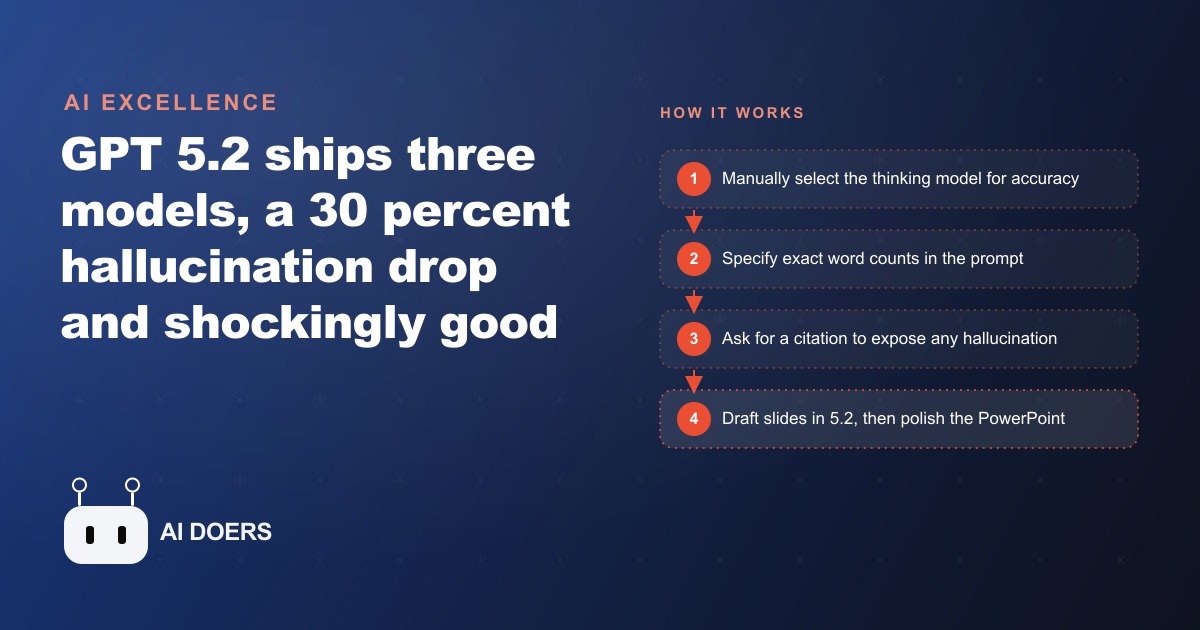
For the past three years, the benchmark that got people excited about a new AI release was capability: what can it do that the previous version could not. I am Madhuranjan Kumar, and GPT 5.2 is the first release where the number I keep coming back to is not a capability number. It is a reliability number. The 5.2 thinking model cuts the hallucination rate from 8.8 percent on 5.1 to 6.2 percent, a roughly 30 percent reduction. That is not a feature. It is a shift in what the AI era is actually about.
The 8.8 percent rate on 5.1 meant roughly one in 11 factual claims was wrong. That number sounds statistical and abstract until you are the person whose name appears on a piece of copy that invented a product specification, cited a study that does not exist, or got a competitor's pricing wrong by 40 percent. At that rate, AI-assisted content required the same vigilance as content written by a junior team member who was confident but unreliable. You still had to check everything. The tool saved time on drafting but did not reduce the verification load by much. The math worked out to AI being useful for high-volume, low-stakes content and still risky for anything that went to a client or a regulator without a thorough human review.
The 6.2 percent rate on 5.2 thinking is not zero, and it is not the number that makes AI content fully self-certifying. But it is, for the first time, a number that changes what percentage of AI-assisted output you can trust with a lighter-touch review rather than a full check. Combined with two specific behaviors the model now demonstrates reliably, refusing to invent citations when asked and hitting exact word counts, this release is the first one where the product is genuinely more trustworthy in addition to being more capable.
The distinction matters because reliability and capability are not the same axis. A model that can write a stunning piece of long-form analysis but invents three of the statistics in it is not a reliable tool. It is a capable one that requires a skilled fact-checker sitting beside it. The practical value of that model in a business context is limited by the cost and availability of that fact-checker. A model that produces slightly less stunning analysis but gets the facts right more often is, for most business applications, more valuable. We have been so focused on the capability frontier for the last three years that this second axis has gotten very little attention. GPT 5.2 is the release that forces the conversation to happen.
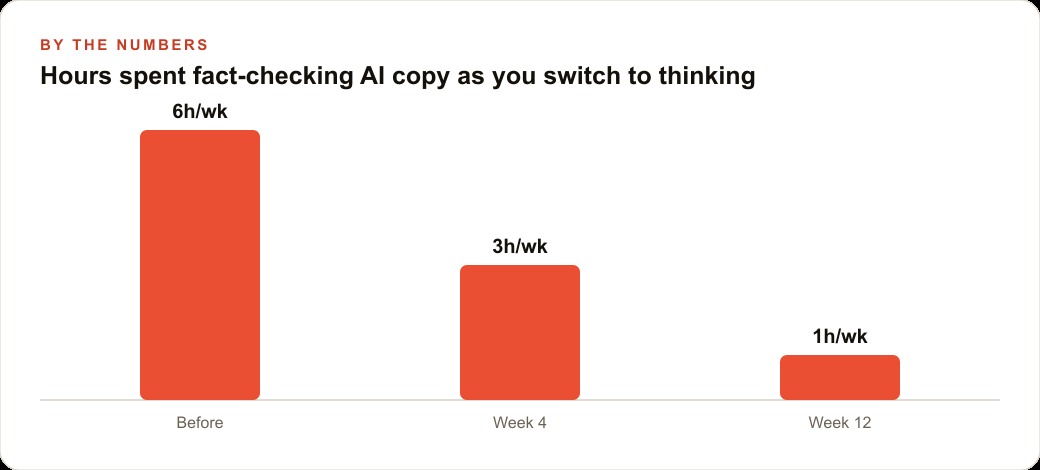
A digital agency content team provided one of the clearest illustrations of what this shift means in practice. The team produced roughly 25 to 30 pieces of AI-assisted content per week, including blog drafts, ad copy, email sequences, and landing page sections. Before switching to 5.2, approximately 40 percent of the time spent on each piece went to fact-checking and correction: hunting down claimed statistics to verify they existed, confirming brand names and product features were accurate, rewriting sections where the model had confidently stated something plausible but wrong. That 40 percent was not optional overhead. It was the work that stood between the AI draft and something safe to publish.
After switching to 5.2 thinking and building two practices into the workflow, always asking for a citation on any factual claim and always specifying exact word counts so the output fit the format without trimming, the fact-checking proportion dropped to roughly 25 percent. Not zero. But a 15-percentage-point shift on 25 to 30 weekly pieces represents a substantial return of hours to higher-value work. The team did not cut headcount. They moved the hours previously spent fact-checking into editing for voice and argument, which produced better content alongside more of it. The output quality went up at the same time the correction burden went down, because the model was producing a cleaner first draft that editors could improve rather than a problematic draft that editors had to defend the client from.
The citation behavior is worth examining carefully because it reveals something about how to use the model rather than just how good it is. Asked for a fake Einstein citation about black holes, 5.2 refused to invent one. That refusal is the correct behavior for a model being used in professional content, and it represents a departure from earlier versions that would produce a plausible-sounding but invented reference without flagging the problem. The practical implication is that asking for a source has become a reliable diagnostic: if the model produces a citation, check it; if it declines and explains it cannot find one, that honesty is more useful than a fabricated one that passes unnoticed into a published piece.
The exact word count control deserves similar attention. Asked for exactly 300 words for a product description, 5.2 thinking produced exactly 300. For anyone who writes titles, meta descriptions, character-limited ad copy, or SMS messages, this is the first version of ChatGPT where the character limit is a trustworthy constraint rather than a rough target that requires manual trimming afterward. For /meta-ads and /google-ads teams writing at scale, where every ad headline has a hard character limit and every description has a maximum, this is not a minor convenience. It is the elimination of a revision step that was previously guaranteed on every output.
Before reaching the slide export, it is worth dwelling briefly on vision, because improved vision changes a specific daily friction that most users will recognize. Previous versions of ChatGPT read screenshots inconsistently. Paste a screenshot of an app interface and ask where to click to accomplish a task, and the answer was sometimes accurate and sometimes confidently wrong about which button did what. The 5.2 improvement on this is real enough that the agency team started using it for onboarding: new team members paste a screenshot of an unfamiliar platform and ask how to find a specific setting, and 5.2's answer is reliable enough to trust on the first try most of the time. That sounds modest until you consider how often people in agencies switch between platforms, and how much time goes into the orientation period when a new tool is added to the stack.
The slide export was the surprise of the release. Given a URL and a set of sources, 5.2 built a polished slide deck and exported it as a PowerPoint that was immediately usable as a starting point for a client presentation. The layout was a genuine leap over what 5.1 produced on the same task: coherent information hierarchy, appropriate use of white space, section titles that matched the argument rather than the heading structure of the source material. This matters because presentations have been a persistent weak point of AI tools. Content judgment and visual structure are two different skills, and models have historically been better at the former than the latter. A deck that demonstrates both is a new data point.
The context retention improvement, near 100 percent across the same 256K token window, is the quieter change that pays dividends in long sessions. Earlier versions of the model forgot early details by the time they reached the final deliverable in a lengthy conversation. A brand voice guide loaded at the start of a session would fade from influence by the time the model was writing the fifth piece in a series. With 5.2 thinking, the constraint set from the beginning of a session stays active through the end. For /seo-content programs producing a cluster of topically related articles in one session, or for /web-crm teams building an email sequence where voice consistency across six messages is a functional requirement, that retention is practically significant.
None of this means the release is without problems. The auto-mode selection still picks wrong for hard tasks. In testing, a visual puzzle sent to auto mode received two seconds of deliberation and a wrong answer. Forcing the thinking model took two minutes and produced the correct one. The gap between those two experiences, same model family, same question, different outcome based only on which mode was selected, is the clearest possible argument for turning off autopilot. Professional users should choose the thinking model manually for any prompt where accuracy matters more than response speed, and reserve instant mode for low-stakes, time-sensitive tasks where a faster wrong answer is still more useful than a slower right one.
Canvas mode for building web applications was the other disappointment. Tasked with building an AI comparison site, 5.2 produced over 1,800 lines of code, far more than 5.1, but the filtering interface was broken in a way that required multiple correction prompts to address. On that specific test, 5.2 did not clearly outperform 5.1. Anyone using 5.2 for app building should budget for two or three rounds of follow-up rather than expecting a working first draft, or should use a dedicated no-code builder for the coding work and reserve 5.2 for the content and research tasks where it now unambiguously delivers.
The vision upgrade and the exact word count control and the lower hallucination rate share something in common that is worth naming explicitly: they are improvements to the model's relationship with constraints. A model that reads a screenshot accurately is honoring the constraint that the answer should match reality. A model that produces exactly 300 words is honoring a format constraint. A model that declines to invent a citation is honoring a truthfulness constraint. The axis that all three improvements move along is not "can it do more things" but "does it do the things it attempts more precisely and more faithfully." That is the reliability axis, and it is the one that matters for professionals who build their reputation on the accuracy of the work they put their name on.
The more durable shift that 5.2 represents is about evaluation criteria. For the past several years, the primary question buyers and users asked when a new model released was "what can it do that the last one could not." That question optimized for capability expansion. The question that makes more practical sense for businesses deploying AI in production workflows is "what can I trust this to get right without a human checking every output." That is a reliability question, not a capability question, and 5.2 is the first release where the answer has moved meaningfully in the direction of "more than before."
The agency team's shift from 40 percent to 25 percent fact-checking time is the shape of that movement. It is not a revolution. It is a compounding improvement on a variable that actually determines whether AI tools deliver net value in professional settings rather than net overhead disguised as productivity. Every percentage point of hallucination reduction translates to minutes per piece of avoided correction work, and minutes per piece at production volume is the number that decides whether AI is a genuine operating leverage tool or an expensive toy that requires more management than it saves.
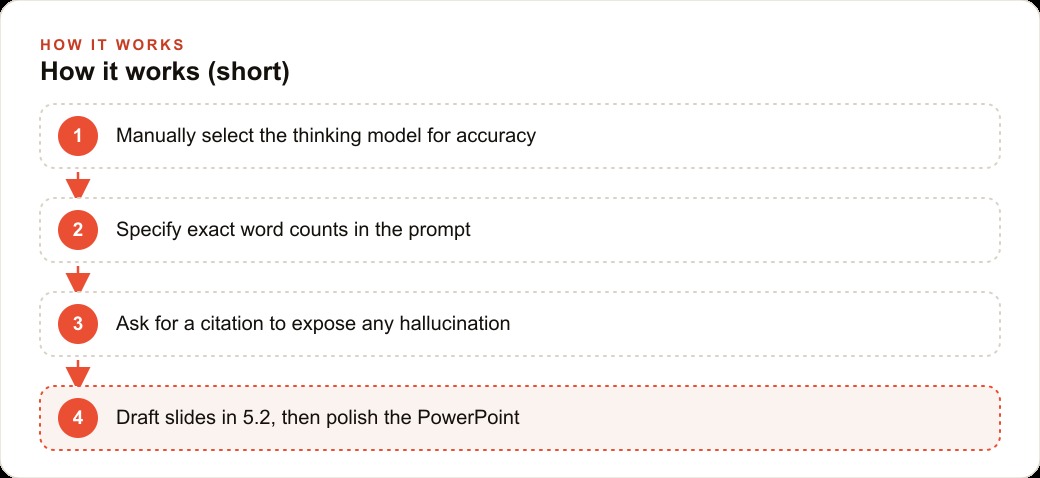
The teams that win with 5.2 are not the ones using the most sophisticated prompts or the most elaborate workflows. They are the ones who turn on thinking, ask for citations on anything factual, specify exact lengths on anything length-constrained, and treat the slide export as a first draft rather than a finished deck. Those four habits, none requiring any technical setup, capture most of the value the release offers and do so starting from the first session.
For businesses deciding whether to upgrade or standardize on 5.2 for their content and research workflows, the practical test is simple: run the same five prompts you use most frequently against both the 5.1 and 5.2 thinking models, check the outputs for factual accuracy and format compliance, and measure whether the 5.2 outputs require fewer correction passes. If they do, the reliability gain is real in your specific use case. If they do not, you have learned something important about which types of tasks the improvement actually affects. That is how every AI evaluation should work, not benchmarks, but your own work on your own prompts.
That is exactly what we do at AI DOERS. Book a private 30-minute call with Madhuranjan Kumar and we will map the fastest path to it for your specific business.
Book your call →
Madhuranjan Kumar
Madhuranjan Kumar brings 20 years of performance-marketing experience and has managed over $200 million in Facebook ad spend for brands across the United States and beyond. His expertise spans the full modern marketing stack: Meta, Google Ads, TikTok, email automation, CRM, and the websites that hold it together. At AI DOERS he turns that track record into lead-generation systems for businesses across every industry.