
GPT-4.5 First Look: Everything Changed About AI Writing This Week
GPT-4.5 launched to the public at midnight and after hours of testing, here is the honest first look. Deep research for everyone. VO2 live. All of it explained.

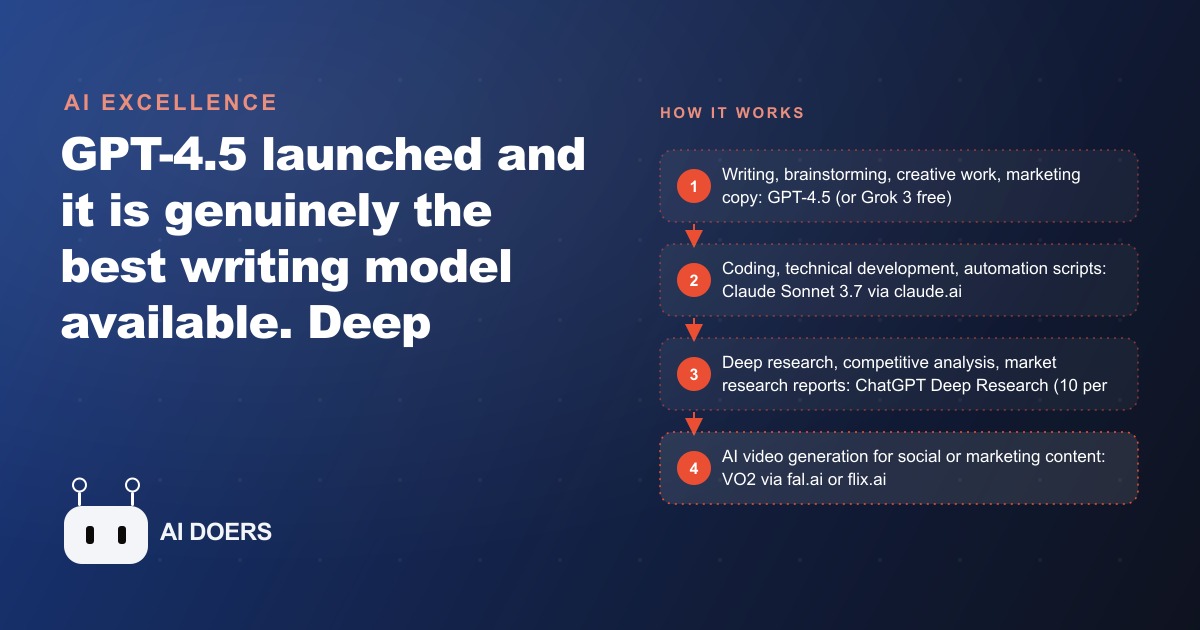
Three significant AI updates landed within days of each other this week, and taken together they change the practical toolkit for any business that communicates with clients, produces content, or runs video. I am Madhuranjan Kumar. Here is a practical guide to each one: what it is, which tasks it is actually best for, and how to get started without wasting time.
Pick the task type where GPT-4.5 outperforms everything else
GPT-4.5 is a non-reasoning language model, which means it responds immediately rather than spending extra time working through a problem step by step. That design choice makes it the wrong tool for complex mathematical reasoning, multi-step coding logic, or anything that benefits from extended deliberation. It makes it the right tool for one specific job: writing that sounds like a person wrote it.
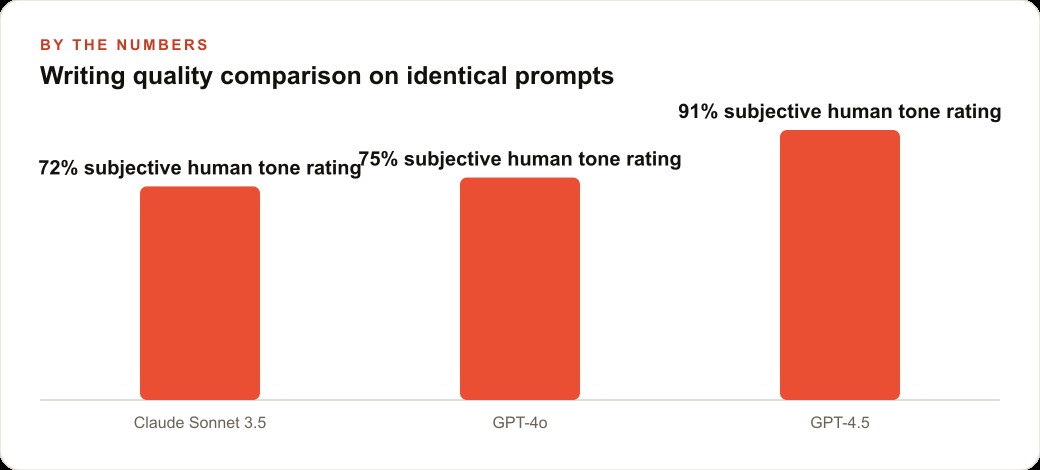
The central claim from OpenAI is that GPT-4.5 has higher emotional intelligence and produces a more natural tone than any previous version. After testing the same prompts through GPT-4.5, GPT-4o, and Claude Sonnet 3.5, the claim holds on writing tasks. The difference is noticeable on the first comparison. GPT-4.5 consistently avoids the markers that make AI writing feel generated: the false enthusiasm in the opening sentence, the overuse of filler transitions like it is worth noting, and conclusions that simply restate the introduction without adding anything.
For professional communication, that quality difference is a visible signal to clients and customers. An email that sounds AI-generated signals that less care went into it. A proposal with AI-writing filler reads as less authoritative than one that sounds like it came from someone who genuinely understands the subject. GPT-4.5 reduces the editing burden on exactly these tasks.
The API pricing is not suitable for high-volume production use. At seventy-five dollars per million input tokens and one hundred and fifty per million output, building automation at scale on GPT-4.5 through the API is expensive. The value is best accessed through the ChatGPT interface at the twenty-dollar Plus plan price. Do not evaluate it through coding benchmarks: that is not what it was built for and the comparison will mislead you.
Run a writing task you do every week and compare the output side by side
The fastest way to know whether GPT-4.5 is worth adding to your workflow is to run a writing task you do regularly, one you already know the quality bar for, and compare the output side by side with what you currently use. Pick a real task: a client update email, a social media caption for a specific product, a newsletter section on a topic your audience cares about. Write the same prompt you normally use, run it through both models, and read the outputs back-to-back.
The brainstorming quality is where the advantage shows up most clearly for many users. Where an earlier model might produce ten campaign ideas with two or three that are genuinely usable, GPT-4.5 tends to produce a higher percentage of ideas that feel like they were written by someone who has a feel for the audience. That ratio matters when you are generating options to choose from, because more usable options per run means fewer runs before you have something you want to use.
For a business running regular Facebook and Instagram ad campaigns that require frequent creative variations, having more usable ideas per generation session is a direct time saving at the creative ideation stage. For a business producing SEO content that requires distinct angles on similar topics, the ideation quality improvement reduces the time spent generating and discarding before finding an approach worth developing.
Open deep research on a topic your business actually needs to understand
Deep research expanded to all ChatGPT Plus subscribers this week, accessible at ten uses per month on the twenty-dollar plan. Previously gated behind the two-hundred-dollar Pro plan, this is the feature where ChatGPT autonomously browses dozens of web sources, synthesizes what it finds, and produces a structured multi-page report on a topic you specify.
This is the most impactful single AI feature for a business owner who does research tasks manually. Market research that currently takes several hours of reading, competitive analysis that means visiting competitor sites and taking notes, regulatory review that requires scanning multiple official sources, these are exactly the tasks deep research handles well. The output is not a chat response. It is a structured report with citations that you can read, verify, and use as a foundation for decisions.
The recommendation is to run at least one deep research session on a topic that actually matters to your business before deciding whether it is useful. Pick something real: the competitive landscape in your local market for a service you offer, the regulatory requirements for something you are considering adding, the pricing and positioning of your three main competitors. Let the agent run for twenty to forty minutes and read what comes back. The quality and depth of the output will likely change how you approach research going forward.
Do not assume ten uses per month will be sufficient once you have experienced the output quality. Track your usage for the first month and decide whether the upgrade to a higher allowance is worth it based on real use rather than estimation.
Use VO2 for the short video content your current tool cannot match
VO2 from Google became accessible to anyone this week through two platforms: fal.ai and flix.ai. VO2 has been rated the best AI video model for human expression and motion physics by most quality assessments since its release. Previously in limited access, it now charges per generation rather than requiring a subscription, so you can test it on a single clip without a monthly commitment.
The quality difference between VO2 and most other accessible AI video models is most visible in clips that include people. Human expression, natural motion, and the physics of how a person moves are where VO2 outperforms its alternatives most clearly. For a business producing short video content for social media or advertising, this is the measure that matters most for viewer engagement and brand perception.
For any business running Google Ads video placements, the quality of this breakdown asset is a direct input to click-through rate and brand impression. A clip where motion looks natural and expression reads as human performs differently from a clip that shows the typical AI-video uncanny qualities. Testing VO2 on a clip for a real business use case takes one generation and a few minutes of review.
Route technical work and automations to a different model entirely
GPT-4.5 is explicitly not the right tool for coding, automation scripts, or technical problem-solving. Using it for those tasks and then drawing conclusions about whether it is worth the subscription misses the design entirely. The model was built for language quality on communication tasks. For technical work, the better choices are the models built for reasoning and code, including the o-series from OpenAI and Claude through the code interface.
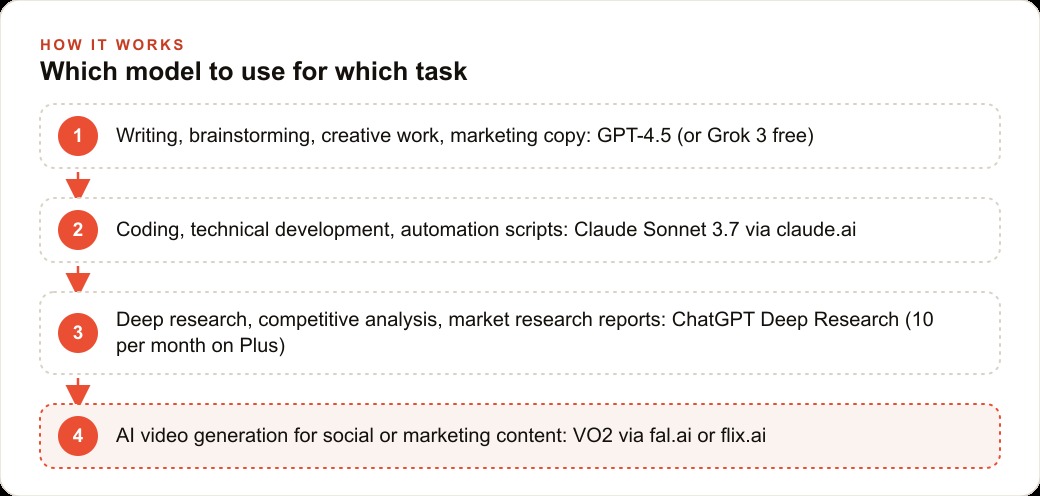
The practical workflow that emerges from this week's releases is a clear split. Writing, brainstorming, client communication, and content: GPT-4.5. Competitive and market research: deep research in ChatGPT. Short video content: VO2 through fal.ai or flix.ai. Technical builds and code: a reasoning-capable model through a code interface. Treating these as distinct tools for distinct jobs produces better output from each one than routing everything through a single model regardless of fit.
The leads and client data that flow through all of these creative and research tasks ultimately land in the business's operational systems. For any business managing those relationships through a CRM and website stack, the improved quality of the outreach, content, and research produced by these tools feeds directly into the quality of what the business puts in front of prospects and clients. Better inputs at the creative and research stage produce better outputs through the entire client relationship system.
That is exactly what we do at AI DOERS. Book a private 30-minute call with Madhuranjan Kumar and we will map the fastest path to it for your specific business.
Book your call →
Madhuranjan Kumar
Madhuranjan Kumar brings 20 years of performance-marketing experience and has managed over $200 million in Facebook ad spend for brands across the United States and beyond. His expertise spans the full modern marketing stack: Meta, Google Ads, TikTok, email automation, CRM, and the websites that hold it together. At AI DOERS he turns that track record into lead-generation systems for businesses across every industry.