
Google Veo and the Rise of the Prompt Driven Camera
AI video now produces footage and matching audio in a single step, turning the prompt into a camera. Here is what changed and how I would use it to grow a dental practice without a film crew.

For most of the last century, the skill bottleneck in video production was execution: who could handle the camera, the lights, the edit suite, and the audio mix. Google Veo ended that bottleneck. It did not make those skills irrelevant. It moved them out of the critical path.
My name is Madhuranjan Kumar, and the shift I am watching right now in creative work is the same rotation that happened in desktop publishing in the 1990s, in web design in the early 2000s, and in e-commerce photography in the 2010s. Each time, a capability that required specialist execution became accessible through a tool, and the scarce skill rotated toward whoever could best direct that tool. Video is having that moment now, and the implications for every business that markets visually are more concrete than most people are ready to act on.
Video production just had its desktop publishing moment
When desktop publishing arrived, it did not eliminate graphic designers. It eliminated the bottleneck of having to send layout specifications to a typesetter and wait days for output. The designer who could sit at the computer and see the result immediately became dramatically more productive. The designer who insisted on maintaining the old separation of roles became a bottleneck. The skill that mattered shifted from knowing how to specify work for someone else to knowing how to direct software in real time.
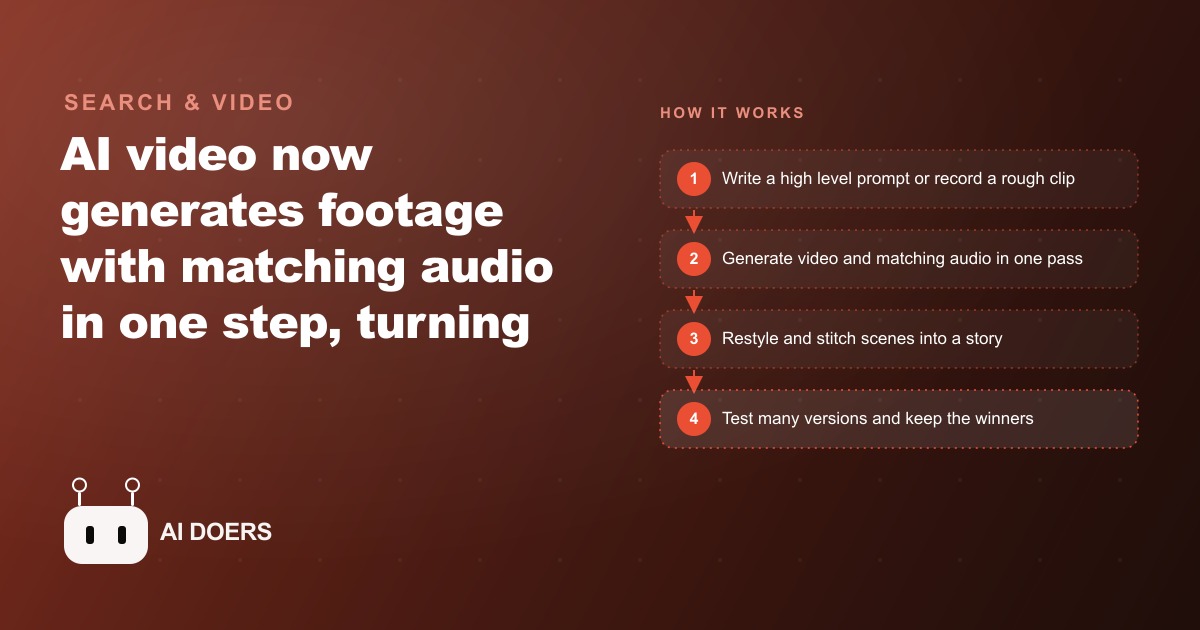
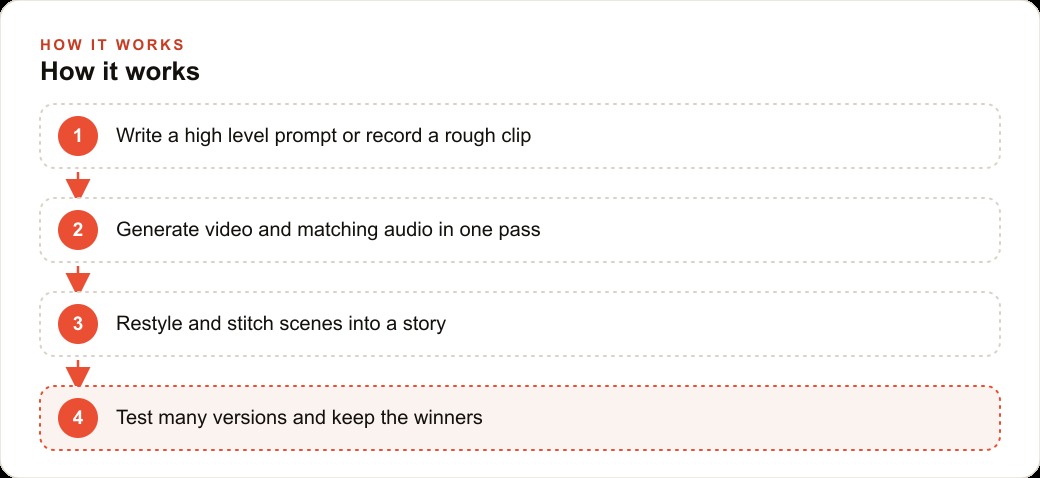
Google Veo generates video and matching audio in a single pass. The lip sync is there. The ambient sound matches the scene. The physics in the shot hold together well enough for most commercial uses. What used to require a multi-day production, a location booking, a crew, a director, a sound recordist, an editor, and a colorist, can now begin with a written description and a phone clip.
The phone-clip-as-wireframe workflow is the most significant practical shift. You record a rough video on any device: the framing, the motion, the rough idea of what should be in frame. That recording becomes the structural input to a model that restyles it into a polished scene. The footage you captured is not the final output. It is the coarse sketch. The model fills in the production quality. What used to require renting a camera and booking a studio can now start with a phone in your hand.
That specific capability removes the two biggest barriers that kept most local businesses out of video marketing: cost and access to equipment. Both of those barriers were real. A single-location dental practice in a mid-size city was not going to book a crew for a five-minute explainer video every two months. The cost did not justify the output volume. With the wireframe approach, the dentist records a rough pass explaining what a first visit looks like, and the model delivers a version suitable for the practice's homepage. That is a new capability, not a marginal improvement.
The scarce skill in creative work rotates toward whoever best directs the machine
This rotation is not new. In every creative field where a tool collapsed the execution bottleneck, the scarce skill moved upstream toward whoever could most precisely articulate what they wanted. Architects who could specify a design precisely thrived after CAD. Photographers who could direct a subject and select a frame thrived after digital cameras automated the chemistry. Writers who could edit, structure, and argue thrived after word processors removed the friction of revision.
Video directing has always been a discipline separate from video execution. The people who could clearly articulate a scene, who understood framing and pacing and emotional arc, were the creative force. The crew was the execution mechanism. What AI has done is make the execution mechanism accessible to anyone who can articulate clearly. The directing skill, which used to be a prerequisite mostly for people who were also managing a crew, is now the entire job.
This is not a minor upgrade to an existing workflow. It is a structural reallocation of creative value. The person who can write a precise scene description, who understands what makes a hook hold attention in the first three seconds, who can direct character presence and tone from text, now does what used to require coordinating five specialists. The people who built careers around the specialist execution steps are not obsolete. But the leverage point has moved, and the businesses that figure out the directing skill first will have a durable advantage over those still treating video as a production problem.
The editing and stitching layer is where the value is actually created. Raw clip generation is now cheap enough that any business can generate footage. The scarce work is assembling that footage into something that tells a coherent story, holds attention through a sequence, and earns a specific audience action at the end. Strong editors who understand narrative structure and pacing are worth more now than they were before AI generation became available, not less. The supply of raw clips went up. The supply of people who can make sense of those clips into a finished piece did not.
A dental practice with a phone and a clear brief now has the same production capability as a studio with a crew
I want to make this concrete with numbers because the scale of the shift is understated in most discussions about AI video.
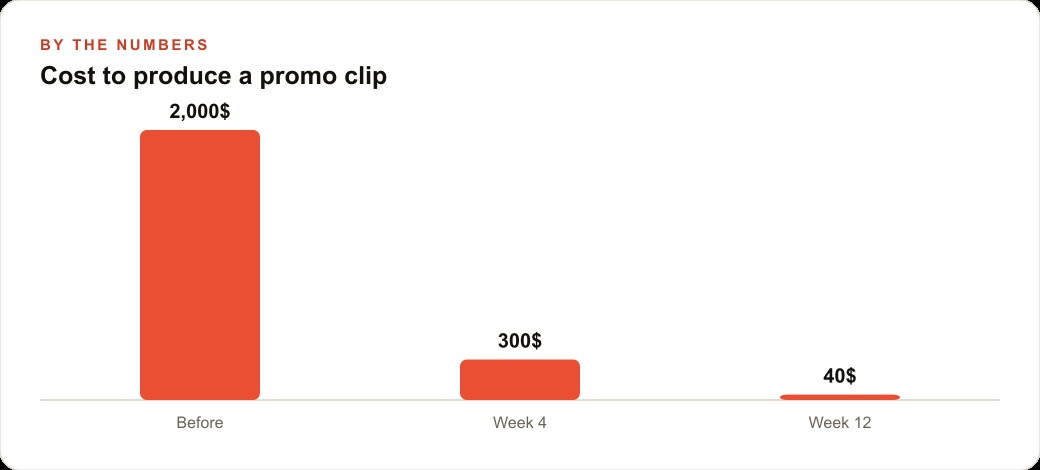
A dental practice wanting a short promotional video had two options before AI generation became capable. Option one: hire a local videographer. The cost for a half-day shoot with editing typically ran between $1,500 and $3,000 depending on the market. The output was a single video, often of professional quality but inflexible: if the offer changed or the hook did not convert, a new video meant another booking and another fee. Option two: record it on a phone without post-production polish. The cost was zero but the output quality was unsuitable for paid advertising placement and often performed poorly even on organic social channels.
The current state with AI-assisted production: a rough phone recording of the dentist takes 20 minutes. The model refines the footage into a clean, well-lit scene. A second pass generates variations with different opening hooks. Total production cost: under $50, including the platform subscription spread across the month's output volume. The same $2,000 that used to produce one video now produces 40 variations.
That ratio change, from one video at $2,000 to 40 variations at $50, does not just save money. It changes the strategic posture entirely. A dental practice that can afford to test 40 variations of an ad hook, observe which ones hold attention past the five-second mark, and scale the two or three that convert best is doing something structurally different from a practice that produced one video per quarter and hoped it worked. The first practice is running a system. The second is making bets.
The practice does not need to understand video production. It needs to understand its patients. It needs to know what concerns a first-time patient carries into that first call, what objections appear most often before someone books an appointment, and what the waiting room needs to feel like to earn trust from someone who is already anxious about dental work. That knowledge, translated into a clear brief, is the entire creative input. The execution is handled.
For ongoing content, the wireframe approach means the dentist records a rough pass of each FAQ video, explaining common patient questions in plain language. The model handles the polish. Variations get tested against each other. The content library grows from those rough recordings at a rate that would have required a full-time videographer under the old model. The practice owner does not need to be comfortable on camera to the level of a professional presenter. They need to be genuine, clear, and specific about what they want patients to understand. Directing skill applied to AI generation handles the rest.
Direction is now the entire job
The argument throughout this essay reduces to one position: the creative skill that matters in video has permanently shifted from execution to direction, and that shift favors businesses and individuals who invest in getting good at articulating what they want.
The implications for businesses are specific and actionable. Stop thinking about video marketing as a production project you outsource when you have budget for it. Start thinking about it as a testing and learning system you run continuously. The economic model that made testing expensive, where each variation required a new production cost, is gone. The new model rewards the business that iterates fastest.
The implication for creative professionals is equally specific. The value is not in knowing how to operate a camera or mix audio. It is in understanding what a viewer responds to, how to structure an opening hook, when to cut, and how to write a brief that produces predictable output from an AI generation tool. Those are directing skills. They can be developed. They will be worth considerably more in two years than they are today because the gap between people who have them and people who do not will be more visible as the generation tools become more widely available.
For the dental practice, the most valuable investment is not platform access. It is learning to write scene descriptions that produce consistent output. One afternoon spent understanding what prompts produce the right tone for a nervous first-time patient versus a loyal returning patient, what scene setting feels warm without feeling staged, and what pacing makes a 30-second clip feel comfortable rather than rushed: that is the investment that makes every subsequent video better. The platform cost is trivial. The directing skill is the durable asset.
Businesses that treat AI video tools as a cost-cutting measure for existing production workflows will capture part of the value. Businesses that recognize the shift in the scarce skill and deliberately invest in developing the directing capability will build something more durable: a system that compounds creative learning, produces better output with each iteration, and costs a fraction of what equivalent output required a year ago.
The rotation has happened. The question is which side of it you want to be on.
For the dental practice, the most practical immediate test is to record one rough phone video this week: a 90-second explanation of what a first visit looks like, spoken naturally without a script. That rough recording is the input. The AI generation tool produces the polished output. The entire production cost from recording to published video is under $30 in platform fees and two hours of time. Compare that output against the $1,500 to $2,000 quote you would have received from a videographer for the same deliverable. The gap tells you everything you need to know about the shift that has already happened.
The businesses and professionals who take directing seriously now, who spend time learning to write scene descriptions that produce predictable output, who develop a systematic testing practice for their video content, are not just ahead of where they were six months ago. They are building a durable capability that will compound as the generation tools improve. Every iteration teaches the director something. Every test result teaches the business something. That learning compounds in a way that a single expensive production never could, because a single production produces a single result. A testing system produces data, and data teaches you how to direct the next iteration better than the last. Six months from now the tools will be more capable. The businesses that spent those six months learning to direct will extract more value from the improved tools than the businesses that waited to start until the tools felt ready. The tools will never be more finished than they are today relative to where they are headed. The time to develop the directing skill is now, with the tools as they are, not later when every serious competitor has already done the same work and the directing advantage has fully closed.
That is exactly what we do at AI DOERS. Book a private 30-minute call with Madhuranjan Kumar and we will map the fastest path to it for your specific business.
Book your call →
Madhuranjan Kumar
Madhuranjan Kumar brings 20 years of performance-marketing experience and has managed over $200 million in Facebook ad spend for brands across the United States and beyond. His expertise spans the full modern marketing stack: Meta, Google Ads, TikTok, email automation, CRM, and the websites that hold it together. At AI DOERS he turns that track record into lead-generation systems for businesses across every industry.