
Google Translate's Free Live Conversation Mode Is the Universal Translator That Finally Works
Google Translate's new conversation mode does near-instant two-way voice translation for free, and alongside it a wave of new voice models, image editors, and ChatGPT memory features all point at the same thing: practical AI you can actually put to work.

The appointment was scheduled for thirty minutes. It lasted twelve, because the provider and the patient could not understand each other, and there was no one else in the room. The patient left with a printed referral they could not read and a follow-up date they were not sure they understood. That same appointment, with Google Translate's new conversation mode on a phone between them, plays out differently. I am Madhuranjan Kumar, and this is a story about what a free software update actually changed for one type of practice.
The barrier that cost more than most practices tracked
A small oral surgery practice in a mixed-language market had been managing language barriers the way most practices do: by shortening appointments, relying on a family member to translate when one was available, and writing off the visits where neither option worked. The cost was visible in the data but not tracked anywhere. Appointments with language barriers ran shorter than scheduled, recall rates were lower, and treatment plan acceptance on anything beyond the immediate problem was nearly zero. The practice did not track these as language-barrier outcomes because no one had a clean way to separate them from other sources of variation. They showed up as diffuse underperformance rather than an identifiable problem with an identifiable fix.
The practice did the math eventually, prompted by a scheduling analysis that showed a pattern in appointment outcomes by patient language flag. Across one year, appointments with patients who required translation assistance had a follow-up conversion rate roughly thirty percent lower than the overall average, and a treatment plan acceptance rate on secondary recommendations that was less than half the practice average. That gap, multiplied across the volume of affected appointments, represented a meaningful revenue difference. The practice had been absorbing it as invisible friction for years.
The framing that changed how the team thought about the problem was not the revenue loss. It was the patient outcome. A patient who cannot understand a post-procedure care instruction is more likely to call with a complication, more likely to require a follow-up visit that takes more time and costs more to deliver, and less likely to return or refer. The language barrier was not just a revenue problem. It was a care quality problem, and it had a free solution sitting in the app store.
After one update, the same appointment plays differently
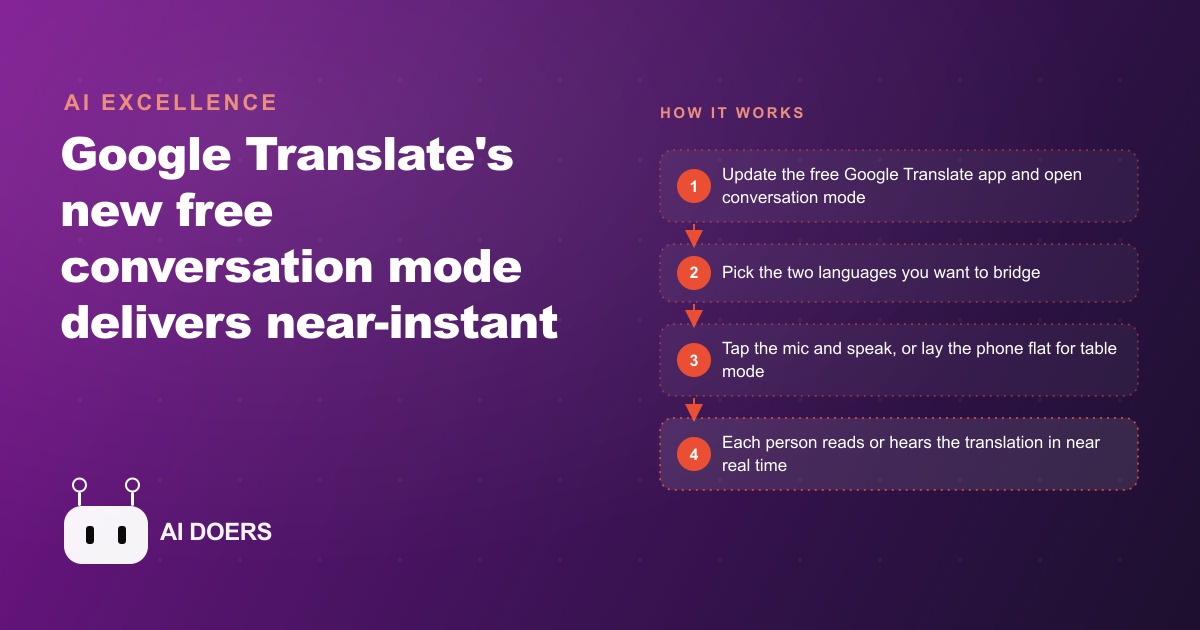
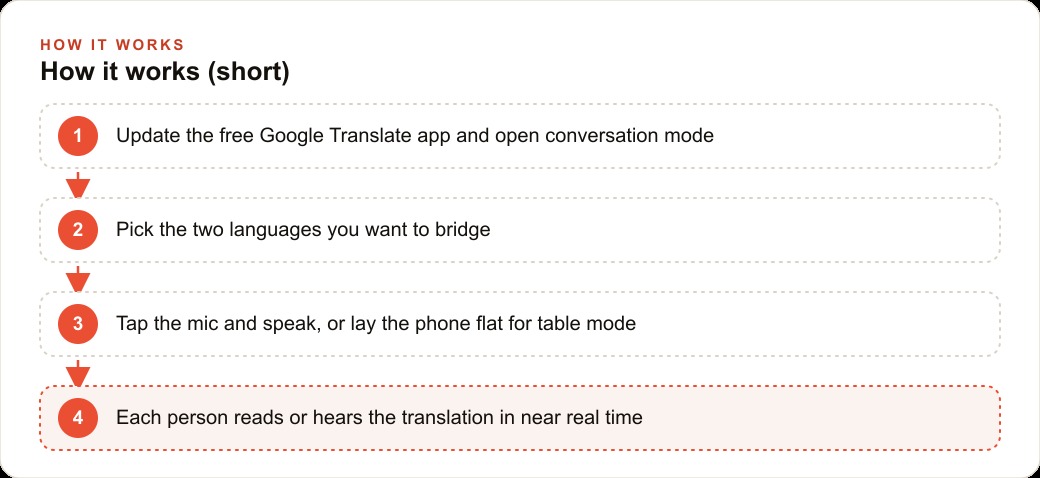
Google Translate's conversation mode lets two people who speak different languages hold a live, back-and-forth spoken conversation through one phone. Earlier versions of real-time translation had enough latency and enough error that the experience felt like shouting through a wall rather than having a conversation. The version that shipped with this update is different. The loop from speaking to receiving the translation lands in under a second in normal conditions, which is fast enough that the conversation feels natural rather than staggered.
The table mode is the configuration that works best in a clinical setting. The phone sits flat on the desk between the provider and the patient. Each person sees the translated text facing them, taps a mic icon to speak, and reads the response on their side of the screen. Neither person needs to hold the phone or hand it back and forth. The rhythm of the consultation stays intact.
The practice started by using it in consultations for secondary treatment recommendations, the part of the appointment where the provider explains a finding and proposes a plan the patient needs to understand and agree to. Before the update, this part of the appointment often ended with the patient nodding without a clear understanding of what they had agreed to, because the explanation could not be given in enough detail through gesture and simple words. With conversation mode, the provider could explain the finding, the options, the timeline, and the expected cost in the same level of detail used with any other patient. The patient could ask clarifying questions and receive a translated answer in real time.
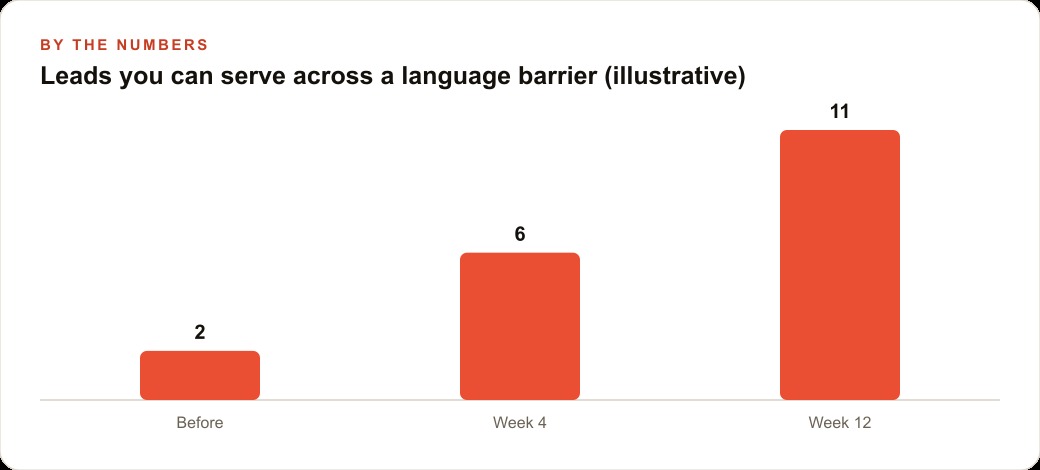
The first two months of using it consistently in affected appointments produced a measurable shift in treatment plan acceptance rates for that patient segment. The practice did not publish these numbers externally, but the direction was clear enough that conversation mode became a standard part of the consultation setup for any appointment flagged as potentially requiring translation assistance.
What changed when consultations could happen in the patient's language
The most significant change was not the metric movement. It was something the front desk described as a shift in the feeling of the appointment. Patients who had previously been quiet and passive through the clinical portion of their visits started asking questions. Treatment plans that the provider had recommended in previous visits and the patient had deflected on were revisited with fresh engagement because the patient could now actually understand why they were being recommended.
The recall pattern changed too. Patients in this segment who received their post-procedure instructions verbally, in their own language, through the conversation mode translation, called back with complications at a lower rate than the same segment had previously. The instructions were the same. The delivery method was different, and the comprehension level was higher. That higher comprehension reduced the follow-up volume and freed appointment slots that had been consumed by avoidable callback visits.
For the front desk, the tool solved a different problem. Appointment confirmations and rescheduling calls for this patient segment had been handled by leaving a voicemail in English and hoping the patient understood it, or waiting until a family member was available to relay the information. Conversation mode on a phone call, with a staff member speaking and reading the translated response on screen, made those calls functional in a way they had not been before. Confirmation rates improved. No-shows in this segment dropped.
The practice also uses it in the context of CRM and website touchpoints, where intake forms and pre-appointment instructions are often the first communication a new patient receives. The ability to walk a patient through a translated version of their own intake paperwork over the phone, using conversation mode rather than waiting for a bilingual staff member or a scheduled interpreter, shortened the intake cycle for affected patients and reduced the number of appointments that started with incomplete paperwork.
Six months later: what the consistent use of one free tool produced
Six months after making conversation mode a standard tool in the consultation room, the practice reviewed the outcomes in the affected patient segment compared to the same period from the prior year. Treatment plan acceptance in this segment was substantially higher. Recall conversion had improved. Post-procedure callback volume had decreased. No one on the clinical staff had changed their approach to these consultations in any other meaningful way. The instrument on the desk changed. The conversation it enabled changed. The outcomes changed.
The costs were zero. The tool is a free update to an app on an existing phone. The training required was thirty minutes of practicing the table mode with a colleague before using it with a patient. The maintenance required is nothing beyond keeping the app updated.
For any local business serving a mixed-language market, this is the type of gap that is easy to underestimate because the lost value is diffuse. The patient who came in once and did not return, the consultation that ended with a referral the patient never followed, the recall appointment that was scheduled and not kept: none of these show up as a single identifiable cost. They show up as quiet underperformance in aggregate metrics that get attributed to general market conditions rather than a specific, solvable problem.
Reaching new language communities effectively also changes what is possible in paid advertising. Facebook and Instagram ad campaigns targeting non-English speaking local audiences can only convert at the rate the practice can serve those patients after they arrive. A practice that has solved the consultation language barrier can run those campaigns confidently, knowing the patient experience on the back end will support the acquisition cost on the front end. Without that piece in place, the ad spend reaches the audience but the conversion stops at the door.
The straightforward lesson from this practice's experience is that the free tool, used consistently and deliberately, can close a gap that had been generating diffuse, untracked cost for years. The conversation mode is free, already in the app, and takes thirty minutes to learn. The gap it closes can be years in the making.
That is exactly what we do at AI DOERS. Book a private 30-minute call with Madhuranjan Kumar and we will map the fastest path to it for your specific business.
Book your call →
Madhuranjan Kumar
Madhuranjan Kumar brings 20 years of performance-marketing experience and has managed over $200 million in Facebook ad spend for brands across the United States and beyond. His expertise spans the full modern marketing stack: Meta, Google Ads, TikTok, email automation, CRM, and the websites that hold it together. At AI DOERS he turns that track record into lead-generation systems for businesses across every industry.