
Google's TurboQuant: 6x Less Memory, 8x Faster, Zero Accuracy Loss
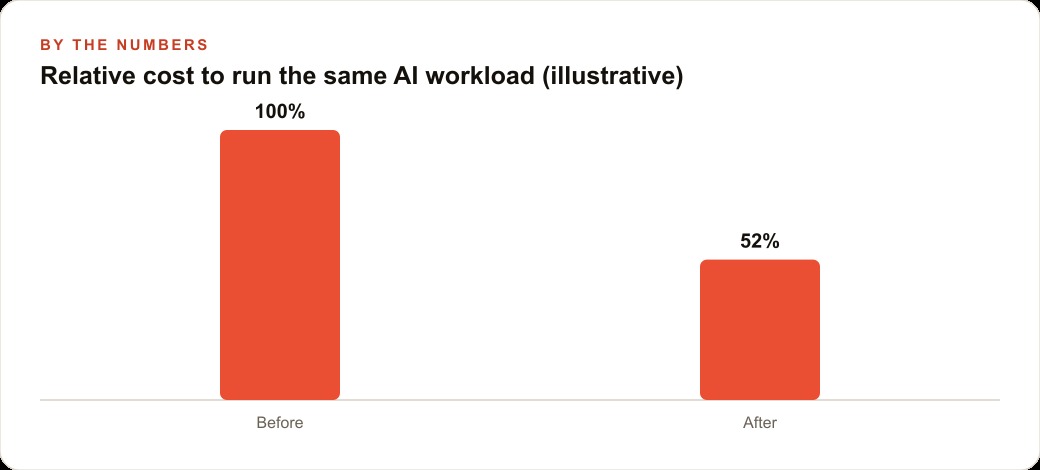
TurboQuant is a Google compression method that cuts AI memory use by at least 6x and runs up to 8x faster with no measurable accuracy loss. For a business it lands as roughly half the cost of running AI, which is why even non-technical owners should care about where this is heading.

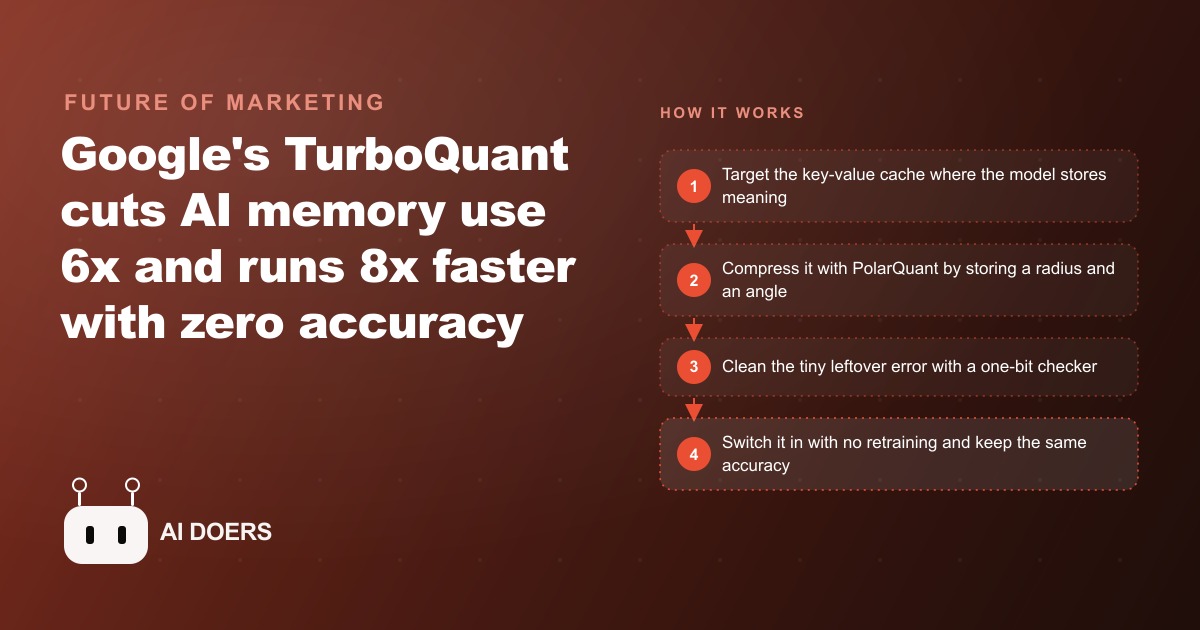
Compression is supposed to be a trade. A JPEG gives up a little sharpness to shrink a photo. So when a research team claims it can cut the memory an AI model needs by at least six times and run it up to eight times faster with zero accuracy loss, the honest first reaction is suspicion, because that combination breaks the usual rule. TurboQuant, a compression method from Google, is exactly that claim, and it is worth taking apart carefully, because underneath the math is a very simple business consequence: running AI is about to get a lot cheaper for the same quality of output.
I am Madhuranjan Kumar, and I want to translate this out of the research framing and into something an owner can use, without pretending the technical part does not matter. Understanding roughly how TurboQuant works is what lets you see why it is durable rather than hype, and why even a non-technical business should care about where it points. This piece pulls the idea apart along its real seams: the part of the model it targets, the two techniques that do the work, why the accuracy stays intact, what it was tested on, and what the whole thing means once it reaches the tools you already pay for.
The target: the memory a model keeps while it reads
Start with what TurboQuant actually squeezes, because that is the key to everything else. When a transformer reads text, it stores the meaning of each word in something called the key-value cache. Think of it as labeled folders the model pulls off a shelf instead of rereading the whole text from scratch every time it needs context. That cache is what lets a model hold a long conversation or a big document in mind. It is also heavy, and its weight is what drives memory use and cost, especially as the context gets longer.
This is the crucial insight for a non-technical reader: the expensive part of running a model is often not the thinking, it is the remembering. The longer the document, the bigger the codebase, the longer the chat history, the more that cache balloons and the more it costs to hold. TurboQuant goes straight at that cache, which is why its savings show up on real workloads rather than in a benchmark that has nothing to do with how businesses actually use these models.
The first technique: pointing with an arrow instead of stepping
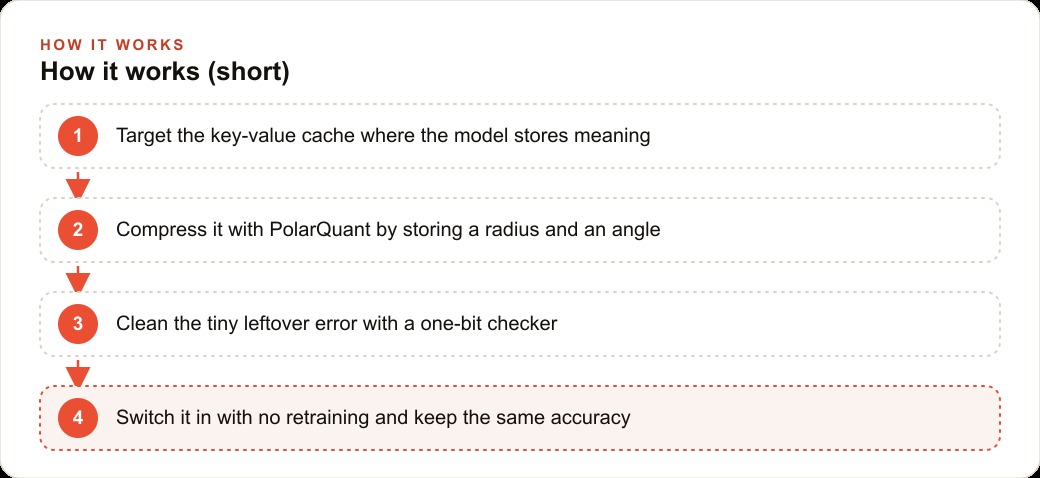
The heavy lifting comes from a method called PolarQuant, and the cleanest way to understand it is through directions. Traditional compression stores each memory vector as step-by-step coordinates, the equivalent of saying go three blocks east, then four blocks north. PolarQuant instead stores an arrow: go five blocks at a 37-degree angle. It keeps a radius for how strong the value is and an angle for which direction it points, and that polar form is far more compact than the block-by-block version.
The reason this works so well is a quiet detail about the data itself. The pattern of angles in these vectors turns out to be known and concentrated, not random. Because the angles cluster in predictable ways, the model can map the data onto a fixed circular grid with known edges. That single fact removes the expensive normalization step that older compression methods have to carry, the costly work of figuring out the boundaries of the data every time. PolarQuant already knows roughly where everything will land, so it skips the survey and goes straight to storing the arrow. That is a large part of where the speed comes from.
The second technique: a one-bit error checker
Compression this aggressive always leaves a tiny residue of error, and that residue is normally where accuracy quietly bleeds away. TurboQuant's second pillar is what prevents that. It uses a quantized version of a well-known technique called the Johnson-Lindenstrauss transform, and its whole job is to clean up the small error PolarQuant leaves behind. The remarkable part is how cheaply it does it: the error checker spends just one bit to correct the leftover mistake.
This is the piece that makes the zero-accuracy-loss claim credible rather than marketing. It is not that the compression is lossless in the way a zip file is. It is that the compression is aggressive and then a very cheap correction step mops up the tiny error before it can accumulate into a wrong answer. One technique does the shrinking, the other guards the accuracy, and together they let the method compress hard without the model getting dumber. Understanding that two-part structure is what separates believing the claim from taking it on faith.
Why the results hold up: tested on real models and real hardware
Claims like this live or die on how they were tested, so the testing detail matters. TurboQuant was run on real open models, including Gemma, Mistral, and Llama, on NVIDIA H100 GPUs, the actual hardware that businesses and labs use in production. Those real runs, not a toy simulation, produced the six-times memory reduction and the eight-times speedup, measured on demanding meaning-retrieval tasks where the model has to find a specific fact buried in a long context.
That last point is worth dwelling on. The hardest thing for a compressed cache to preserve is the ability to still find one small fact in a large amount of context, the needle-in-a-haystack case. Holding up there is exactly the test that would expose a method that only looks good on easy inputs. Passing it on multiple real models and on production GPUs is what turns this from an interesting paper into something you can expect to reach real tools.
What it means once it reaches your bill
Here is the translation for a business. For a company running models at scale, the estimated saving is around fifty percent, and it applies to every prompt, every API call, and every agent workflow, with no retraining or fine-tuning required. You switch it in and the model behaves the same while costing roughly half as much. It also lifts a real ceiling, because a lighter cache means models that were capped by hardware can now handle longer context on the same chips, which translates to larger documents, bigger codebases, and longer conversation histories without buying new hardware.
The businesses that gain are not only AI labs. They are any operation where the cost or the context limit of AI was the thing holding back a project that would otherwise pay off. Take a gym as an illustration. Say the owner wants an assistant that reads every member's check-in history, workout logs, and class attendance, then writes a personalized monthly progress note and flags anyone whose visits are dropping off before they quietly cancel. A month ago, running that across a few thousand members on long histories would have been expensive enough to shelve. With inference cost cut by roughly half and longer context on the same hardware, the same project becomes affordable, because the assistant can hold a member's full year of activity in one pass instead of being trimmed to save money. The gym owner never touches TurboQuant; the platforms the gym already pays for absorb it, and the bill for AI features quietly drops while what those features can handle quietly grows. Those retention notes can flow into the gym's CRM and website stack so the outreach sends itself, and the freed budget can go toward the Facebook and Instagram ad campaigns that bring the next cohort of members in.
The market's wrong instinct, and the right one
When the news hit, memory chip stocks dropped, with several major suppliers falling anywhere from three to six percent in a single move. The market read a memory-saving breakthrough as falling demand for memory chips, which is an intuitive but probably backwards reaction. The counterpoint is Jevons paradox: when a resource gets cheaper, people invent more uses for it, and total demand often rises rather than falls. Cheaper inference unlocks weirder and more numerous use cases, so the demand for GPUs and memory may climb rather than drop. The projects everyone parked as too expensive come back onto the table all at once, and that new appetite has to run on hardware.
There is a strategic footnote worth noticing too. Google chose to publish TurboQuant rather than hoard it, the same way it published the original transformer research that much of the current industry is built on. A remarkable amount of today's AI landscape exists in part because Google keeps releasing this kind of work into the open, and TurboQuant is another entry in that pattern.
The facet worth internalizing: the cost of AI is falling structurally
It is easy to read a story like this as a one-off headline and move on, but the more useful reading is as one data point in a steady trend. The cost of running AI has been dropping for a while, through better hardware, more efficient models, and now methods like this that attack the memory bottleneck directly. TurboQuant is notable because of the size of the jump and the zero-accuracy-loss claim, but the direction it points is the same direction the whole field has been moving: the same capability, cheaper, every few months.
For a business, internalizing that trend is worth more than understanding any single breakthrough. It means that any AI project you evaluate today has a shelf life on its price tag. Something that is marginally too expensive to justify right now may well be comfortably affordable in a year, not because you did anything, but because the cost curve kept falling underneath it. That reframes how you should plan, because the question stops being can I afford this now and becomes when does this cross into affordable, and am I ready to move when it does.
Reading the second-order effects
The chip-stock reaction is a useful lesson in how easy it is to read a technology story backwards. The intuitive response, cheaper memory means less memory demand, feels obvious and is probably wrong, because history keeps showing that cheaper resources get used more, not less. When inference gets cheaper, the projects that were parked as too expensive all come back at once, and that new wave of usage has to run on real hardware. The people who panicked about falling demand may be watching the setup for a surge in demand.
The strategic footnote about Google publishing the method rather than hoarding it points at the same dynamic from a different angle. Openly published research accelerates the whole field, which lowers costs faster, which unlocks more use cases, which drives more usage. For an owner, the takeaway is not to track every paper. It is to understand that you are operating inside a system that keeps making your AI options cheaper and more capable, and to build a habit of revisiting your shelved ideas on a regular schedule so you catch the moment each one becomes worth doing.
The move for a non-technical owner
You do not install TurboQuant yourself, and you should not try. The realistic response is to treat falling inference cost as a planning signal. Make a short list of the one or two AI ideas you shelved because they were too expensive or needed too much context, and put them back on the table, because the economics that blocked them are shifting underneath you. Then watch your existing tools, since the platforms you already use will adopt efficiency gains like this and pass some of it through in lower prices or higher limits. Those cheaper capabilities also make previously marginal projects worth building, whether that is content that feeds SEO and organic search at scale or an assistant that finally handles your full customer history.
You can track this yourself and reprice your shelved ideas as costs fall. If you would rather have someone audit where AI is worth deploying in your business now that it is cheaper, and build the one project that pays back first, that is the kind of work I do for clients, and you can bring me in to handle it. The technical breakthrough belongs to the researchers. The opportunity belongs to whoever notices, first, that the projects they gave up on just got affordable.
That is exactly what we do at AI DOERS. Book a private 30-minute call with Madhuranjan Kumar and we will map the fastest path to it for your specific business.
Book your call →
Madhuranjan Kumar
Madhuranjan Kumar brings 20 years of performance-marketing experience and has managed over $200 million in Facebook ad spend for brands across the United States and beyond. His expertise spans the full modern marketing stack: Meta, Google Ads, TikTok, email automation, CRM, and the websites that hold it together. At AI DOERS he turns that track record into lead-generation systems for businesses across every industry.