
Google's AI Firehose Week, Anthropic's Price Hike, and China's Open Giant
In a single week Google bundled video, music, and avatars into one editor and previewed an AI Gmail inbox, Anthropic teased a flagship Opus model while quietly raising agent costs, and China shipped GLM-5.1, a 754 billion parameter open model nearly matching Opus on coding. Here is what actually matters for your business.

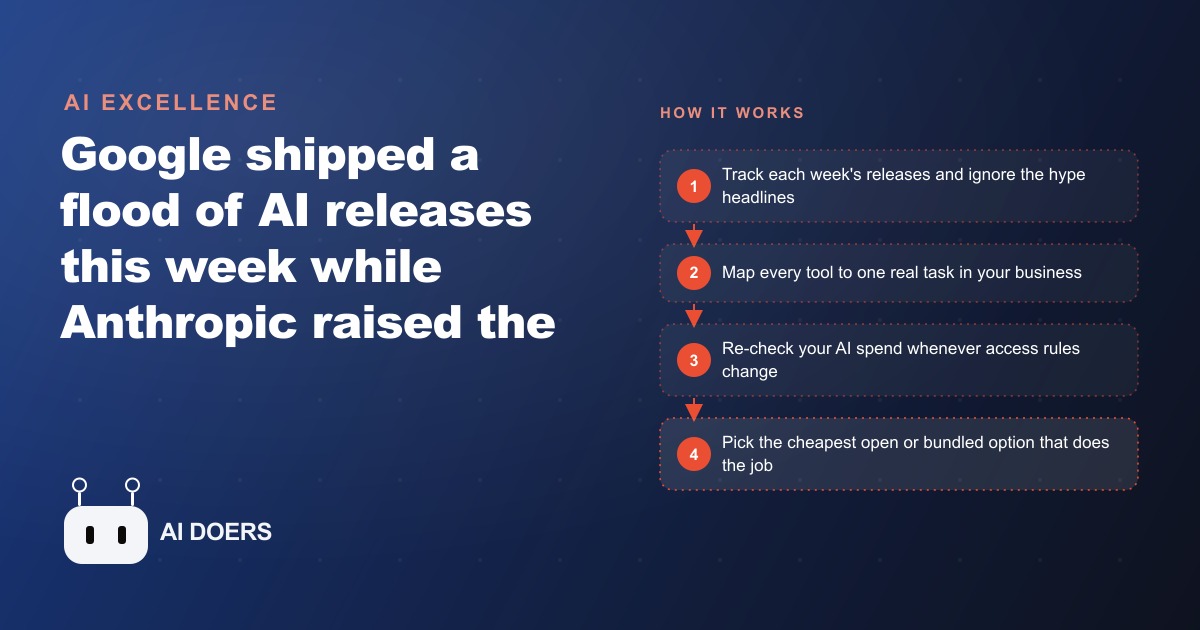
Eleven AI releases in one week. Three major announcements from Anthropic. New models from Google and Microsoft. Open-source releases from China with parameter counts large enough to generate headlines. Gmail AI for top-tier users. Video avatars joining calls. A research note about plain text knowledge bases. A subscription price change that affects hundreds of thousands of existing users.
If you read all of it and tried to act on any of it, you made your business worse this week, not better.
Madhuranjan Kumar has watched this pattern across the businesses he advises. The weekly AI news cycle is one of the most expensive habits a small-operation owner can develop. Not expensive in money. Expensive in attention, which is the resource that actually constrains small-operation output. A week like the one just described is not an opportunity to improve your business. It is an obstacle to improving your business dressed up as an opportunity.
The businesses winning with AI right now are not the ones who responded to every announcement. They are the ones who picked one working tool, integrated it into something that generates real output, and ignored everything else until that first tool was paying back its cost every single week.
The AI news cycle is optimized for urgency, not for your business needs
Every AI release is announced as a breakthrough. Every benchmark score is the best ever on that particular test. Every new feature is described in terms of what it makes possible, not what it makes necessary. The language is optimized to create urgency: adopt now, or fall behind the companies that did.
That framing is correct for one audience: enterprise technology buyers who evaluate platforms on multi-year contracts, have dedicated AI adoption teams, and face real competitive disadvantage from missing a product cycle. For that audience, tracking every release and evaluating it against an existing technology stack is part of the job description.
For a three-person HVAC operation, a five-person accounting firm, or a solo legal practice, that framing creates urgency that does not correspond to any real competitive threat. Your competitor in your service area is not adopting Anthropic's latest model this week. Your customer is not switching providers because you have not integrated Gmail AI. The urgency is manufactured for an audience that is not you.
The cost of chasing the cycle is not the time you spend reading about releases. It is the time you spend evaluating tools that are not relevant to your actual workflow, setting up accounts for products you will use once and abandon, and explaining to your team why the tool you introduced last month is being replaced by the one announced this week. That cost is invisible because it never appears in a budget line. It appears in the hours that should have gone to client work, customer follow-up, or the one AI tool you already have that is not yet producing consistent results because you have not finished setting it up properly.
There is also a second-order cost that is harder to see: the team's tolerance for new tool introductions decreases each time a tool is abandoned before it reaches value. After three or four incomplete implementations, the associates, dispatchers, or staff who are asked to learn the next tool bring skepticism that makes the next adoption harder. The news cycle does not just consume your attention. It consumes your team's willingness to adopt new things.
The Anthropic subscription price change is the only story from this week that requires an immediate decision
Out of eleven announcements in one week, one requires a business decision. Anthropic's move to restrict Claude subscription access through third-party agents like Open Claude means that a specific workflow, using Claude through a third-party interface at the existing subscription price, is ending. If you are using that workflow, you need to decide whether to pay the higher direct-access price, find an alternative model, or redesign the workflow around a different tool.
That is a real decision with a real cost implication. The math is not complicated: calculate whether the workflow's documented value justifies the new price, and if not, identify the alternative. That decision takes 30 minutes and produces a clear answer.
The other ten stories do not require an immediate decision. The Karpathy plain-text knowledge base is a method, not a product. You can implement it whenever it becomes relevant to your operation. The Gmail AI inbox sorting is a feature you will receive automatically if you are on the relevant subscription tier. This breakdown avatars are interesting but do not affect any existing workflow for a small operation this week. The open-source Chinese model at 754 billion parameters is significant for large enterprise teams evaluating self-hosted infrastructure. It is not relevant this week for a business that does not self-host models.
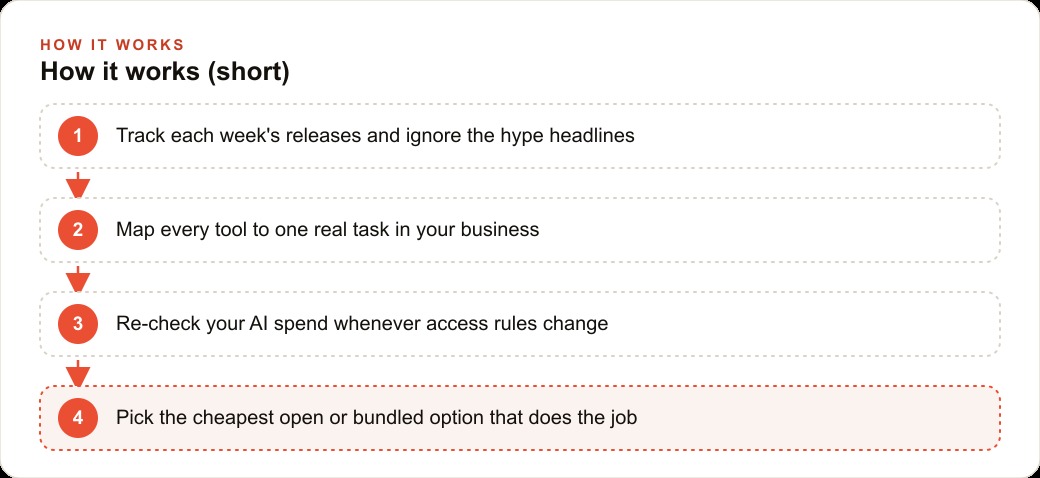
The practice of reading every announcement as if it requires a response creates the feeling that your to-do list is always expanding. Most AI announcements require no immediate response from a small operation. Sorting them into "requires a decision now," "might be relevant later," and "not relevant to this business" is a five-minute exercise that saves hours of distraction and prevents the adoption of tools that are not yet ready for your use case.
The Karpathy plain-text knowledge base is worth more attention than every flashy video release
The plain-text knowledge base approach did not make many headlines relative to this breakdown avatar announcements and the benchmark scores this week. That ratio is exactly backward for a small-operation owner trying to use AI productively.
The approach is straightforward: instead of using a complex retrieval system, a vector database, or a sophisticated retrieval-augmented architecture, you organize your business knowledge as plain text files and load them directly into a long-context model when you need them. Your standard operating procedures, your product specifications, your pricing rules, your frequently asked customer questions, your warranty and parts reference information: all of it in plain text, structured in a way the model can read and use.
For small operations, this approach is more useful than complex retrieval systems for a specific reason. Retrieval systems pull the most relevant chunks of a knowledge base and feed them to the model. That works well when your knowledge base is large enough that loading all of it would exceed the model's context limit. Most small operations do not have knowledge bases that large. Their relevant operational knowledge fits comfortably in a few thousand words. Loading all of it directly gives the model access to full context rather than only the chunks that matched the retrieval query, which is where retrieval systems introduce their characteristic failure mode: the relevant information that was not retrieved because the query did not match it closely enough.
The practical application for a single-trade contractor is immediate. A plain-text document with every part number the company regularly installs, the compatible system models for each part, the warranty terms, and the standard labor time for each installation creates a reference the model can use to answer dispatcher questions in seconds. Not retrieve from, not search through: use directly, because the full document is in its context window.
That capability is more valuable than a video avatar joining a customer call or an AI email sorter for a subscription tier you may not be on. The avatar and the sorter are tools in search of a workflow to fit into. The plain-text knowledge base solves a workflow problem every small operation already has: employees spending time looking up information they need to do their jobs. The solution to that problem is not a new tool. It is a new way of organizing information you already have.
One working tool used every day beats ten tools sampled once
The attention cost of chasing new releases is not just the hours spent reading announcements. It is the opportunity cost of not finishing the implementation of the tool that is already working at 60 percent of its potential.
Every AI tool goes through a ramp period before it produces consistent value. The ramp period includes writing prompts that work reliably for your specific inputs, training your team to use the tool consistently, identifying which parts of your workflow benefit from the tool and which do not, and building the feedback loop that catches when the tool produces incorrect output. That ramp period takes weeks, not days. It requires concentrated attention from whoever is responsible for the implementation, not occasional check-ins between announcement reading.
When a new announcement redirects that attention to a different tool, the ramp on the existing tool stalls. The existing tool continues producing results at whatever level it reached before the distraction. The new tool gets a trial that is too short to reveal its full capability or its actual limitations. Neither tool reaches its potential. Both are eventually abandoned when the next announcement cycle begins.
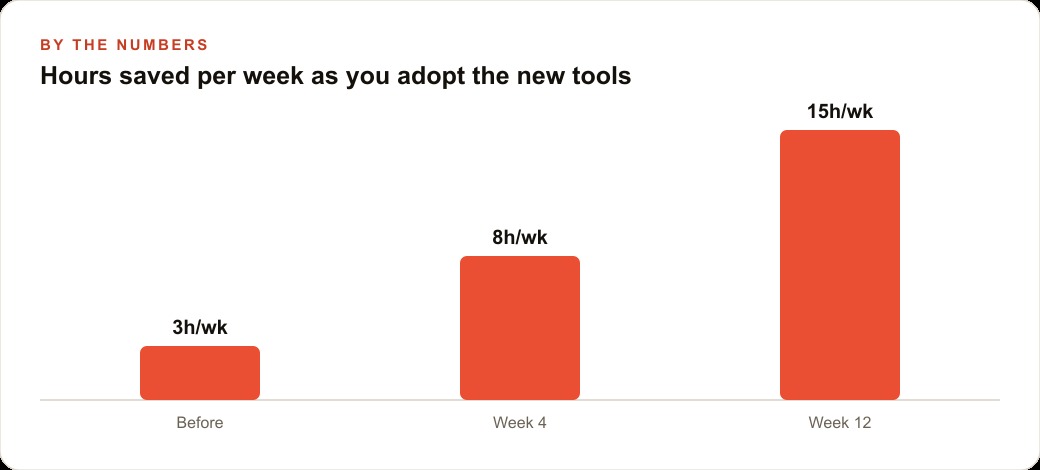
The businesses that have extracted the most value from AI tools in the past two years are overwhelmingly the ones that made a deliberate decision to finish one implementation before starting the next. They used the same tool every day for months. They found its failure modes and worked around them. They built their prompts to a point where the output required minimal editing. They reached a place where the tool was saving real hours every week before they evaluated what to do next.
That approach produces compounding returns because each tool that reaches mature implementation frees up capacity for the next one. A team that has never finished implementing a tool is perpetually in the ramp period, perpetually extracting only a fraction of what any tool can provide, and perpetually convinced that the problem is the tool rather than the incomplete implementation.
What the right AI week debrief actually looks like for a small operation
The HVAC company in this example tried to adopt three tools from one announcement cycle. The owner read about the Gmail AI inbox, this breakdown avatar for customer-facing calls, and a new scheduling assistant that was released the same week. All three looked relevant to the business. All three got trial accounts created on the same day. All three had introductory sessions with the team during the following week. None of them were in production use two weeks later.
The Gmail AI was available on a subscription tier the company was not on. Upgrading would cost $30 more per user per month. This breakdown avatar created setup friction that the company's tablet hardware could not handle reliably in the field. The scheduling assistant required an integration with the existing dispatch software that the company did not have the technical capacity to configure without outside help.
Three hours of the owner's time and two team training sessions produced no operational change.
Meanwhile, the tool the company had been using for six weeks to generate follow-up emails after service calls was producing results that were 70 percent of their potential. The email templates still used generic seasonal language rather than the specific maintenance language the owner had identified as resonating with the customer base. The prompts had not been updated since the initial setup. The tool was working, but it had not been optimized.
The owner spent three hours on tools that did not fit the operation, and did not spend three hours finishing the optimization of the one that was already working.
After that review, the approach changed. The owner implemented one update: a plain-text reference document with the company's four most common seasonal maintenance talking points, loaded into each follow-up email prompt. The email quality changed immediately. Customer replies to the emails increased. Two replies in the following week turned into booked service calls, generating revenue that was directly traceable to the prompt update.
The right AI week debrief for a small operation is three questions. Does anything announced this week require an immediate decision about an existing tool or subscription? Is there any method or approach in this week's news that applies directly to a workflow problem I already have and have not solved? And what is the next specific improvement to the tool I am already using that would produce a measurable result this week?
Those three questions take twenty minutes to answer honestly. Everything else in the announcement cycle can wait, or not be read at all. The businesses that understand this are not behind. They are using the time everyone else spent on eleven tool evaluations to finish the implementation of the one tool that is already in their workflow and already producing value that has not yet been fully captured.
That is exactly what we do at AI DOERS. Book a private 30-minute call with Madhuranjan Kumar and we will map the fastest path to it for your specific business.
Book your call →
Madhuranjan Kumar
Madhuranjan Kumar brings 20 years of performance-marketing experience and has managed over $200 million in Facebook ad spend for brands across the United States and beyond. His expertise spans the full modern marketing stack: Meta, Google Ads, TikTok, email automation, CRM, and the websites that hold it together. At AI DOERS he turns that track record into lead-generation systems for businesses across every industry.