
Google's 9-Hour Prompt Engineering Course, Distilled to What Works
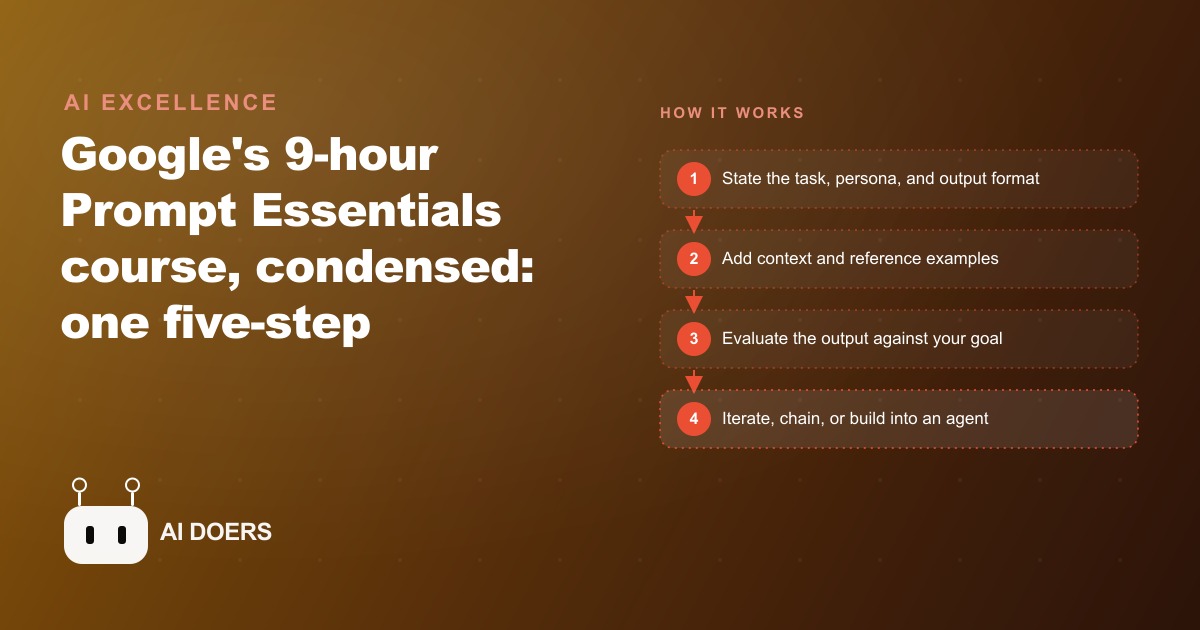
Google's Prompt Essentials course reduces to one repeatable five-step framework you can run every time. I will break it down and show how a law firm would actually put it to work.

A law office was drowning in the same problem every busy firm has: two paralegals asked an AI the same question and got two completely different answers, one usable and one useless. That single inconsistency is the story of this walkthrough, and fixing it took nothing more exotic than one five step framework pulled from a nine hour course, applied with discipline over about twelve weeks. Let me tell you exactly how that transformation went, chapter by chapter, because the framework only proves itself when you watch it land in a real business.
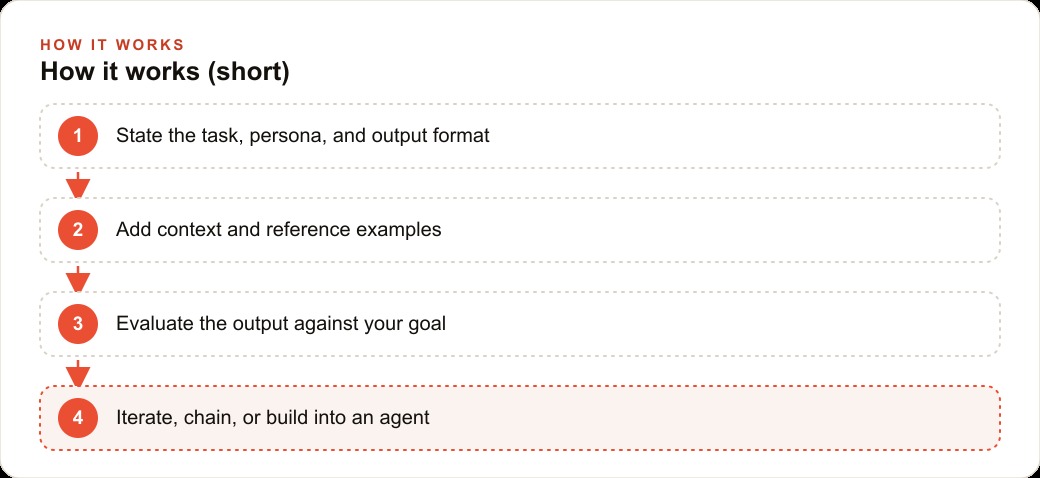
I am Madhuranjan Kumar, and I sat through Google's entire Prompt Essentials course so a business owner would not have to. The honest headline is that the framework is the course. Everything in those nine hours is a variation on five moves: Task, Context, References, Evaluate, Iterate. What follows is how a small family law and estate planning practice went from lucky prompting to reliable prompting using only those five, and the numbers, framed as illustrative, that came with it.
Week one: the baseline was chaos
When I first looked at how the firm used AI, there was no system at all. Whoever needed a document typed something like summarize this into whatever tool was open, accepted whatever came back, and edited heavily. The output quality swung wildly. A senior paralegal got decent drafts because she instinctively added detail. A newer hire got generic mush because he typed three word requests. Nobody could reproduce anyone else's results.
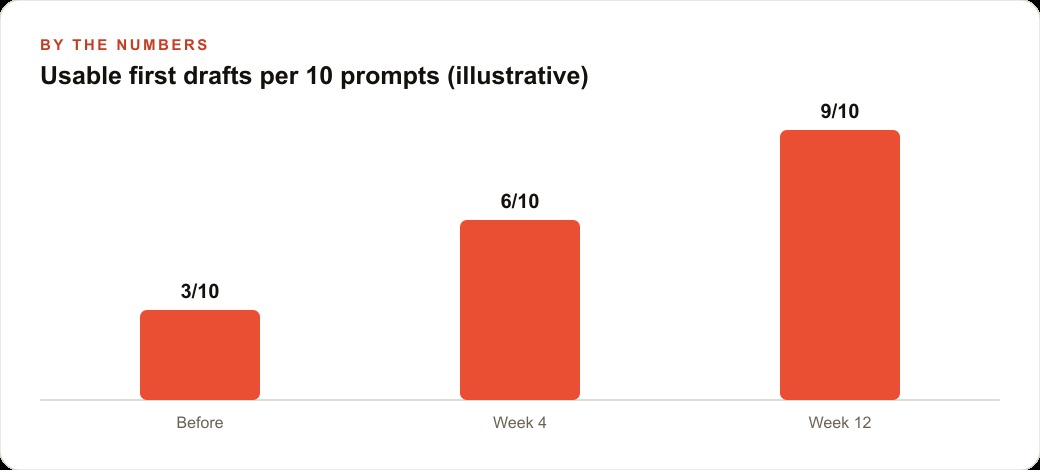
I measured a rough baseline before changing anything. Out of every ten AI prompts the team ran, only about three produced a first draft good enough to build on. The other seven were either too generic, wrong in tone, or missing the firm's house style so completely that starting from a blank page would have been faster. That three in ten number is the before figure, and it is the thing the framework had to move.
Week two: the task and the two free upgrades
We started at the foundation, the task, which is simply what you want the model to do stated plainly. A bare task gets you a mediocre answer because the model has to guess at everything you left out. The first real lesson landed the moment we added two things on top of every task: a persona and an output format.
For the firm, the persona became a standing default. Instead of draft a client update, the prompt became act as an experienced paralegal drafting a plain English client update letter. Then the format: as a formal letter with headed sections. That is it. Two clauses. The same request that used to return a shapeless paragraph now returned a structured letter in the firm's register. A persona narrows the model to the right slice of its knowledge, and a named format removes the guesswork about how the answer should be shaped. Within a week the newer hire's output was nearly as good as the senior paralegal's, because the framework carried the judgment he had not developed yet. By the end of week two the usable draft rate had climbed from three in ten toward six in ten just from that one habit.
Week four: context and reference examples did the heavy lifting
The next chapter was context, and the rule of thumb Google teaches is blunt: the more relevant detail you give, the better the result. We built context into the firm's prompt template so it always carried the matter type, the key dates, and the goal behind the request. A generic letter became a letter about this specific probate matter with these specific deadlines.
Then came references, which turned out to be the biggest single lever for this firm. Sometimes a sample shows what you want far better than any description, and these models are excellent at copying a pattern you hand them. So we took three client letters the partners already loved and pasted one into the prompt as a reference every time. If you want a letter to read a certain way, paste a letter that already reads that way. The tone matching went from approximate to uncanny. This is where the firm crossed a threshold: the drafts stopped needing a rewrite and started needing only a light edit. At the four week mark the usable first draft rate sat at roughly six in ten, double the baseline, and the character of the editing had changed from rebuilding to polishing.
Week six: evaluate and iterate, the steps everyone skips
Here is the chapter most teams never reach, and it is the one that mattered most. The last two moves, evaluate and iterate, are the ones people skip and the ones that separate lucky prompting from reliable prompting. Prompting is circular, not one and done. The first answer is a starting point, not the finish line.
We built a rule into the firm's workflow: read the output against what you actually wanted before you accept it, and if it misses, apply one of four fixes rather than starting over. Revisit the framework and add more context or sharpen the persona. Break the prompt into shorter sentences so the model handles one instruction at a time. Try different or analogous phrasing. Or add a hard constraint, like a jurisdiction or a length limit, to narrow a vague request. We kept a shared note of which fix unstuck which kind of prompt, so the whole team learned the same shortcuts instead of each person rediscovering them. Most stuck prompts came unstuck with one of those four, and the note meant the second person to hit a problem solved it in seconds.
Week eight: templates turned a skill into a system
By now the individual prompts were strong, but the real business win was making them repeatable. The framework is not about clever one off prompts, it is about repeatable prompting you can teach a whole team so that two people asking for the same thing get the same quality back. That was the firm's original pain, and this is where it got solved.
We saved the best prompts as reusable templates in a shared document: the client update letter, the intake summary, the discovery checklist, the routine client email. Each one carried the persona, the format, the context slots, and a reference example baked in. New work meant filling in the blanks, not composing from scratch. The two paralegals who once produced wildly different results now produced matching quality, because they were running the same five step structure through the same templates. This is the quiet payoff of the framework: it is a way to bottle judgment and pour it out consistently.
Week ten: chaining and an intake agent
With the basics locked, we reached for the advanced layer, which extends the same five steps rather than replacing them. Prompt chaining feeds one output into the next, building complexity in stages instead of demanding everything in one overloaded request. For the firm, one prompt summarized a long matter file, the next drafted the client letter from that summary, and a third turned the letter into a short status email. Three clean steps, each verifiable, instead of one giant ask that half worked.
We also built a small agent, which is just the framework packaged with a persona, rich context, an interaction style, a stop phrase, and a feedback step. The firm's version role played a nervous client so a junior associate could practice intake calls, ended on a stop phrase, and then critiqued the associate's questions afterward. Chain of thought helped here too: adding explain your thought process exposed the model's reasoning so a supervisor could catch a wrong turn before it reached anyone. For the genuinely knotty questions, tree of thought explored several reasoning branches at once. None of this was a new skill. It was the same five moves, stacked.
Week twelve: the numbers and the guardrail
By the twelve week mark the firm's usable first draft rate had reached about nine in ten, up from three in ten at the start. Frame those as illustrative, but the shape is what matters: the framework roughly tripled the rate at which the first AI draft was good enough to build on, and it collapsed the variance between team members. The senior paralegal and the newest hire now produced interchangeable quality on templated work.
One guardrail rode along the entire twelve weeks and never came off. Models hallucinate wrong answers and inherit bias from their training data, so every single output passed a lawyer's review before it touched a real client, and privileged details stayed out of public tools entirely. That human in the loop discipline is not optional friction, it is the thing that makes the speed safe. This kind of consistent, well governed output is also exactly what feeds a stronger marketing operation, since the same clarity that improves a client letter improves the copy behind Facebook and Instagram ad campaigns and the pages that carry SEO and organic search, and it keeps the intake replies flowing cleanly through the firm's CRM and website stack.
What the twelve weeks changed about the firm itself
The most interesting result was not the drafts, it was what happened to the people. Before the framework, AI skill in the firm was tacit and unevenly distributed, locked in the head of whoever had a knack for it. After twelve weeks it was explicit, written down as templates, and teachable to the next hire in an afternoon. That is a durable asset. When a new paralegal joined near the end of the experiment, they were producing house style drafts by the end of their first week, not because they were talented at prompting but because the firm had turned prompting into a documented process anyone could run.
That shift also changed how the partners thought about capacity. The bottleneck in a small firm is almost always attorney and paralegal time, and time spent rebuilding an AI draft from scratch is pure waste. By roughly tripling the rate at which the first draft was usable, the framework did not just speed up individual tasks, it freed hours that flowed back into billable work and into taking on matters the firm would previously have turned away. None of that required new headcount or new software. It required treating prompting as a process rather than a party trick.
There is a broader point here that applies beyond law. Most businesses adopt AI as a scattering of individual habits, where each person prompts their own way and quality swings wildly. The firms and shops that actually compound their advantage are the ones that standardize, that write down the prompts that work, that build the review step in from day one, and that teach the whole team the same five moves. The tool is commodity and available to everyone. The process discipline around it is the moat, and it is entirely within a small business owner's control to build.
It is worth naming what did not change, too, because it explains why the human in the loop rule never came off. The framework made the drafts far better, but it did not make the model trustworthy on its own. It still occasionally invented a citation, softened a deadline, or produced a confident sentence that was subtly wrong on the law, and any of those reaching a client unchecked would have cost the firm more than the whole experiment saved. So the review step was not a grudging concession to caution, it was the load bearing part of the process. The lesson the partners took away was that the framework buys you speed and consistency, and the human review buys you safety, and you do not get to skip either one. A small business in any regulated or reputation sensitive field should read that the same way: the prompting discipline and the verification discipline are two halves of one system, and dropping the second to move faster is how a time saving tool turns into a liability.
What the walkthrough proves
None of this was exotic. It was Task, Context, References, Evaluate, Iterate, applied with discipline, plus a human checking the work. The firm did not need a data scientist or a paid course. It needed to stop treating prompting as a lucky guess and start treating it as a repeatable process anyone can run. The point is repeatable prompting, not lucky prompting. A framework you can run every time beats a clever one off you cannot reproduce.
You can roll this out yourself with a free afternoon and a shared document of templates, and you will feel the difference within the first week. If you would rather have the templates written, the review process built, and a couple of working agents tuned to your business, you can do it yourself or bring in an expert to set it up, and that is the kind of setup I do for clients.
That is exactly what we do at AI DOERS. Book a private 30-minute call with Madhuranjan Kumar and we will map the fastest path to it for your specific business.
Book your call →
Madhuranjan Kumar
Madhuranjan Kumar brings 20 years of performance-marketing experience and has managed over $200 million in Facebook ad spend for brands across the United States and beyond. His expertise spans the full modern marketing stack: Meta, Google Ads, TikTok, email automation, CRM, and the websites that hold it together. At AI DOERS he turns that track record into lead-generation systems for businesses across every industry.