
Google's Agentic Era: Distribution Is the Real Weapon
Google made agents native across search, Gmail, YouTube, and a Universal Cart, all riding a user base near 900 million. Here is what that means for a business and how a med spa can win in an answer-driven search.

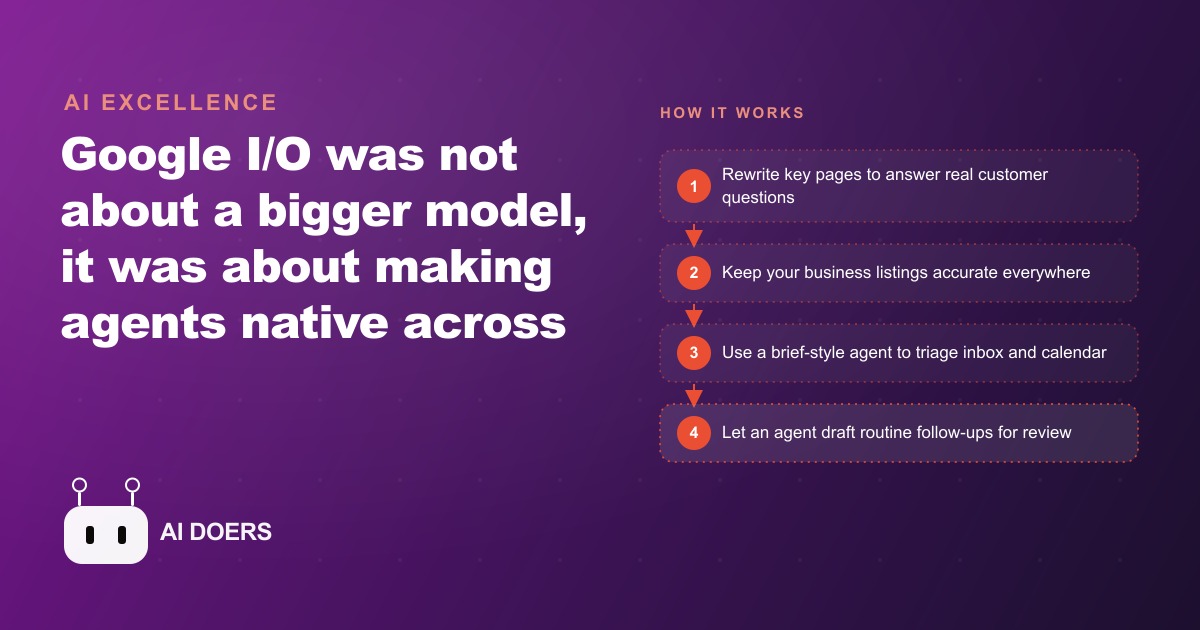
Google I/O was not about a bigger model. The headline Gemini release that many people expected did not appear, and what appeared instead was a strategy: embed AI agents into every product Google already owns and let distribution do the work that model capability alone cannot. I am Madhuranjan Kumar, and what I want to walk through is the practical playbook for a business adapting to this shift, because the move Google made this week has direct operational implications for how you attract customers and run daily operations.
Audit your most-visited pages for answer-readiness before the search shift arrives
The most consequential thing Google shipped at I/O was not a new model. It was the confirmation that AI mode in search, now running on Gemini 3.5 Flash, is changing what a search result looks like. Instead of ten blue links, it generates answers directly on the results page, and it pulls those answers from the content it judges most trustworthy and most clearly structured.
For a business that depends on organic search traffic, this is a structural change to how you get found. The question is not how to rank higher in the old list of links. The question is how to become the source that the AI cites when it generates an answer for a query in your category. That is a different discipline, and it requires a different kind of content.
The practical audit starts with the questions your customers actually ask. What does this treatment cost? Who is this service for? What happens at the first appointment? How long does it take? For each question, check whether your current website answers it directly, clearly, and in a way that does not require the reader to navigate or infer. The AI that reads your page to generate a search answer is looking for a clear question and a clear answer, not a marketing page with the answer buried in paragraph eight.
Fixing this is a content task, not a technical one. For each important customer question, write a direct answer at the top of the relevant section. Use the question itself as a subheading. Provide the specific detail the customer needs without requiring them to read the whole page first. This structure serves human readers and AI-powered search results equally well, and it is the most durable investment you can make in your search visibility as AI mode rolls out more broadly.
For businesses investing in SEO and organic content, this is the work to prioritize right now. The window where getting this right creates a significant advantage over competitors who have not adapted is shorter than most people expect.
Wire an agent into your inbox and calendar before your competitors do
The two Google products that land immediately for any business are Gemini Spark and Daily Brief. Spark is a personal agent that takes actions across Gmail, Docs, Sheets, and Slides around the clock, with open access to other apps through the MCP standard. Daily Brief is the lighter version: it reads your email, calendar, and tasks, then generates a short prioritized summary of what actually requires your attention today.
The business value of Daily Brief is not complicated to see. If your morning starts with opening an inbox and mentally sorting through forty messages to identify the five that need a response today, Daily Brief does that sorting for you. It takes the same set of inputs you would read anyway and returns the prioritized version in less time than it takes to open the email client. The output is a short, actionable list, not another thing to manage.
The workflow this supports most directly is customer follow-up. A business running Google Ads or Facebook and Instagram ad campaigns receives leads that need timely, consistent response. An agent that reads the morning's new inquiries and drafts consistent follow-up responses, which a human then reviews and sends, handles the response rate problem without requiring the owner to personally draft every message. The agent does the first draft; the owner handles the relationship.
Setting this up does not require technical expertise. It requires identifying the two or three daily email categories that consume the most time, describing them clearly to the agent, and verifying that the drafts the agent produces are accurate and appropriately toned before they go to customers. That verification step is important and non-optional; the agent draft is a starting point, not a final product.
Structure your product catalog for the Universal Cart, not just a search results page
Google's Universal Cart works as a single checkout across search, YouTube, Gmail, and major retailers including Nike, Target, Walmart, and Shopify. The practical consequence for a business selling products is that the point of discovery and the point of purchase are collapsing into the same interface. A customer who sees your product mentioned in a YouTube video or in a Gmail newsletter no longer has to navigate to your store. The cart is already present.
The preparation for this is catalog hygiene. Every product needs accurate, complete metadata: the exact name, the precise description, the correct category, the accurate price, the reliable inventory status. An AI agent assembling a shopping comparison or a purchase recommendation reads these fields and uses them to decide whether to include your product. A product with incomplete data or inconsistent naming across platforms gets excluded from the Universal Cart results not because it was judged and found wanting, but because the agent could not confidently identify what it is.
For businesses using Shopify or similar commerce platforms, this is a data quality task that has compounding returns. Clean catalog data serves the Universal Cart, serves Google Shopping, serves any comparison engine that reads structured product data, and serves the direct customer experience on your own site. A single investment in catalog quality improves outcomes across every surface where the product appears.
Build your content to be cited, not just clicked
The fourth shift that Google formalized this week is the Ask YouTube integration, which gives users structured answers from video content without watching this breakdown. Upload a video about your service, and a potential customer can ask a specific question about it and get the answer with a timestamp, without sitting through the full video to find it.
For a business producing video content, this changes what a well-produced video needs to contain. A video optimized for the old discovery model, with a strong thumbnail and the most interesting moment at the top, is still useful. But a video optimized for AI-mediated search and discovery needs to also be well-structured at the level of individual claims. Each specific question that a potential customer might ask should be answered clearly at a specific point in this breakdown, so the timestamp reference is accurate and the cited clip is directly responsive.
This is a longer-term content strategy adjustment, not a one-week task. But the direction is clear: content that was built to attract attention is now also being evaluated for its ability to answer specific questions accurately. The businesses that produce content with both in mind will see their material cited by AI assistants far more often than businesses still producing content primarily for click optimization.
The agent-to-agent infrastructure Google announced, including partnerships for agentic commerce and open MCP connectors, is the structural foundation for all of this. It means the agents running on Google's platform will increasingly be able to act across the web, not just within Google's own products. For a business, that means the interfaces where customers discover and evaluate you are multiplying, and the common thread across all of them is the same: content that answers questions clearly, catalog data that is accurate and complete, and a follow-up workflow that responds quickly because agents are handling the routine parts of that triage. You can build this yourself with focused effort over several weeks. If you want help restructuring your pages for answer-readiness, cleaning up your catalog for the Universal Cart, and wiring a draft-and-review workflow for customer follow-up, that is exactly the kind of setup that pays for itself in the first month. ## A concrete example: one med spa's response over four weeks
The business case for adapting to the agentic era is most concrete with a specific timeline. A med spa offering facial treatments, injectables, and laser services ran a four-week structured response to Google's agentic shift.
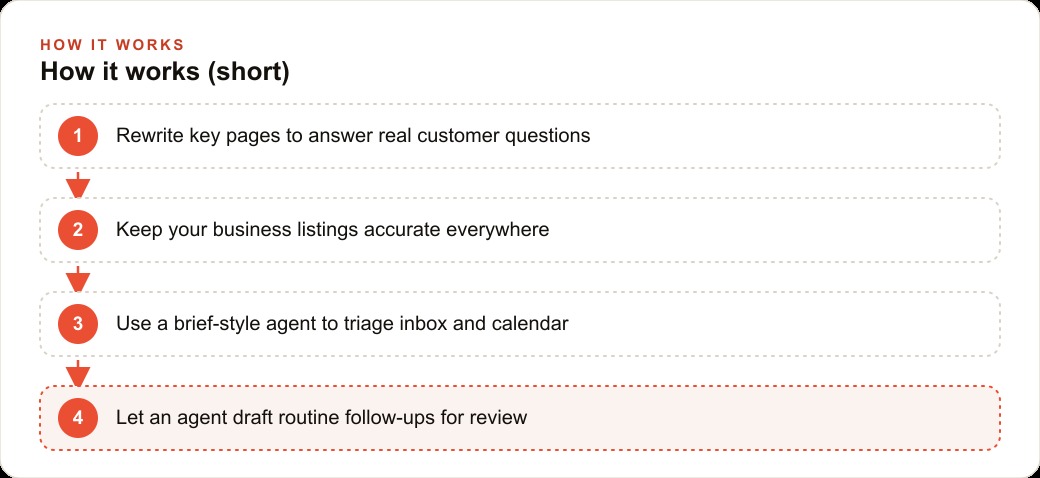
Week one was content and listing audit. The owner identified the five questions that incoming clients asked most often: what does this treatment cost, how long does recovery take, am I a good candidate, what results can I expect, and what is the difference between this and a similar treatment they had seen advertised. For each question, they rewrote the relevant page section to lead with a direct answer rather than a description of the service. Price ranges appeared at the top of each treatment page, not buried in a booking inquiry section. Recovery timelines appeared in plain bullet points at the start of the section, not in a FAQ at the bottom. Candidacy criteria appeared as a simple self-check list. The goal was that any AI reading the page could extract a clear answer to each common question without inference.
Week two was Google Business Profile cleanup. Every service was listed with current pricing, hours were confirmed as accurate, and the appointment booking link was tested and updated. Photos were refreshed with edited versions using Gemini image editing: the reception area, three treatment rooms, and the before-and-after gallery. The existing 47 reviews were responded to where they had not been, because AI-powered search considers review response engagement as a quality signal.
Week three was inbox and follow-up workflow. The owner set up a daily brief agent using an AI tool connected to her email. Each morning, the agent read the previous day's consultation inquiries and drafted a consistent first response for each one, which the front desk reviewed and sent. The draft quality was high enough that the review added about two minutes per message rather than the ten minutes that writing each response from scratch had required. For new Facebook and Instagram ad campaigns running simultaneously, the inquiry response time dropped from an average of four hours to under thirty minutes, which is the threshold that significantly improves lead conversion rates.
Week four was catalog and Universal Cart preparation. The spa's retail skincare products, a line of six items sold at the reception desk and through a basic e-commerce page, were updated with consistent product names, accurate descriptions, and pricing that matched across Google Shopping, the website, and the physical menu. Nothing was changed about the products. The data was made clean and consistent so the Universal Cart and any AI-powered comparison tool could represent them accurately.
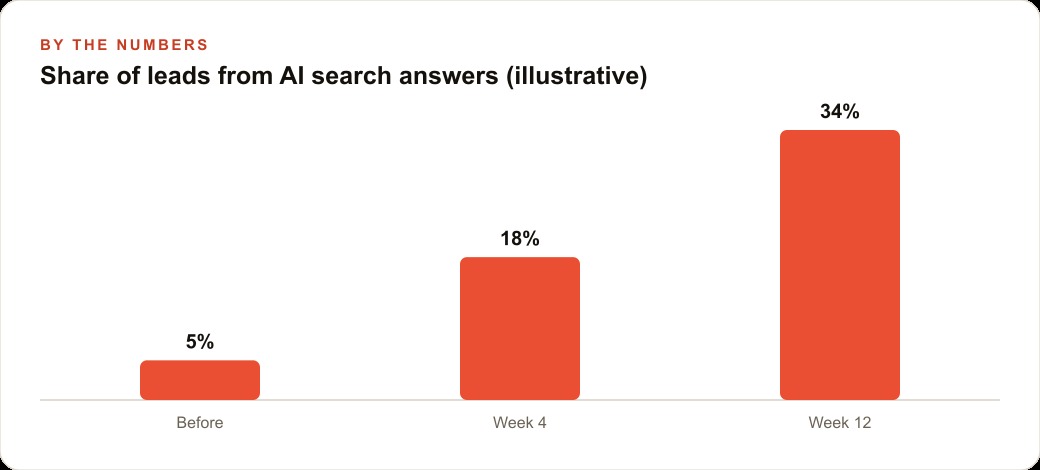
The four-week result was measurable. Organic search visibility for the spa's core treatment terms improved enough that two new consultation inquiries per week came from AI-generated search results that cited the spa's content directly. Inquiry response time dropping to under thirty minutes improved consultation-to-appointment conversion by a measurable amount. The front desk reported spending thirty percent less time per inquiry because the draft responses handled the standard questions and only the edge cases required original writing.
The cost of the four weeks: the owner's own time, roughly twelve hours across four weeks, plus the free Gemini usage for image editing and the cost of one AI tool subscription for the daily brief agent. The benefit compounds forward as AI-powered search continues to evolve and the spa's content remains among the clearest and most directly answerable in its local market.
The agentic era does not require a technology overhaul to adapt to. It requires a content and operations audit to identify where your business presents clear, direct answers, where your customer experience creates natural decision points, and where your current workflows could be handed to an AI agent with the right instructions. Every business that completes that audit now is preparing for a search environment that is already shifting. The businesses that are still optimizing for the old search paradigm a year from now will find themselves competing for traffic in a channel that is sending less and less of the decision-stage traffic to websites that were not designed for AI-assisted discovery.
That is exactly what we do at AI DOERS. Book a private 30-minute call with Madhuranjan Kumar and we will map the fastest path to it for your specific business.
Book your call →
Madhuranjan Kumar
Madhuranjan Kumar brings 20 years of performance-marketing experience and has managed over $200 million in Facebook ad spend for brands across the United States and beyond. His expertise spans the full modern marketing stack: Meta, Google Ads, TikTok, email automation, CRM, and the websites that hold it together. At AI DOERS he turns that track record into lead-generation systems for businesses across every industry.