
Google IO Plus Claude 4 in One Week: The Business Owner's Summary
Two major AI events in five days produced more practical capability than most businesses realize. Here is what actually changed, what is available today, and how to put it to work.

Two events a few days apart changed the ceiling for what AI tools can do in a business context. I am Madhuranjan Kumar, and I want to do something different from summarizing the announcement lists: trace what actually changed at the capability level, which is different from what shipped as a feature, and explain why one of those changes is more significant than it appears in the headlines.
The two events were Google's IO developer conference and Anthropic's developer day, which launched Claude Opus 4 and Claude Sonnet 4. Both happened within a week. Together they represent what I would call a dual frontier expansion: not one lab pulling ahead on one dimension, but two labs simultaneously improving on different dimensions in ways that matter for different types of work.
Seven-hour agents and why that duration is the significant number
For the past two years, the practical limit on AI agents was a short working window. A task that required context from an hour ago required re-sending the entire conversation history back to the model, which became expensive quickly and practically limited agents to tasks that fit within one focused session. The work had to be designed around that constraint. Longer tasks were broken into human-supervised handoffs.
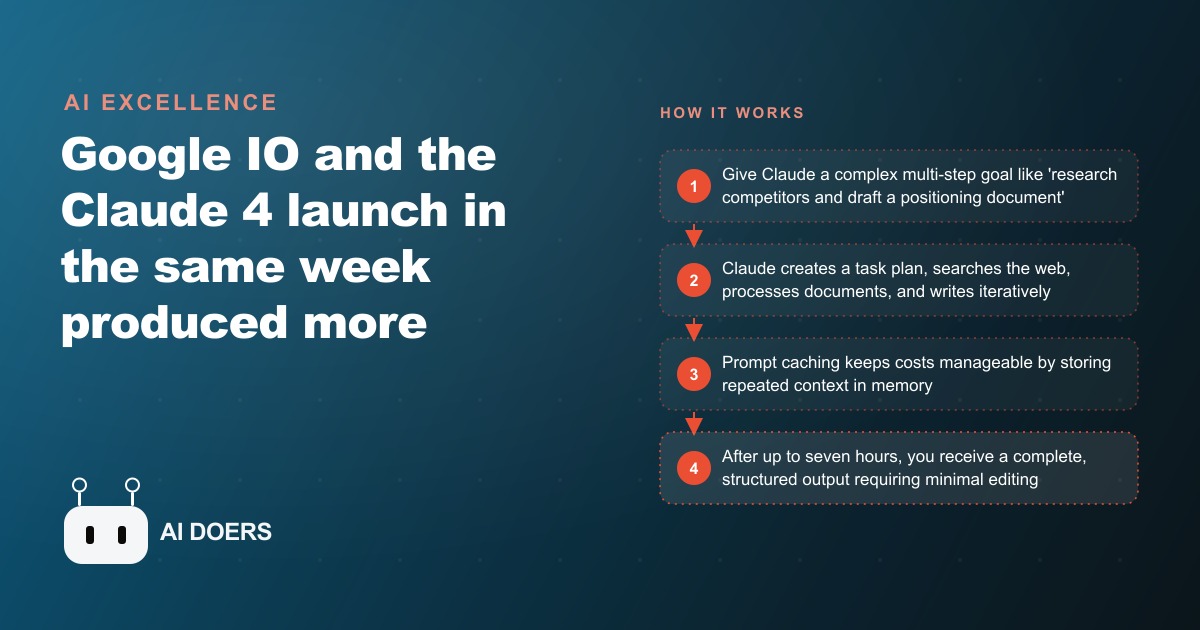
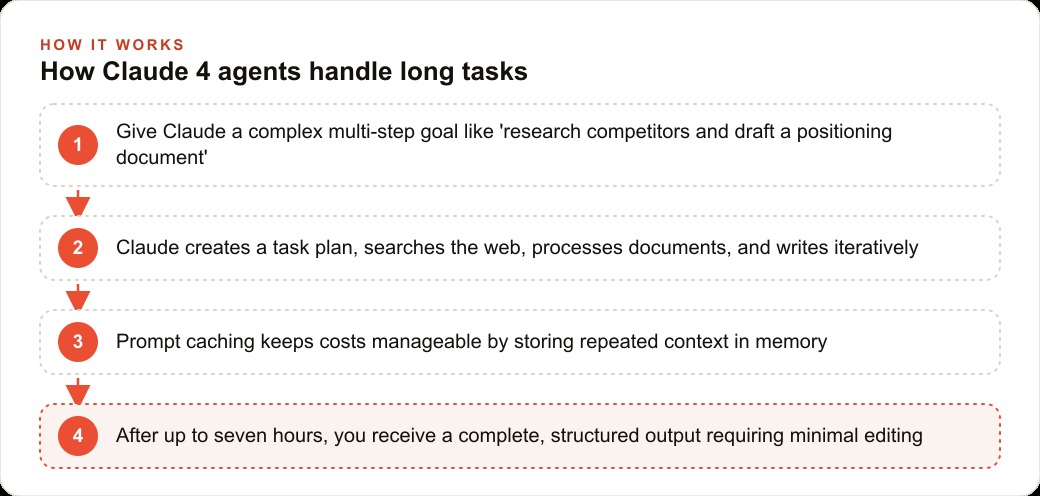
Claude 4 changes this in a specific and important way. Claude-powered agents can now run for up to seven hours through the API. That is not seven hours of continuous model inference: it is a system that can maintain context, take actions, evaluate results, adjust course, and continue working for a session of that duration without requiring human intervention at each step. The underlying mechanism that enables this is an extension of prompt caching from five minutes to one hour, which means the agent can hold working context across a long session without the cost of re-sending the full history on each call rising to prohibitive levels.
The practical meaning of this: an agent can now take on research, analysis, and development work that a human employee would spread across a full working day. It can search the web, read documents, write and execute code, analyze the results, adjust its approach based on what the output reveals, and repeat, all within one continuous task session. That capability class did not exist at this price point before this launch.
The implication for businesses is not just efficiency. It is delegation. Tasks that previously required a human to supervise each step can now be handed to an agent that runs the whole process and returns a finished output for human review. The human role shifts from step-by-step oversight to final approval, which is a meaningfully different operating model. For teams running Google Ads campaigns where the analysis, reporting, and optimization decisions currently require someone to check multiple data sources and synthesize an action, an agent with a seven-hour window can run that entire analysis cycle and present a finished recommendation.
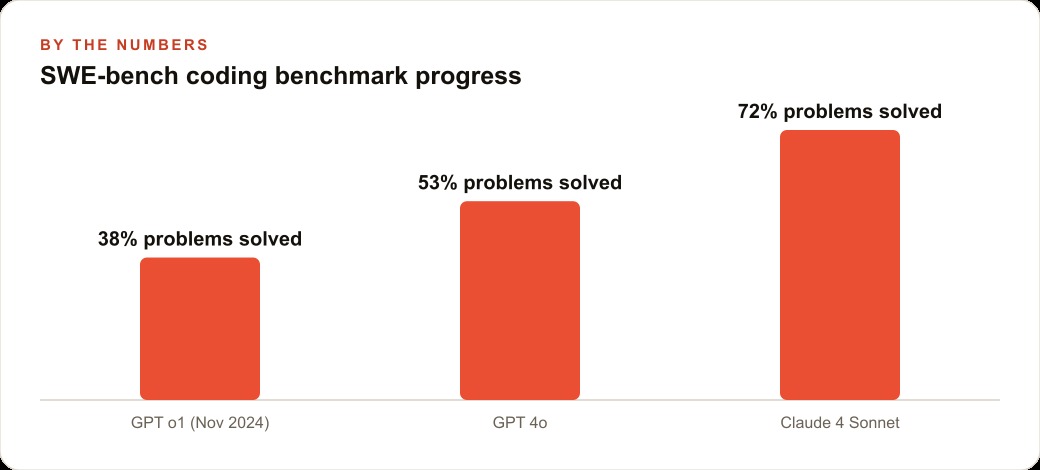
Claude Sonnet 4 became the leading coding model on the most credible benchmarks available, solving approximately 72 percent of the problems on the primary software engineering benchmark. That is a significant jump from the prior generation. For businesses that use Claude or any tool built on Claude models for writing and content work, the quality improvement in Claude Opus 4's prose is concrete: it produces text that does not read as AI-generated in the way that previous generations reliably did. That matters most in professional services, healthcare, and legal contexts where the tone and precision of written communication carries real consequences.
Google's week: what shipped, what matters, and what to ignore
Google's IO announced a significant volume of products, and not all of them are immediately available or relevant for most businesses. The discipline of filtering the relevant from the impressive is worth applying deliberately.
Flow, Google's new video generation product, is in a different category from previous AI video tools because it generates synchronized audio alongside this breakdown, including ambient sound, background music, and dialogue, all from a single text prompt. For businesses producing short-form video content, this changes the production cost structure meaningfully. The constraint is access: Flow is currently on the Google AI Ultra plan at around 250 dollars per month and US-only at launch. That price is justified for high-volume video production operations and likely to filter to lower price points over time.
Canvas in Gemini received a meaningful update. In direct testing on identical prompts, Gemini's Canvas produced more visually sophisticated and interactive results than the equivalent ChatGPT Canvas implementation. For businesses using AI to produce client-facing dashboards, data visualizations, or interactive content tools, this is worth a direct test.
Stitch is the product from this week with the broadest immediate applicability because it is free and available now. It generates complete mobile or web interface designs from a text prompt and exports to Figma or as code. For any business owner who wants to visualize a product idea before investing in development, Stitch removes that barrier at zero cost.
Deep Research in Gemini improved on the dimension that matters most for real research tasks: specificity to the actual question rather than comprehensive treatment of the general topic. In head-to-head testing on a specific medical recovery query, Gemini's output addressed the specific scenario described while the competing tool produced comprehensive but generic content. For businesses using AI research to prepare client proposals or competitive analyses, that specificity difference is the one that determines whether the output is useful or needs heavy additional work.
For businesses running Facebook and Instagram ad campaigns and any content production tied to those campaigns, the combination of Claude 4's improved writing quality and Google's improved Canvas for data visualization means the quality floor for AI-assisted marketing materials rose in a single week. The creative and analytical work that supports a paid advertising operation is the category that benefits most immediately from both improvements.
The honest caveat for both events: many of the most impressive features from Google IO are on the most expensive plan or not yet rolled out outside specific markets. Verify access before building plans around any specific capability. And benchmark performance, while meaningful as a signal, does not automatically translate to better performance on your specific tasks. The only reliable evaluation is a direct test on the actual work you need done.
The broader pattern that both events confirm is the one that matters most strategically: the tools are shifting from impressive-in-a-demo to capable-in-production on tasks that previously required a human in the loop at each step. Businesses that start experimenting with what a long-running, high-quality agent can do for their specific operation now are accumulating the experience and institutional knowledge to use that capability well as it improves. The advantage is not the access. The access will be broadly available. The advantage is the accumulated practice of working with these tools at a level that most businesses will not reach until later.
That is exactly what we do at AI DOERS. Book a private 30-minute call with Madhuranjan Kumar and we will map the fastest path to it for your specific business.
Book your call →
Madhuranjan Kumar
Madhuranjan Kumar brings 20 years of performance-marketing experience and has managed over $200 million in Facebook ad spend for brands across the United States and beyond. His expertise spans the full modern marketing stack: Meta, Google Ads, TikTok, email automation, CRM, and the websites that hold it together. At AI DOERS he turns that track record into lead-generation systems for businesses across every industry.