
Everything Google Released at IO: What Is Available Now and What Is Actually Worth Using
Google IO's AI release event was the largest single batch of AI announcements ever. After hours of hands-on testing, here is what is live, what requires the expensive plan, and what genuinely changed.

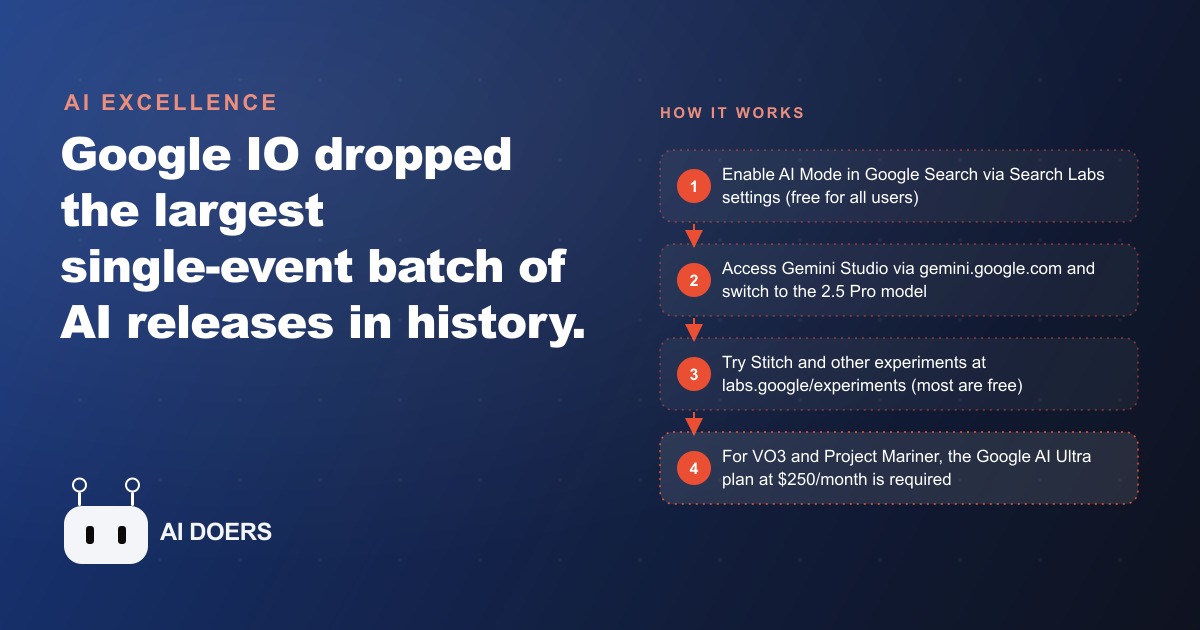
Google announced more than twenty AI products in a single keynote at Google IO, which is not a feature launch. It is a reading comprehension test. I am Madhuranjan Kumar, and the argument I want to make is not about which product is best. It is about the skill that a mass-announcement event from a company this size now requires from anyone trying to apply these tools to a real business: the ability to filter a press-release feature list by actual price tier and actual availability, without getting distracted by the headline-tier features that land on the $250 per month plan with a six-month waitlist.
That filtering skill is not obvious, and it is not how most coverage handles these events. The coverage covers everything equally, because everything was announced in the same keynote. A business owner reading that coverage comes away with the impression that a video model that generates synchronized audio and a free AI mode in the search bar are similar kinds of developments. They are not. One requires a $250 monthly subscription and is currently available only in the United States. The other is free, available in most markets, and changes the default search experience for anyone who enables it today. Treating them as equivalent leads to either expensive tool adoption or paralysis, and both outcomes mean the business does not benefit from the release at all.
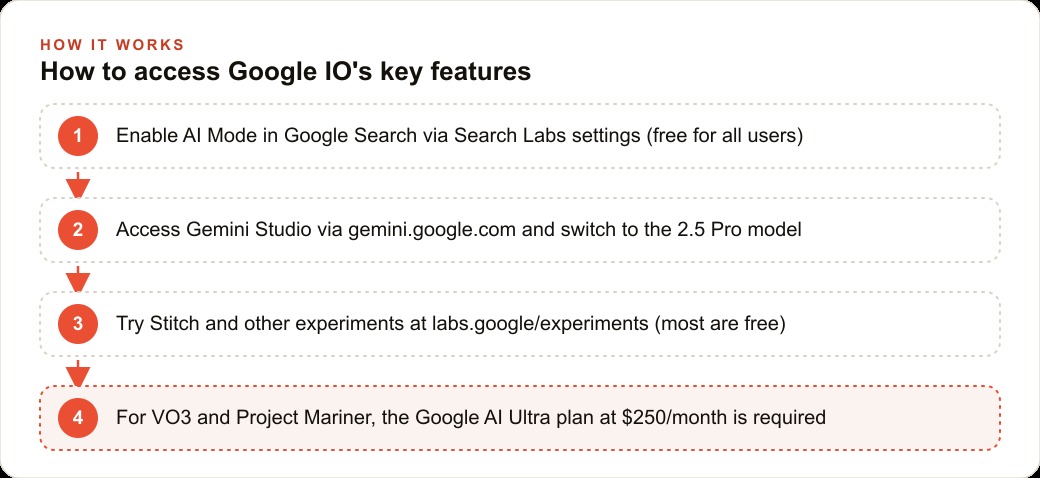
The right filter has two questions. First: is this feature live right now, or is it a roadmap announcement? Second: what price tier does the live version actually require? Applied consistently, those two questions reduce a twenty-product announcement down to three or four things worth acting on this week, and a handful of things worth watching for the next six months.
---
Start with what is free and live, because that is always where the immediate opportunity sits.
The most accessible change from Google IO is AI Mode in Google Search. It is a new tab in the standard search interface that replaces the list of blue links with a conversational, source-cited answer. It is free. It does not require a Google One subscription. It is available in most markets through Google's Search Labs settings. Enabling it takes two minutes and changes the default research experience immediately.
For a business owner who uses search for competitive research, supplier evaluation, or trend monitoring, this is not a cosmetic change. The conversational format allows you to ask follow-up questions without starting a new search, and the source citations let you verify the basis for each claim without clicking through five links. The research workflow that previously required opening eight tabs and synthesizing across them can now happen in one conversation with cited sources at each point. That is a real time saving on the tasks that most owners do informally and slowly, and it requires no purchase.
Stitch is the other zero-cost development from Google IO worth immediate attention. It lives in Google AI Studio, it is free with a Google account, and it generates complete mobile and web application interface designs from a short text prompt. The output is exportable to Figma or usable directly as code. For a business that has been deferring an app interface or a landing page redesign because of the design cost, Stitch removes the blank-canvas problem at the interface level. The result is a starting point for a developer conversation or a Figma mockup session, not a finished product, but it collapses the conceptual work that previously required a UX engagement.
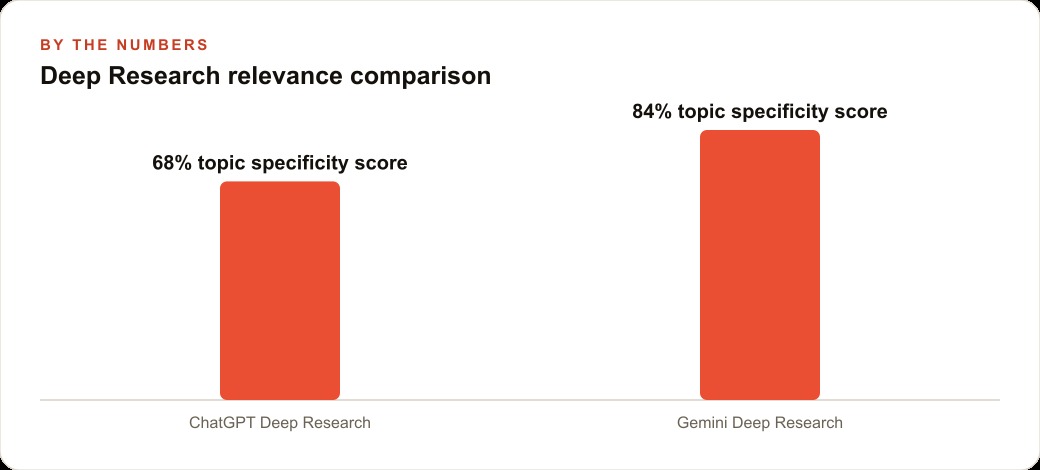
Gemini Deep Research, available on the twenty-dollar Pro plan, is where the practical value density is highest for most businesses in the post-IO landscape. The model update produced measurably more specific outputs on detailed research queries compared to the previous version. Side-by-side testing showed that a specific contextual query, one with real-world nuances rather than a generic topic, returned a report from Gemini that filtered every recommendation through the specific constraints of the question. A competitive analysis run through Gemini Deep Research returns outputs specific to the niche being researched rather than a general market overview that requires substantial additional work to make relevant.
For business research tasks, that specificity difference determines whether the output is usable as-is or requires a full rewrite. An owner researching competitors for a specific local service category needs a report that speaks to that category, not a general summary of competitive dynamics in a broad market. The Pro plan at twenty dollars per month is the price of one hour of research time from a junior analyst, and the output volume it enables across a month is substantially larger than one analyst hour.
---
Now for the headline-tier features, which deserve honest treatment rather than dismissal.
VO3 is the most technically significant announcement from Google IO. It is the first mainstream AI video model that generates synchronized audio as part of the same generation: sound effects timed to the visual action, ambient environmental sound, and background music, all produced in a single pass without a separate audio editing step. A clip of a street market generates crowd sounds and ambient chatter. A cooking demonstration generates pan sounds and kitchen ambient noise. The synchronization between what is visible and what is audible is handled by the model.
This matters for short-form video content production because it removes one of the most time-consuming steps in the current workflow: sourcing or generating audio, then editing it against this breakdown in a timeline. VO3 collapses that into one generation. For a business producing weekly social video content, the time saving per video is real and compounds across a content calendar.
VO3 requires the Google AI Ultra plan at $250 per month. That plan is currently available in the United States. For businesses outside the US or businesses not yet producing video at a volume that justifies $250 per month, VO3 is a feature to revisit in six to twelve months as pricing and availability evolve. The LTX Studio platform integrates Google's video model and charges per clip, which is a more economical entry point for occasional use.
Project Mariner, Google's browser automation agent with a "teach mode" that records a demonstrated workflow and then replicates it automatically, is on the same Ultra plan. The teach mode concept is genuinely novel: demonstrate a manual web task once, and Mariner learns to execute it independently going forward. The use cases for repetitive web-based admin tasks are real. But at $250 per month and with early-stage reliability on tasks outside the preset scenarios, it is not a practical first adoption for most small businesses in 2026.
The strategic lesson from the IO pricing structure is consistent with how Google has historically introduced features. The headline capabilities launch at the premium tier, where adoption volume is low and iteration feedback is manageable. They move to the standard tier as the engineering cost drops and as competition from other providers forces pricing down. VO3 will not cost $250 per month indefinitely. Mariner's reliability will improve with each model update. The right posture for most businesses is to understand what these features do, watch the pricing curve, and adopt when the tier-to-value equation makes sense for the specific business.
---
A local Italian restaurant provides a practical illustration of how to apply this filtering strategy and extract real value from the IO release without spending beyond what is warranted.
The restaurant owner reads about Google IO. The press coverage describes twenty releases. If he tried to evaluate all twenty, he would spend more time on evaluation than on the restaurant. The filtering questions reduce the list.
Week one: enable AI Mode in Google Search. Free, two-minute setup, immediate impact on how he researches local food trends, competitor menu changes, and supplier pricing. He uses the conversational format to research what seasonal ingredients local Italian restaurants in his area are promoting this month, follows up on specific dishes that appear across multiple competitors, and identifies two ingredients that are showing up in premium positioning across menus he respects. That research session would previously have taken forty-five minutes across multiple tabs. The AI Mode session takes fifteen.
Week two: run a competitor deep research report through Gemini Pro Deep Research. He prompts a detailed analysis of how local Italian restaurants with comparable positioning are describing their value in online content, what price ranges they feature prominently, and which seasonal menu angles appear most frequently in their recent social content. The report comes back specific enough to inform a menu update conversation with his chef, which is exactly the level of specificity that makes the twenty-dollar monthly subscription justify itself on the first use.
This content research also connects directly to his organic SEO and content strategy, because the competitor positioning analysis reveals which search terms and local topics are being emphasized and which are underserved. Running Google Ads against local dining searches is more efficient when the bidding strategy is informed by what competitors are doing in organic content. And running Meta ads for the restaurant's seasonal promotions is more effective when the creative angles are informed by what is resonating in competitor posts rather than invented from scratch.
Month three: evaluate VO3 access through LTX Studio for a single video of the restaurant's new seasonal pasta dish, with ambient kitchen sounds and soft background music included in the generation. Test whether the quality justifies the per-clip cost for a weekly social video cadence before committing to the Ultra subscription. Use the result to produce a short reel and track whether video posts outperform static image posts in reach over the following two weeks.
That three-month sequence costs roughly twenty dollars in the first month (Gemini Pro), a small per-clip fee in month three for VO3 testing, and zero dollars in the first two weeks where AI Mode and Stitch are the tools in play. The restaurant owner does not try to adopt twenty features simultaneously. He filters by what is live, what is free or low-cost, and what solves a real task in the restaurant's current marketing workflow.
---
The reading skill this approach requires is one any business owner can develop, and it is worth naming explicitly because it applies to every major AI announcement that will follow Google IO, and there will be many.
Whenever a major AI company announces a large batch of features, the useful analysis starts by separating the announcement into three tiers. Tier one is free and live today. Tier two is paid and live today, at a price point worth evaluating against the specific business case. Tier three is live at a premium price or announced but not yet released. Tier one and two are where action belongs in the first month. Tier three is where to set a calendar reminder for six months from now.
Applied to Google IO: Tier one is AI Mode in Google Search and Stitch in Google AI Studio. Tier two is Gemini Deep Research on the twenty-dollar Pro plan and Gemini Canvas for interactive prototyping. Tier three is VO3, Project Mariner, and the remaining Ultra-tier features.
That filter takes a twenty-product announcement and produces a clear week-one action list, a clear month-one experiment plan, and a clear watchlist for the rest of the year. The business owner who applies that filter consistently across announcements from Google, from Anthropic, from OpenAI, and from any other major AI provider will spend less time on evaluation, more time on adoption, and will build a steadily improving operational toolkit without the cognitive overhead of trying to track everything at once.
The announcements will keep arriving at this volume. The filter is how you stay in control of which ones actually change your business.
One additional use for the Italian restaurant is worth naming because it connects the IO research tools to operational improvement rather than just marketing. Gemini Deep Research can be run on operational questions, not just competitive ones. The owner prompts a research session on reservation management systems that integrate with POS systems, filtered to small independent restaurants rather than large chains. The output covers a handful of specific options with pricing and integration requirements, surfacing the one or two that fit the restaurant's scale. That research session replaces three hours of tab-switching across review sites and vendor websites. The finding then informs a web and CRM decision for the restaurant, because the right reservation system connects customer visit history to email follow-ups and makes the regulars feel recognized. The tools announced at IO do not operate in a silo. They feed decisions across marketing, operations, and customer experience, which is why the filtering skill matters: the right two tools applied to real decisions produce more value than twenty tools half-adopted because the announcement was exciting.
That is exactly what we do at AI DOERS. Book a private 30-minute call with Madhuranjan Kumar and we will map the fastest path to it for your specific business.
Book your call →
Madhuranjan Kumar
Madhuranjan Kumar brings 20 years of performance-marketing experience and has managed over $200 million in Facebook ad spend for brands across the United States and beyond. His expertise spans the full modern marketing stack: Meta, Google Ads, TikTok, email automation, CRM, and the websites that hold it together. At AI DOERS he turns that track record into lead-generation systems for businesses across every industry.